


5 Self-Testing Methods For Quran Memorization
Have you ever finished memorizing a page perfectly, only to stumble badly on it two weeks later? Almost every hafiz has lived that moment. The problem usually isn’t weak memorization — it’s that nobody ever tested it.
Most students revise by re-reading. They open the mushaf, read the page three or four times, feel familiar with it, and close it satisfied.
Familiarity feels like mastery, but it isn’t. Research on how memory actually works keeps pointing to one conclusion: pulling information out of your mind builds far stronger recall than pushing it in again.
That is exactly what the self-testing methods for Quran memorization in this guide are built around. Each one forces retrieval, exposes weak spots early, and turns vague “I think I know it” into measurable confidence.
In the next few minutes, you’ll learn what self-testing means in hifz, why it outperforms ordinary revision, five practical methods you can start using today, and how to fit them into a weekly schedule without adding hours to your day.

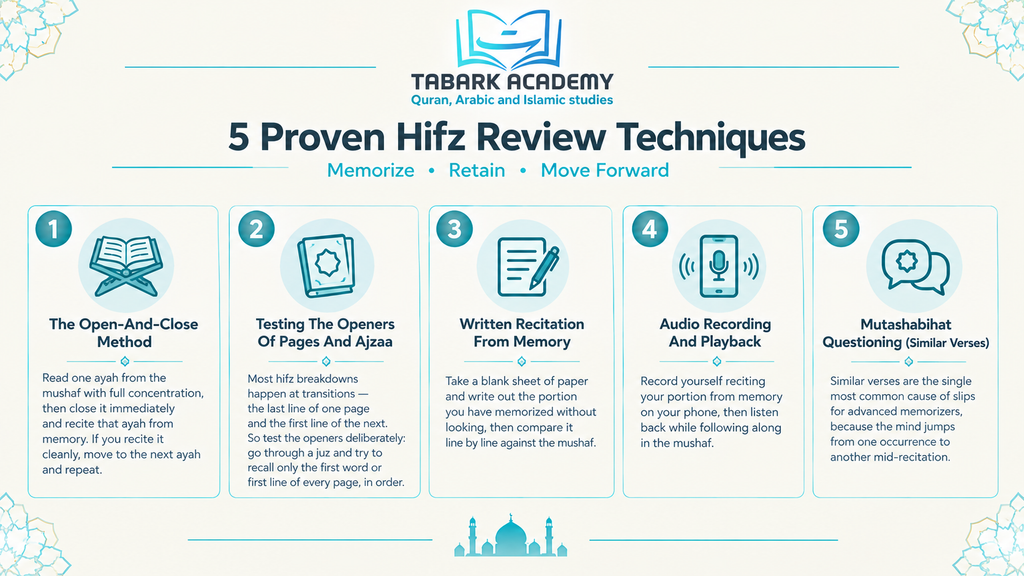
1. The Open-And-Close Method
Read one ayah from the mushaf with full concentration, then close it immediately and recite that ayah from memory. If you recite it cleanly, move to the next ayah and repeat.
If you stumble, open the mushaf at once, look at the exact word you missed, close it again, and repeat the ayah several times. That immediate correction matters. Studies on feedback timing consistently show that errors corrected straight away are far less likely to be repeated than errors left uncorrected.
This method suits the first hours after memorizing something new, while the words are still fragile. It gives you a clean verdict on every single ayah before you move forward and build on unstable ground.
Keep the unit small — one ayah, or one line of a long ayah. Testing a whole page at this stage only tells you that you failed somewhere, without showing you exactly where the weakness actually sits.
2. Testing The Openers Of Pages And Ajzaa
Most hifz breakdowns happen at transitions — the last line of one page and the first line of the next. So test the openers deliberately: go through a juz and try to recall only the first word or first line of every page, in order.
Then do the same for the opening of each rub’ (quarter) and each surah. This takes five minutes and reveals structural gaps that a full recitation can hide, because during full recitation momentum carries you across weak joints without you noticing.
A useful variation is to work backwards: start at the last page of the juz and recall the openers in reverse order. Reversing the sequence strips away the momentum your memory leans on and shows what you genuinely know.
Write down every opener you hesitate on in a short list. Those few lines usually explain most of your long pauses during full recitation, and repairing them costs far less effort than re-revising an entire juz.
3. Written Recitation From Memory
Take a blank sheet of paper and write out the portion you have memorized without looking, then compare it line by line against the mushaf.
Writing is slower than reciting, which is exactly why it works. It forces you to retrieve every word individually, and it exposes errors your tongue glosses over — a missing particle, a swapped pronoun, a wrong conjunction.
Mark every mistake in a different color and keep the sheet. After a month, you will have a personal map of your recurring weak points. Ten minutes of writing usually exposes more real errors than an hour of comfortable re-reading.
Students who also study Arabic language fundamentals find this method especially powerful, because understanding the grammar makes the correct wording feel obvious rather than arbitrary.
Experience Our Interactive Learning
Curious about how we teach? Watch these brief video clips from our recent live sessions to see our structured curriculum, advanced learning platform, and dynamic student-teacher interactions firsthand.
4. Audio Recording And Playback
Record yourself reciting your portion from memory on your phone, then listen back while following along in the mushaf.
You will catch two categories of mistakes at once: memorization errors (wrong word, skipped phrase) and tajweed errors (shortened madd, missed ghunnah, weak qalqalah) that you simply cannot hear while you are the one reciting.
Record in one continuous take without stopping to correct yourself, because a paused recording hides the hesitations you most need to hear.
Label every file with the surah and the date, so your progress becomes a record instead of a scattered pile of voice notes.
Keep the recordings for a few weeks and compare. Hearing measurable improvement in your own voice is one of the strongest motivators in hifz.
Recurring tajweed slips, though, need a trained ear — which is why many students pair this method with online Tajweed classes rather than trying to self-diagnose pronunciation.
Read also :How to Revise Quran Without a Teacher: 7-Step System
5. Mutashabihat Questioning (Similar Verses)
Similar verses are the single most common cause of slips for advanced memorizers, because the mind jumps from one occurrence to another mid-recitation.
Build your own question bank: write questions like “Which surah contains this exact phrase, and what comes immediately after it?” or “Recite all the places this ayah appears and state how each ending differs.”
Test yourself on these weekly. Cumulative quizzing like this grows into a permanent personal resource — and the act of writing the questions is itself a form of retrieval practice.
This method is for memorizers who already hold several ajzaa, since similar verses only turn into a problem once enough of them sit side by side in your memory. Beginners rarely need it yet.
Ask a friend or a family member to read your questions aloud in random order. Being asked, rather than asking yourself, removes the predictability that quietly makes solo testing easier than it should be.
Self-Testing Methods for Quran Memorization: Why They Work
Self-testing means recalling verses from memory without looking at the mushaf, then checking yourself against the text. Psychologists call it retrieval practice or the testing effect, and it is one of the most reliable learning techniques ever studied.
A widely cited review in Psychological Science in the Public Interest examined ten popular study techniques across nearly 400 prior studies. Only two earned the highest rating: practice testing and distributed practice — spacing study out over time instead of cramming.
For a student of Quran, that combination is already familiar. Daily hifz plus spaced murajaah is distributed practice. Adding structured self-testing on top is what completes the formula.
What Self-Testing Means In Hifz
Ordinary revision looks like: memorize, revise, memorize, then revise. Self-testing changes the pattern to: memorize, revise, test, test, then test.
You still memorize carefully and keep your revision schedule running. The difference is that you deliberately close the mushaf and force your memory to produce the words with no support.
That effort is the point. The struggle to retrieve is what strengthens the memory trace — something that never happens when your eyes are resting on the page.
Why Re-Reading Gives False Confidence
When you re-read a page, your brain recognizes the words rather than recalls them. Recognition is easy, fast, and deeply misleading.
Research from Purdue University found that learners who practiced repeated retrieval performed dramatically better on later tests than those who simply reviewed the same material. Re-reading felt easier at the time — and produced weaker long-term retention.
In hifz, that gap shows up in salah, in front of a teacher, or during an ijazah examination. Self-testing moves the discovery of your mistakes to a safe moment, while there is still time to fix them.
Testing Is A Diagnosis, Not A Judgment
A failed self-test is not a sign of weak memory. It is information telling you precisely which ayah, which page transition, or which similar verse needs attention.
Students who treat testing as feedback improve steadily. Students who treat it as a verdict avoid testing altogether — and their hifz quietly erodes.
This is one of the first habits our tutors work on inside the structured Hifz program at Tabarak Academy, where every session ends with a short recall check rather than another read-through.
Read also: Noon Sakinah & Tanween Rules Explained Simply
How to Build a Weekly Self-Testing Schedule
These five methods mentioned above are arranged from simplest to most demanding. You do not need all five every day — rotate them so that your memory never settles into a comfortable pattern it can predict. Self-testing only works when it is scheduled.
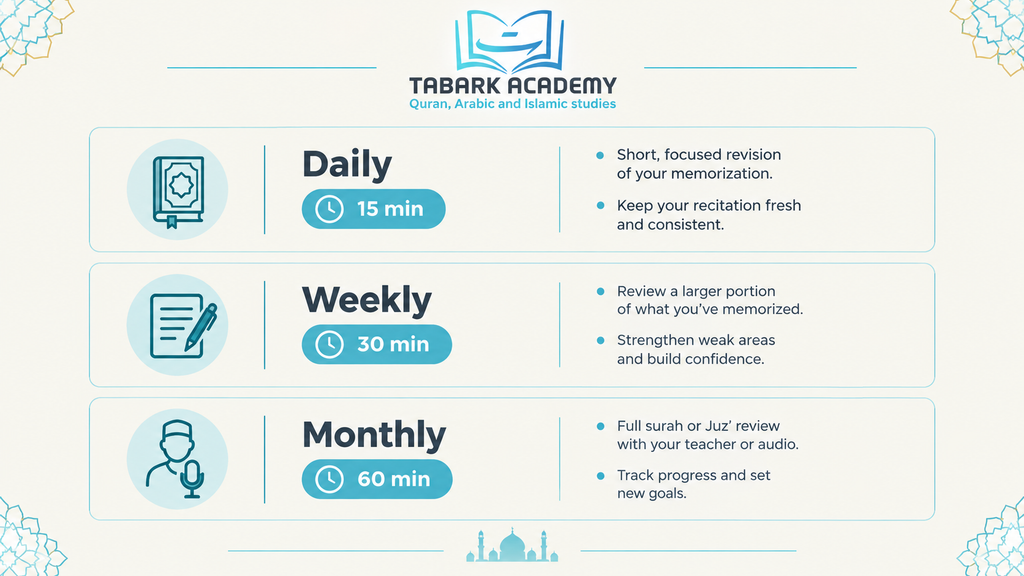
1. Daily (10–15 minutes)
This level suits every student without exception, and especially new memorizers and children, whose portions are small and fade fastest. If you adopt only one habit from this article, make it this one.
Apply the open-and-close method to today’s new memorization, then test the page openers of yesterday’s portion. Keep it short and non-negotiable.
2. Weekly (30 minutes)
This session fits students who already hold two or three ajzaa and now carry enough older material to lose track of. Busy adults balancing work or study will find it the most realistic anchor in their week.
Choose one juz from your older hifz and do a written test on two pages of it, plus an audio recording of one page. Review your mutashabihat questions for that juz.
3. Monthly (45–60 minutes)
This one is aimed at serious memorizers, ijazah candidates, and anyone approaching the end of the Quran. Parents of hifz students should treat it as non-negotiable, since children rarely detect their own errors.
Recite a full juz from memory to a teacher or hifz buddy who follows along in the mushaf and stops you at every error.
This last step is the one no self-test can replace. Classical Quranic education has always been transmitted through a qualified teacher — the Prophet ﷺ received the Quran from Jibreel and taught it directly to his companions, and every reliable chain of transmission since has worked the same way. A recording tells you that something is wrong; a teacher tells you why and stops it from becoming a habit.
Step Inside Our Virtual Classrooms
See our engaging teaching methods in action! watch real snippets of our live classes and discover how our expert instructors make learning interactive, memorable, and inspiring for every student.
Book a Free Trial Lesson and Put Your Hifz to the Test
You can test yourself every day and still not know whether your madd lengths are correct or whether that one ayah you “always get right” is actually right. A certified teacher removes the guesswork in a single session.
At Tabarak Academy, our Egyptian and Azhari-qualified tutors run live one-to-one sessions in Hifz, Tajweed, Quran recitation, and Arabic — for children and adults alike. Each lesson includes structured recall checks, mutashabihat drills, and clear feedback on exactly where your memorization stands.
Your first lesson is free, with no card required. Book your free trial lesson, meet your tutor, and find out in thirty minutes what months of solo revision may have been hiding.
Our Quran Memorization / Hifz Courses
- Online Hifz Program
- Juz 30 Memorization Course
- Hifz for Kids Course
- Hifz for Adults Course
- Hifz for Sisters Course
- Short Surah Memorization Course
- Hifz Ijazah Course

Conclusion
Self-testing is the difference between memorization that feels secure and memorization that is secure. By closing the mushaf and forcing recall, you replace the comfortable illusion of familiarity with honest, usable information about your hifz.
The five self-testing methods for Quran memorization covered here — open-and-close recall, testing page and juz openers, written recitation, audio recording, and mutashabihat questioning — each attack a different weakness. Rotate them across a daily, weekly, and monthly rhythm rather than relying on any single one.
And remember the limit of solo work. Self-testing shows you where you are slipping, but only a qualified teacher can confirm that what you have memorized is correct in wording, tajweed, and delivery.
FAQs
How often should I test myself on Quran memorization?
Test new memorization daily and older portions weekly. A full-juz test once a month is enough to catch fading areas before they collapse, provided your regular murajaah continues alongside it.
Is self-testing better than repeating the page many times?
Yes, for retention. Repetition builds the initial memory, but retrieval is what makes it durable. The most effective approach is a limited number of focused repetitions followed immediately by a closed-mushaf test.
Can I memorize the Quran without a teacher if I test myself well?
You can memorize the words, but you cannot verify your pronunciation, madd lengths, or tajweed rules on your own. Self-testing catches memory errors; a teacher catches recitation errors that would otherwise become permanent.
What should I do when I keep confusing similar verses?
Write both occurrences side by side, highlight the exact word that differs, and create a question for each. Test yourself on that pair specifically for two weeks until the difference becomes automatic.
How can children use self-testing methods for Quran memorisation?
Keep it playful and short. Ask a child to recite the first word of each page, to recite while walking or drawing, or to “teach” the ayah back to a parent — all of these are retrieval practice in a form children enjoy.
Does writing verses from memory really help?
It does, especially for spelling-level accuracy. Writing slows retrieval down and forces attention to every particle and pronoun, exposing errors that fluent recitation tends to smooth over.