

Adult Beginner Quran Reading Course – Start From Zero at Any Age
Most adults who enquire about an adult beginner quran reading course open with the same sentence: “I think I’ve left it too late.” They haven’t. Adults learn to read the Quran from the first letter every day, in every decade of life, and they often move faster than children once the lessons are structured correctly.
The reason adults stall is rarely ability. It is starting in the wrong order — jumping into surahs before the letter sounds are secure — or studying without a teacher who can hear a mispronounced dad (ض) and correct it on the spot.
This guide from Tabarak Academy sets out the real stages, honest timelines, and what to look for before you pay for any course.
What you’ll learn in this article
- The four stages every adult beginner passes through, in order.
- Realistic timelines from the first letter to reading a full page.
- What a 30-minute one-to-one lesson actually contains, minute by minute.
- The four traps that stop adult learners, and how to avoid each.
- How to choose a teacher, and the five questions that expose a weak one.
What Does An Adult Beginner Quran Reading Course Cover?
An adult beginner Quran reading course is a structured program that takes a learner from Arabic letter recognition to reading the Quran with correct pronunciation, taught one-to-one by a qualified teacher.
It is not an Arabic language course — you learn to read and pronounce the script accurately, which is a separate and much shorter skill than learning to speak Arabic.
That distinction matters, because many adults delay for years believing they must master Arabic grammar first. You do not. Reading the Mushaf aloud correctly is a decoding skill built on 28 letters, three short vowels, their long counterparts, and the rules that govern how they meet.
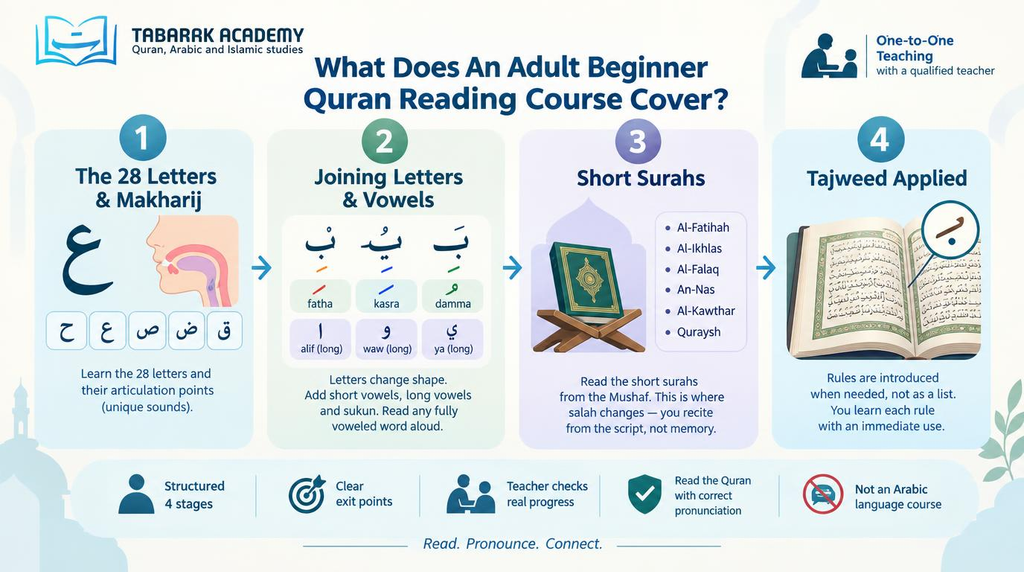
The four stages, in the order they must be taken:
1. The 28 letters and their articulation points (makharij)
The letters themselves are easy. The difficulty lies in the sounds English has no equivalent for: ḥa (ح), ‘ayn (ع), ṣad (ص), dad (ض), qaf (ق). A live teacher hears each attempt and corrects before the wrong sound sets.
2. Joining letters and adding vowels
Letters change shape depending on position. Fatha, kasra and damma are added, then the long vowels and sukun. By the end of this stage you can read any fully voweled Arabic word aloud, whether or not you know its meaning.
3. Short surahs
Al-Fatihah first, then al-Ikhlas, al-Falaq, an-Nas, al-Kawthar, Quraysh. This is the stage where salah changes, because you are reciting from understanding of the script rather than memory of a sound.
4. Tajweed applied to what you already read
Rules are introduced at the moment a surah requires them, not as an abstract list memorised in advance. Adults absorb them quickly because each rule arrives with an immediate use.
In Tabarak Academy’s beginner track, each stage has a defined exit point — a teacher does not move a student forward because weeks have passed, but because the student can demonstrate the skill cleanly.
Why do adults often learn to read the Quran faster than children?
Adults carry three advantages a child cannot match, and they are worth naming because most adult learners assume the opposite.
- Sustained attention: A thirty-minute focused lesson is unremarkable for an adult. A six-year-old needs games, breaks and repetition to cover the same ground.
- Analytical understanding: Tell an adult “this is madd, and it has three sub-types” and they hold the structure and apply it to a new word immediately. A child absorbs the same rule slowly, through dozens of examples.
- Chosen motivation: An adult decides to be in the lesson. A child is sent. The gap shows in every revision week.
Children do hold one genuine edge — pronunciation plasticity. They copy unfamiliar sounds more naturally. This is exactly why makharij work at Stage 1 deserves more lesson time for an adult, not less, and why group classes fail adult beginners: the teacher cannot hear your individual letters.
Realistic Timelines For An Adult Beginner
The figures below assume three thirty-minute lessons per week plus ten minutes of daily review — a total of under three hours weekly. They reflect the pace Tabarak Academy’s teachers see with adult beginners; individual progress varies with consistency more than with age.
| Milestone | Realistic timeline |
| Recognise and pronounce all 28 letters | 4–6 weeks |
| Read voweled words and short combinations | 2–3 months |
| Read al-Fatihah and short surahs confidently | 3–5 months |
| Read any Mushaf page with light effort | 6–9 months |
| Recite with full tajweed application | 12–18 months |
Two consistent lessons a week sustained for two years will take you further than six lessons a week for one month followed by nothing. Consistency, not intensity, is the variable that decides outcomes.
If you want to see where you actually sit on this table, Tabarak Academy’s free trial lesson is a leveling assessment — the teacher places you at the correct starting page rather than restarting you from zero unnecessarily.
Experience Our Interactive Learning
Curious about how we teach? Watch these brief video clips from our recent live sessions to see our structured curriculum, advanced learning platform, and dynamic student-teacher interactions firsthand.
Start Your Quran Learning Journey
Join Tabark Academy today for structured online lessons with qualified tutors, customized to fit your goals.
Book Your Free Trial LessonWhat Does A One-On-One Adult Lesson Actually Look Like?
A typical thirty-minute session in an adult beginner quran reading course online runs on a fixed rhythm:
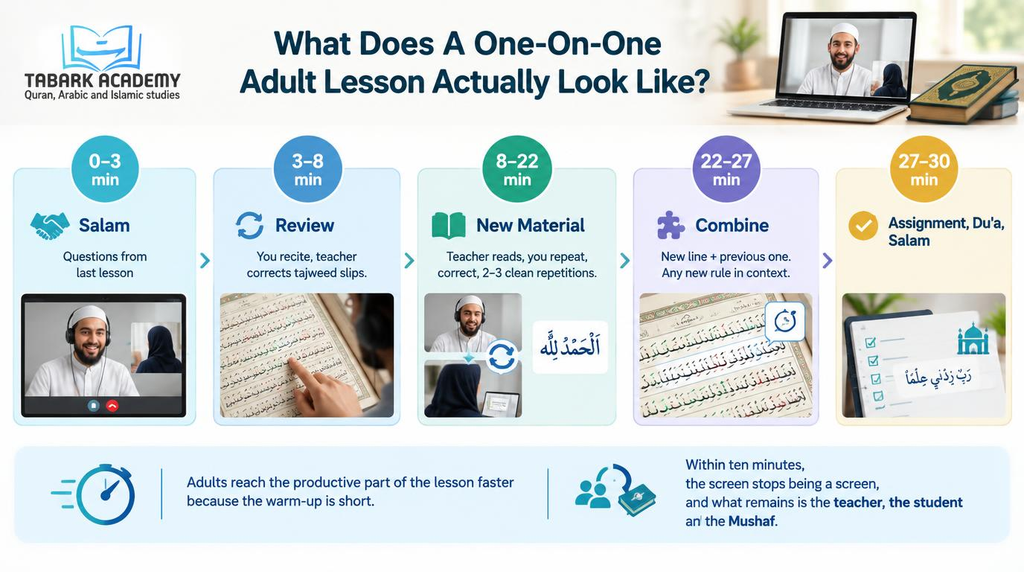
- 0–3 min: Salam, questions carried over from last lesson.
- 3–8 min: Review. You recite the previous assignment; the teacher corrects tajweed slips immediately.
- 8–22 min: New material. The teacher reads a line, you repeat, correct, then two or three clean repetitions until it holds.
- 22–27 min: Combine the new line with the previous one. Any new rule explained in context.
- 27–30 min: Assignment, du’a, salam.
Adults reach the productive part of the lesson faster than children because the warm-up is short. Within ten minutes the screen stops being a screen, and what remains is the teacher, the student and the Mushaf.
Read also: How To Learn The Quran When You Converted Late In Life?
Four obstacles that stop adult learners
None of these are about intelligence or ability. They are the four patterns that recur across adult beginners.
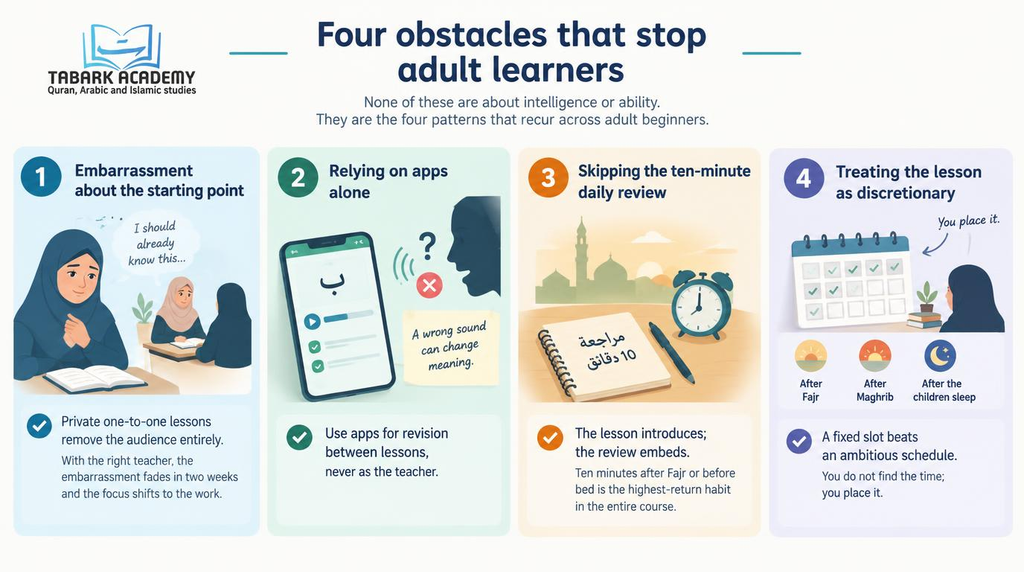
1. Embarrassment about the starting point
Many adults delay for years because they feel they should already know this. Private one-to-one lessons remove the audience entirely.
A teacher who specialises in adult beginners has taught hundreds of people starting at the same letter you are. In practice the embarrassment fades inside two weeks and the focus shifts to the work.
2. Relying on apps alone
Apps drill letter recognition well. They cannot hear you. In Arabic, a mispronounced letter can change meaning, and a wrong sound repeated for three months takes far longer to unlearn than to learn correctly the first time. Use apps for revision between lessons, never as the teacher.
3. Skipping the ten-minute daily review
The lesson introduces material; the review embeds it. Without review, much of a lesson fades before the next one. Ten minutes after Fajr or before bed is sufficient — this is the single highest-return habit in the entire course.
4. Treating the lesson as discretionary
The students who are still learning two years later are the ones who placed the lesson in a fixed slot and defended it. You do not find the time; you place it.
Three slots that survive a normal week — after Fajr, after Maghrib, or once the children are asleep — outperform any ambitious schedule that collapses in month two.
How To Choose A Teacher For An Adult Beginner Course?
The teacher accounts for most of the outcome. Ask these five questions before paying anyone.
- Where did the teacher study? Strong answers name institutions — Al-Azhar, the Islamic University of Madinah, a recognised sanad chain. “Ten years of experience” with no institutional anchor is a warning sign.
- Does the teacher hold an ijazah? An ijazah certifies that the teacher recited the Quran correctly to their own teacher in a recognised recitation, most commonly Hafs ‘an ‘Asim. For beginners it matters less than for Hifz students, but it indicates formal testing.
- Is the teaching strictly one-to-one? For recitation this is non-negotiable. Tajweed correction requires the teacher to hear every individual letter you produce.
- Is the trial lesson real teaching? A genuine trial assesses your level and teaches something. If the trial is a sales call with a price list at the end, that tells you what the paid lessons will be.
- Is a female teacher available for sisters? For many learners this is a fundamental requirement. Confirm it before enrolling, not after.
Tabarak Academy answers all five directly: Al-Azhar-trained native Arabic teachers, one-to-one only, male and female teachers available, and a free trial that is a lesson rather than a pitch.
Read also: How To Build A Daily Hifz Routine That Lasts?
Learning At Different Adult Stages
Twenties and thirties usually show the fastest progression — sharp memory, and a schedule that still bends. Short surahs within three months and Mushaf reading by month six is a normal trajectory.
- Forties and fifties bring analytical maturity, so tajweed rules click quickly. Short-term memory needs slightly more daily review minutes to compensate; the overall timeline shifts little.
- In the sixties and beyond, I learned to read the Quran for the first time regularly. The pace is gentler, lessons are often shortened to twenty minutes, and the curriculum is usually weighted toward the surahs used most in salah.
Many adults enroll alongside their children, taking lessons at different times and revising together at home. The household effect is significant — the child sees the parent working on the same letters.
Step Inside Our Virtual Classrooms
See our engaging teaching methods in action! watch real snippets of our live classes and discover how our expert instructors make learning interactive, memorable, and inspiring for every student.
Start Your Quran Learning Journey
Join Tabark Academy today for structured online lessons with qualified tutors, customized to fit your goals.
Book Your Free Trial LessonStart Your Adult Beginner Quran Reading Course This Week
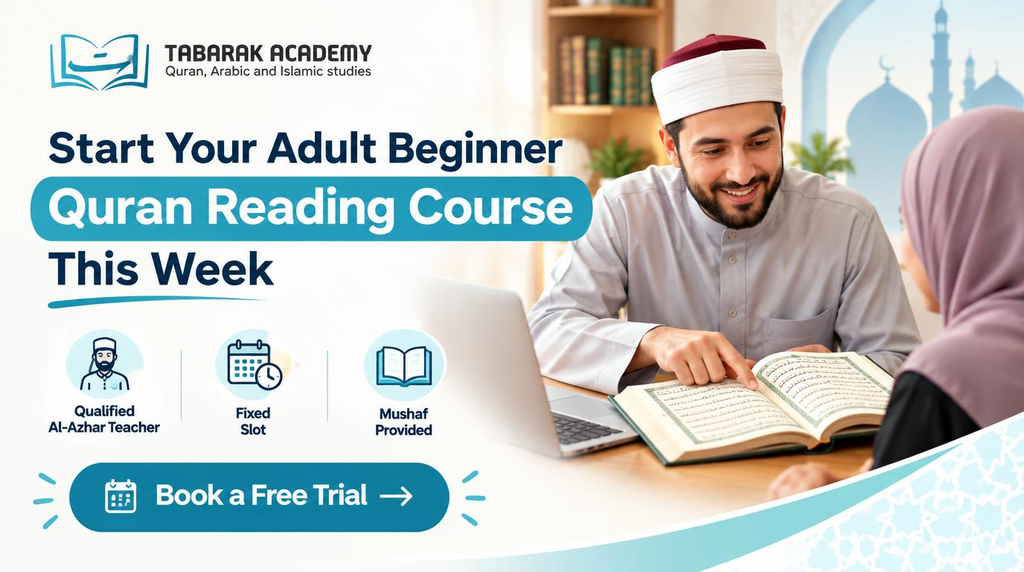
You do not need to prepare, pre-study, or “get a bit better first.” You need a teacher, a fixed slot, and a Mushaf. Book a free trial lesson with Tabarak Academy. A qualified Al-Azhar teacher will assess your current level, place you at the correct starting point, and set the first assignment — in one session, at no cost, with no obligation to continue.
Our Quran Courses:
- Online Quran Classes for Adults
- Online Quran Classes for Beginners
- Online Quran Classes for Kids
- Online Quran Classes for Men
- Online Quran Classes for Sisters
- Quran Reading Course
- Quran Recitation Course
- Online Qirat Course
- Quran for Toddlers / Young Children
- Weekend Quran Classes
Conclusion
An adult beginner quran reading course works when three things are in place: the correct stage order, a live teacher who hears every letter, and a schedule you actually keep. Age is not the limiting factor — sequence and consistency are.
Give it four to six weeks on the letters, three to five months to short surahs, and six to nine months to read a page of the Mushaf with light effort.
Tabarak Academy’s one-to-one adult beginner quran reading course online is built around exactly that sequence, with Al-Azhar-certified teachers and schedules that fit around work and family.

Frequently Asked Questions
Below are the questions adult beginners ask most often before enrolling — on prior knowledge, timelines, tajweed, cost of time, and whether online lessons match in-person ones.
1. Can I take an adult beginner quran reading course with no Arabic knowledge at all?
Yes. An adult beginner quran reading course starts at the 28 Arabic letters and assumes zero prior knowledge. You learn to read and pronounce the script, not to speak Arabic — two separate skills with very different timelines.
2. How long does it take an adult to read the Quran from zero?
Most adult beginners read short surahs within three to five months and any Mushaf page with light effort within six to nine months, studying three thirty-minute lessons weekly plus ten minutes of daily review.
3. Is an adult beginner quran reading course online as effective as in-person lessons?
Yes, for one-to-one recitation. Online lessons preserve what matters — the teacher hearing each letter and correcting immediately — while removing travel time, which is the main reason adult learners drop out of in-person classes.
4. Should adults learn tajweed from the beginning or later?
Tajweed is introduced at Stage 4, once letters, vowels and word reading are secure. Introducing rules before the letter sounds are correct slows beginners down, because the rules have nothing stable to attach to.
5. Does Tabarak Academy offer female teachers for adult sisters?
Yes. Tabarak Academy provides both male and female Al-Azhar-certified native Arabic teachers, and you can request a female teacher when booking your free trial lesson.
6. Is one lesson a week enough for an adult beginner?
One weekly lesson progresses, but slowly, because gaps between sessions erode new material. Two to three short lessons per week is the minimum that produces steady, visible progress for adult beginners.