


How To Revise Quran Without A Teacher – A 7-Step System
Have you ever finished a page of Hifz, felt proud for a week, then opened the same page a month later and stumbled on the third verse? You are not failing — your revision system is.
The Prophet ﷺ said: “Commit yourself to the Qur’an, for by Him in whose Hand is my soul, it is surely more prone to break away than a camel in its bind .” (Sahih al-Bukhari). Memorization is not the finish line; retention is.
“ تَعَاهَدُوا الْقُرْآنَ فَوَالَّذِي نَفْسِي بِيَدِهِ لَهُوَ أَشَدُّ تَفَصِّيًا مِنَ الإِبِلِ فِي عُقُلِهَا ”.
The good news is that you can learn how to revise the Quran without a teacher and protect what you have memorized using a fixed daily routine, honest self-testing, and audio verification. Thousands of huffaz maintain their Hifz this way between formal sessions.
In this guide, you will find seven practical self-revision methods, a realistic daily schedule, the warning signs of weak revision, and the exact point where independent review stops being enough.

1. Set a Fixed Daily Wird and Never Skip It
You revise Quran without a teacher by setting a fixed daily portion, always reviewing old memorization before new, testing yourself out loud without looking, and verifying every session against a trusted recitation.
Choose a fixed amount — a quarter of a juz, half a juz, or a full hizb — and read it from memory every single day. Consistency beats volume every time.
At a quarter of a juz per day, you cover the entire Quran in about four months; at one juz per day, you complete a full cycle each month. Pick the amount you can sustain on your worst day, not your best.
Write your daily portion into a simple tracker. What gets recorded gets repeated, and a visible streak is the closest thing to accountability when you study alone.
Protect the wird on bad days by keeping a minimum version of it — half a page recited from memory still counts. Breaking the chain costs far more than shortening it.
2. Apply the “Old Before New” Rule
Always begin your session with your oldest and weakest memorization, not the page you learned yesterday. New material feels rewarding; old material is what actually breaks.
Give your old portions 25–40 focused minutes before touching anything new. This single reordering fixes the most common cause of Hifz loss among self-taught students.
If you are still adding new pages, tie the two together: for every new page you memorize, revise two pages of old material on the same day.
Rank your memorized portions from weakest to strongest once a month and revise in that order. Your weakest juz should meet your freshest attention, not your leftover energy.
Expect old material to feel slower and less satisfying than new pages. That discomfort is the actual work of Hifz, and the students who sit with it are the ones who still have their memorization ten years later.
3. Recite Aloud From Memory Without Looking
Silent reading creates the illusion of mastery. Reciting aloud, with the Mushaf closed, is a real test — and your tongue will tell you the truth within seconds.
Recite as though someone is listening to you. Stop the moment you hesitate, note the exact verse, then open the Mushaf and confirm what you missed.
Repeat the corrected verse five to seven times, then reconnect it to the verse before and after it. Isolated repetition fixes words; linked repetition fixes sequence.
Recite standing or walking rather than slumped over the Mushaf. An upright posture steadies your breath, which steadies your stopping points and keeps long verses from collapsing halfway.
Reciting aloud also reveals pronunciation habits you can no longer hear in yourself. If the same words keep coming out heavy or rushed, guided recitation classes with a certified tutor will correct in a few sessions what solo repetition tends to reinforce.
4. Revise Inside Your Daily Salah
Salah is free, guaranteed revision time that no busy schedule can take from you. Read longer memorized portions in Fajr and Isha, medium portions in Maghrib, and short surahs elsewhere.
Prayer forces slow, deliberate recitation. You cannot guess your way through a verse while standing before Allah, so weak spots surface immediately.
Qiyam al-layl is the strongest tool of all — a single quarter juz recited in the night prayer will hold in your memory far longer than the same portion read at a desk. Many students at Tabarak Academy are taught to plan their Hifz portions specifically around what they intend to recite in salah that week.
Plan your salah recitation the night before instead of choosing at takbir. Deciding in advance stops you from defaulting to the same three short surahs every day.
Sunnah and nafl prayers are your safest testing ground, since a slip there carries no pressure. Use them for shaky pages and save your solid material for fard prayers.
Experience Our Interactive Learning
Curious about how we teach? Watch these brief video clips from our recent live sessions to see our structured curriculum, advanced learning platform, and dynamic student-teacher interactions firsthand.
5. Record Your Recitation and Listen Back
Record yourself reciting your daily portion on your phone, then listen to the recording on your commute, during housework, or before sleep.
Hearing your own voice is uncomfortable, and that is exactly why it works. You will notice rushed madd, missed ghunnah, and wrong stops that you never felt while reciting.
Then compare your recording with a trusted qari — Shaykh Mahmoud Khalil Al-Husary’s murattal recitation is the standard reference for tajweed precision. Shadow him verse by verse until your rhythm matches his.
Keep your recordings in dated folders rather than deleting them. Comparing this month’s recitation with last month’s is the clearest proof of progress a self-taught student can get.
Listen once for accuracy and a second time for tajweed, never both at once. Splitting the two passes keeps your attention sharp and catches errors that a single listen always misses.
Read also: How to Test Your Own Hifz: 5 Proven Methods
6. Write Verses From Memory Once a Week
Once a week, take a blank sheet and write out your current portion entirely from memory. Writing activates a different pathway in the brain than reciting does.
The verses where your pen slows down or stops are your true weak points — far more accurately than recitation reveals them. Mark those verses in your Mushaf with a light pencil dot.
This method is especially powerful for mutashabihat, the similar-sounding verses that appear in Al-Baqarah and Aal-Imran. Writing them side by side makes the difference visible instead of vague.
Write without pausing to check, even when you are unsure. Gaps on the page are diagnostic information, and correcting mid-flow hides exactly the verses you need to find.
Keep one dedicated notebook for this and revisit it monthly. The same verses failing twice tells you the problem is the verse itself, not a bad day.
7. Build a 7-Day Rotation Plan
Divide everything you have memorized into seven parts and revise one part each day, so that no page goes unread for more than a week.
This mirrors the Prophetic practice of dividing the Quran into seven parts and completing it weekly. Structure, not willpower, is what makes long-term retention possible.
| Day | Revision Focus | Suggested Time |
| Day 1 | Section 1 of your memorized portion | 45–90 min |
| Day 2 | Section 2 | 45–90 min |
| Day 3 | Section 3 | 45–90 min |
| Day 4 | Section 4 | 45–90 min |
| Day 5 | Section 5 | 45–90 min |
| Day 6 | Section 6 | 45–90 min |
| Day 7 | Section 7 + light review of flagged verses | 30–45 min |
Divide by difficulty rather than by equal page counts. A day holding Al-Baqarah should carry fewer pages than a day holding the short surahs of Juz Amma.
Rebuild the rotation every time you complete a new juz. A plan that no longer matches what you have memorized quietly leaves pages uncovered for weeks.
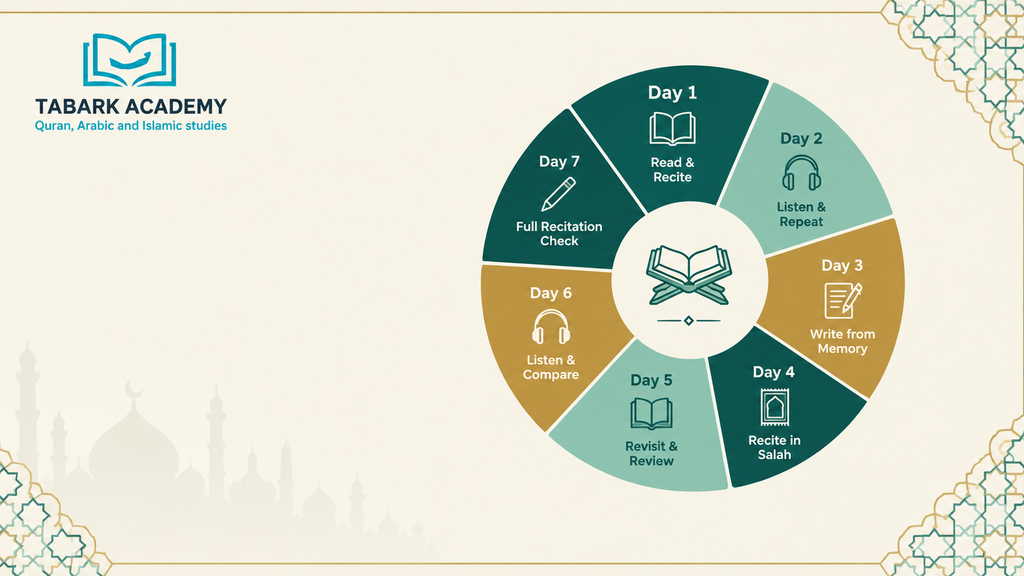
The Best Way to Revise Quran Without a Teacher
The best way to revise Quran without a teacher is to combine three layers in every session: read from the Mushaf, recite from memory with the Mushaf closed, then re-open it and mark each mistake immediately.
This three-layer loop is simply what a qualified teacher does for you, performed on yourself. Layer one refreshes visual memory, layer two tests genuine recall, and layer three corrects errors before they harden.
Most self-taught students only ever do layer one. That is why they feel they “know” a page until the moment someone asks them to recite it.
Build a Realistic Daily Schedule
Anchor your revision to prayer times rather than clock times — prayer times never move, but your schedule will. The best time will be after Fajr.
At this time, your fixed daily wird, when the mind is clearest. Also, you can revise before sleep where you can recite your most recent juz in witr.
There are other times when you can revise. Midday, when you can make a quick recall of the last two days’ material, and after Asr where you can revise new memorization plus the current week’s portion.
Keep the total between 60 and 90 focused minutes. Short, sharp sessions retain far better than long, exhausted ones.
Watch for the Signs of Weak Revision
Your Hifz is slipping if you regularly stop mid-page, mix up similar verses, cannot recite a full juz in salah without a Mushaf, or forget a surah after a single week away from it.
These are not signs of a bad memory. They are signs that your revision system needs restructuring — usually more old material and less new.
If two or more of these signs describe you right now, add a recovery week: pause new memorization entirely and run the 7-day rotation twice before moving forward. Students who reach this point often book a free trial lesson simply to have someone diagnose which verses are actually unstable.
How to Revise Quran Without a Teacher Online
You can revise Quran without a teacher online by using verse-by-verse audio players, repetition settings, memorization apps, and recorded recitation checks — but you must verify every correction against a trusted qari, not against another learner.
Online tools solve two of the three problems: they set your schedule, and they give you audio to compare against. What they cannot do is hear you.
Tools That Genuinely Help
Use a Quran platform, like Ayah, with adjustable repeat counts and hidden-text modes so you can test recall rather than read passively. Set the verse range to your daily wird and let it loop.
Pair this with a listening habit: one qari, one recitation style, repeated daily. Mixing reciters mid-revision confuses rhythm and stopping points.
Where Self-Revision Reaches Its Limit
Audio can tell you that something sounds different; it cannot tell you why. Errors in ikhfa, qalqalah depth, madd length, and hamzah articulation are almost impossible to diagnose in your own voice.
This is also where most self-taught adults plateau — the memorization holds, but the recitation quality stops improving. A weekly listening session with a qualified tutor closes that gap faster than months of solo effort.
Tabarak Academy’s Hifz and Ijazah program is built around exactly this: you revise independently during the week, and a certified teacher audits your recitation and adjusts your load.
For a deeper breakdown of revision systems, our guide on 9 strategies to revise memorized Quran expands on the methods above.

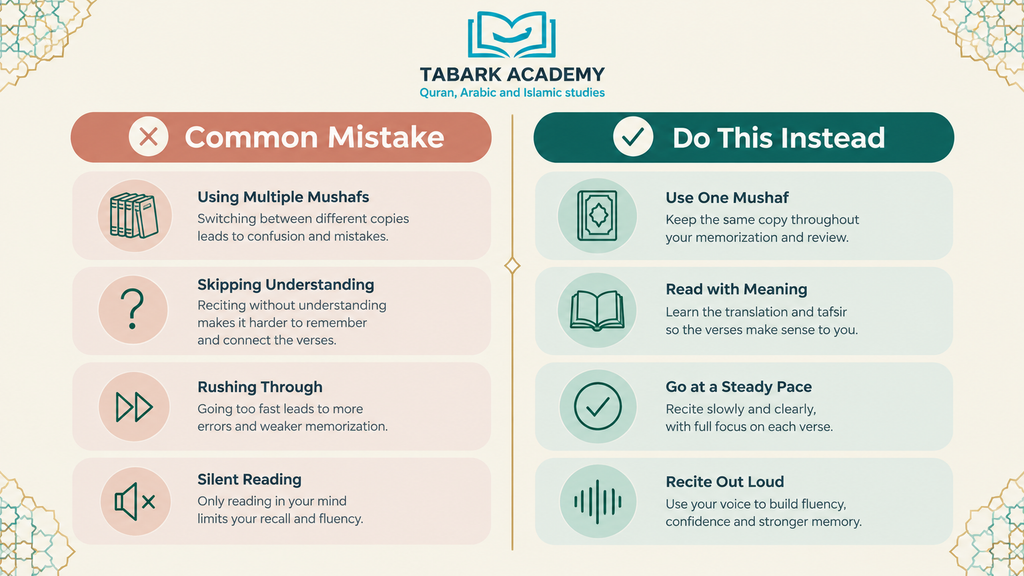
Revise Quran Without a Teacher: Tips That Prevent Common Mistakes
Most Hifz is not lost in dramatic setbacks; it fades through small, repeated habits that feel harmless at the time. Small habits decide whether your self-revision compounds or quietly erodes over months.
Use One Mushaf Only
Stick to a single copy of the Mushaf — ideally the 15-line Madinah print — for your entire Hifz journey. Photographic memory attaches to page layout, line breaks, and verse positions.
Switching editions mid-journey resets that visual map and costs you weeks of fluency.
Never Guess a Verse
When you hesitate, stop. Guessing a word and moving on teaches your brain the wrong version, and repeated guessing turns a small slip into a permanent error.
Open the Mushaf, confirm the correct wording, and repeat it in context before continuing.
Do Not Rush New Memorization
Adding new pages while old ones are shaky is the fastest route to losing both. Hold your new memorization steady until your old portions run smoothly for seven consecutive days.
A hafiz with ten solid juz is far stronger than one with twenty unstable ones. Correct tajweed matters just as much here — if your makharij are drifting, structured online tajweed classes will fix in weeks what self-correction rarely catches.
Experience Our Interactive Learning
Curious about how we teach? Watch these brief video clips from our recent live sessions to see our structured curriculum, advanced learning platform, and dynamic student-teacher interactions firsthand.
Strengthen Your Hifz With a Certified Tutor — Book Your Free Trial Today
Self-revision protects what you have. A qualified teacher is what turns fragile memorization into recitation you can lead salah with, confidently, for the rest of your life.
At Tabarak Academy, certified male and female tutors guide children and adults through structured Hifz, tajweed, and Arabic programs. Your teacher builds a personalized revision plan, flags the exact verses that are weakening, and holds you to it in the weeks your motivation dips.
Classes run one-to-one, online, at times that fit around school and work — and your first lesson is completely free. Meet your tutor, recite one page, and see precisely where your Hifz stands today.
Our Quran Memorization / Hifz Courses
- Online Hifz Program
- Juz 30 Memorization Course
- Hifz for Kids Course
- Hifz for Adults Course
- Hifz for Sisters Course
- Short Surah Memorization Course
- Hifz Ijazah Course

Conclusion
Learning how to revise Quran without a teacher comes down to structure rather than talent. A fixed daily wird, old material before new, and a seven-day rotation will keep every page you have memorized within reach all year long.
The three testing methods — reciting aloud from memory, recording yourself, and writing verses by hand — are what separate real retention from the comfortable illusion of it. Each one exposes different errors, which is exactly why you need all three rather than your favorite one.
Self-revision, though, has a clear ceiling. It maintains memorization beautifully, but it cannot diagnose tajweed drift or rebuild a juz you lost two years ago, and that is where a certified tutor changes the trajectory of your Hifz.
Takeaway Message: Revise consistently on your own, verify honestly against a trusted qari, and bring in expert correction the moment your recitation stops improving — that combination is what keeps the Quran in your chest for life.
FAQs
How much time should I spend revising Quran daily?
Between 60 and 90 focused minutes is enough for most students, with the majority of that time spent on older memorization. Consistency matters far more than duration — thirty honest minutes every day beats three hours once a week.
Can I really memorize and revise Quran without a teacher?
You can revise and maintain memorization independently, and many students do. However, learning correct tajweed and receiving an ijazah both require listening sessions with a qualified teacher, since recitation errors cannot be reliably self-diagnosed.
What should I do if I forgot a juz I memorized years ago?
Treat it as fresh memorization with a shortcut: the verses are still in long-term memory. Spend one focused week on that juz alone, using the three-layer method, before returning to your normal rotation.
How do I revise similar verses (mutashabihat) on my own?
Write the similar verses side by side on one page and highlight the differing words in colour. Then memorize the difference and its surah context, not just the verse itself.
Should I stop new memorization to focus on revision?
Yes, temporarily, if you stop more than twice while reciting a page of old material. Pause new Hifz, run your full rotation twice, and resume only once your old portions flow without hesitation.
Is revising Quran in salah as effective as a formal session?
It is more effective for retention, because slow, attentive recitation under focus creates stronger memory traces. It does not replace a structured revision session, though — use both together.