


Quranic Arabic vs Modern Standard Arabic
If you are learning Arabic to better understand the Quran, you may wonder about the difference between Quranic Arabic and Modern Standard Arabic (MSA).
Although they share the same linguistic roots and much of the same grammatical foundation, they are not the same. Quranic Arabic vs Modern Standard Arabic mainly differs in vocabulary, style, usage, and the context in which each form of Arabic is used.
Understanding these differences can help you choose the right learning approach for your goals, whether you want to understand the Quran, study Arabic, or communicate in formal settings.
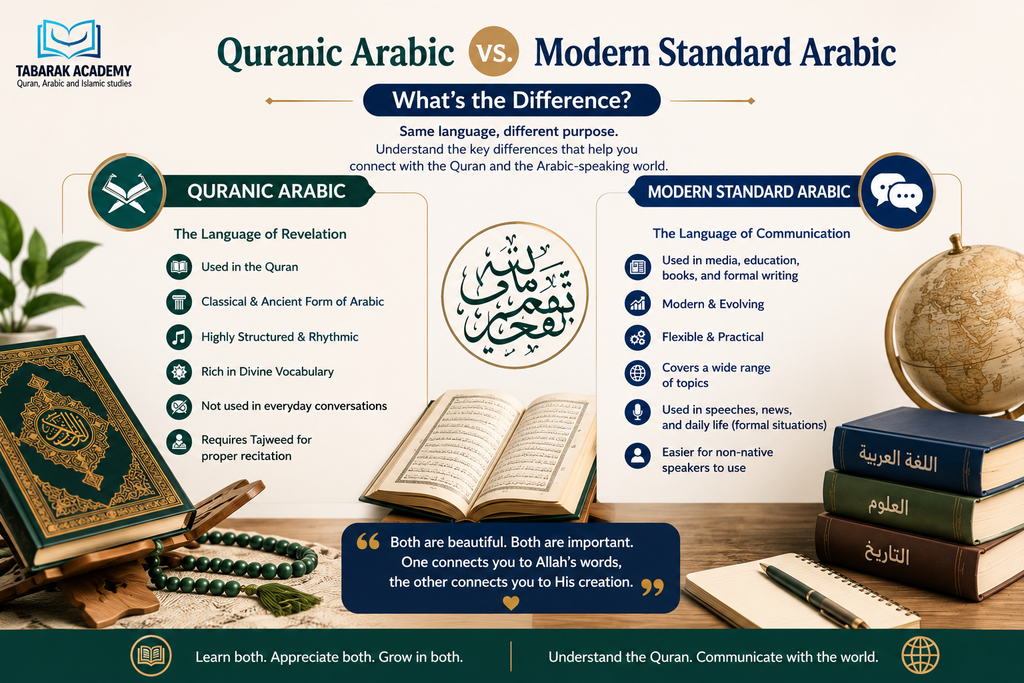
Quranic Arabic vs Modern Standard Arabic: Key Differences
When comparing Quranic Arabic vs Modern Standard Arabic, the two forms are much closer than many beginners expect. Understanding these distinctions makes it easier to choose the right type of Arabic for your learning goals.
Vocabulary
Quranic Arabic contains words and expressions associated with the language of the Quran and the Classical Arabic tradition. Some words may have meanings or nuances that depend heavily on their Quranic context.
MSA, meanwhile, has expanded to describe the modern world. It includes terminology related to technology, science, medicine, politics, business, and media, including terms that were not needed in the linguistic environment of the Quran.
Grammar and Syntax
Quranic Arabic and MSA share a substantial grammatical foundation, including Arabic verb patterns, noun structures, and case-related principles. However, Quranic Arabic can contain distinctive constructions, word choices, and grammatical usages that reflect its classical linguistic context.
MSA generally applies the inherited grammatical system in a standardized way for contemporary formal communication. The differences are therefore better understood as variations within closely related forms of Arabic, rather than completely separate grammatical systems.
Read also: How to Read the Quran in Arabic Easily Today
Style and Expression
One of the most noticeable differences is style and expression. The Quran has distinctive rhetorical, linguistic, and stylistic features that contribute to the meaning and impact of its verses.
Understanding these features often requires more than knowing individual vocabulary words.
MSA is generally designed for clear communication in modern formal contexts. It can certainly be literary and sophisticated, but its purpose extends to communicating modern ideas, information, and institutions.
Pronunciation and Recitation
Quranic Arabic should also be distinguished from Tajweed, which refers to the rules governing proper Quranic recitation.
When reading the Quran, learners may encounter specific pronunciation, articulation, elongation, and stopping rules associated with correct recitation. MSA pronunciation, by contrast, is generally taught as part of learning standard Arabic rather than as Quranic recitation.
Therefore, learning Quranic Arabic and learning Tajweed are related but not the same thing.
Where Each Form Is Used
The context in which each form is used is another important distinction.
Quranic Arabic is primarily studied for:
- Understanding the Quran
- Quranic interpretation and study
- Islamic scholarship
- Reading classical Islamic texts
MSA is commonly used for:
- News and broadcasting
- Formal education
- Books and publications
- Government communication
- Academic writing
- Formal speeches
This difference in purpose is one of the clearest ways to understand Quranic Arabic vs Modern Standard Arabic.
Experience Our Interactive Learning
Curious about how we teach? Watch these brief video clips from our recent live sessions to see our structured curriculum, advanced learning platform, and dynamic student-teacher interactions firsthand.
Are quranic arabic vs modern standard arabic the Same?
No, Quranic Arabic and Modern Standard Arabic are not exactly the same, although they are closely related. MSA developed from the Classical Arabic tradition and shares much of the grammatical structure and vocabulary found in Quranic Arabic.
The main differences appear in vocabulary, expressions, context, and modern terminology. Quranic Arabic reflects the linguistic environment and distinctive style of the Quran, while MSA has evolved to communicate modern subjects such as technology, science, politics, and business.
Read also: Do You Really Need MSA to Understand the Quran?
Which Should You Learn: Quranic Arabic or MSA?
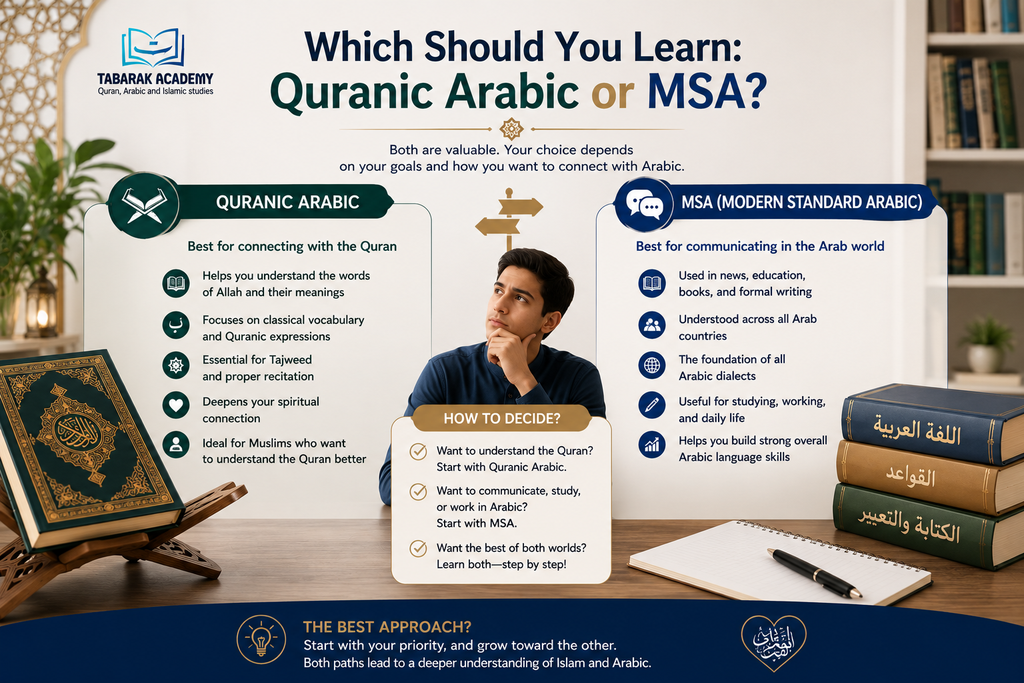
The best choice depends on why you want to learn Arabic. Neither Quranic Arabic nor Modern Standard Arabic is universally better; each serves a different purpose.
Choose Quranic Arabic If You Want to:
- Understand the Quran in its original language.
- Learn the meanings of common Quranic words.
- Explore Quranic vocabulary and grammar.
- Study the Quran more deeply.
- Understand classical Islamic texts.
Choose MSA If You Want to:
- Read modern Arabic books and publications.
- Follow Arabic news and media.
- Study Arabic academically.
- Understand formal written Arabic.
- Build a foundation for professional or academic communication.
What If You Want to Learn Both?
You don’t necessarily have to choose one permanently. Because Quranic Arabic and MSA share a strong linguistic foundation, learning one can support your understanding of the other.
If your main purpose is understanding the Quran, a Quran-focused Arabic course can help you concentrate on relevant vocabulary, grammar, and structures instead of spending months learning modern terminology you may not immediately need.
Read also: Reading the Quran in Transliteration: Is It Allowed?
Can You Learn Quranic Arabic If You Don’t Know Arabic?
Yes, you can learn Quranic Arabic even if you have no previous knowledge of Arabic. You do not need to become fluent in spoken Arabic before beginning to understand the language of the Quran.
How to Learn Quranic Arabic Effectively
Learning Quranic Arabic becomes easier when you follow a structured approach instead of trying to memorize large amounts of vocabulary at once. The goal is to gradually connect Quranic words, grammar, and context so you can understand verses more confidently.
1. Build a Quranic Vocabulary
Start with frequently repeated words and expressions in the Quran. Learning high-frequency vocabulary allows you to recognize familiar words across different surahs and build comprehension faster.
2. Learn Essential Arabic Grammar
You do not need to master every area of Arabic grammar immediately. Begin with the grammatical concepts that frequently appear in Quranic verses, such as pronouns, verb forms, nouns, and basic sentence structures.
Read also: Step-by-Step Beginner’s Guide to Learning Quranic Arabic
3. Study Short Surahs
Short surahs provide a practical starting point for beginners. Read the Arabic text, identify familiar vocabulary, and gradually connect individual words to the overall meaning of each verse.
4. Learn Words in Context
Rather than memorizing isolated translations, study how a word is used within Quranic verses. A single Arabic word can have different meanings depending on its context, so context is essential for deeper understanding.
Read also: The Exact Number of Words Needed to Understand the Quran
5. Use Reliable Tafsir
A good Tafsir can provide historical, linguistic, and contextual explanations that a basic translation may not fully convey. Use trusted resources alongside your Arabic studies to develop a more complete understanding.
6. Practice Consistently
Regular practice is more effective than occasional intensive study. Set aside time each week to review vocabulary, read Quranic passages, and reinforce the grammar you have learned. With the right learning plan and consistent guidance, Quranic Arabic for beginners can become a manageable and rewarding journey toward understanding the Quran more deeply.
Quranic Arabic vs Modern Standard Arabic: Which Is Better for Understanding the Quran?
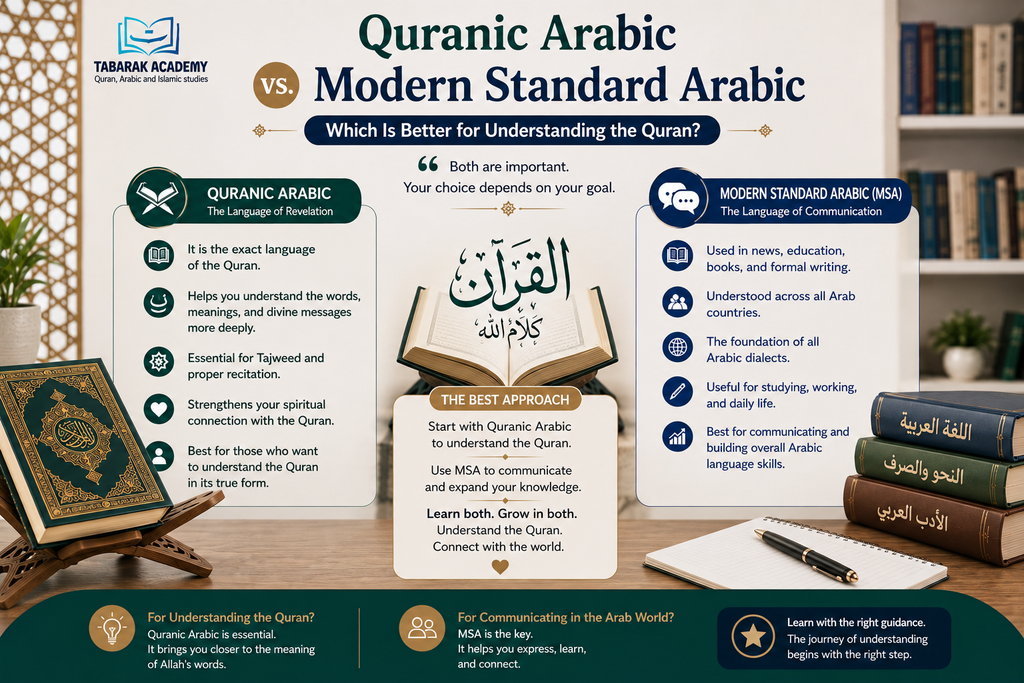
If your main goal is to understand the Quran in its original language, studying Quranic Arabic is the more direct choice. It focuses specifically on the vocabulary, grammar, expressions, and linguistic features you encounter in the Quran.
- MSA can still provide a useful foundation because it shares many grammatical and lexical features with Quranic Arabic. However, learning MSA alone does not necessarily prepare you to understand every Quranic expression or appreciate its classical linguistic nuances.
- For learners who want deeper Quran comprehension, a focused approach can therefore be especially helpful. You can begin with common Quranic vocabulary and essential grammar, then gradually develop your ability to understand verses in context.
Step Inside Our Virtual Classrooms
See our engaging teaching methods in action! watch real snippets of our live classes and discover how our expert instructors make learning interactive, memorable, and inspiring for every student.
Learn Quranic Arabic Online With Tabarak Academy
Understanding the Quran in its original Arabic can be a meaningful journey, but learning on your own can sometimes feel overwhelming. Tabarak Academy provides online Quran classes designed to help learners and families build their Quranic knowledge through structured, accessible lessons.
Why Learn With Tabarak Academy?
- Online Quran classes: Learn from the comfort of your home with flexible online lessons.
- Qualified teachers: Receive guidance from experienced Quran instructors.
- Beginner-friendly learning: Start at a level appropriate for your existing knowledge and skills.
- Personalized instruction: Get support that matches your learning goals and progress.
- Quran-focused education: Develop the skills needed to read and understand the Quran more confidently.
- Family-friendly learning: Make Quran education a consistent part of your family’s routine.
Ready to begin your Quranic Arabic journey? Explore Tabarak Academy’s online Quran classes and start learning with structured guidance today.
Our Quranic Arabic Courses
- Quranic Arabic Classes
- Quranic Arabic Course for Kids
- Quranic Arabic for Beginners
- Quranic Arabic Grammar Course
Conclusion
Understanding Quranic Arabic vs Modern Standard Arabic becomes easier when you remember that they are closely related but serve different purposes.
Quranic Arabic is particularly relevant for those who want to understand the Quran in its original language, while MSA is more suited to modern formal communication, education, media, and publications.
Ready to understand the Quran beyond translation? Start your learning journey with Tabarak Academy and develop your Quranic Arabic skills with guided online Quran classes.
FAQs
Can MSA help me understand the Quran?
Yes. MSA provides a useful foundation because it shares substantial vocabulary and grammatical structures with Quranic Arabic. However, specialized Quranic Arabic study can help you understand Quran-specific vocabulary, expressions, and context more deeply.
Can I learn Quranic Arabic without knowing Arabic?
Yes. You can start as a complete beginner by learning the Arabic alphabet, pronunciation, basic vocabulary, and foundational grammar before progressing to Quranic texts.
How long does it take to learn Quranic Arabic?
There is no fixed timeframe. Progress depends on your starting level, study schedule, learning method, and goals. Consistent practice over time is more important than trying to reach a specific level quickly.
Do I need Tajweed to learn Quranic Arabic?
Not necessarily. Quranic Arabic and Tajweed are related but different areas of study. Quranic Arabic focuses on understanding the language, while Tajweed teaches the rules for proper Quranic recitation.
What is the difference between Quranic Arabic vs modern standard arabic?
Quranic Arabic is the language of the Quran and belongs to the Classical Arabic tradition. Spoken Arabic usually refers to regional dialects used in everyday conversation. These dialects can differ considerably from both Quranic Arabic and MSA.