


Can I Read the Quran in Transliteration?
If you do not know how to read Arabic yet, you may wonder, “Can I read the Quran in transliteration?” Transliteration can help beginners pronounce Quranic words using familiar English letters, making it easier to get started. However, it should be viewed as a temporary learning aid rather than a replacement for reading the Quran in its original Arabic.
In this guide, we’ll explain can I read Quran in transliteration, whether it is allowed to use it, the difference between transliteration and translation, and how you can gradually learn to read the Quran in Arabic with proper Tajweed.
Can I Read the Quran in Transliteration?
Yes, you can use Quran transliteration as a learning aid, especially if you are a beginner who cannot yet read Arabic. It can help you recognize and pronounce Arabic words using familiar English or Latin letters while you work toward learning the Arabic script.
If you are asking, “Can I read the quran in transliteration?”, a practical approach is to use it alongside the Arabic text, listen to qualified reciters, and gradually learn the Arabic alphabet and basic Tajweed.
Is It Allowed to Read the Quran in Transliteration?
If you are wondering, “Is it allowed to read the Quran in transliteration?”, the answer requires an important distinction.
- Transliteration can be useful for beginners who are learning how to pronounce Quranic Arabic, but it does not reproduce the Quran in its original Arabic script.
- Many scholars caution against treating transliteration as a permanent substitute for the Arabic Quran because English or Latin letters cannot always represent Arabic sounds and Tajweed rules accurately.
- For this reason, learners are generally encouraged to use transliteration as a temporary aid while working toward reading the Quran in Arabic.
- If you currently cannot read Arabic, don’t let that stop you from learning. You can listen to Quran recitation, study a reliable translation to understand the meaning, and use transliteration alongside structured lessons as you develop your Arabic reading skills.
For questions about whether a particular form of recitation is valid in Salah, especially when you are unable to read Arabic, consult a qualified Islamic scholar for guidance specific to your circumstances.
What Is Quran Transliteration?
Quran transliteration is a way of representing Arabic words using English or Latin letters. It helps people who cannot yet read Arabic script pronounce Quranic words by following a phonetic spelling.
For example:
بِسْمِ اللَّهِ الرَّحْمَٰنِ الرَّحِيمِ
“Bismillāh ir-Raḥmān ir-Raḥīm”
“In the name of Allah, the Most Gracious, the Most Merciful.”
Transliteration can make the first steps of Quran reading less intimidating, particularly for new Muslims and non-Arabic speakers. However, it cannot perfectly represent every Arabic sound or Tajweed rule.
That is why it is best used as a supporting learning tool while you gradually learn to read the Quran in Arabic.
Experience Our Interactive Learning
Curious about how we teach? Watch these brief video clips from our recent live sessions to see our structured curriculum, advanced learning platform, and dynamic student-teacher interactions firsthand.
Can I Use Transliteration While Learning to Read the Quran?
Yes. Transliteration can be a useful starting point for beginners, especially if you are not familiar with the Arabic alphabet. It can be particularly helpful for:
- New Muslims who want to begin reciting while learning Arabic.
- Non-Arabic speakers who are unfamiliar with Arabic letters and pronunciation.
- Beginners who need additional support when practicing short surahs.
- Quran students who want a temporary pronunciation reference between lessons.
For the best results, combine transliteration with Arabic text, audio recitation, and Tajweed instruction.
How to Read the Quran Using Transliteration as a Beginner
Transliteration can make the first stages of Quran reading more accessible when you cannot yet recognize Arabic script.
However, it works best as a temporary bridge to Arabic reading, not as a permanent replacement for the original Quranic text.
Use it together with Arabic script, audio recitation, and pronunciation guidance while gradually developing the skills needed to read directly from the Mushaf.
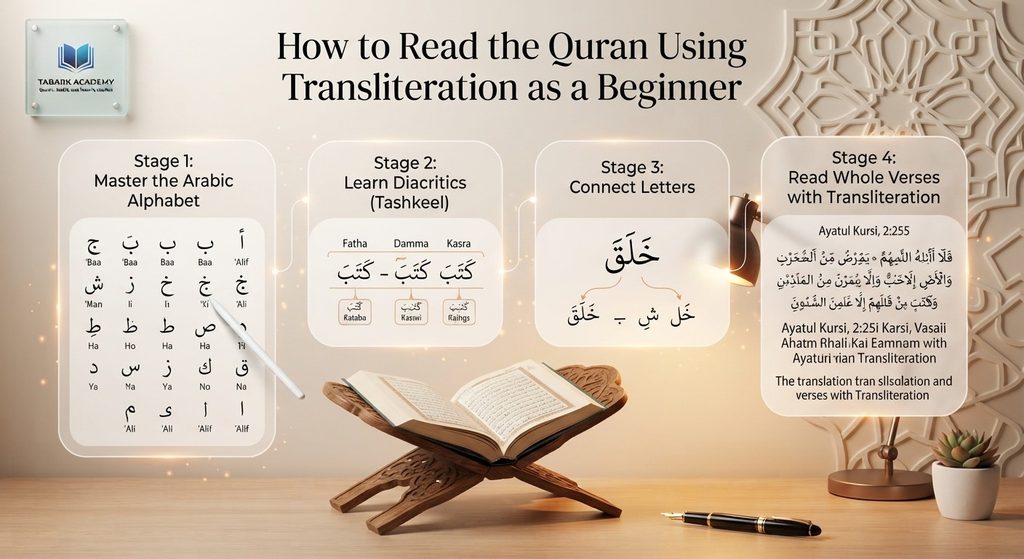
Step 1: Learn the Arabic Alphabet Before Depending Heavily on Transliteration
Even if transliteration helps you begin reciting immediately, start learning the 28 Arabic letters and their basic sounds from the beginning.
Pay particular attention to Arabic letters that English spelling cannot represent accurately, such as ع, ح, خ, غ, ق, ص, and ض. Learning these sounds early helps you understand why transliteration is only an approximation of Quranic pronunciation.
Read also:How to Start Reading the Quran in Arabic Easily
Step 2: Practice Transliteration With Short and Familiar Surahs
Begin with short Surahs that are easy to repeat, such as Al-Fatihah, Al-Ikhlas, Al-Falaq, and An-Nas.
Work with one Ayah at a time rather than trying to complete the entire Surah immediately. Read slowly, listen to the correct recitation, and repeat difficult words several times.
The goal is not to pronounce English letters exactly as they appear. Your goal is to use them as a temporary guide to reproduce the Arabic sounds you hear from the reciter.
Step 3: Keep the Arabic Text Beside the Transliteration to Build Letter Recognition
Whenever possible, use a resource that displays the original Arabic and transliteration together.
As you read each transliterated word, look at its Arabic equivalent. Begin noticing letters and words that appear repeatedly.
For example, instead of allowing your eyes to remain only on the transliteration, deliberately look back at the Arabic after each word or phrase. Over time, this helps create a connection between Arabic shape → Quranic sound, reducing your dependence on English letters.
Read also:Easy Ways to Master Quranic Arabic for Beginners
Step 4: Listen to a Clear Quran Reciter Before Pronouncing the Transliteration Yourself
Do not assume that English transliteration tells you exactly how a Quranic word should sound.
Listen to a clear recitation while following both the Arabic text and transliteration. Then use a simple practice cycle:
Listen → Follow → Repeat → Compare → Correct
Pay particular attention to sounds that transliteration represents imperfectly, as well as elongation, nasalization, and pauses.
Audio should guide your pronunciation; transliteration should only help you follow it.
Step 5: Learn Basic Tajweed Rules That Transliteration Cannot Show Accurately
As your reading develops, begin learning essential Tajweed rules that affect how Quranic words are actually pronounced.
Start with foundational areas such as Makharij, Madd, Ghunnah, and Qalqalah. These involve details of articulation and sound that cannot always be communicated reliably through English letters.
Whenever possible, practice with a qualified Quran teacher who can listen to your recitation and correct mistakes that neither transliteration nor self-study may reveal.
Step 6: Gradually Reduce Transliteration Until You Can Read Directly From Arabic
The ultimate goal is not to become faster at reading transliteration. It is to stop needing it.
As you learn Arabic letters, Harakat, connected forms, and common Quranic words, challenge yourself to look at the Arabic text first.
Try this progression:
Arabic + Transliteration → Arabic First + Transliteration When Needed → Arabic Only
If you can recognize a word directly from Arabic, avoid checking its transliteration unnecessarily. Each word you learn to read independently brings you closer to reading directly from the Mushaf.
Read also: Do You Need to Learn MSA to Read the Quran?
Step 7: Practice Consistently Until Arabic Recognition Becomes More Automatic
Set aside a short period every day to practice the same skills rather than relying on occasional long sessions.
You might spend a few minutes reviewing Arabic letters, another few minutes listening and repeating, and the remainder reading a familiar passage while trying to depend less on transliteration.
Measure progress by your independence rather than your reading speed. Being able to recognize one more Arabic word without transliteration is meaningful progress.
With consistent practice, transliteration should gradually move from being your primary reading aid to an occasional reference—and eventually become something you no longer need.
Step Inside Our Virtual Classrooms
See our engaging teaching methods in action! watch real snippets of our live classes and discover how our expert instructors make learning interactive, memorable, and inspiring for every student.
Learn to Read the Quran With Tabarak Academy
If you are using transliteration because you are still learning Arabic, Tabarak Academy can help you take the next step toward confident Quran reading.
- Our online Quran classes are designed to make learning accessible for beginners, children, and adults, with lessons that can be adapted to different learning levels.
- With guidance from qualified Quran teachers, students can work on Quran reading, pronunciation, and Tajweed while developing a stronger connection with the Arabic text. Instead of depending on transliteration permanently, you can follow a structured learning path that gradually builds your ability to recognize Arabic letters, read Quranic words, and recite more accurately.
- Whether you are beginning from the Arabic alphabet or already using transliteration to practice short surahs, consistent guidance can make your learning journey easier and more organized.
Our Quranic Arabic Courses
- Quranic Arabic Classes
- Quranic Arabic Course for Kids
- Quranic Arabic for Beginners
- Quranic Arabic Grammar Course
Our Quran Memorization / Hifz Courses
- Online Hifz Program
- Juz 30 Memorization
- Hifz for Kids
- Hifz for Adults
- Hifz for Sisters
- Short Surah Memorization Course
- Hifz Ijazah Course
Ready to move beyond transliteration and learn to read the Quran with confidence? Explore Tabarak Academy’s online Quran classes and take your next step today.

Conclusion
So, can you read the Quran in transliteration? Yes, transliteration can be a helpful starting point when you cannot yet read Arabic, especially for following short Surahs and becoming familiar with Quranic pronunciation. However, it works best as a temporary learning aid rather than a permanent substitute for the original Arabic text.
Use transliteration alongside the Arabic Quran, listen carefully to accurate recitation, and gradually learn the Arabic alphabet, Harakat, and basic Tajweed. As your reading improves, challenge yourself to rely less on English letters and recognize more Quranic words directly from Arabic.
Remember that progress is not measured by how quickly you can read transliteration. A better sign of progress is being able to recognize more Arabic letters and words, pronounce difficult sounds correctly, and recite familiar Ayahs with less assistance.
FAQs
Can I read Quran in transliteration if I don’t know Arabic?
Yes. If you cannot read Arabic yet, transliteration can help you begin practicing pronunciation. Combining it with Arabic lessons, audio recitation, and Tajweed can help you gradually develop your Quran reading skills.
Is it allowed to read the Quran in transliteration?
The use of transliteration as a learning aid is distinguished from replacing the Arabic Quran with a transliterated version. Because scholarly opinions can vary depending on the context, particularly regarding recitation in Salah, consult a qualified Islamic scholar for specific religious guidance.
Can transliteration help me learn Quran pronunciation?
It can provide useful support for beginners, but transliteration cannot represent every Arabic sound or Tajweed rule perfectly. Listening to qualified reciters and learning with a teacher can provide pronunciation guidance that written transliteration cannot.
Should I eventually learn to read Arabic?
Yes. If you currently depend on transliteration, learning the Arabic alphabet and gradually reading the Quran in its original script is a valuable long-term goal.
Can I use transliteration while learning Tajweed?
You can use it as supplementary material, but Tajweed is best learned through a combination of Arabic text, listening, practice, and guidance from a qualified teacher.