


How to Stay Motivated During Hifz? A Practical Guide
Every hifz student knows this pattern: you start with excitement, memorize a full page in your first week, and then hit a wall. Three days later, you haven’t opened the Mushaf once.
If you’re searching for how to stay motivated during hifz, you’re not failing at something unique to you — you’re facing the single biggest challenge in Quran memorization, and it’s one every successful hafiz has learned to manage.
At Tabarak Academy, our instructors work with students at every stage of their hifz journey, from young children to working adults, and the pattern is always the same. Motivation doesn’t disappear because a student lacks discipline.
It disappears because the system around their memorization — the pacing, the revision, the environment — wasn’t built to sustain it. Below are ten practical habits that keep hifz sustainable for months and years, the same ones our teachers use with students inside Tabarak Academy’s programs.
1. Renew Your Intention (Niyyah) Before Every Hifz Session
Niyyah — the sincere intention behind an act of worship — is not something you set once at the start of your hifz journey. It needs daily renewal.
Students who struggle most with motivation are often the ones who began for an external reason: a parent’s expectation, comparison with a sibling, or social pressure. When that external reason fades, so does the motivation attached to it.
The Prophet ﷺ emphasized the central importance of intention:
إِنَّمَا الأَعْمَالُ بِالنِّيَّاتِ، وَإِنَّمَا لِكُلِّ امْرِئٍ مَا نَوَى
“Actions are but by intentions, and every person will have only what they intended.”— Sahih al-Bukhari (1)
Before opening the Mushaf each day, take sixty seconds to silently remind yourself why you’re memorizing — for Allah’s pleasure, for intercession on the Day of Judgment, for carrying His words in your heart. That short pause changes the quality of the entire session that follows.
2. Set A Daily Hifz Portion You Can Actually Maintain
One of the most common patterns among new hifz students is what our teachers call the “surge and crash” cycle: five lines one day, a full page the next out of enthusiasm, then nothing for three days because the pace felt unsustainable. This cycle is the biggest destroyer of early motivation.
The fix isn’t more willpower — it’s a smaller, more honest daily target based on your actual level.
| Student type | Daily portion | Approximate completion (full Quran) |
| Absolute beginner (non-Arabic speaker) | 3–5 lines | 6–8 years |
| Consistent intermediate | 5–10 lines | 3–5 years |
| Structured advanced | Half page to 1 page | 1.5–3 years |
| Intensive, full-time | 1–2 pages | 8–14 months |
A student who memorizes five lines every single day, without exception, will outperform a student who memorizes a full page some days and nothing on others — both in retention and in emotional resilience.
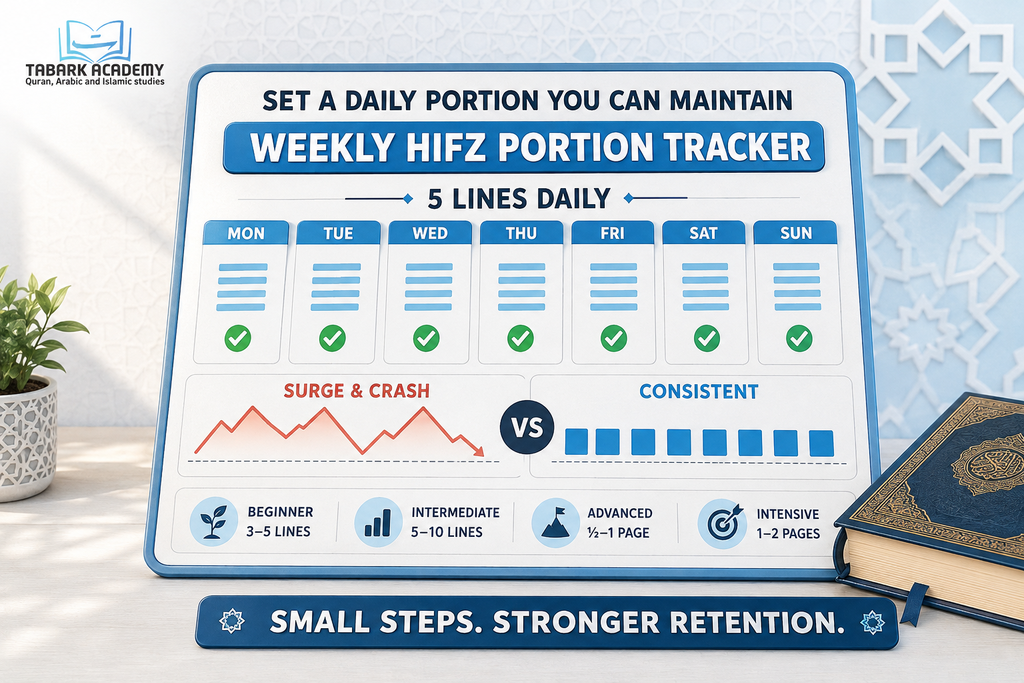
Choose a portion that feels almost too easy for your first two weeks. You can always increase it later; you cannot easily recover motivation lost to a crashed cycle.
Tabarak Academy’s Online Hifz Program builds this pacing directly into each student’s personalized plan, so the portion is set by a teacher rather than by enthusiasm.
3. Build a Revision System Before You Have Anything to Forget
The most discouraging experience in hifz is reciting a surah you memorized months ago and finding it has nearly disappeared. This isn’t a memory failure — it’s a revision failure, and it’s the leading cause of hifz abandonment among adult learners.
Tabarak Academy teachers introduce a three-tier review structure from a student’s very first week:
| Tier | Content | Frequency | Purpose |
| New (Jadeed) | Today’s newly memorized verses | Daily | Lock into short-term memory |
| Recent (Qarib) | Last 7 days of memorization | Daily | Transfer to medium-term retention |
| Old (Qadeem) | Everything memorized before the last 7 days | Weekly rotation | Prevent long-term erosion |
This structure ensures no portion of your memorized Quran goes unreviewed for more than a week. Students who apply this from week one report far fewer of the “I’ve lost it all” moments that quietly end a hifz journey.
Read also: Best Revision Schedule for Hifz
Experience Our Interactive Learning
Curious about how we teach? Watch these brief video clips from our recent live sessions to see our structured curriculum, advanced learning platform, and dynamic student-teacher interactions firsthand.
4. Track Your Progress So You Can See What You’ve Achieved
Motivation responds to visible evidence of progress. Knowing you’ve memorized seventeen surahs produces far less motivational pull than a wall chart showing exactly how far you’ve come.
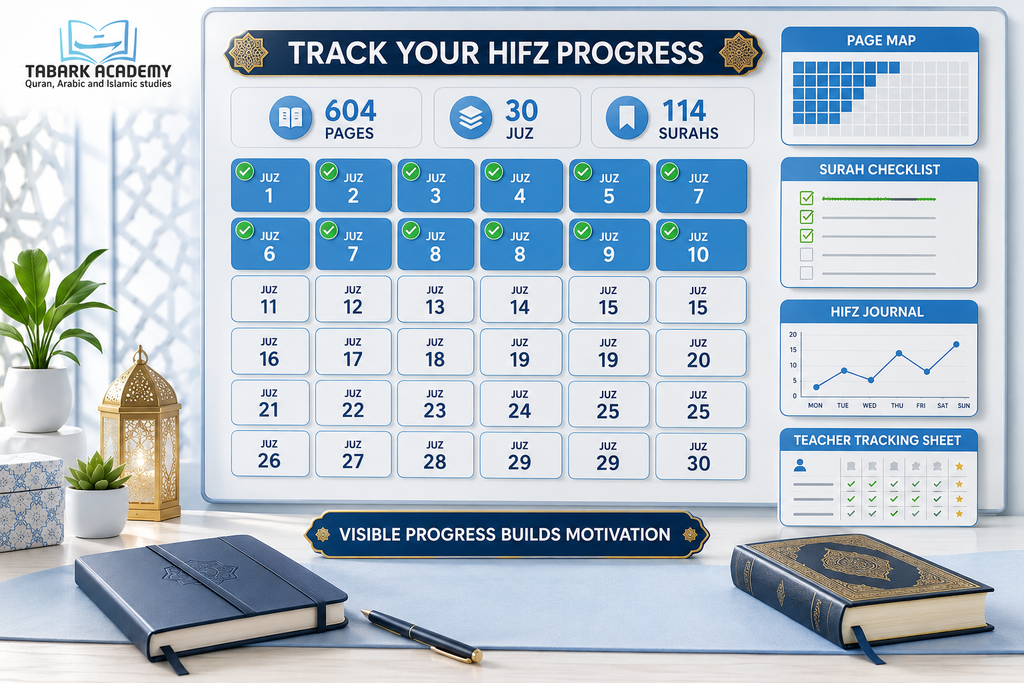
The Quran contains 604 pages, 30 Juz’, and 114 surahs — every portion completed is a quantifiable, trackable achievement.
Simple tracking options that work well:
- A printed Quran map, coloring in each page as it’s memorized.
- A surah checklist posted where you study.
- A dedicated hifz journal logging daily line counts.
- A shared tracking sheet with your Tabarak Academy instructor for accountability.
Even drawing a single line through a completed surah reinforces the behavior that got you there. That’s not a shortcut — it’s simply working with how the mind sustains long-term effort.
Read Also: Is It Too Late to Learn to Read the Quran as an Adult?
5. Memorize with Meaning, Not Just Sound
Motivation collapses fastest when hifz becomes mechanical — repeating sounds with no connection to their meaning. This is especially true for students memorizing in a language they don’t yet speak fluently.
Meaning-first memorization means spending five to ten minutes reading a reliable translation and a brief tafsir note on a passage before memorizing it. This creates a semantic anchor that makes the Arabic far easier to retain.
وَنُنَزِّلُ مِنَ ٱلْقُرْءَانِ مَا هُوَ شِفَآءٌ وَرَحْمَةٌ لِّلْمُؤْمِنِينَ
Wa nunazzilu minal-Qur’ani ma huwa shifa’un wa rahmatun lil-mu’minin
“We send down the Quran as a healing and mercy for the believers.” (Al-Isra 17:82)
When you understand what a passage is actually saying — not just how it sounds — the memorization gains emotional weight, and emotional weight is one of the strongest memory anchors available.
This is a core part of how instructors in Tabarak Academy’s Online Quran Classes build tajweed and comprehension alongside memorization from the start.
6. Protect Your Most Focused Hours for New Memorization
Hifz done at the wrong time of day is noticeably harder than hifz done at the right one. The early morning hours, from Fajr onward, combine cognitive freshness with real spiritual value.
Students who memorize new portions between Fajr and mid-morning consistently report stronger retention than those who try to memorize at night, especially after a full working day.
Reserve your new memorization for mornings, and use evenings for revision instead — your brain handles familiar material better than new encoding when it’s tired.
Read Also: The Hidden Psychological Barriers to Quran Memorization (And How to Beat Them)
7. Find Accountability Through A Teacher, Study Partner, Or Family
Hifz without accountability is one of the hardest disciplines a Muslim can sustain alone. The habit of self-permission — “I’ll make it up tomorrow” — operates almost without conscious awareness when no one else is checking in.
The most effective accountability structures include:
- A qualified hifz teacher who hears recitation regularly and corrects errors in real time.
- A hifz partner at a similar stage who exchanges recitation and progress updates.
- A family accountability system, where a parent or spouse checks in daily.
Students who recite to another person retain their memorization at noticeably higher rates than those who only recite to themselves — which is exactly why hifz has traditionally been passed down through oral recitation to a teacher, not private silent study.
Tabarak Academy builds this into every program: the Hifz for Kids, Hifz for Adults, and Hifz for Sisters courses all include regular recitation sessions with qualified instructors who track each student’s retention between classes.

8. Handle Memorization Plateaus Without Losing Motivation
Every hifz student, without exception, hits a stretch where memorization feels impossible. New verses won’t stick. Old portions feel shaky. This is a memorization plateau, and it’s a normal part of consolidation — not a sign of failure or lost ability.
The response matters more than the plateau itself:
- Switch to revision only for three to seven days to relieve pressure and let consolidation happen.
- Reduce your new portion to the minimum rather than stopping entirely.
- Ask your teacher for feedback on technique, since a plateau sometimes points to a method issue.
- Avoid simply adding more session time without changing your approach — that adds fatigue, not progress.
If you’re reviewing consistently and showing up daily, you’re succeeding, even on the days it doesn’t feel that way.
Read also: 5 Easy Self-Test Methods for Quran Memorization
9. Celebrate Milestones And Make Hifz A Family Experience
Completing a surah deserves acknowledgement. Finishing a Juz’ deserves celebration. These milestones represent weeks or months of consistent effort and real sacrifice, and marking them gives your mind the reward signal it needs to keep pursuing the next goal.
Practical ways students and families mark progress:
- Reciting the completed surah to the whole family, turning memorization into a shared moment.
- A dedicated du’a session thanking Allah and asking for firmer retention (thubaat).
- Sharing the milestone with your instructor for their recognition and feedback
- A modest, halal, personally meaningful reward.
For children especially, involving the whole family — listening together, discussing the meaning of a surah, or hearing a parent recite alongside them — builds the sense that hifz is a shared journey rather than a solitary task.
Tabarak Academy’s Online Quran Classes for Kids are designed with this family involvement in mind, keeping parents informed of progress at every stage.
Read also: Simple Ways to Make Your Quran Recitation Sound Better
10. Use Quick Daily Habits to Reinforce Motivation
Beyond the core structure above, these smaller practices support day-to-day consistency and are some of the best ways to stay motivated during hifz once your main routine is already in place:
- Make dua regularly for consistency and a love for the Quran’s words, not just for memorization ability.
- Recite newly memorized verses in your daily salah to reinforce them naturally.
- Take short breaks during study sessions — mental fatigue increases forgetfulness, so quality matters more than hours logged.
- Join a hifz study group or community for shared motivation and gentle accountability.
- If you’re new to Arabic altogether, building basic reading fluency first through Online Quran Classes for Beginners makes memorization considerably less frustrating.
Step Inside Our Virtual Classrooms
See our engaging teaching methods in action! watch real snippets of our live classes and discover how our expert instructors make learning interactive, memorable, and inspiring for every student.
Start Your Hifz Journey with Tabarak Academy Today
Staying motivated during hifz is far easier with the right pacing, a qualified teacher, and a structured revision plan behind you — you don’t need to build all of this alone.
Tabarak Academy’s certified instructors guide students of every age and level through a personalized memorization plan, from a first Juz’ to a complete hifz of the Quran, whether you’re starting through the Juz 30 Memorization course or a full program.

Our Quran Memorization / Hifz Courses:
- Online Hifz Program
- Juz 30 Memorization Course
- Hifz for Kids Course
- Hifz for Adults Course
- Hifz for Sisters Course
- Short Surah Memorization Course
- Hifz Ijazah Course

Conclusion
Staying motivated during hifz isn’t about finding one burst of inspiration — it’s about building a system that keeps working after the initial excitement fades.
A daily portion you can sustain, a revision structure that protects what you’ve already memorized, visible progress tracking, and real accountability all matter more than willpower alone.
If you take one thing from this guide, let it be this: consistency in small, sustainable steps will always outperform ambition that collapses after a week.
Used together as a system rather than as a checklist you try once, these stay motivated during hifz tips turn memorization into a lasting habit — especially with the right support, such as the programs at Tabarak Academy — hifz becomes a lasting habit rather than a cycle of starting over.

Frequently Asked Questions
The questions below cover the situations that come up most often for hifz students working on staying motivated, from pacing to setbacks.
1. What is the best way to stay motivated during hifz?
The best way to stay motivated during hifz is to combine a daily intention check with a sustainable memorization portion and a consistent revision routine. Motivation built on habit and structure lasts far longer than motivation built on enthusiasm alone.
2. How long does it typically take to memorize the Quran?
Completion time depends on your daily portion and consistency, ranging from about 8–14 months for intensive, full-time students to 6–8 years for beginners memorizing 3–5 lines a day. Steady daily progress matters more than speed.
3. Can adults start hifz later in life?
Adults can absolutely start and complete hifz, though the pace is often slower than for children due to competing responsibilities. Structured programs like Tabarak Academy’s Hifz for Adults course adjust pacing and scheduling around working adults’ realistic availability.
4. How can parents help keep their children motivated during Hifz?
Parents help most by celebrating small milestones, listening to recitation regularly, and keeping the tone encouraging rather than pressured. Involving the whole family in a child’s hifz progress makes the experience feel shared rather than isolating.
5. What should I do if I forget what I already memorized?
Forgetting memorized material usually points to a revision gap rather than a memory problem. Rebuilding a structured review routine, such as the new, recent, and old method, typically restores retention within a few weeks.
6. Is it normal to hit a point where hifz feels impossible?
Yes, this is a memorization plateau, and nearly every hifz student experiences it at some stage. Reducing your new portion and focusing on revision for a few days usually resolves it without derailing your progress.