

How to Make Your Voice Better for Quran Recitation
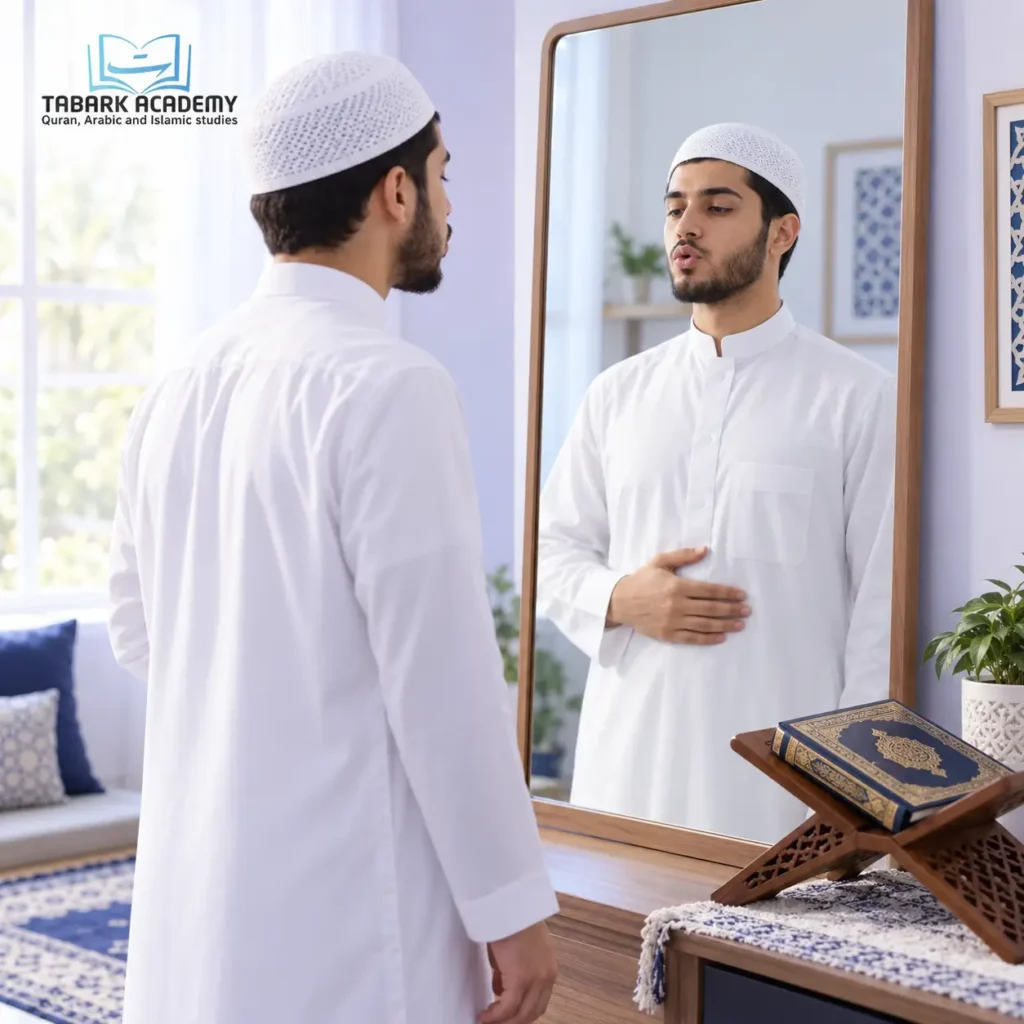
Your voice does not have to sound like a famous Qari for your Quran recitation to be beautiful. With the right practice, you can make your voice clearer, steadier, and more pleasant while strengthening your Tajweed and pronunciation.
If you are wondering how to make your voice better for Quran recitation, the best approach is to work on several skills together: breath control, vocal preparation, Arabic pronunciation, natural pitch, and consistent Quran recitation practice.
You can improve your voice for Quran recitation with consistent and focused practice. While everyone has a naturally different voice, you can develop better breath control, vocal stability, pronunciation, pitch, and clarity over time.
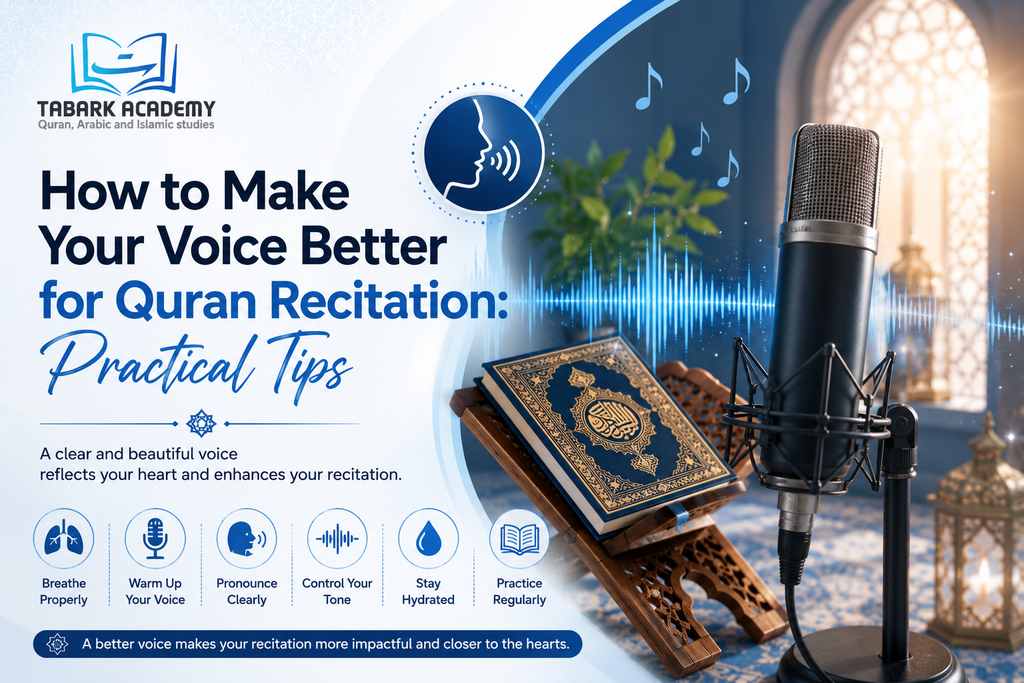
In this guide, you’ll discover practical make your voice better for Quran recitation tips and a simple approach to improving your recitation without forcing your natural voice.
10 Practical Tips to Make Your Voice Better for Quran Recitation
Learning how to make your voice better for Quran recitation is not about forcing yourself to sound like a famous Qari. A beautiful recitation develops when correct Tajweed, clear pronunciation, controlled breathing, a comfortable vocal range, and consistent practice work together.
The following practical tips can help you develop a Quran recitation voice that sounds clearer, steadier, more natural, and more controlled while keeping accuracy at the center of your practice.
Read also: How to Improve Your Quran Recitation With Perfect Tajweed
1. Build Your Recitation Voice on Correct Tajweed First
Before focusing on melody or vocal beauty, make sure your recitation has a strong foundation in Tajweed. A pleasant voice cannot compensate for incorrectly pronounced letters, altered vowel sounds, or improperly applied recitation rules.
Begin with Makharij (the articulation points of letters) and Sifaat (their characteristics). Then strengthen your application of essential rules such as Madd, Ghunnah, Qalqalah, Ikhfa, Idgham, and other Tajweed principles relevant to your level.
As these rules become more natural, you will spend less effort thinking about individual sounds and gain greater control over your overall delivery. Accuracy itself can make your recitation sound noticeably cleaner and more confident.
2. Strengthen Your Breath Control for Longer, Steadier Quran Recitation
Breath control directly affects your pace, vocal stability, and ability to complete phrases without rushing. If you regularly run out of breath, you may speed through the final words of a verse or stop in an unsuitable place.
Practice taking comfortable, controlled breaths before reciting rather than filling your lungs to the point of tension. Keep your shoulders and throat relaxed and release the air gradually as you recite.
You can also practice with a short passage by marking appropriate stopping points beforehand. Recite from one stopping point to the next at an even pace without accelerating as your breath decreases.
The goal is not to hold your breath for as long as possible. It is to use your available breath efficiently while maintaining clear pronunciation and appropriate Waqf.
3. Warm Up Your Voice Before Longer Quran Recitation Sessions
Just as you would prepare before extended speaking or singing, a short and gentle vocal warm-up can help your voice feel more relaxed before Quran recitation.
Begin with a few minutes of comfortable breathing, gentle humming, or light lip trills without forcing your voice. You can then recite a familiar short Surah quietly and gradually settle into your normal recitation volume.
A warm-up should feel easy rather than demanding. If an exercise creates tension or discomfort in your throat, stop and return to a comfortable speaking or recitation range.
Experience Our Interactive Learning
Curious about how we teach? Watch these brief video clips from our recent live sessions to see our structured curriculum, advanced learning platform, and dynamic student-teacher interactions firsthand.
4. Find Your Natural Pitch Instead of Forcing a Deeper or Higher Voice
You do not need an unusually deep, powerful, or high voice to recite the Quran beautifully. Trying to imitate another reciter’s vocal range can create unnecessary strain and make it harder to maintain consistent pronunciation.
Start close to your natural speaking pitch and choose a tone you can sustain comfortably. Once you have good control within that range, you can experiment gently with higher and lower tones.
Pay attention to how your voice feels as well as how it sounds. Your throat should remain relaxed, and changes in pitch should never interfere with your Tajweed, pronunciation, or ability to complete a phrase comfortably.
The objective is to develop your own controlled and pleasant recitation voice, not to reproduce someone else’s.
5. Refine Your Makharij to Make Every Quranic Letter Clearer
One of the fastest ways to make your Quran recitation sound cleaner is to improve the pronunciation of individual Arabic letters.
Study the Makharij carefully so you understand where sounds originate from the throat, tongue, lips, nasal passage, and oral cavity. Then practice difficult letters individually before placing them back into Quranic words and verses.
Non-native Arabic speakers may need additional practice distinguishing letters such as ق (Qaf), ط (Ta), ص (Sad), ض (Dad), ع (Ayn), ح (Ha), خ (Kha), and غ (Ghayn).
Instead of repeating an entire Surah when one letter is causing difficulty, isolate the problem. Practice the letter, then words containing it, and finally the verse. This focused approach can make pronunciation practice much more effective.
Read also: Master the 17 Makharij of Arabic Letters Easily
6. Study Skilled Qaris for Tajweed, Breathing, Waqf, and Vocal Control
Listening to experienced Quran reciters can train your ear to recognize what accurate, controlled recitation sounds like.
Choose a Qari whose pronunciation is clear and whose pace is easy for you to follow. Rather than concentrating only on the melody, listen for specific technical details:
- Where does the Qari breathe?
- Where do they pause and resume?
- How are Madd lengths maintained?
- How clearly are similar Arabic letters distinguished?
- How does the reciter change pitch without affecting pronunciation?
- Does the pace remain controlled through longer phrases?
Work with only one or two verses at a time so you can concentrate on the details instead of trying to imitate an entire recitation.
7. Record Your Recitation to Identify Mistakes You Cannot Hear While Reading
Your voice often sounds different to you while you are speaking than it does on a recording. Recording Quran recitation therefore gives you an opportunity to evaluate your performance more objectively.
Choose a short Surah or several verses and record yourself without repeatedly stopping to correct mistakes. Then listen back while focusing on specific areas such as:
- unclear letters or Makharij
- incorrect or inconsistent Madd
- rushed words
- inappropriate pauses
- unstable pitch
- breathlessness near the end of phrases
- unnecessary vocal tension
Avoid trying to correct everything at once. Choose one or two specific weaknesses, work on them, and record the same passage again. Comparing recordings over time can also help you recognize genuine progress.
Read also: The Ultimate Guide to a Beautiful Quran Recitation Voice
8. Master Waqf and Maintain a Measured Pace for Smoother Recitation
Beautiful Quran recitation depends not only on the voice but also on when you pause and how quickly you recite.
Rushing can reduce pronunciation accuracy, shorten sounds that should be extended, and cause you to run out of breath unexpectedly. Reciting too slowly without understanding phrase structure can also make the recitation feel disconnected.
Practice at a measured pace that gives you enough time to pronounce each letter and apply Tajweed correctly. Learn the common Waqf signs in your Mushaf and identify suitable stopping points before reciting longer verses.
When your breath begins to decrease, resist the temptation to rush through the remaining words. Instead, develop the habit of planning your breathing around appropriate stopping points.
9. Protect Your Voice From Strain During Quran Recitation Practice
Improving your recitation requires regular practice, but more practice is not always better if your voice is becoming tired or strained.
Stay adequately hydrated, recite at a comfortable volume, and avoid repeatedly forcing very high or low pitches. Long periods of shouting or other unnecessary vocal strain can also make controlled recitation more difficult.
Pay attention to signs that your voice needs rest. If your throat becomes uncomfortable, your voice becomes unusually hoarse, or producing sound starts to feel difficult, stop practicing and allow your voice to recover rather than forcing another session.
A healthy, relaxed voice gives you a much better foundation for developing control and consistency.
Read also: How to Breathe While Reciting the Quran: 11 Steps
10. Follow a Consistent Daily Routine to Improve Your Recitation Voice Over Time
Improving your Quran recitation voice is a gradual process. You are unlikely to transform your pronunciation, breathing, Tajweed, and vocal control in a few sessions, but focused daily practice can produce noticeable progress over time.
Instead of practicing randomly, create a simple routine you can repeat consistently. For example:
- 2 minutes: Relax your breathing and gently warm up your voice.
- 3 minutes: Practice one difficult Makhraj or Tajweed rule.
- 5 minutes: Recite a short passage slowly and accurately.
- 3 minutes: Practice the same passage alongside a skilled Qari.
- 2 minutes: Record yourself and identify one point to improve tomorrow.
A short, focused routine is often more useful than an occasional long session. As your Tajweed, pronunciation, breath control, and confidence improve together, your voice can become naturally clearer, steadier, and more beautiful in Quran recitation.
Best Way to Make Your Voice Better for Quran Recitation
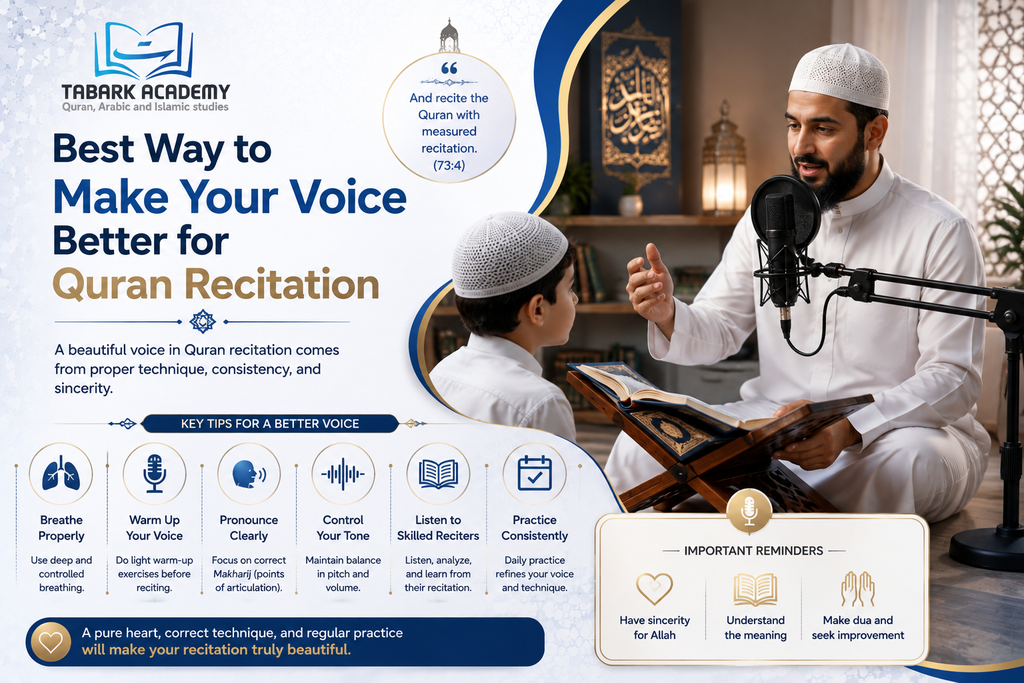
The best way to make your voice better for Quran recitation is to follow a simple, consistent routine that combines vocal preparation with proper Quranic recitation skills.
A Simple 20-Minute Practice Routine
- 5 minutes – Warm up your voice: Use gentle humming, lip trills, and relaxed breathing to prepare your voice.
- 5 minutes – Practice Tajweed and pronunciation: Choose one rule or a few difficult Arabic letters and practice them carefully.
- 5 minutes – Recite with a skilled Qari: Listen to a short passage, pause, and repeat it while focusing on pronunciation, pace, and breath control.
- 5 minutes – Record and review: Record yourself and listen back. Identify one specific issue to improve during your next practice session.
The key is consistency. A focused 20-minute routine practiced regularly can be more useful than an occasional long session
Make Your Voice Better for Quran Recitation: Tips for Beginners
If you are just starting, don’t worry about having a naturally beautiful or powerful voice. Your first priority should be correct Quran recitation, and your voice can gradually become clearer and more controlled through practice.
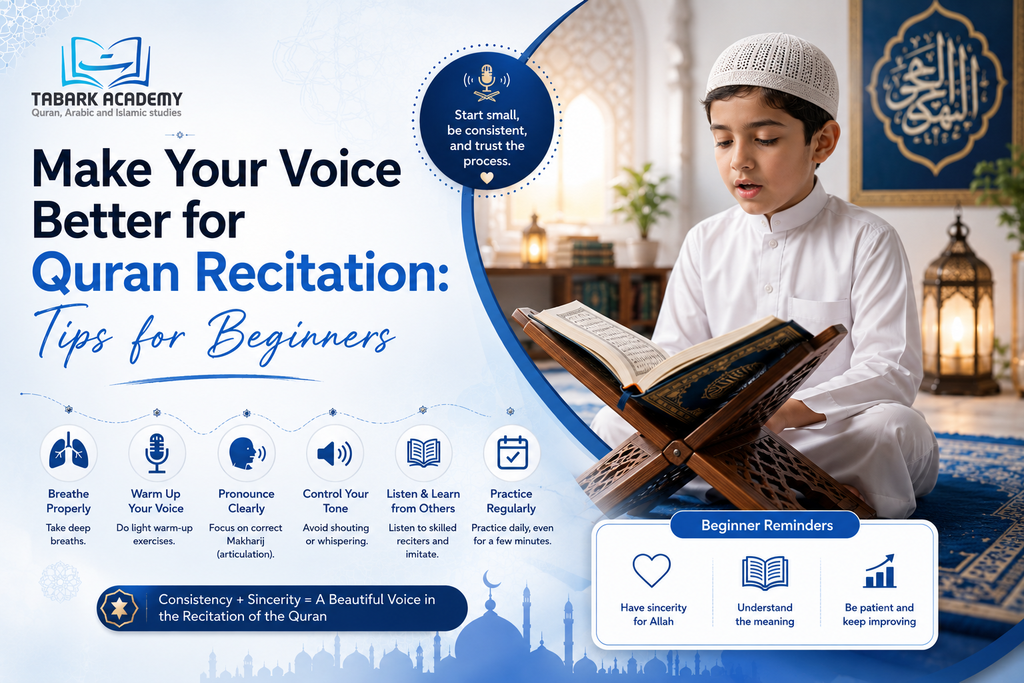
Here are some practical make your voice better for Quran recitation tips for beginners:
- Start slowly: Focus on accuracy rather than speed.
- Practice short Surahs: Master a few verses before moving to longer passages.
- Focus on Tajweed: Correct pronunciation is more important than vocal beauty.
- Use your natural pitch: Never force your voice to sound deeper or higher.
- Practice breathing: Learn to take calm breaths at appropriate stopping points.
- Listen to skilled reciters: Pay attention to their pronunciation, pauses, and rhythm.
- Record yourself: Listening back can reveal mistakes you don’t notice while reciting.
- Practice one skill at a time: Work on pronunciation, breath, or rhythm instead of trying to fix everything at once.
- Get teacher feedback: A qualified Quran teacher can identify mistakes that may be difficult to recognize on your own.
- Be patient: Consistent practice will produce better results than trying to improve your voice overnight.
Most importantly, don’t compare your natural voice with someone else’s. Your goal is to develop your own clear, confident Quran recitation while maintaining proper Tajweed.
Step Inside Our Virtual Classrooms
See our engaging teaching methods in action! watch real snippets of our live classes and discover how our expert instructors make learning interactive, memorable, and inspiring for every student.
Improve Your Quran Recitation With Tabarak Academy
You can practice many of these techniques on your own, but personalized guidance can help you improve faster and avoid repeating mistakes.
At Tabarak Academy, learners can study the Quran online with qualified teachers who can provide individual feedback and help develop stronger Tajweed, pronunciation, breath control, and recitation skills.
Whether you are a beginner or already have experience with Quran recitation, structured lessons can help you identify your strengths and focus on the areas that need improvement. Instead of trying to change your natural voice, you can learn how to make your voice better for quran recitation more confidently while maintaining accurate and respectful Quran recitation.
Ready to improve your Quran recitation? Learn with Tabarak Academy and take the next step toward clearer, more confident, and more beautiful recitation with personalized guidance.
Our Quran Memorization / Hifz Courses
- Online Hifz Program
- Juz 30 Memorization
- Hifz for Kids
- Hifz for Adults
- Hifz for Sisters
- Short Surah Memorization Course
- Hifz Ijazah Course
Conclusion
Learning how to make your voice better for Quran recitation is a gradual process. You don’t need to change your natural voice or imitate a famous Qari. Instead, focus on Tajweed, clear pronunciation, breath control, natural pitch, measured pacing, and consistent practice.
The best way to make your voice better for Quran recitation is to combine these skills with regular feedback and patience. Small improvements made consistently can lead to a clearer, steadier, and more confident recitation.
If you’re ready to improve your Quran recitation with personalized guidance, Tabarak Academy can help you build your skills step by step with qualified Quran teachers.
FAQs
What is the best to make your voice better for Quran recitation?
The best way to make your voice better for Quran recitation is to combine proper Tajweed with regular voice and breathing practice. A simple routine of warming up, practicing pronunciation, reciting with a skilled Qari, and reviewing your own recording can gradually improve clarity and vocal control.
Can I improve my Quran recitation if I don’t have a naturally beautiful voice?
Yes. You do not need a naturally beautiful or powerful voice to recite the Quran well. Focus on correct Tajweed, clear pronunciation, steady breathing, and a comfortable natural pitch.
Should I imitate famous Quran reciters?
You can learn from famous Quran reciters, but you do not need to copy their voices. Pay attention to their Tajweed, pronunciation, breathing, pauses, and rhythm while developing your own natural recitation voice.
How can I improve my breathing for Quran recitation?
Practice calm, controlled breathing and learn to use appropriate Waqf points. Start with shorter passages and gradually build your breath control without forcing yourself to hold your breath uncomfortably.
Can a Quran teacher help me improve my recitation voice?
Yes. A qualified Quran teacher can listen to your recitation and identify mistakes in Tajweed, pronunciation, Waqf, pace, and other areas that may be difficult to notice on your own.