


9 Strategies Of How To Revise Memorized Quran
Completing the memorization of the Quran is one of the most significant achievements a Muslim can reach — but every hafiz quickly discovers that how to revise memorized Quran is a question that doesn’t end when the last surah is memorized.
The hifz you worked years to build can loosen quietly without a structured approach, and the more effort you invested in memorization, the sharper the frustration when verses start slipping.
The Prophet ﷺ addressed this directly: “Guard this Quran, for by the One in Whose hand is my soul, it slips away faster than a camel from its tethering rope.” (Agreed upon). This is not a warning to fear — it is a roadmap. Forgetting is predictable, which means it is also manageable. What it requires is a system, not willpower.
This article lays out nine tested strategies for how to revise memorised Quran for huffaz at every stage, from those maintaining all thirty juz’ to those stabilizing earlier portions while still memorizing new ones.
Read also: How To Memorize The Quran?
1. To Know How To Revise Memorized Quran, Set A Daily Revision Minimum That Holds Even On Difficult Days
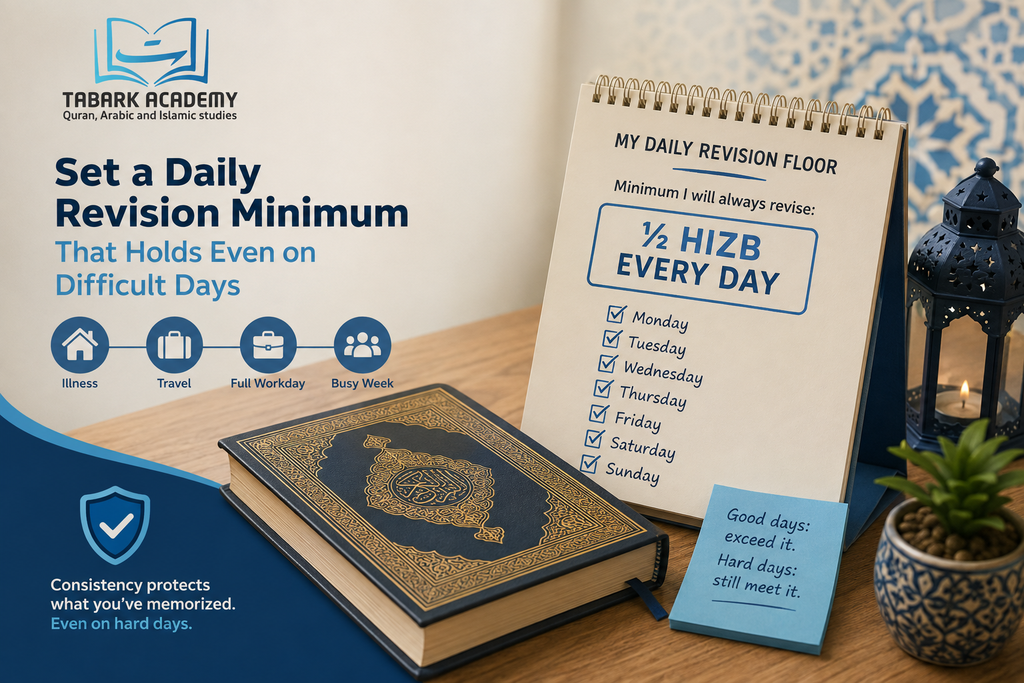
Consistency is the determining factor in Quran retention — more than the quantity of any single session. A half-hizb reviewed every day without exception maintains the memory trace that larger but irregular sessions cannot.
Define the absolute minimum you will revise even on your worst possible day: during illness, travel, a full workday, or an exhausting family week. That floor is what prevents the long gaps that allow forgetting to accumulate. On good days you exceed it. On hard days, you still meet it. Protecting this floor over time is more valuable than any single marathon revision session.
2. Treat Your Near And Far Quran Revision As Entirely Separate Tasks
One of the most consistent mistakes in Quran revision is treating all memorized content as though it needs the same level of attention. Recent memorization — the past one to two weeks — requires intensive, near-daily reinforcement before it stabilizes. Older memorization needs consistent but less frequent cycling.
When these are blended into one undifferentiated session, recent material reliably crowds out the old. The practical fix is to divide your session deliberately: the first portion targets your recent memorization, and the second follows a fixed rotating schedule through your older juz’. Both portions are non-negotiable. Neither one is optional.
Join a free trial of Hifz Ijazah Course at Tabarak Academy

3. Use Your Daily Prayers As A Revision Session You Are Already Attending
Every obligatory prayer and every nafl rak’ah is a built-in revision opportunity that most huffaz leave underused. Rather than defaulting to the same handful of surahs memorized in childhood, make a deliberate choice before each prayer about which portion of your current memorization you will recite.
In qiyam al-layl, this becomes especially effective — sustained recitation in night prayer is one of the most powerful ways to consolidate recently memorized material, because both the act of worship and the sustained mental focus reinforce the memory simultaneously.
Consistent engagement with the text during prayer also means you naturally improve your language skills with Quran, as active recitation builds Arabic recognition over time in ways that passive reading alone cannot.
Read also: How long does it take to memorize one juz of quran
Experience Our Interactive Learning
Curious about how we teach? Watch these brief video clips from our recent live sessions to see our structured curriculum, advanced learning platform, and dynamic student-teacher interactions firsthand.
4. Find A Revision Partner Who Won’t Let You Off The Hook
Accountability changes behavior in ways that private intention cannot. When you know a partner is listening on Thursday morning, you prepare on Wednesday night. This is not a question of discipline — it is how humans reliably respond to genuine social commitment.
A revision partner can be a classmate, a family member, or someone you connect with online. The structure is simple: each person recites their assigned portion to the other, who follows in the Mushaf and marks corrections. Swap roles.
Two sessions a week creates real accountability without overwhelming either party. If finding a local partner is a challenge, Tabarak Academy‘s online programs pair students with qualified instructors who provide exactly this kind of scheduled, consistent accountability.

5. Let Your Ears Do The Heavy Lifting And Listen To Your Memorized Portions Daily
Auditory memory plays a significant role in Quran memorization, and unlike visual revision, it can be exercised while doing other things — during a commute, while cooking, or in the minutes before sleep. Make it a daily habit to listen to whichever portion you’re currently revising.
Consistent listening to the same reciter maintains the specific pronunciation patterns and rhythms that anchor your memorization. Switching reciters frequently can subtly disrupt the mental template you’ve built, creating confusion at verse transitions.
If you’re interested in how the tradition handles legitimate recitation variation, reading about the types of Qirat in the Quran gives useful context for understanding how precise and governed this entire tradition is.
Join a free trial of Quranic Arabic Course for Kids at Tabarak Academy

6. Track The Verses That Keep Tripping You Up “The Mutashabihat”
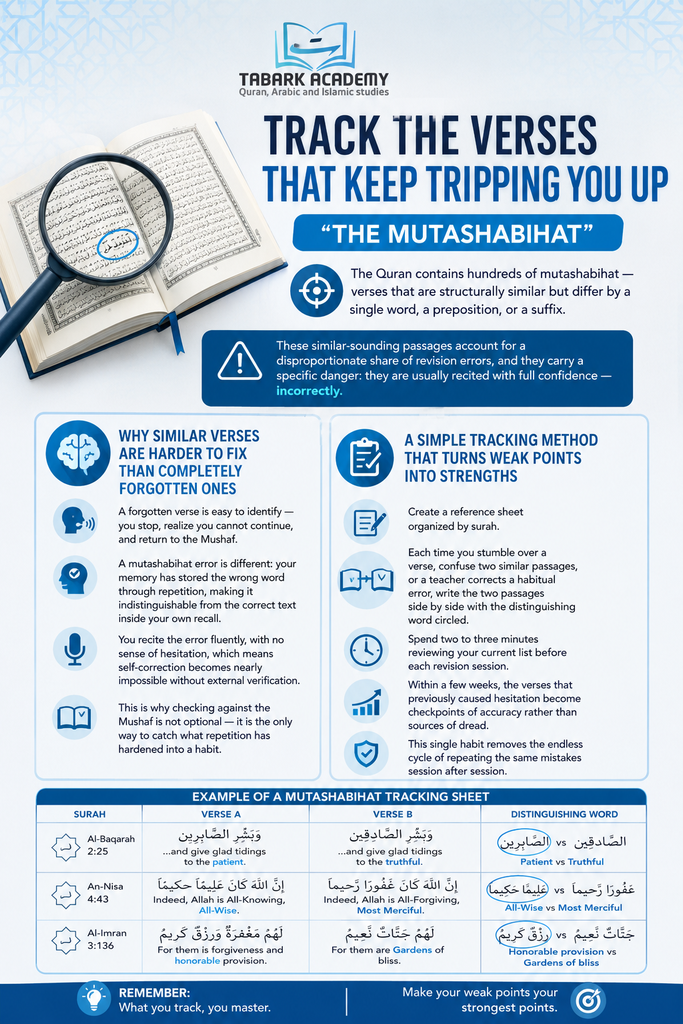
The Quran contains hundreds of mutashabihat — verses that are structurally similar but differ by a single word, a preposition, or a suffix. These similar-sounding passages account for a disproportionate share of revision errors, and they carry a specific danger.
Unlike completely forgotten verses, they are usually recited with full confidence — incorrectly. Tracking these problem verses consistently is among the most practically effective revised memorized Quran tips for anyone dealing with recurring errors.
Read also:How many years does it take to memorize quran
A. Why Similar Verses Are Harder To Fix Than Completely Forgotten Ones
A forgotten verse is easy to identify — you stop, realize you cannot continue, and return to the Mushaf. A mutashabihat error is different: your memory has stored the wrong word through repetition, making it indistinguishable from the correct text inside your own recall.
You recite the error fluently, with no sense of hesitation, which means self-correction becomes nearly impossible without external verification. This is why checking against the Mushaf is not optional — it is the only way to catch what repetition has hardened into a habit.
Start your Free Trial of Tafseer Al-Quran Course Today

B. A Simple Tracking Method That Turns Weak Points Into Strengths
Create a reference sheet organized by surah. Each time you stumble over a verse, confuse two similar passages, or a teacher corrects a habitual error, write the two passages side by side with the distinguishing word circled. Spend two to three minutes reviewing your current list before each revision session.
Within a few weeks, the verses that previously caused hesitation become checkpoints of accuracy rather than sources of dread. This single habit removes the endless cycle of repeating the same mistakes session after session.
Read also:Tips to Keep Up Your Quran Memorization Routine
7. Recite Your Memorized Portion Without Looking Then Open The Mushaf To Find Where You Fell Short
Most people revise by reading from the page, feeling reasonably comfortable, and moving on. The method that actually builds lasting retention works in the opposite direction: close the Mushaf, recite the passage from memory until you either complete it or reach a point of genuine uncertainty, then open the page to identify exactly where the breakdown occurred.
This approach forces a real retrieval attempt before the answer is available. The act of struggling to recall — even briefly — strengthens the memory trace more reliably than rereading does. When you identify an error, correct it immediately with three to five focused repetitions before moving on.
This discipline is what Tabarak Academy’s instructors reinforce in every session, because it consistently produces stable hifz where passive reviewing does not.
Explore our Free Tajweed Quran Course at Tabark Academy

8. Choose One Mushaf And Commit To It
Quran memorization depends partly on spatial and visual memory. Your brain encodes the approximate position of words on a specific page layout, and this visual map is part of how you retrieve the text. When you switch Mushaf editions, you disrupt that map and force partial re-encoding — a hidden but real source of instability in revision.
Select one Mushaf with a clear layout and consistent page divisions, and use it exclusively for both memorization and review. Many huffaz find that deepening their understanding of Arabic significantly strengthens this visual memory of the text, since the meaning of each word anchors its position more firmly.
The importance of the Arabic language for a hafiz extends well beyond translation – it changes how the entire text is held in memory.
Read also: 10 Strategies Of How To Memorize Quran Fast And Never Forget
Step Inside Our Virtual Classrooms
See our engaging teaching methods in action! watch real snippets of our live classes and discover how our expert instructors make learning interactive, memorable, and inspiring for every student.

9. Revise Under A Qualified Teacher
Self-revision has a ceiling that most huffaz eventually hit. An error that you repeat consistently becomes invisible to you — your memory automatically fills in the expected word rather than registering what you actually said.
A teacher who follows along in the Mushaf hears the gap you no longer notice. Regular sessions with a qualified instructor catch tajweed errors, habitual word substitutions, and the subtle mispronunciations that accumulate undetected over time.
For huffaz pursuing formal mastery of their recitation, how to get Ijazah explains the certification process in full — a chain of transmission that requires audited, verified recitation, and represents the most rigorous form of revision accountability in the tradition.

Start Your Revision Journey At Tabarak Academy Where Every Hafiz Gets A Real Plan
Revising memorized Quran alone is possible. Revising it under qualified guidance is what produces lasting results. Tabarak Academy pairs every student with an experienced tutor who designs a personalized revision schedule, provides consistent Tajweed correction, and maintains the accountability structure that keeps revision on track week after week.
Students from across the world work with Tabarak Academy‘s teachers at their own pace and in their own time zone — from children stabilizing their first juz’ to adults maintaining a full thirty-juz’ program. The best investment a hafiz can make is in the system that protects the investment already made.
Tabarak Academy offers a comprehensive range of Quran and Arabic programs for learners at every level:
Our Quran Memorization / Hifz Courses
- Online Hifz Program
- Juz 30 Memorization
- Hifz for Kids
- Hifz for Adults
- Hifz for Sisters
- Short Surah Memorization Course
- Hifz Ijazah Course
Begin Your Free Trial with Tabarak Academy And Reserve Your Place Today

Conclusion
Knowing how to revise memorized Quran is ultimately about building a system that runs even when motivation is low. The nine strategies above cover the full range — from the micro-level discipline of testing yourself before opening the Mushaf, to the structural approach of the three-circle system that keeps near and far memorization in ongoing balance.
The most important shift these strategies make is in how you relate to forgetting. It is not failure — it is a signal that the revision system needs attention. Every error you catch in a session, every mutashabihat verse you track, every prayer where you choose to recite from a weaker juz rather than a familiar one — these are not small habits.
They are the accumulated decisions that transform memorization from a temporary achievement into a permanent relationship with the Quran. Whether you’re revising a single juz’ or all thirty, the path forward is built on a daily floor that never drops to zero.
A structured rotation between layers of memorization, a teacher who hears what you cannot, and the understanding that every revision session is itself an act of worship. The best way to revise memorized Quran is the one you actually do — consistently, deliberately, and with full trust that the effort is never wasted.
Frequently Asked Questions
How many pages should I revise each day to maintain strong hifz?
There is no single number that applies to everyone, but a practical starting point is two to four pages of active review per day for someone maintaining full memorization. The specific amount matters less than the regularity — one page reviewed every day outperforms eight pages reviewed once a week with nothing in between.
What is the best way to revise memorized Quran when time is extremely limited?
Link revision to daily prayers you are already performing. Reciting from your memorized juz’ in Fajr, Dhuhr, and ‘Asr prayers covers three genuine revision sessions without adding any extra time to your day. Supplementing this with ten minutes of targeted review before sleep creates a functional daily system even under significant time pressure.
How do I get back on track after a long break from revision?
Return to the Mushaf without expectation. Read each page of your memorized juz’ once with your eyes open to rebuild the visual template, then attempt recitation without looking. Note every passage where you hesitate or stop.
Is self-revision enough, or do I need a teacher?
Both belong in a sustainable revision system. Solo revision builds independence and fits around any schedule. A teacher catches the errors that self-revision cannot — particularly habitual word substitutions and Tajweed mistakes that become invisible through repetition.
How do I handle similar-sounding verses that I keep confusing even after repeated practice?
Write the two passages side by side with the differing word identified, and review this list for two minutes before every revision session. Isolated, deliberate comparison of the distinguishing word — rather than simply repeating both verses at full speed — resets the memory trace for each.