
To teach Quran to a child who refuses to sit requires understanding why the child struggles to remain focused during lessons. If your child runs away when you open the Mushaf, firm words and rewards may not hold their attention.
This behavior does not necessarily indicate a lack of interest in the Quran or a failure in your teaching. Shortening sessions, allowing movement, and adapting activities to the child’s attention span can make Quran learning more manageable and enjoyable.
1. Measure Your Child’s Real Attention Window First
Before changing anything, spend one week observing without correcting. Note how many minutes pass before your child loses focus on any structured activity: a puzzle, a story, a homework task. That number is your starting point.
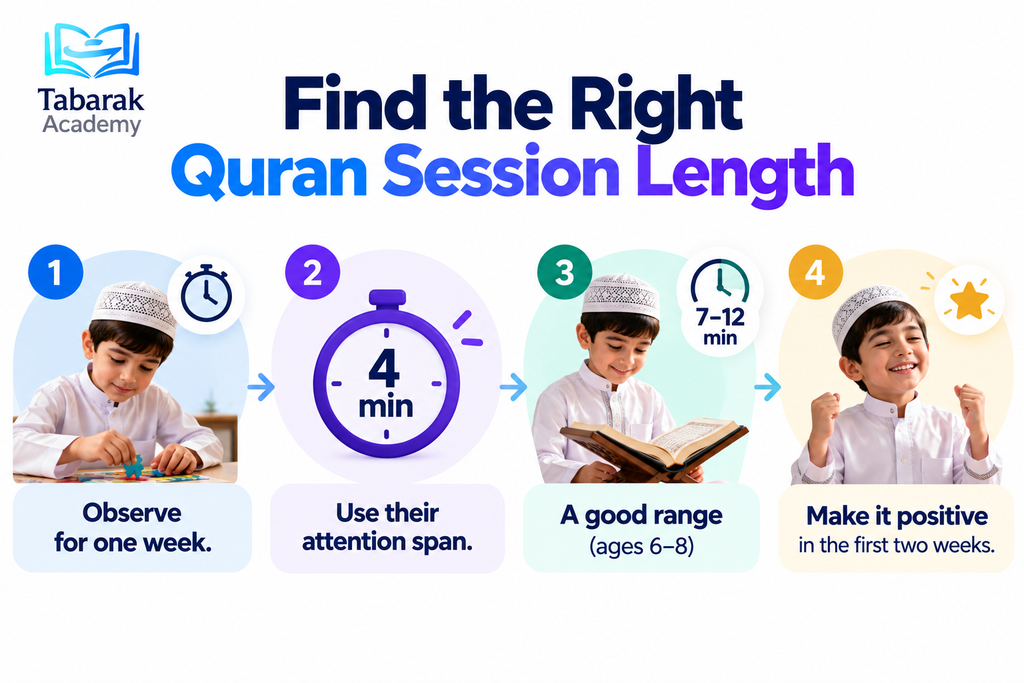
If the answer is four minutes, build four-minute Quran sessions. A session planned around the child’s actual capacity will succeed where a session planned around an ideal produces only daily conflict.
Children aged six to eight commonly manage seven to twelve minutes of focused recitation before attention drops. Starting within that window, and stopping before it ends, is the single most important structural decision you will make.
The goal in the first two weeks is not memorization. The goal is that the child associates Quran time with calm success, not exhaustion.
Attention window by age as a rough planning guide:
| Age | Realistic focused session length |
| 5 to 6 years | 5 to 7 minutes |
| 7 to 9 years | 8 to 12 minutes |
| 10 to 12 years | 12 to 18 minutes |
| 13 and above | Up to 25 minutes with a mid-session break |
2. Build a Fixed Routine with a Clear Start Cue
A child who fights sitting down for Quran time is often fighting the uncertainty of transition, not the Quran itself. When the sequence before the lesson is identical every single day, the brain stops spending energy resisting and starts preparing.
Choose a natural anchor point in the day when your child is genuinely calmer. This is almost never right after school, when sensory and social fatigue peak. Morning sessions before school, or the window thirty minutes after a snack and outdoor play, are commonly the most productive.
The lead-in sequence should be fixed and short:
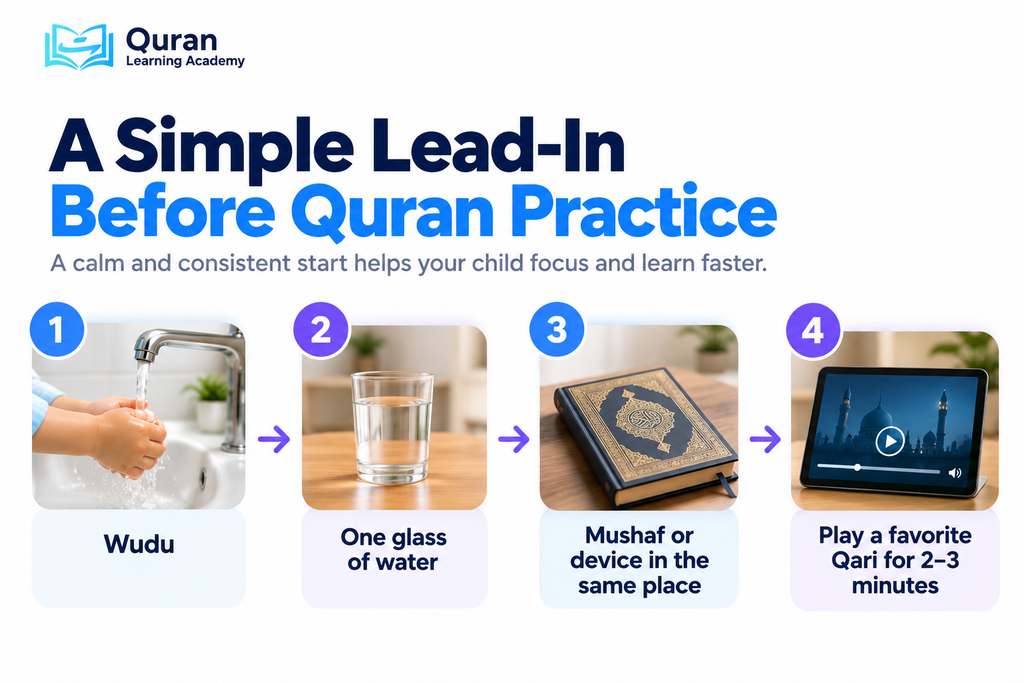
- Wudu.
- One glass of water on the table.
- The Mushaf or device in the same place.
- Two to three minutes of a favorite Qari playing before the child is asked to repeat anything.
The two to three minutes of audio is not a warm-up luxury. Hearing the ayah from a familiar voice before being asked to recite it lowers the entry threshold significantly. The child already has the sound in their ear when you ask them to open their mouth.
Experience Our Interactive Learning
Curious about how we teach? Watch these brief video clips from our recent live sessions to see our structured curriculum, advanced learning platform, and dynamic student-teacher interactions firsthand.
Start Your Quran Learning Journey
Join Tabark Academy today for structured online lessons with qualified tutors, customized to fit your goals.
Book Your Free Trial Lesson3. Allow Movement During Recitation Rather Than Fighting It
Requiring a child to sit still and memorize Quran simultaneously asks them to manage two cognitively demanding tasks at once. For children whose bodies need movement to regulate, removing the sitting requirement frees mental capacity for the actual learning.
Classical Quran scholarship has always accommodated this. Students recited while rocking, while pacing, and while holding their hands in their laps. None of this is disrespect for the text; it is the body helping the brain encode.
Practical movement options that work during recitation include:
- Slow pacing around the room while repeating the phrase.
- Gentle swaying while seated.
- Pointing to each word on the page with one finger as it is said aloud.
- Holding a soft, silent fidget ball in one hand while the Mushaf is held in the other.
- Standing at a counter or bookshelf instead of sitting at a table.
Test two of these in the first week. Children will show you quickly which option lets them focus rather than distracts them further. Once you find what works, keep it consistent.
Read more: Revision Plan for a Hafiz of the Whole Quran.
4. Break Each Ayah into Three to Five-Word Pieces
The single most common technical mistake when parents try to teach Quran to a child who refuses to sit is presenting an entire ayah as the unit of memorization. For a child with a short attention window, “memorize this verse” is simply too large a target.
The correct unit is a phrase of three to five words. Recite the phrase yourself two to three times at a natural pace. Ask the child to repeat it. When they can produce it clearly and consistently, add the next phrase, then chain the two together.
This mirrors how the Prophet, peace be upon him, taught: the Quran was revealed piece by piece, and the Companions received and mastered small portions before moving forward. A child who masters two lines of Surah Al-Fatiha perfectly has achieved something real.
A practical breakdown of how to split longer ayahs:
| Teaching step | What the parent does | What the child does |
| Audio exposure | Play the phrase from a Qari audio 3 times | Listens only, no pressure to repeat |
| First echo | Recite the phrase once yourself | Repeats once, however imperfectly |
| Repetition | Recite again clearly | Repeats 5 to 7 times until stable |
| Chain | Add the next phrase and chain both | Recites the combined sequence |
5. Use a Visible Progress Tracker the Child Controls
Children whose bodies refuse stillness often struggle with abstract motivation. “You will love the Quran when you are older” carries no weight with a seven-year-old. A chart with physical boxes that the child crosses off after each session produces immediate, visible proof of effort.
The tracker must be simple, and the child must be the one who marks it. One box per session, not per ayah, not per page. The session itself is the achievement worth marking.
Set targets the child can reach today. “Three phrases today” is a goal. “Finish Surah Al-Ikhlas this month” is too far away to pull on a child’s attention in the present moment. When a short-term target is met, mark it together, acknowledge it genuinely, and move on without lingering.
The Quran Recitation Course at Tabarak Academy helps children build consistent recitation habits through live, one-on-one sessions with certified Arab tutors who adapt their pace to each child’s real attention capacity.

Start improving your recitation today.
6. Replace Correction-First Teaching with Listen-First Exposure
When a child mispronounces a word and the immediate response is correction, the brain registers failure. Repeated correction without sufficient prior exposure produces a child who stops trying before the session begins.
The principle here is to ensure the child has heard the correct form enough times before they are asked to produce it. Play the ayah from a Qari your child finds natural to listen to. Let them hear it five to seven times during the day without any formal session, during a car ride, at breakfast, in the background during play.
When the sound is already familiar, the child’s brain is retrieving a known pattern rather than constructing something new. The cognitive load drops sharply, and the child’s ability to sit with the task long enough to repeat it correctly increases.
Recognizing this, the best way to teach Quran to a child who refuses to sit during formal sessions is to make much of the exposure happen outside formal sessions. The body does not need to sit still to listen.
Step Inside Our Virtual Classrooms
See our engaging teaching methods in action! watch real snippets of our live classes and discover how our expert instructors make learning interactive, memorable, and inspiring for every student.
Start Your Quran Learning Journey
Join Tabark Academy today for structured online lessons with qualified tutors, customized to fit your goals.
Book Your Free Trial Lesson7. Separate the Physical Setup from All Other Activities
A corner of the living room where the child also plays video games or watches television carries competing associations. The brain has not learned that this space means “Quran time.” Moving between these signals costs the child energy every session.
Designate one consistent physical spot for Quran learning. It does not need to be elaborate: a small prayer rug facing a plain wall is sufficient. The key conditions are:
- No screens visible or accessible during the session.
- Good, calm lighting.
- The Mushaf and any audio device in the same position each time.
- No other family activity happening in the child’s direct line of sight.
Within two weeks of maintaining this space consistently, most children begin transitioning into focus more quickly simply because the environment has become a signal. This is the same mechanism behind a child who reads better in the library than at the kitchen table.
The Hifz For Kids Course at Tabarak Academy pairs each child with a native Arab tutor who structures the memorization session around the child’s pace, using audio-first methods that reduce resistance before the session begins.

Join your first free trial now.
8. Apply Teach Quran to a Child Who Refuses to Sit Tips During Low-Resistance Moments
Most parents wait for the scheduled session and then battle through it. The more effective approach is to scatter brief exposures throughout the day at moments when the child is already calm and occupied.
A child drawing quietly will often absorb a Qari playing in the same room without objection. A child in the bath will sometimes start repeating phrases they have heard twenty times without ever being asked to. A child in the car with nothing else to do is in one of the most receptive states of the day.
These passive exposures are not a replacement for structured practice. They are the preparation that makes structured practice shorter, less frustrating, and more successful. Every exposure before the session reduces the cognitive distance the child has to cross when you sit down together.
Apply teach Quran to a child who refuses to sit tips like this specifically during the hour before bedtime. The brain consolidates what it heard during the day into memory during sleep. A child who falls asleep having heard Surah Al-Ikhlas repeatedly will retrieve it more reliably the next morning.
Read more: Quran Learning Activities for 5 Year Olds That Build Real Skills.
9. End Every Session Before the Child Asks to Stop
This is counterintuitive for parents who have finally gotten the child to sit. The instinct is to extend the session since it is going well. The correct move is to stop first.
Ending a session while the child is still engaged and still succeeding conditions the brain to return willingly the next day. Ending a session because the child has collapsed into resistance conditions the brain to expect the session to end badly and to start resisting earlier the next time.
The practical rule: set a timer before the session starts. When it rings, stop, even if things are going well. Acknowledge what was achieved specifically: not “good job” but “you repeated that phrase seven times and it came out clearly. That is real progress.” Then release the child to play without any qualifier about what they should do better next time.
Start Your Quran Journey with Tabarak Academy
Tabarak Academy offers structured, one-on-one live Quran and Arabic sessions delivered by certified native Arab tutors, designed specifically for children, adults, sisters, and families at every level. Sessions are flexible across all time zones, with real-time Tajweed correction and a free trial class available before any commitment.
Whether your child is a complete beginner or needs a reset after previous struggles, a dedicated tutor who adapts to your child’s pace changes the picture dramatically.
Our Quran Courses
- Hifz For Kids Course
- Quran Recitation Course
- Online Quran Classes for Sisters
- Quran Reading Course
- Online Ijazah Course

Register at Tabarak Academy today and book your child’s first free trial class
Conclusion
How to teach Quran to a child who refuses to sit is a question of structure, not willpower. Shorter sessions, consistent routines, movement during recitation, and listening-first exposure before any formal repetition are the practical steps that change the daily experience. The child’s relationship with the Quran is built slowly, session by session, each one ending in calm success.
FAQ
How long should a Quran session be for a child who refuses to sit?
Start with the length your child can sustain on any focused task. For most children aged six to nine, this is seven to twelve minutes per session.
Can a child memorize Quran without sitting still at a desk?
Yes. Walking recitation, standing, and gentle swaying all support encoding and have been used in classical Quran education for centuries.
How many times a week should we practice Quran with a resistant child?
Five short daily sessions produce more retention than one long weekly session, even if each session is only ten minutes.
What is the best way to teach Quran to a child who refuses to sit during lessons?
Reduce the session length to match the child’s real attention window, allow movement, and use listen-first exposure before asking for any repetition.
Should I correct my child every time they mispronounce a word?
No. Prioritize sufficient audio exposure first. Correct gently and only after the child has heard the correct form multiple times.




0 Comments