
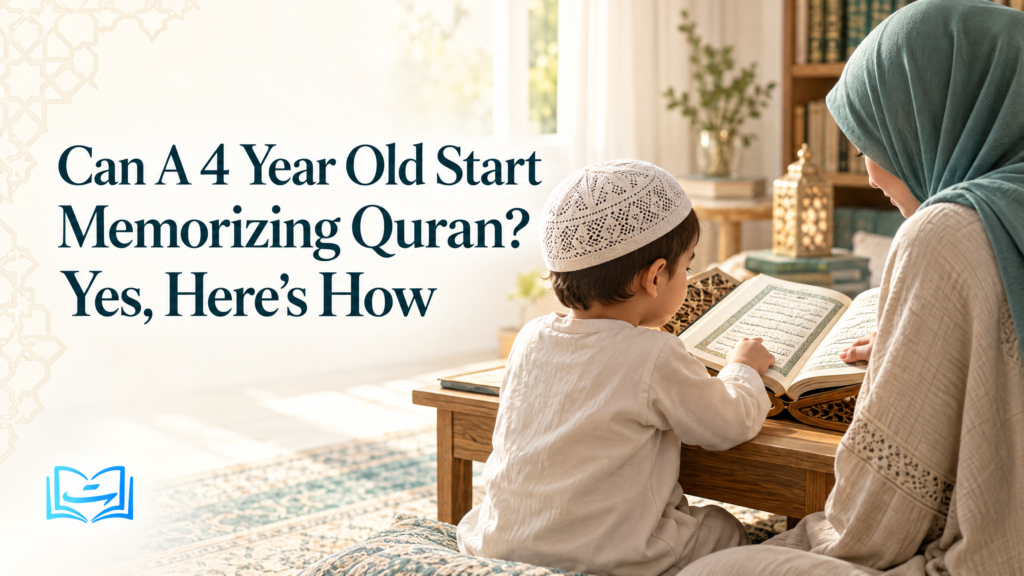
Yes, a 4 year old can start memorizing Quran. What matters is keeping it gentle, short, and fun, so your child sees the Quran as something they enjoy and not a test they have to pass.
Maybe it started with a small moment. Your child hummed Al-Fatiha in the back seat, or copied you while you prayed. Now you’re asking yourself if this is the right time.
Most parents worry about one of two things. Some are afraid they’ll push too hard and make their child dislike the Quran. Others are afraid they’ll wait too long and miss the years when little ones soak everything up. Both worries make sense, and both come from love.
You don’t have to pick one side. At four, the way you start matters far more than how much your child learns. A few calm minutes a day, with plenty of warmth, can give your child a love for the Quran that stays with them for life.
What You Will Learn In This Article
- What a 4-year-old can memorize, and what should wait.
- Four signs your child is ready.
- Which surahs to teach first.
- A simple four-step way to teach at home.
- What to avoid, and how age 4 compares with older ages.
What A 4 Year Old Can Memorize From The Quran
A 4 year old can memorize Quran by listening to a verse and repeating it after a parent or teacher. Most children this age can learn Al-Fatiha and short surahs from Juz Amma in daily sessions of 5 to 10 minutes.Memorizing the whole Quran, with daily page goals and tests, should wait a few years.
How A 4 Year Old Learns Short Surahs By Listening
Your child will learn how a surah sounds before they know what it means. So if they can say Al-Ikhlas but don’t know what it’s about, that’s fine. That’s how it works at four.
This way of learning is called talaqqi. It means learning the Quran by hearing it from someone else. Muslim kids have learned this way for hundreds of years.
With each new surah, you’ll see the same pattern. First, your child knows it when they hear it. Then they say the last word when you stop. Next, they say it with you. Then one day, they say it all by themselves.
That last step is the goal. Here’s an easy check. The next day, ask your child to say the surah, but don’t give them the first word. If they can start on their own, they know it.
Al-Falaq and An-Nas often get mixed up. Both start with “Qul a’udhu bi rabbi,” so kids sometimes jump from one to the other. Teach one first, and wait until your child knows it well. When you start the second one, show them the word that’s different: “al-falaq” in one and “an-nas” in the other.
Give each surah one easy meaning. For Al-Ikhlas, you can say, “This surah tells us Allah is One.” That’s enough. Kids remember words better when they mean something.
You’re not doing this alone. Allah made the Quran easy to remember (Quran 54:17). And the Prophet ﷺ said the best people are those who learn the Quran and teach it (Sahih al-Bukhari 5027). Every short surah you teach your child counts.
Why Memorizing The Whole Quran Should Wait Until Later
Memorizing the whole Quran is a big job. The most common printed copy has 604 pages. A full plan means learning new lines every day, reviewing old ones every day, and reciting in front of a teacher. Plenty of grown-ups find that hard.
Now picture a 4-year-old trying to keep up with that. They can only focus for a few minutes, and they learn best by playing and copying you. Give them a daily target, and Quran time quickly starts to feel like homework.
You’ll usually know if it’s too much. Your child might cry or hide when it’s time to practice. They might tell you, “I don’t like Quran time.” Some kids rush through the words just to get it over with. Others start forgetting old surahs because new ones keep piling on.
If that sounds familiar, take a step back. Stop adding new verses for a week or so and just listen together. Most kids bounce back quickly once the pressure is gone.
For now, keep your goals small. You want your child to enjoy the Quran, say the words right, and feel proud of every little win. That matters far more than how many surahs they know.
It’s a bit like planting a seed. You don’t dig it up every day to see if it’s growing. You water it and wait. The love your child builds for the Quran now is what will carry them later, when the work gets harder.
Signs Your 4-Year-Old Is Ready To Start
Age only tells you so much. Two kids born the same month can be in totally different places, so it’s better to watch your own child. These four signs will give you a good idea, and you can check each one at home in a few minutes.
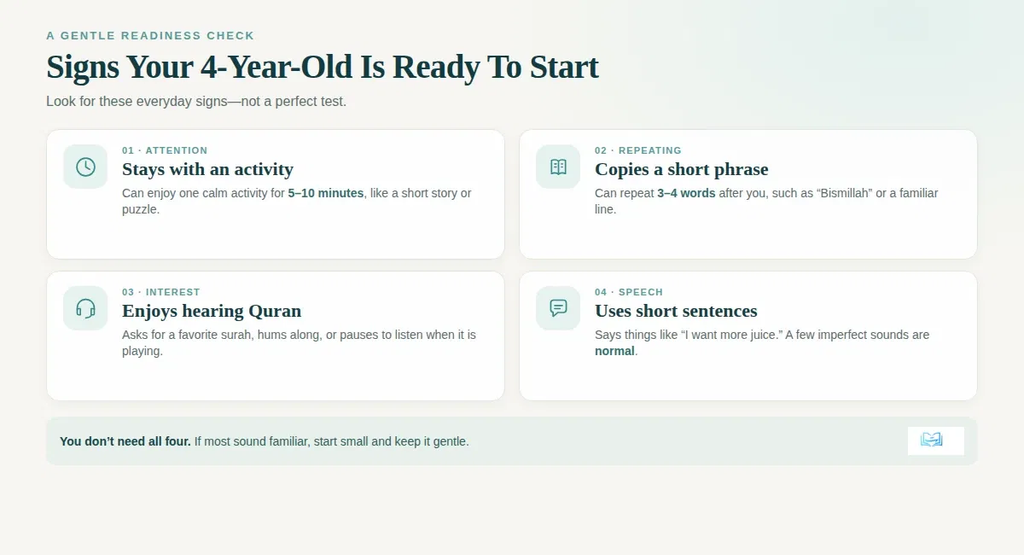
- They can sit with something for 5 to 10 minutes. Not perfectly still, just staying with one calm activity without running off. Read them a short story or do a puzzle together. If they stick with you until the end, a short Quran session won’t be a problem.
- They can repeat a short phrase after you. At four, memorizing is mostly copying, so this one’s important. Say “Bismillah” or a line from a song they like and ask them to say it back. If they get three or four words out in the right order, they’re ready to try short verses.
- They like hearing the Quran. You might catch them asking for “the Fatiha one” in the car, or humming along when it plays. Even a child who just stops what they’re doing to listen is showing you something. Kids who already enjoy the sound tend to learn with a smile, not a fight.
- They talk in short sentences. Most verses in the short surahs are only a few words long. If your child says things like “I want more juice” or “Look, a bird!”, they can manage a short verse. A few sounds might still come out wrong, and that’s completely normal at this age.
You don’t need to see all four. If most of them sound like your child, go ahead and start small. If you’re only seeing one or two, read the next part first.
What To Do If Your Child Is Not Ready Yet
Don’t worry if your child shows only one or two signs. Nothing is wrong. They just need more time to listen first. Every child grows on their own clock.
During this time, let the Quran be a normal sound in your home. Play a clear recitation of a short surah at bedtime or in the car. Recite out loud when you pray, so your child sees you doing it. Don’t ask them to repeat anything yet. Just let them hear it and enjoy it.
Watch for small changes. Your child may start to hum along. They may fill in the last word of a verse when you pause. These are good signs. One day you might hear them say “Qul huwa Allahu ahad” while playing with blocks. That’s your cue to start short sessions.
Check the four signs again every few weeks. Children change fast at this age. A child who could not sit still in spring may be ready by summer. When most of the signs show up, move on to the steps below.
Step Inside Our Virtual Classrooms
See our engaging teaching methods in action! watch real snippets of our live classes and discover how our expert instructors make learning interactive, memorable, and inspiring for every student.
Read also: How to Deal with Anxiety about Hifz
Which Surahs Should A 4-Year-Old Memorize First?
Start with Surah Al-Fatiha. Your child hears it in every prayer, and no prayer is complete without it (Sahih al-Bukhari 756).
After Al-Fatiha, move on to the shortest surahs of Juz Amma. This order works well for most young children:
- Al-Fatiha
- Al-Ikhlas
- Al-Falaq
- An-Nas
- Al-Kawthar
- Al-Asr
- Other short surahs from Juz Amma, at your child’s pace
Al-Ikhlas, Al-Falaq, and An-Nas come early because the Prophet ﷺ used to recite them before sleep (Sahih al-Bukhari 5017), and many families keep this habit with their children. Al-Kawthar and Al-Asr have only three verses each, so they give quick wins.
If you’d like a teacher to guide your child through these surahs, Tabarak Academy has a Short Surah Memorization Course that focuses on the short surahs young children learn first.
Start Your Quran Learning Journey
Join Tabark Academy today for structured online lessons with qualified tutors, customized to fit your goals.
Book Your Free Trial LessonHow To Teach A 4-Year-Old To Memorize Quran Step By Step
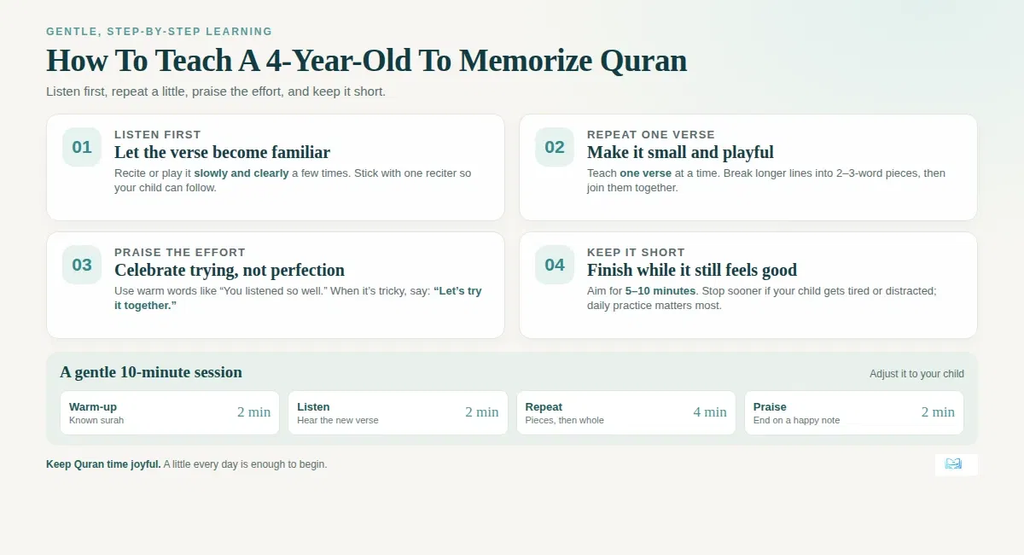
Teaching a 4-year-old works best with four simple steps. Listen first, repeat one verse at a time, praise the effort, and keep it short.
Step 1: Listen To The Verse Before Saying It
Before your child says a word, they need to hear it many times. Play the verse or recite it yourself, slowly and clearly. Do it a few times in a row. Sit face to face, so your child can watch your lips move. Young children copy what they see as well as what they hear.
Pick one reciter and stay with them. Every reciter has a different speed and tune. If your child hears Al-Fatiha in five styles, it’s harder to copy. One slow, clear voice is best. Many teachers suggest the recordings of Sheikh Mahmoud Khalil Al-Husary. His slow style was made for people who are learning.
Many Quran apps can play one verse on repeat. This is a big help. Set the app to loop the new verse. Play it quietly while your child eats a snack or colors a picture. Your child doesn’t have to say anything. The sound is just becoming known to them.
By the time you sit down for the lesson, the verse will already feel a little easy. That makes the next step much smoother.
Step 2: Repeat One Verse At A Time
Now ask your child to say the verse after you. Teach only one verse in a session. Never try a whole surah at once. One new verse is plenty for a 4-year-old.
If the verse is long, cut it into small pieces of two or three words. Surah Al-Ikhlas starts with “Qul huwa Allahu ahad.” Say “Qul huwa” and let your child repeat it. Then say “Allahu ahad.” When both parts feel easy, join them into one line. You can read more about this idea in the chunking method for Quran memorization.
Make the repeats fun. Whisper a piece, then say it a bit louder. Say it slowly, then a little faster. Changing the way you repeat keeps your child from getting bored, even when they say the same words many times.
How many times should your child repeat a verse? There’s no magic number. Some verses stick after a few tries. Others need many more. This guide on how many times to repeat a verse to memorize it explains why. Move on only when your child can say the verse without your help.
Step 3: Praise The Effort, Not Only The Result
Your words shape how your child feels about the Quran. So praise the trying, not just the perfect answer. Say “You listened so well today” or “I love how you tried that hard word.” Small comments like these tell your child that effort counts.
A sticker chart helps too. Add a star each time your child finishes a session or learns a new verse. Four-year-olds love watching their stars grow. When they finish a whole surah, make it special. Let them recite it for a grandparent on a video call, or plan a small family treat.
Your love should never depend on how much they memorize. A child who feels loved on a hard day will come back tomorrow. A child who feels they failed may not. When your child makes a mistake, a gentle “Let’s try it together” works much better than “No, that’s wrong.” Your calm voice teaches them that mistakes are part of learning.
Step 4: Keep Each Session To 5 To 10 Minutes
Short sessions work best at this age. Aim for 5 to 10 minutes a day. Stop sooner if your child starts to wiggle, yawn, or look away. It’s better to end while they still want more.
Daily practice matters more than long practice. Ten minutes every day beats one long hour on the weekend. A child remembers what they meet again and again.
Start each session with a surah your child already knows. Saying it together keeps old surahs strong. It also lets your child begin with a win, so the new verse feels less scary.
If 10 minutes feels like too much, split it. Do 5 minutes in the morning and 5 in the evening. Two small sessions are often easier for a 4-year-old than one long one.
A 10-minute session can be split into four parts. The table below shows one way to do it, and you can change it to fit your child.
| Part | What to do | Time |
| Warm-up | Say a surah your child already knows | 2 minutes |
| Listen | Hear the new verse a few times | 2 minutes |
| Repeat | Say it in small pieces, then as one line | 4 minutes |
| Praise | Add a star and end on a happy note | 2 minutes |
How To Help Your 4-Year-Old Say The Words Correctly
Your 4-year-old learns to say the Quran correctly by copying you, not by learning rules. Children who speak English at home often find letters like ع (‘ayn), ح (ha), ق (qaf), and ض (dad) hard, because English has no match for them. These simple steps help:
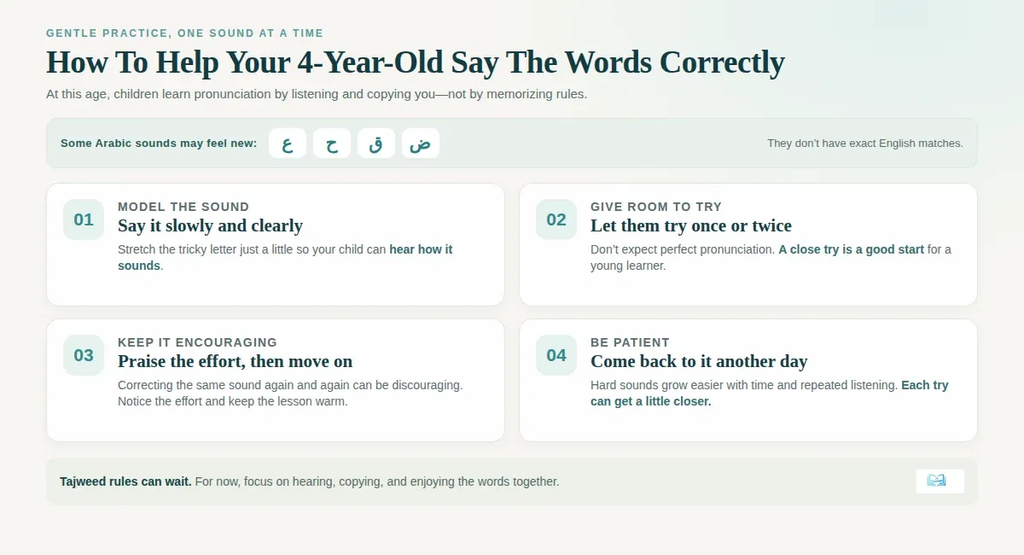
- Say the sound slowly. Stretch the hard letter a little so your child can hear it clearly.
- Let your child try once or twice. Don’t expect it to be perfect. A close try is a good start.
- Praise the try and move on. If you correct the same letter again and again in one session, most young children give up.
- Come back to it another day. Hard sounds get easier with time. Your child will slowly get closer each time they hear it.
- Leave tajweed rules for later. Rules can wait until your child can read. When that time comes, this guide on how long it takes to learn tajweed will help you plan.
What To Avoid When Teaching A 4-Year-Old Quran
Some habits can turn a young child away from Quran time. Try to avoid these:
- Testing your child in front of guests when they don’t want to.
- Comparing them with a brother, sister, or cousin.
- Holding a session on a day they’re sick, tired, or upset.
- Leaving them alone with Quran videos and calling it a lesson. A screen can’t hear their mistakes.
Quran Memorization At Age 4 Vs. Older Ages
What your child does at four is only the first stage. Learning grows as your child grows. The table below shows how the focus and method change with age.
| Age | Focus | Method |
| 3 to 4 | Listening and short surahs | Playful, no targets |
| 5 to 7 | Structured memorization | Teacher-led, with regular review |
| 8 to 10 | Reading, tajweed, and memorization | Formal lessons |
Age 7 is an important point. The Prophet ﷺ told parents to teach their children to pray at seven (Sunan Abi Dawud 495). A child who learns Al-Fatiha and a few short surahs at four will be ready to pray with confidence by then. That gives this early year a clear purpose.
Can A 4-Year-Old Learn Quran Online?
Yes, with the right setup. One-on-one classes work best at this age, because a 4-year-old needs the teacher’s full attention. Group video classes are hard for young children to follow.
Choose a quiet room with no toys or TV in sight. Check that the sound is clear, since your child learns by ear. Sit next to your child, but let the teacher lead.
Parents at Tabarak Academy have shared how this works with young children. One parent wrote that the teachers were very patient with their 4 year old daughter, and that the activities at the end of each class kept her excited for the next one. You can read more parent reviews of Tabarak Academy to see what other families say.

Experience Our Interactive Learning
Curious about how we teach? Watch these brief video clips from our recent live sessions to see our structured curriculum, advanced learning platform, and dynamic student-teacher interactions firsthand.
Start Your Quran Learning Journey
Join Tabark Academy today for structured online lessons with qualified tutors, customized to fit your goals.
Book Your Free Trial LessonBook A Free Trial Lesson For Your Child At Tabarak Academy
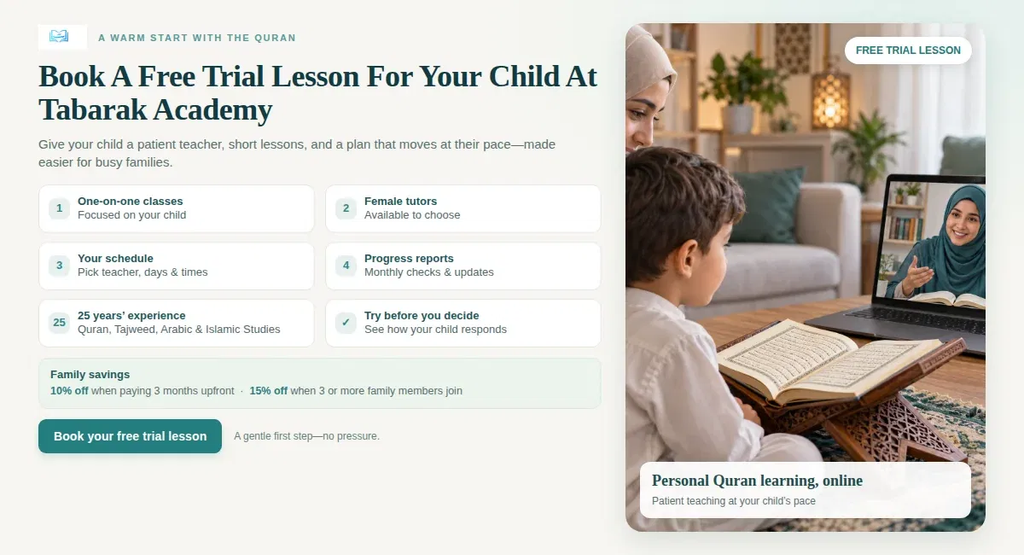
Your child’s first steps with the Quran shape how they feel about it for years. Give them a patient teacher, short lessons, and a plan that moves at their pace. Tabarak Academy makes this easy for busy families:
- One-on-one classes, so the teacher works only with your child.
- Female tutors are available.
- You pick your teacher and set the days and times that suit your family.
- Monthly progress checks and reports, so you always know how your child is doing.
- 25 years of experience teaching Quran, Tajweed, Arabic, and Islamic Studies.
- Family savings: 10% off when you pay for three months upfront, and 15% off when three or more family members join.
Try a free lesson first. See how your child responds before you decide.
Our Quran Courses
Reading your bedtime surahs on your own is a goal almost anyone can reach with the right help. At Tabarak Academy, every course is taught one-on-one online, so you learn at your own pace with a teacher who hears every word you read.
- Online Quran Classes
- Online Quran Classes for Beginners
- Online Quran Classes for Kids
- Online Quran Classes for Adults
- Online Quran Classes for Men
- Online Quran Classes for Sisters
- Quran Reading Course
Conclusion
Can a 4 year old start memorizing Quran? Yes. At four, your child can learn Al-Fatiha and short surahs by listening and repeating. Formal hifz with goals and tests can wait until they are older.
The whole plan fits into a few minutes a day. Check the signs, start with Al-Fatiha, teach one verse at a time, and end every session with a smile.
Want to begin this week? Pick one quiet time each day. Play Al-Fatiha a few times, then say the first verse together. Add a star to a chart when you finish. That’s all your first lesson needs.
Keep the mood light as the weeks go by. A happy child who knows three surahs is in a better place than a stressed child who knows ten. Your patience now protects their love for the Quran later.
The small steps you take today can last a lifetime. The Prophet ﷺ said the one who memorizes the Quran will be told on the Day of Judgment to recite and rise, and their rank will be at the last verse they recite (Sunan Abi Dawud 1464). Every short surah your child learns now is a first step on that path.
FAQs
Parents often have more questions once they start teaching their young child. Below are short answers to the ones we hear most.
Does A 4 Year Old Need To Read Arabic Before Memorizing Quran?
No, a 4 year old doesn’t need to read Arabic to memorize Quran. They learn by ear first. Reading lessons come later, when your child can focus longer.
What Should I Do If My 4 Year Old Refuses To Memorize?
If your 4 year old refuses, take a short break and look for the reason. They may be tired, bored, or need a different way of learning. Try again in a few days with listening only.
Do I Need To Know The Whole Quran To Teach My Child?
No, you don’t need to know the whole Quran to teach your child. You can teach the short surahs you know, one verse at a time. If you’d like to memorize more yourself, see this realistic hifz timeline for adults.
Can A 4 Year Old Start Memorising Quran If English Is Their First Language?
Yes, a 4 year old can start memorising Quran even if English is their first language. Young children pick up new sounds more easily than adults do. Many children grow up with two languages without any trouble.
How Many Surahs Can A 4 Year Old Memorize?
There’s no set number of surahs a 4 year old should memorize. Some children learn a handful in a year, and others learn Al-Fatiha and one or two more. Both are a good start.
What Is The Best Time Of Day For A 4 Year Old To Memorize Quran?
The best time is when your child is rested and calm, such as after breakfast or after a nap. Avoid times when they’re hungry or sleepy. Using the same time each day helps build the habit.
Is It Too Late To Start If My Child Is 7 Or Older?
No, it’s never too late to start memorizing Quran. Older children can often read, focus longer, and follow a plan. They can make steady progress from wherever they begin.
What Is The Best Age To Start Memorizing Quran?
There’s no single best age to start memorizing Quran. Many children begin short surahs at 4 or 5, and structured memorization often starts between 5 and 7. Your child’s readiness matters more than the exact number.



0 Comments