

Maybe you heard a young hafiz lead Taraweeh last Ramadan. Or maybe your child came home reciting a new surah, and something stirred in your heart. Whatever brought you here, you’re thinking about something big: carrying the whole Quran in your heart.
And right away, one question comes up. How long will it take?
How long does it take to become a hafiz? For most people, it takes 2 to 5 years. Some finish in 1 year. Others need 10 years or more, and that’s okay.
The time to become a hafiz isn’t set by how smart you are. It depends on two simple things: how much you learn each day, and how well you review what you’ve already learned.
If that range feels wide, or even a little scary, you’re not alone. Many students and parents worry they’ve started too late or won’t have enough time. But every hafiz began with a single verse, on an ordinary day, with a busy life just like yours.
Below, you’ll find honest numbers, not wishful ones, and a plan you can start this week, even if you only have 30 minutes a day.
What You’ll Learn in This Article
- How long hifz really takes, and the math behind it.
- The time it takes for full-time, part-time, working, and casual students.
- Whether a 6-month hifz is a good idea.
- The three stages of hifz and how your review time grows.
- How to split your daily time and avoid the mistakes that cost years.
The Average Time to Become a Hafiz
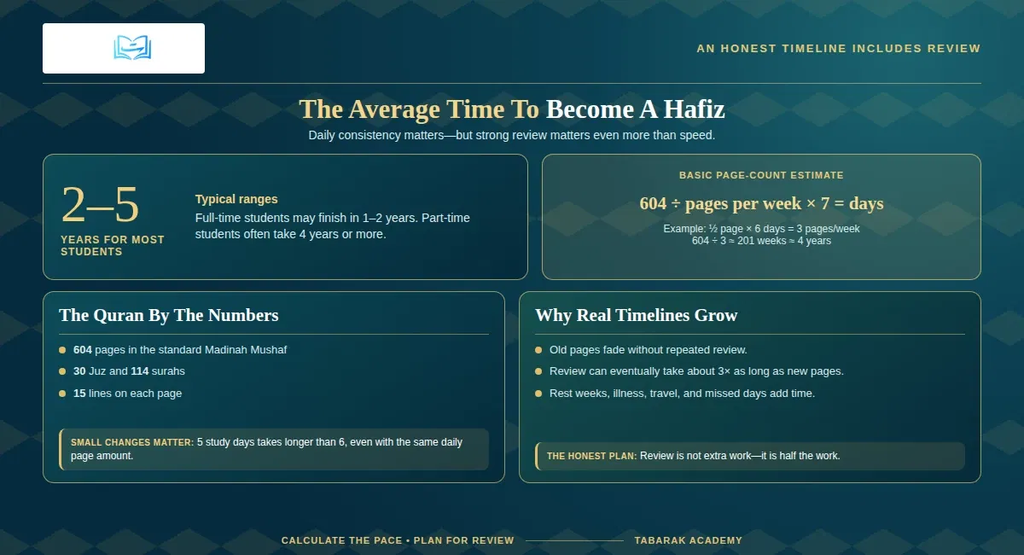
Most students become a hafiz in 2 to 5 years if they work every day. Full-time students often finish in 1 to 2 years. Part-time students often take 4 years or more. How well you review matters more than how fast you learn.
Why is the range so wide? To see why, you need two things: the basic numbers of the Quran, and the hidden time that review adds.
The Basic Numbers Behind Every Hafiz Timeline
The standard Madinah Mushaf has 604 pages. It has 30 juz and 114 surahs. Each juz is about 20 pages, and each page has 15 lines.
These numbers let you find your finish date. Here is the formula. Divide 604 by the pages you learn each week. Then multiply that by 7. That gives you the number of days.
Here’s an example. Say you learn half a page, 6 days a week. That’s 3 pages a week. 604 divided by 3 is about 201 weeks, or close to 4 years.
If you learn 5 days a week instead, it’s closer to 4.5 years. Small changes in your week make a big change in your finish date.
But this is your starting point, not your finish line. It only counts new pages. It assumes nothing will go wrong.
Real life always adds time. You’ll get sick. You’ll travel. You’ll have busy weeks at school or work. Most of all, you’ll need time to review.
Why Real Timelines Are Longer Than the Math
The formula assumes you never forget a page. But memory doesn’t work that way. A page you learned last month will fade if you don’t say it again.
Many hifz teachers see the same pattern. Review starts small, then grows until it takes about three times as long as new pages. This surprises most new students.
They plan for the new pages and forget that the old ones need care too.
So one page a day looks like 20 months on paper. In real life, it often takes 2 to 3 years. The extra time goes to review, rest weeks, and missed days.
The Prophet ﷺ warned about this in Sahih al-Bukhari 5033. He said the Quran slips away faster than a camel that breaks free from its rope.
So review is not extra work. It is half the work. Once you accept this, your plan becomes honest. And an honest plan is one you can finish.
How Your Hafiz Timeline Changes With Your Daily Schedule
The 2 to 5 year average is a helpful starting point, but your own timeline may be shorter or longer. It depends mostly on how much time you can give each day, as the table below shows.
| Student type | Daily time | Daily new memorization | Realistic timeline |
| Full-time student | 4 to 6 hours | 1 to 2 pages | 1 to 2 years |
| Part-time dedicated | 2 to 3 hours | Half a page to 1 page | 2 to 4 years |
| Working adult | 1 to 2 hours | 5 to 10 lines | 3 to 6 years |
| Child with school | 30 to 45 minutes | About 5 lines, 6 days a week | 7 to 9 years |
| Casual learner | 30 to 60 minutes | 3 to 5 lines | 6 to 10+ years |
Find the row that fits your life today. The two parts below explain what each row looks like day to day.
Full-Time and Part-Time Students
A full-time student treats hifz like a school day. Mornings go to new pages. The rest of the day goes to review with a teacher. Many finish in 1 to 2 years.
This path is fast, but it is not for everyone. Most adults can’t leave work for two years. Some young students also get worn out if the pace is too hard.
A part-time student gives 2 to 3 hours a day. Many are teens on a break year or adults with lighter jobs. At one page a day, most finish in 2 to 3 years. At half a page, plan for about 4 years.
Part-time students often keep their hifz very well. The slower pace leaves room to review each page many times.
The hard part is staying steady. Busy weeks make it easy to skip days, and skipped days add up fast. Treat your study time like a fixed meeting you can’t miss.
Working Adults, Casual Learners, and Children
Working adults often have 1 to 2 hours a day. Most learn 5 to 10 lines. At 10 lines a day, you can finish in about 3 to 4 years. At 5 lines, plan for 5 to 6 years.
Starting later in life? This guide on how to memorize Quran as an adult beginner can help you build your first routine.
Casual learners give 30 to 60 minutes a day and learn 3 to 5 lines. That pace takes 6 to 10 years or more. It’s slow, but it’s steady, and steady people finish.
Children in school often learn about 5 lines, 6 days a week. That adds up to 7 to 9 years. A child who starts at 7 often finishes around 15. That is a normal pace.
Many parents expect half that time, then feel let down in year two. The Hifz for Kids Course at Tabarak Academy sets each child’s daily amount around their real school schedule. So the goal fits the child, not the other way around.

Take A Look Inside Our Online Classes
Watch short clips from real live lessons. See how our teachers explain each step, fix mistakes kindly, and help every student enjoy learning.
Start Your Quran Learning Journey
Join Tabark Academy today for structured online lessons with qualified tutors, customized to fit your goals.
Book Your Free Trial LessonCan You Become a Hafiz in 6 Months?
Yes, you can become a hafiz in 6 months, but very few people should try. It means learning more than 3 pages every single day. That takes 4 to 6 hours of focus daily, with almost nothing else on your plate.
The biggest risk is weak memory. At that speed, there’s little time to review. Many fast students reach the last page while the first juz is already fading.
The second risk is burnout. Few people can keep that pace for six months straight.
For most serious students, 1 to 2 years is a better goal. It still takes full-time effort. But it leaves room for review, so you finish with a hifz that lasts.
The Three Stages of Becoming a Hafiz
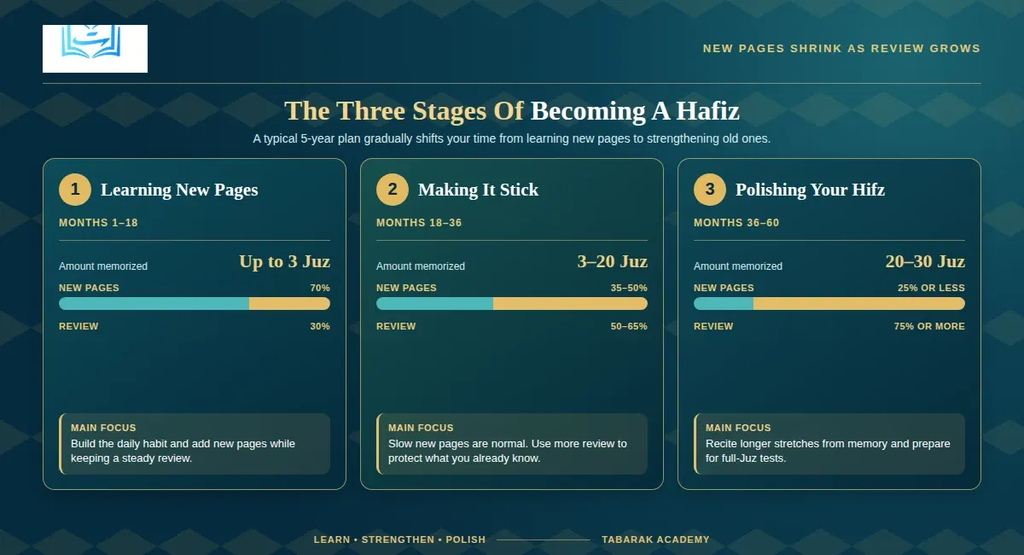
Hifz doesn’t move at one speed from start to finish. Most students pass through three stages, and review grows in each one.
The table shows how your time shifts as you learn more. The months fit a typical 5-year plan, and full-time students move through them faster.
| Stage | Amount memorized | Typical months | New pages | Review |
| 1. Learning new pages | Up to 3 juz | 1 to 18 | 70% | 30% |
| 2. Making it stick | 3 to 20 juz | 18 to 36 | 35% to 50% | 50% to 65% |
| 3. Polishing your hifz | 20 to 30 juz | 36 to 60 | 25% or less | 75% or more |
Stage 1: Learning New Pages (Months 1 to 18)
This stage is about adding new pages. Most of your time goes to new lines. Only about a third goes to review.
Many students start with Juz 30. Its surahs are short, and you may know some from prayer. This gives you quick wins early on.
Finishing your first juz feels great, and that feeling keeps you going.
Your biggest job now is building the habit. Pick the same time each day. Many students like the time after Fajr, when the house is quiet and the mind is fresh.
Sit in the same place, and use the same Mushaf every time. Your eyes will start to remember where each verse sits on the page.
Keep a simple log. Write the date and the pages you learned each day. On hard days, looking back at that list shows how far you’ve come.
Stage 2: Making It Stick (Months 18 to 36)
In this stage, review takes over. Once you pass about 3 juz, review needs half your time. Later, it needs even more. Your new pages shrink on purpose.
This is where many students feel stuck. The early speed is gone, and they think they are failing. They are not. Slower new pages here are normal and healthy.
You’ll also meet a new problem. Some verses look almost the same but sit in different surahs. Teachers call them mutashabihat, or similar verses. They cause many mix-ups.
The fix is simple. Keep a small notebook. Each time you mix up two verses, write both down side by side. Then circle the word that is different.
Read that list once a week. Over time, the mix-ups fade, and your reading becomes clean and sure.
Many students find this little notebook becomes one of their most useful tools.
Stage 3: Polishing Your Hifz (Months 36 to 60)
This is the last stage. New pages slow down or stop. Most of your time goes to long review sessions.
Your goal now is to recite a full juz in one sitting, from memory, with no big mistakes. Then you move up to two juz, and more. This builds the strength to recite long stretches with confidence.
Your teacher will test you in bigger chunks. They may pick any page and ask you to start there. This shows whether your hifz is truly strong, or only strong in order.
Many students also get ready for an ijazah in this stage. An ijazah is a license from a qualified teacher. It shows you recite the Quran correctly from memory.
Each ijazah comes with a chain of teachers that goes all the way back to the Prophet ﷺ. Not every hafiz takes one, but many do.
A Daily Hifz Plan for Your Time Budget
Every good hifz day has three parts. Sabaq is your new lesson. Sabqi is review of the last few weeks. Manzil is review of older pages in a set order.
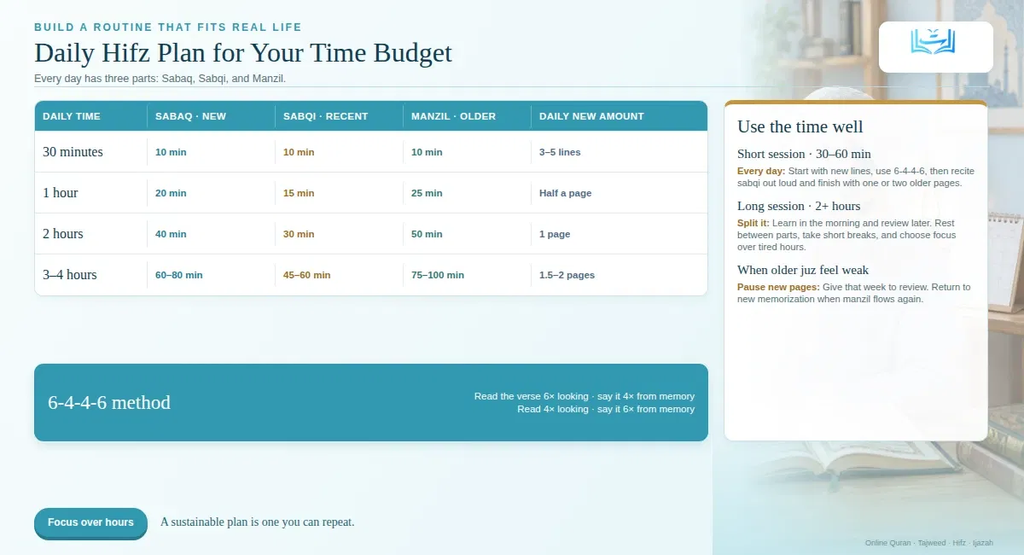
The table below shows how to split each time budget. The daily new amount matches the student types above.
| Daily time | Sabaq (new) | Sabqi (recent) | Manzil (older) | Daily new amount |
| 30 minutes | 10 minutes | 10 minutes | 10 minutes | 3 to 5 lines |
| 1 hour | 20 minutes | 15 minutes | 25 minutes | Half a page |
| 2 hours | 40 minutes | 30 minutes | 50 minutes | 1 page |
| 3 to 4 hours | 60 to 80 minutes | 45 to 60 minutes | 75 to 100 minutes | 1.5 to 2 pages |
How to Split a Short Daily Session (30 to 60 Minutes)
A short session works well when you follow the same order every day. These steps help you get the most out of every minute.
- Study every single day. With only a few lines a day, even one missed week sets you back a lot. Ten minutes every day beats an hour once a week.
- Start with your new lines while your mind is fresh. Use the 6-4-4-6 method: read a verse 6 times while looking, then say it 4 times from memory.
- Repeat the verse to lock it in. Read it 4 more times while looking, then say it 6 more times from memory. Do this for each verse before you join them together.
- Review what you learned over the past week or two. This is your sabqi. Say it out loud, not in your head, because your tongue needs practice, not just your eyes.
- Finish with your manzil. In a short session, one or two older pages is enough. Pick up each day where you stopped the day before.
How to Split a Long Daily Session (2 Hours or More)
A long session can feel heavy if you try to do it all at once. These steps help you use your time well and keep your memory fresh.
- Split your time into two parts. Learn your new page in the morning, then do your review in the late afternoon or evening.
- Rest between the two parts. Your brain keeps working on the new page while you rest. When you come back, it often feels stronger than when you left it.
- Add one full juz of manzil each day once you pass 10 juz. This way, every older page comes back within a few weeks, and no juz goes too long without being heard.
- Take short breaks when your mind starts to drift. Stand up, drink some water, and come back. Tired minutes lead to mistakes, and mistakes stick.
- Choose focus over hours. Ninety focused minutes beat three tired hours, so stop when you can’t concentrate anymore.
- Cut new pages when your older juz feel weak. Pause new memorization for a week and give that time to review instead.
What Speeds Up or Slows Down Your Hifz
Beyond your schedule, three personal things shape your timeline. Raw brain power is rarely one of them.
Your Age and Stage of Life
Children often learn quickly. Their days are simpler, and they have fewer worries pulling at them. That’s one reason many hifz schools focus on young students.
But children need more help. They need a parent or teacher to keep them on track. Many also struggle to sit still for long. Short daily lessons work best for them.
Adults may learn new lines a little more slowly. But they bring real strengths. They chose hifz for themselves, so their drive runs deep.
Many adults also understand some of what they recite. Knowing the meaning gives the words something to hold on to. A verse you understand is easier to keep.
So age changes how you study, not whether you can finish. Many adults complete hifz in their 30s, 40s, and later. They just need a routine that fits around work and family.
Your Tajweed and Reading Level
How well you read before you start makes a big difference. If you read the Quran smoothly with correct tajweed, you learn each page once.
If you still make reading mistakes, you end up learning each page twice. First you learn it with the mistake. Then you unlearn it and learn it again. The second time is harder.
That’s why many teachers ask new students to fix their reading first. If your reading is slow, plan 6 months to a year for it.
That time is not wasted. It makes every page after it faster and cleaner. Think of it as building a strong base before the walls go up.
Tajweed means the rules for saying each letter and word the right way. A few months on the basics, like where each letter comes from and when to stretch a sound, pays off for years.
Your Teacher and Class Schedule
A good teacher saves you time. They catch mistakes before those mistakes settle in. They test you in ways you can’t test yourself.
They also keep you honest on the days you’d rather skip. Knowing someone will hear you tomorrow is a strong push.
You can memorize alone, but it’s harder. Self-taught students often move slower and forget more, because no one hears the small errors.
More classes help, but only up to a point. Two classes a week are much better than one. Three are better than two.
But five classes a week rarely give a young child double the results. Memory needs rest between lessons. For most kids, three classes a week plus daily home practice works well.
The teachers at Tabarak Academy are huffaz who hold ijazah. They teach live, one-on-one, so every class is about your reading and your next step.

Mistakes That Add Years to Your Hifz
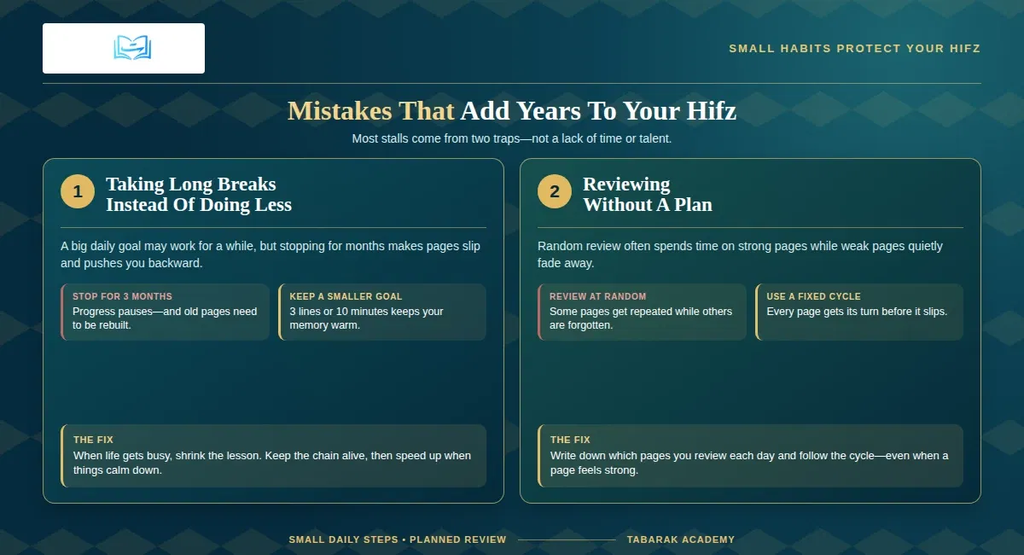
Most students who stall don’t lack time or talent. They fall into the same two traps again and again.
1. Taking Long Breaks Instead of Doing Less
Many students start with a big daily goal. They learn a full page a day for two months. Then life gets busy, and they stop for three months.
Now think of a student who learns just a quarter page every day without stopping. After one year, the steady student is far ahead. The quarter pages kept adding up while the full pages sat still.
A long break doesn’t just pause your progress. It pushes you back. Pages you knew start to slip, and you spend weeks just getting back.
So when life gets busy, don’t stop. Make your goal smaller instead. Do 3 lines instead of a page. Do 10 minutes instead of an hour.
Keep the chain alive, even if it’s thin. A small daily step keeps your memory warm. And it makes it easy to speed up again when things calm down.
2. Reviewing Without a Plan
Imagine you have 200 pages memorized. You sit down to review, but you don’t know where to start. So you pick pages at random.
You spend an hour on pages that were already strong. The pages that were about to slip get no time at all. A few weeks later, they’re gone.
This is one of the top reasons students give up. They feel they forget faster than they learn. But the problem was never their memory. It was the lack of a plan.
The fix is a fixed review cycle. Decide which pages you’ll review each day, and write the list down. Follow it, even when a page feels strong.
That way, every page gets its turn. If you study without a teacher for now, this guide on how to revise Quran without a teacher shows you how to build that cycle step by step.
How to Pick a Pace You Can Keep
Most students ask, “How fast can I finish?” A better question is, “How much can I learn every day for five years without stopping?”
Call this the Sustainable Dose Rule. Pick the amount you can keep in your busiest week, not your best week. Then let your finish date come from that number.
A small amount you never drop will finish the Quran. A big amount you can’t keep will not, no matter how gifted you are.
Check your progress once a month with these five signs:
- You can recite last month’s pages without mistakes.
- You haven’t missed more than three days in a row.
- You know your daily amount without thinking, because it stays the same.
- You often catch your own mistakes before your teacher does.
- Your review time grows as your memorized pages grow.
If two or more signs are missing, don’t push harder. Make your daily amount smaller or fix your review cycle. To check yourself between classes, try these ways to test your own hifz.
What Happens In A Tabarak Academy Class?
Watch short videos from real lessons with real students. You’ll see how our teachers guide, correct, and encourage learners of every age
Start Your Quran Learning Journey
Join Tabark Academy today for structured online lessons with qualified tutors, customized to fit your goals.
Book Your Free Trial LessonStart Your Hifz With Tabarak Academy Today
You don’t have to plan your daily amount, review, and tajweed on your own. At Tabarak Academy, you get a clear plan and a teacher who guides every step. Here’s what you get:
- Every hifz teacher is a hafiz who holds an ijazah.
- Classes are live and one-on-one, so each lesson is all about you or your child.
- Your teacher sets your daily amount based on your level, age, and schedule.
- Every class includes review of recent and older pages, so you keep what you learn.
- Monthly progress checks show where your hifz stands and what to work on next.
- There are hifz courses for kids, adults, and sisters, plus a path to the Hifz Ijazah.
- You learn from home, with no travel and no traffic.
Try it before you pay anything. Book a free trial lesson, meet your teacher, and get a timeline made just for you.

Our Quran Courses
Explore Tabarak Academy’s online Quran courses, taught live and one-on-one by qualified teachers for kids and adults.
- Online Quran Classes
- Online Quran Classes for Beginners
- Online Quran Classes for Kids
- Online Quran Classes for Adults
- Online Quran Classes for Men
- Online Quran Classes for Sisters
- Quran Reading Course
- Quran Recitation Course
Conclusion
So, how long does it take to become a hafiz? For most people, 2 to 5 years. Full-time students can finish in 1 to 2 years. Working adults often need 3 to 6.
Children in school and casual learners may take 7 years or more. Each of these is a normal pace. None of them is a failure.
The math gives you a starting point, not the full story. Review decides your real time to become a hafiz. As your hifz grows, review takes more of your day, and that’s how it should be.
The best plan is the one you can keep. Choose an amount that fits your busiest week. Split your time between sabaq, sabqi, and manzil. And never let a busy month turn into a long break.
Remember why you started. Allah says He made the Quran easy to remember in Surah Al-Qamar 54:17. The Prophet ﷺ said the best of you learn the Quran and teach it, in Sahih al-Bukhari 5027.
Think about the reward at the end. In Jami’ at-Tirmidhi 2914, the Prophet ﷺ said the companion of the Quran will be told to recite and rise. His rank will be at the last verse he recites.
Every line you learn today brings you closer to that moment. So don’t wait for the perfect time. Pick your daily amount, open your Mushaf, and start today.
FAQs
Many students have the same questions when they plan their hifz. Here are clear answers to the ones we hear most.
How Many Pages a Day Do I Need to Finish in One Year?
You need about 1.7 new pages every day to finish in one year. Most students aim for 2 pages a day, 6 days a week, to leave room for review days.
How Long Does It Take to Memorize One Juz?
One juz is about 20 pages, so it takes 3 to 4 weeks at one page a day. At half a page a day, plan for 6 to 8 weeks, including review.
How Young Can a Child Start Memorizing the Quran?
A child can start learning short surahs as early as 4 or 5. Most formal hifz starts between 7 and 10, when children can read Arabic and sit for longer lessons.
Can I Become a Hafiz Without Speaking Arabic?
Yes, you can become a hafiz without speaking Arabic. Many huffaz around the world don’t speak it, but they read the Arabic letters correctly with tajweed.
Is There a Set Time Limit for Hifz in Islam?
No, Islam sets no time limit for memorizing the Quran. Scholars say each person learns as much as they can, and only Surah Al-Fatiha is required for prayer.
Which Juz Should I Memorize First?
Most students begin with Juz 30, but you have other options. Some start with Surah Al-Baqarah, the longest surah, so the rest feels easier after it.
Can I Memorize the Quran Online?
Yes, you can memorize the whole Quran online with a qualified teacher. In a live class, your teacher hears every verse and fixes mistakes right away.
What Should I Do If I Forget Pages I Already Memorized?
Forgetting some pages is normal, and you can win them back. See how long it takes to re-memorize a juz to plan your comeback.
How Do I Keep My Hifz After I Finish?
You keep your hifz by reviewing the whole Quran on a set cycle for life. Many huffaz also recite in their night prayers, which keeps the pages fresh.



0 Comments