
Thousands of Muslim parents want to teach Quran to an autistic child but feel unsure where to start, what method works, or how long to push through a session. That uncertainty is valid, but it does not mean progress is impossible. Autistic children process information differently, not deficiently, and the Quran’s rhythmic, repetitive structure can actually align well with how many of them learn.
This article gives you a step-by-step, evidence-based plan built from specialized research and applied teaching experience. Every method here has a documented reason behind it, no theory without a practical application.
1. Assess the Child’s Sensory Profile Before Starting Any Lesson
Before you open a Mushaf or play any audio, you need to understand exactly how the child responds to sound, light, space, and human proximity. Many autistic children have heightened sensitivity to loud voices, which means a teacher reciting loudly can cause distress rather than engagement.
Observe and note the child’s reactions during normal daily activities:
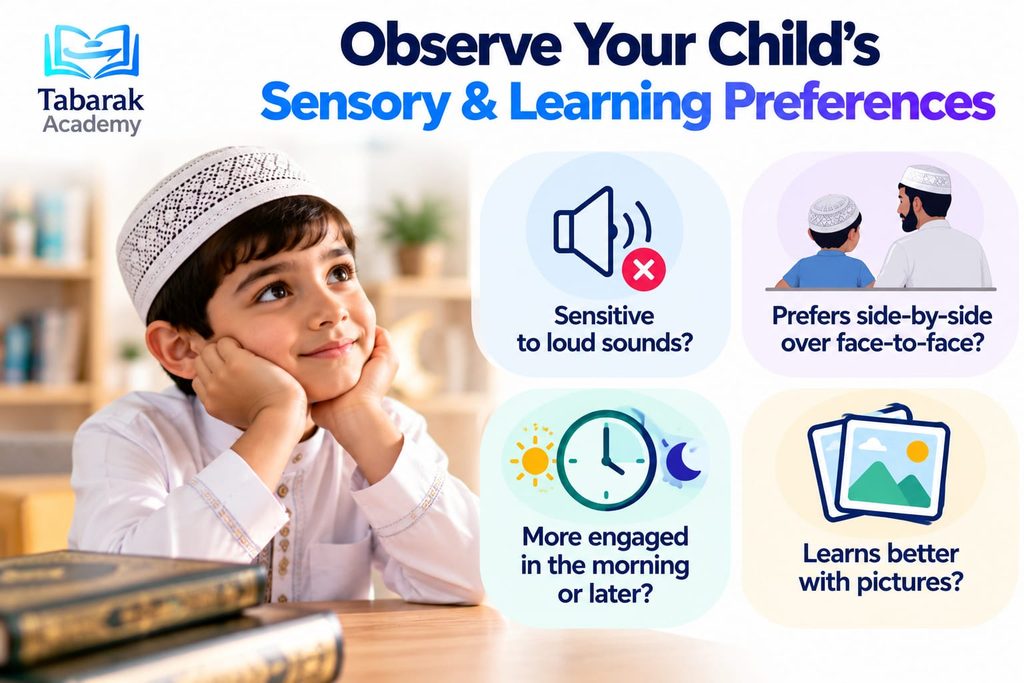
- Does the child cover ears in response to sudden or high-pitched sounds?
- Does the child tolerate sitting face-to-face comfortably or prefer a side-by-side position?
- Does the child engage more during morning hours or later in the day?
- Does the child show a preference for visual information such as pictures and cards over spoken instructions?
This profile shapes every decision that follows, from session timing to the teacher’s voice volume to the room setup. Without it, even the best teaching method will underperform.
2. Build the Right Physical Environment Before the First Session
The physical environment directly controls how much of the child’s cognitive capacity is available for learning. Autistic children process sensory input at a heightened level, meaning a cluttered or noisy room is not merely distracting but actively draining.
The table below compares a high-distraction setup with an autism-friendly learning space:
The learning space should meet these conditions before any session begins:
| Feature | High-Distraction Setup | Autism-Friendly Setup |
| Lighting | Bright fluorescent, flickering | Soft, steady, natural or warm |
| Sound | TV or music nearby | Silent room, no background noise |
| Seating | Child facing teacher directly | Child seated side-by-side with teacher |
| Decor | Multiple posters and objects | Minimal visuals, one dedicated Quran corner |
| Scent | Air fresheners or strong odors | Neutral, familiar scent |
Side-by-side seating deserves specific attention. When the teacher sits beside the child rather than across from them, the child feels guided rather than watched or evaluated. This removes the social pressure of direct eye contact, which is a documented stressor for many children on the spectrum.
Tabarak Academy’s Online Quran Classes For Kids removes the physical environment problem entirely by delivering one-on-one sessions from the child’s own familiar home space, where parents control every sensory variable.
3. Use Audio-First Learning Before Introducing Any Text or Reading
The first stage of teaching Quran to an autistic child is pure listening. No Mushaf, no Arabic letters, no repetition prompts. Play clear, calm Quran audio daily for three to five minutes during a relaxed moment in the child’s routine, such as after breakfast or before sleep.
This approach works because the Quran’s rhythmic and melodic recitation pattern mirrors how autistic children often develop pattern recognition.
The child begins associating specific sound sequences with comfort and familiarity before any formal instruction begins. Research on murotal Quran training with autistic children at a special needs school in Indonesia found that consistent exposure to Quran recitation improved attention span and reduced sensory reactivity over time.
Choose a reciter with a slow, clear, and calm voice. Avoid fast-paced recitations in the early stage. Sheikh Mahmoud Khalil al-Husary’s murattal recitation is widely recommended for its measured, clear pronunciation. Play the same surah repeatedly across multiple days.
Familiarity with one surah before moving to the next prevents cognitive overload and builds genuine recognition.
Experience Our Interactive Learning
Curious about how we teach? Watch these brief video clips from our recent live sessions to see our structured curriculum, advanced learning platform, and dynamic student-teacher interactions firsthand.
Start Your Quran Learning Journey
Join Tabark Academy today for structured online lessons with qualified tutors, customized to fit your goals.
Book Your Free Trial Lesson4. Introduce Arabic Letters Through the Noorani Qaida With Visual Flashcards
Once the child recognizes the sound patterns of short surahs, the next step in how to teach Quran to an autistic child is letter identification through a structured phonics method.
The Noorani Qaida is the most appropriate foundation tool for this stage because it uses a phonics-first approach, where children produce sounds before memorizing letter names, and it introduces letters in small, controlled groups.
For autistic learners, pair each letter of the Noorani Qaida with a physical flashcard showing only that letter in large, clear font on a plain background. Introduce a maximum of two to three letters per session.
Research published through Universitas Muhammadiyah Gresik confirmed that flashcard-based letter recognition significantly improved letter identification ability in children with autism spectrum disorder compared to conventional text-only methods.
The teaching sequence for each letter should follow this order:
- Show the flashcard and say the letter sound once in a calm, clear voice.
- Wait for the child to look at the card before repeating.
- Have the child point to the card, not necessarily say the sound immediately.
- Introduce imitation of the sound only after the child shows comfort with the visual.
- Review all previously learned letters at the start of every new session before introducing anything new.
Do not rush to connect letters into words until the child reads each individual letter correctly without hesitation. Speed is not the goal at this stage.
Read more: How to Teach Quran to a Child Who Refuses to Sit.
5. Apply the Mauro Method to Begin Surah Memorization
The Mauro method is a structured Quran memorization system that combines three simultaneous inputs: listening to the verse, seeing the written text, and repeating.
A peer-reviewed study published in the journal Ta’dib in 2024 tested the Mauro method on autistic children over 14 sessions and found measurable improvement in their ability to read and retain short surahs.
The study used a Single Subject Research design and confirmed the method’s effectiveness specifically for children with autism spectrum disorder.
The practical application of the Mauro method for an autistic child works as follows:
- Play the audio of one verse, such as Ayah 1 of Surah Al-Ikhlas, while the child looks at the written text or a large-print card of that verse.
- Immediately after the audio ends, repeat it. Do not ask the child to recite yet.
- After three to five listens, softly model the recitation yourself while the child looks at the card.
- Invite, never demand, the child to join. Accept any sound approximation as a valid response.
- Repeat the same verse at the start of every session for a minimum of five days before moving forward.
Begin with Surah Al-Ikhlas, Surah Al-Falaq, and Surah An-Nas. These three surahs have short, rhythmically distinct ayat that are among the easiest to retain for any beginner, including autistic learners.
Tabarak Academy’s Noorani Qaida Course For Kids covers foundational letter recognition through recitation using certified tutors who are trained in working with children at different ability levels. Noorani Qaida Course For Kids at Tabarak Academy
Start your Quran journey today.
6. Structure Every Session With a Fixed, Visual Daily Schedule
Autistic children thrive on predictability. A session that starts, unfolds, and ends the same way every day removes the anxiety of the unknown and allows the child to direct full cognitive energy toward the Quran itself rather than toward figuring out what comes next.
The table below shows a sample 15-minute daily session structure:
| Time | Activity |
| 0-2 minutes | Listening to familiar surah audio (no interaction required) |
| 2-6 minutes | Noorani Qaida letter review with flashcards |
| 6-11 minutes | Mauro method repetition of current target verse |
| 11-14 minutes | Child’s free response or quiet listening |
| 14-15 minutes | Closing: same closing phrase every session (“Well done, Quran time is done”) |
Use a visual schedule card, a printed strip of pictures or icons showing each step, and place it at eye level in the child’s learning space.
Before each session begins, point to the strip from left to right so the child knows exactly what will happen. This visual preview reduces resistance and transition anxiety significantly.
Never extend a session because the child seems to be doing well. End on time. A child who ends Quran time feeling calm and successful builds a positive association with it, while a child pushed past their threshold ends it with distress.
7. Use a Consistent Positive Reinforcement System Tied to Session Completion
Positive reinforcement for autistic children must be immediate, predictable, and personally meaningful. Generic praise such as “good job” is often insufficient for sustained motivation.
The reward system must be built around what the specific child values, whether that is a sticker on a chart, five minutes of a preferred activity, a small toy token, or simply hearing a specific celebratory phrase.
Design the reward system before the first session and maintain it consistently:
- Reward session completion, not perfect performance.
- Use a visual progress chart showing each completed session as a filled square or a sticker.
- Celebrate milestones such as completing five sessions, recognizing all letters in a surah, or repeating a full verse after audio.
- Never withhold the reward for imperfect recitation. Autistic children’s motivation collapses faster than neurotypical children when rewards become conditional on accuracy.
Research into reward-based Quran memorization methods with special needs students confirmed that consistent reward application improved both motivation and retention. The reward teaches the child that showing up and engaging, regardless of output quality, is the valued behavior.
Tabarak Academy’s Hifz For Kids Course includes structured session-by-session progress tracking with certified tutors who apply developmentally appropriate feedback and encouragement for every learner. Hifz For Kids Course at Tabarak Academy
Begin your Quran journey today.
8. Involve Prophet Stories to Reinforce Quranic Content Through Narrative
Many autistic children who struggle with abstract instruction respond powerfully to concrete narrative. Prophet stories from the Quran provide a context-rich format that anchors Quranic content to sequenced events, which is a cognitive strength in many children on the spectrum.
When the child is studying a surah that relates to a prophet or event, introduce the story through illustrated cards or a simple picture sequence before or after the recitation session.
For example, when working on Surah Al-Fil, show four or five picture cards showing elephants, birds, and stones in sequential order.
This visual narrative activates the child’s pattern memory and connects the surah sounds to meaningful content. Keep the story presentation brief, two to three minutes maximum, and use simple language with no complex vocabulary.
Never present a story and a new recitation challenge in the same session. Separate them across two consecutive sessions to prevent overload.
Step Inside Our Virtual Classrooms
See our engaging teaching methods in action! watch real snippets of our live classes and discover how our expert instructors make learning interactive, memorable, and inspiring for every student.
Start Your Quran Learning Journey
Join Tabark Academy today for structured online lessons with qualified tutors, customized to fit your goals.
Book Your Free Trial Lesson9. Track Progress With a Weekly Log and Adjust the Plan Monthly
Progress for autistic children in Quran learning is not linear. Some weeks will show no visible advance, and others will produce unexpected retention. Parents and teachers who do not track weekly often misread plateaus as failure and make premature changes that disrupt the child’s routine.
Maintain a simple weekly log that records:
- Date and duration of each session.
- Child’s mood and sensory state at the start of each session.
- Specific letter, verse, or surah covered.
- Child’s response level: active participation, passive listening, or refusal.
- Any environmental changes that affected the session positively or negatively.
Review the log at the end of each month. Look for patterns: which session times produce the calmest engagement, which surahs showed the fastest recognition, and which environmental factors correlated with the best sessions. Adjust the plan based on actual evidence from the log, not based on comparison with other children or external timelines.
Read more: How Many Verses Should a Child Memorize Per Day.
Join Tabarak Academy and Learn with Confidence
At Tabarak Academy, certified native Arab tutors deliver one-on-one live Quran and Arabic sessions tailored precisely to each child’s pace, ability level, and sensory needs.
Every session is conducted in a structured, calm format with real-time recitation correction, flexible scheduling across all global time zones, and dedicated programs for children at every stage from Noorani Qaida foundations through to Hifz. A free trial class is available with no commitment required.
Our Quran Courses
- Online Quran Classes For Kids
- Noorani Qaida Course For Kids
- Hifz For Kids Course
- Weekend Quran Classes
- Quran for Toddlers / Young Children
- Online Qirat Course

Conclusion
Learning how to teach Quran to an autistic child begins with understanding the child’s sensory world before opening any book. Structure, repetition, and calm consistency are the real teachers.
When parents apply these methods with patience and track real progress over time, the Quran becomes not a source of pressure but a source of peace and connection for their child.
FAQ
Can an autistic child actually memorize the Quran?
Yes. Research confirms autistic children can memorize Quran using structured methods like the Mauro method, which combines listening, seeing, and repeating in controlled sessions.
How long should a Quran session be for an autistic child?
Sessions of 10 to 15 minutes during the child’s calmest daily window are significantly more effective than longer forced sessions.
What is the best way to teach Quran to an autistic child who is non-verbal?
Focus entirely on audio exposure and listening. Accept any form of engagement, humming, rocking, or sound approximation, as valid progress before requiring any verbal output.
Should Tajweed rules be taught at the beginning?
No. Explaining Tajweed rules verbally overloads most autistic learners. Correct pronunciation is absorbed naturally through repeated modeled listening first.
How do I know when to move from one surah to the next?
Move forward only when the child recognizes the entire surah’s audio without prompting. Recognition precedes recitation, and recitation precedes memorization.
What should I do when the child refuses the session?
Never force engagement. Note the time, environment, and sensory state in the log and identify what triggered the refusal. Adjust accordingly before the next session.
Which surah should be taught first to an autistic child?
Surah Al-Ikhlas is the most recommended starting point due to its short length, rhythmic clarity, and distinct sound pattern that autistic children recognize quickly.

0 Comments