

Yes. You can memorize the Quran at 50, and you are far from alone in wanting to.
Maybe this wish has stayed with you for years. You hear a young hafiz recite in Taraweeh. A grandchild comes home with a new surah. And a quiet voice inside asks, “Is it too late for me?”
It is not too late. Allah made the Quran easy to remember, and He did not put an age limit on that gift.
Many people begin Hifz in their fifties and sixties. They have busy weeks, tired evenings, and memories that need a little more patience. They also have focus, steady habits, and a deep love for the words they are learning, and those count for more than you might think.
Every hafiz started with a single verse. Yours can start today, with a few lines and a sincere heart. Begin small, stay steady, and you may be surprised how far you go.
What You Will Learn
- Whether it is allowed to memorize the Quran at 50.
- How your memory works after 50.
- A simple plan for your first 90 days.
- How to review so you do not forget.
- Why a teacher matters.
- How long it takes.
- How to protect your energy.
Can You Memorize The Quran At 50? What Islam Says
Yes, you can memorize the Quran at 50. Hifz means learning the Quran by heart and reading it correctly, and Islam sets no age limit for it. So if you are asking, “Can I memorize Quran at 50?”, what changes is how you learn, not your chance to succeed.
Two worries usually hold older learners back: whether it is too late to start, and whether a slow pace still counts. The Quran, the Sunnah, and the lives of the companions answer both.

Why Islam Rewards You For Starting Hifz At 50
If you have ever wondered whether it is allowed to memorize the Quran at 50, the Quran and Sunnah go much further than allowing it. They honor anyone who comes to the Quran, at any age.
Allah says He made the Quran easy to remember, then asks if anyone will take that chance (Surah Al-Qamar 54:17). This invitation has no age written on it.
The Prophet ﷺ said the best of people are those who learn the Quran and teach it (Sahih al-Bukhari 5027). At 50, you may have children or grandchildren close by. Each surah you learn is one you can teach them, so you become a learner and a teacher at once.
There is special good news for older learners. The Prophet ﷺ said that a person who reads the Quran with trouble, and stumbles on the words, gets two rewards (Sahih Muslim 798).
So if the words feel heavy on your tongue, do not feel shame. That struggle is not a sign that you started too late. It is the very thing that doubles your reward.
Why Memorizing Slowly After 50 Is Nothing To Be Ashamed Of
Starting is one worry. The other is speed: “What if it takes me years?” If it does, you are in very good company.
The best people of this Ummah did not rush. Imam Malik reported that Abdullah ibn Umar spent eight years learning Surah Al-Baqarah (Muwatta Malik, Book 15, No. 12). That is eight years for one surah.
Why so long? The companions learned a few verses at a time and lived by them before moving on. Each verse had to settle in the heart and show in their actions first.
Abdullah ibn Umar was one of the most learned companions, and people came to him for knowledge for many years. If a man like him gave one surah eight years, there is no shame in your pace.
So be gentle with yourself. Do not judge your Hifz by how many pages you finish in a month. Judge it by how well you know each verse, and whether you can read it with care. That is the kind of progress the companions valued most.
How Your Memory Works When Memorizing The Quran After 50
Your memory after 50 is not broken. It just works in a new way. Here is what changes, and how to repeat verses so they last.
What Changes In Your Memory After 50
At 50, you may notice that new words slip away faster. This is normal, because new sounds need more repeats than they did when you were young.
But some things get better with age. You understand meaning more deeply, you link ideas more easily, and you bring patience that many young people do not have yet.
Think of it like carving words into stone. It takes more strokes than writing in sand, but once the words are carved, they stay for a long time.
So your plan must lean on repeats. You will repeat more and add new verses more slowly, and that is the right method for your stage of life.
Your life experience helps too. When you feel what a verse means, it becomes easier to recall.
Sleep plays a part as well. Your brain sorts and stores what you learned while you sleep, so a good night of rest makes the next day’s review much easier.
What Happens In A Tabarak Academy Class?
Watch short videos from real lessons with real students. You’ll see how our teachers guide, correct, and encourage learners of every age
Start Your Quran Learning Journey
Join Tabark Academy today for structured online lessons with qualified tutors, customized to fit your goals.
Book Your Free Trial LessonHow To Repeat A Verse So It Stays
Older learners remember verses best when they hear, see, say, and write them. Follow these five steps for each new verse:
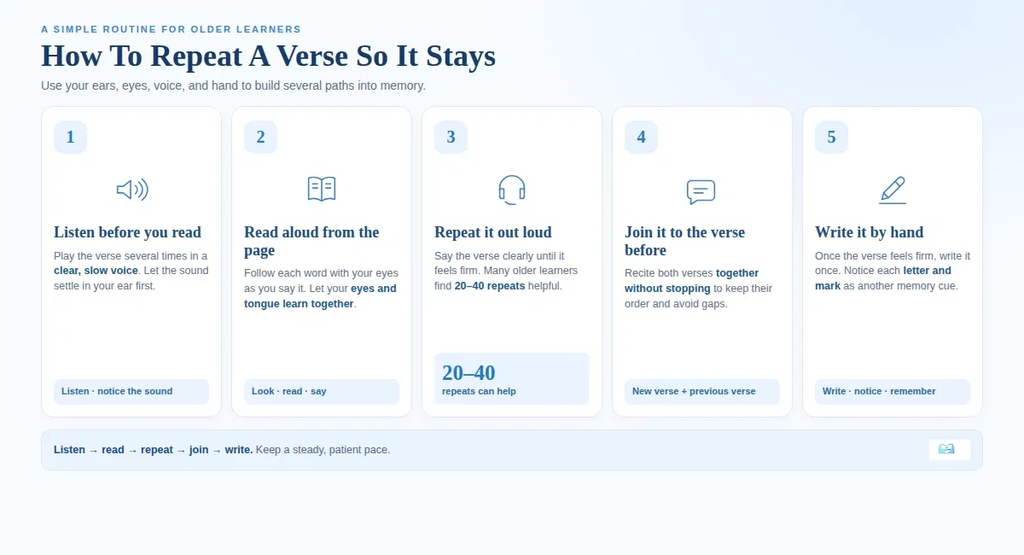
- Listen before you read. Play the verse many times in a clear, slow voice, like that of Sheikh Al-Husary or Sheikh Al-Minshawi. This puts the right sound in your ear before you try to say it.
- Read the verse out loud while looking at the page. Follow each word with your eyes as you say it, so your eyes and your tongue learn the verse together.
- Repeat the verse out loud until it stays. Many older learners need 20 to 40 repeats. Say it in a clear voice, not in your head, so you hear, see, and say the verse at once.
- Join the new verse to the one before it. Recite both together without stopping. This keeps the verses in the right order and helps you avoid gaps.
- Write the verse by hand once it feels firm. Writing makes you notice each letter and mark, which gives your memory one more path back to the verse.
Learn more in our guides on how many times to repeat a verse to memorize it and the chunking method for Quran memorization.
Your First 90 Days Of Hifz
Most adults who quit do so in the first few weeks because they start too big. The plan below starts small and grows only when you are ready.
How Many Lines To Learn Each Day
Start with only 2 to 3 lines a day. A page in the common Madinah Mushaf has 15 lines, so this is less than a quarter of a page.
The Prophet ﷺ said the deeds Allah loves most are the ones done often, even if they are small (Sahih al-Bukhari 6464). Three lines each day are worth more than one page once a week.
Why count lines and not verses? Verses are not the same size. Some are only a few words, while one verse in Surah Al-Baqarah fills almost a whole page. Counting lines keeps your daily load steady.
Later, many learners settle at 5 to 7 lines a day, which is about half a page. Treat that as your top limit, not your starting point.
Your 90-Day Hifz Plan, Month By Month
The plan below covers your first three months. It starts with the shortest surahs at the end of the Quran and moves backward through Juz Amma.
| Month | Daily new lines | What you memorize | Goal by the end of the month |
| Month 1 | 2 lines | Al-Fil to An-Nas (the last 10 surahs) | Recite all 10 surahs from memory |
| Month 2 | 3 lines | Al-Humazah back to Al-Alaq | Join months 1 and 2 without mistakes |
| Month 3 | 3 lines (4 only if revision is smooth) | At-Tin back to Al-Balad | Recite from Al-Balad to An-Nas |
Each week, follow a simple rhythm. Learn new lines on 5 days. Use 1 day for revision only, with no new lines. Keep 1 day light, and recite what you know in your prayers.
If you already know some of these surahs, use that month to make them perfect with a teacher, then move ahead.
By day 90, you will carry about 25 surahs, from Al-Balad to An-Nas. That is roughly half of Juz Amma.
What To Memorize After Your First 90 Days
After 90 days, keep moving step by step. Each stage is a full goal on its own:
- The rest of Juz Amma, from An-Naba to Al-Fajr.
- Longer surahs you love, like Al-Mulk, Al-Kahf, or Yasin.
- The full Quran, one juz at a time, if your time allows.
Use the same printed Mushaf every time you learn. Your eyes will start to remember where each verse sits on the page, which gives you one more way to recall it.
Want a teacher to build this plan with you? Tabarak Academy’s Hifz for Adults Course sets your daily lines to what you can keep, in private lessons at your pace.

The Revision Rule For Quran Memorization After 50
Revision, called Muraja’ah in Arabic, means going back over what you already learned. It decides whether your Hifz lasts.
Why Revision Matters More Than New Lines
The Prophet ﷺ told us to keep reciting the Quran, because it slips from memory faster than camels escape their ropes (Sahih al-Bukhari 5033). This advice is for every age, but it matters most for older learners, whose new verses fade faster without review.
Most forgetting is not a memory problem. It is a revision problem. People add new lines on top of weak lines, and soon everything feels shaky.
So follow one simple rule: spend about twice as much time on revision as on new lines. If you spend 10 minutes learning, spend 20 minutes reviewing.
Watch for signs that your revision is slipping. You pause in the middle of a surah. You mix up mutashabihat, the verses that look alike. You need to glance at the page to keep going. When you see these signs, stop new lines for a few days and fix the old parts first. Then start again slowly.
A Simple Three-Level Revision System For Older Learners
Hifz teachers have long used a simple system to stop verses from fading. It splits your work into three levels, so new verses get daily attention and older ones still get their turn. Each level has an Arabic name you may hear from your teacher.
- New lesson (Sabaq): the lines you memorize today.
- Recent review (Sabqi): what you learned in the past week or month, reviewed every day.
- Older review (Manzil): all your older surahs, reviewed in turns so each one is recited at least once a month.
This system works because of spaced repetition, which means reviewing each part just before you would forget it.
Here is a simple example. Say you know 12 older surahs. Review 2 of them each day from Saturday to Thursday, then recite all 12 on Friday. Mark each one on a sheet so nothing is left behind.
Your prayers can carry much of this work. Recite your older surahs in your Sunnah prayers and your recent lines in your daily prayers. This turns revision into worship, not a chore.
Why You Need A Quran Teacher After 50
A Quran teacher is a trained reciter who listens to you, fixes your mistakes, and keeps your plan on track. Learning alone is possible, but it is much harder.
How A Teacher Fixes Your Tajweed Mistakes
Tajweed means reading each letter of the Quran the right way. It covers how each sound is made, how long to stretch a letter, and when to read through the nose.
Most people cannot hear their own mistakes. You may cut a long sound short or read a heavy letter as a light one, and never notice. A trained teacher will.
This matters even more when you memorize. Each time you repeat a verse the wrong way, the mistake grows stronger, and after a year it can take months to fix. A teacher catches it on the first day.
Some sounds need extra care. Letters like ‘ayn, ha, and qaf do not exist in many languages, and your mouth has spent 50 years making other sounds. In a live lesson, your teacher hears you in real time and helps you fix each sound before it sets in your memory.
If you are new to Tajweed, read our guide on how long it takes to learn Tajweed.
How A Teacher Keeps You Going On Hard Days
Some days you will feel tired, busy, or low. These are the days when most people stop.
A teacher changes this. When someone expects to hear your lines, you show up and prepare, even on hard days.
A teacher also sees your progress when you cannot see it yourself. You may feel stuck, but your teacher knows how far you have come, and that reminder can carry you through a hard month.
Be open with your teacher about your work hours, your health, and your family duties. A good teacher will lower your daily lines in heavy weeks and add more when you are doing well. This kind of support is hard to get from an app or a book, and for many adults it is the reason they finish.
Want to hear from people who started late and kept going? Read what real students say about Tabarak Academy in our verified student reviews.

How Long Does It Take To Memorize The Quran At 50?
The time depends on your daily lines and how much you review. The full Quran is about 9,000 lines across 604 pages.
The table below gives simple estimates for each goal. They leave room for revision and busy weeks.
| Goal | Daily new lines | Expected time |
| Last 10 surahs | 2 to 3 lines | About 2 to 3 months |
| Juz Amma | 2 to 3 lines | About 6 to 12 months |
| Full Quran | 3 to 7 lines | About 4 to 8 years |
If you start at 50, you may finish the full Quran in your mid or late 50s. For more detail, read our guide on a realistic Hifz timeline for adults.
How To Protect Your Health And Energy During Hifz
A good plan at 50 works with your body, not against it.
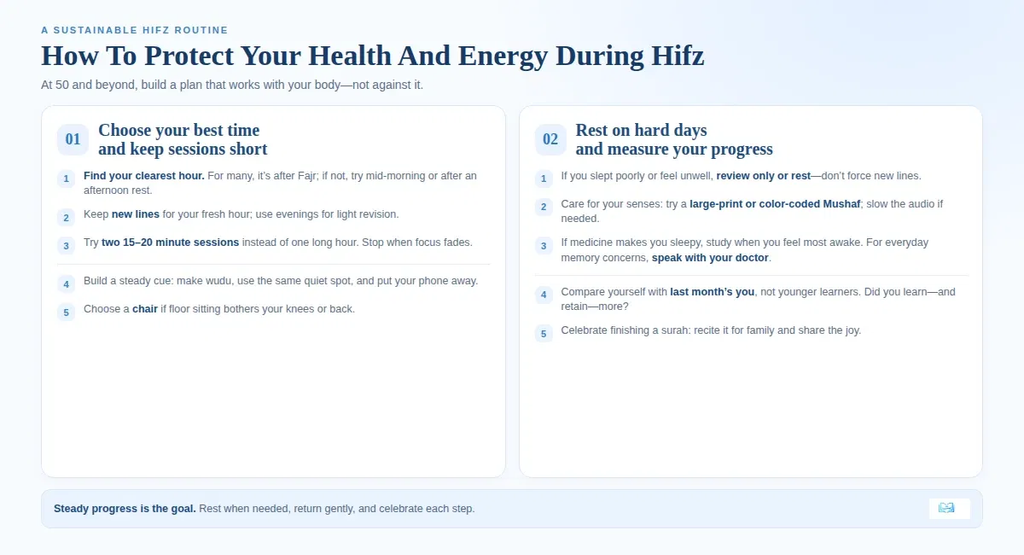
1. Choose Your Best Time And Keep Sessions Short
For most people, the best time is right after Fajr. The mind is fresh and the house is quiet. If Fajr does not work for you, find your own clear hour, such as mid-morning or after an afternoon rest.
Keep new lines for that best time. Use evenings for light revision only, because a tired mind does not hold new verses well.
Keep each session short. Two sessions of 15 to 20 minutes often work better than one long hour. When your focus fades, stop and come back later.
Build a small routine around each session. Make wudu, sit in the same quiet spot, and put your phone in another room.
If sitting on the floor hurts your knees or back, use a chair. Over time, your mind will link that place and time with the Quran.
2. Rest On Hard Days And Measure Your Own Progress
On days you sleep badly or feel unwell, do not push for new lines. Review only, or rest. Missing one day costs little, while forcing lines when sick often means learning them again later.
Care for your eyes and ears too. A large-print or color-coded Tajweed Mushaf eases eye strain, and you can slow the audio if a reciter feels fast. If a medicine makes you sleepy, learn when you feel most awake. And if you worry about your memory in daily life, speak with your doctor.
Do not compare yourself with younger learners. Compare yourself only with who you were last month. Did you learn more, and did you keep it? If yes, you are doing well.
Enjoy each small win. When you finish a surah, recite it for your family and let them share your joy. These moments give you the push to start the next one.
Take A Look Inside Our Online Classes
Watch short clips from real live lessons. See how our teachers explain each step, fix mistakes kindly, and help every student enjoy learning.
Start Your Quran Learning Journey
Join Tabark Academy today for structured online lessons with qualified tutors, customized to fit your goals.
Book Your Free Trial LessonStart Your Hifz With Tabarak Academy Today
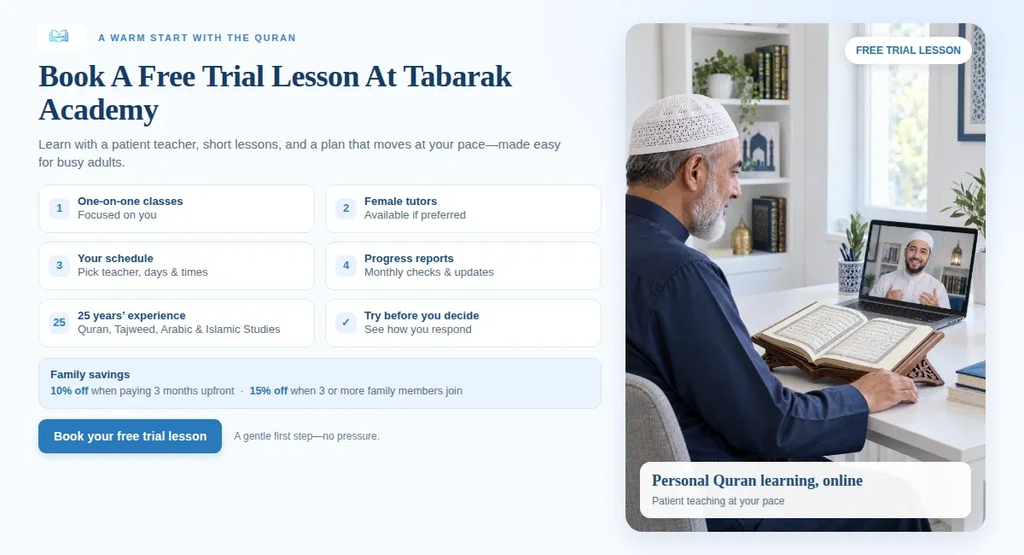
You need the right plan and the right teacher, and Tabarak Academy gives you both.
Here is what you get with Tabarak Academy:
- 25 years of teaching the Quran
- Teachers who hold a verified Al-Azhar Ijazah
- Private 1-on-1 live lessons
- Female teachers for sisters, at no extra cost
- Morning, evening, and weekend times
- Monthly progress reports, so you can see your Hifz grow
- Students in more than 15 countries
Saif F. wrote on Trustpilot: “Tabarak Academy has allowed me to memorise the book of Allah.” Read his full review on Trustpilot
So, don’t wait and be the next one. Your first class is free, with no payment, and it is confirmed within 24 hours.
Book Your Free Trial Class Now
Our Quran Courses
It’s never too late to start your Quran memorization journey; browse our courses and click Free Trial.
- Online Quran Classes
- Online Quran Classes for Beginners
- Online Quran Classes for Kids
- Online Quran Classes for Adults
- Online Quran Classes for Men
- Online Quran Classes for Sisters
- Quran Reading Course
- Quran Recitation Course
Conclusion
So, can I memorize the Quran at 50? Yes. It is allowed, it is possible, and many people your age are doing it today. Allah made the Quran easy to remember, and that promise has no age limit.
Your age changes the method, not the result. Your memory needs more repeats, but it brings patience and deep understanding, and the companions themselves took years for a single surah. Many learners find that the verses they worked hardest for become the ones they love most.
The path is simple. Learn a small portion each day, starting with short surahs. Give revision more time than new lines, and recite to a teacher who can fix your mistakes. Protect your best hours, rest on hard days, and measure yourself only against who you were last month.
Success is not about speed. It is about staying close to the Quran for every year Allah gives you. Each verse you carry becomes a light in your prayers and a gift you can pass on to the people you love.
Make your intention sincere, ask Allah to make it easy for you, and take the first step. Start today with a few lines, and let each small step add up. May Allah make you among the people of the Quran.
FAQs
Here are the questions older learners ask most. Each answer is short and direct.
Is It Too Late To Memorize The Quran At 60?
No, it is not too late to memorize the Quran at 60. The same plan works, and every verse you learn brings reward.
Can I Memorize The Quran If I Cannot Read Arabic Yet?
Yes, you can start memorizing the Quran before you read Arabic. Many people learn short surahs by ear while studying the Noorani Qaida.
Do I Need To Understand Arabic To Memorize The Quran?
No, you do not need to understand Arabic to memorize the Quran. Reading each verse’s meaning in your language still helps you remember it.
Can I Memorize The Quran Using Only An App?
Yes, an app can help you memorize the Quran, but it cannot hear your mistakes or replace a teacher.
Can I Recover Surahs I Memorized Years Ago?
Yes, you can recover surahs you memorized years ago, and they come back faster than new ones. Add them to your Manzil and recite them often.
Can I Become A Hafiz And Earn An Ijazah After 50?
Yes, you can become a Hafiz and earn an Ijazah after 50. An Ijazah is a teacher’s approval of your recitation, linked in a chain back to the Prophet ﷺ, and age is not a condition.
What If I Die Before I Finish Memorizing The Quran?
If you die while learning the Quran with a sincere heart, your effort is with Allah. Focus on each day’s effort, not only the finish line.

0 Comments