
Your child comes home from Quran class with a simple question: “How many chapters does the Quran have?” You know it’s more than a hundred, but you’re not sure of the exact number. Many parents, students, and new Muslims have been in the same spot.
Here is the clear answer. The Quran has 114 surahs, or chapters. It opens with Surah Al-Fatihah and closes with Surah An-Nas. So whenever someone asks how many surahs are in the Quran, the answer is always 114.
Each surah is made of verses called ayat. Some surahs are very short, and others are very long. The Quran is also split into 30 equal parts called juz, which helps many Muslims read a little every day.
Knowing the number is a great start, but it often leads to more questions. Why do some books give a different number of verses? What makes a surah Makki or Madani? And which surah is the shortest of all?
This guide answers each of these questions in plain, simple words. You will also find the full list of all 114 surahs in order, with the number of verses in each one, so you can look up any surah in seconds.
What You’ll Learn In This Article
- The total number of surahs, ayat, and juz in the Quran.
- The difference between a surah, an ayah, and a juz.
- How many surahs are Makki and how many are Madani.
- The longest and shortest surahs, and how the surahs are ordered.
- The full list of the 114 surahs, plus a simple way to use it when memorizing.
How Many Surahs Are In The Quran In Total?
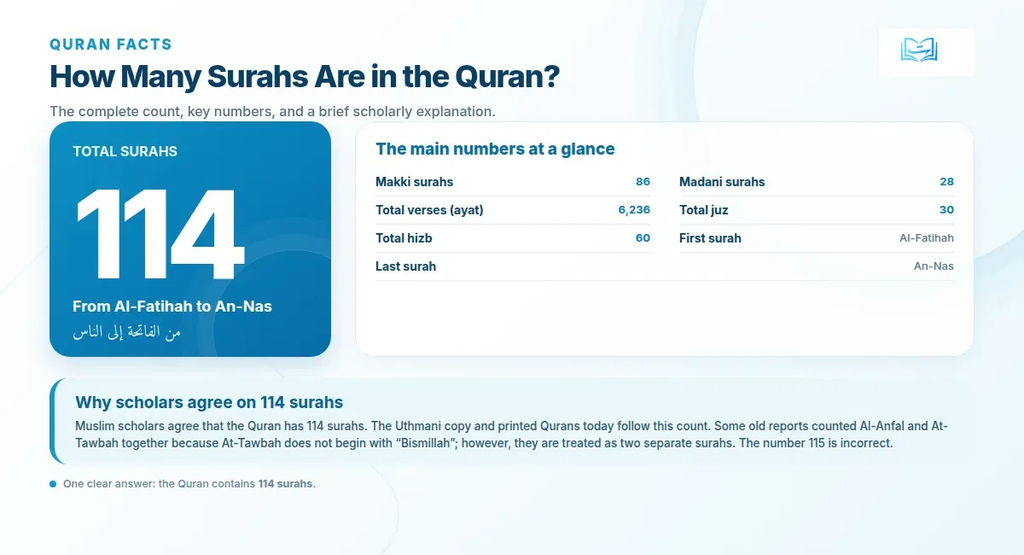
The Quran has 114 surahs in total. The table below shows the main numbers in one place, so you can save it or print it for later.
| Item | Number |
| Total surahs | 114 |
| Makki surahs | 86 |
| Madani surahs | 28 |
| Total verses (ayat) | 6,236 |
| Total juz | 30 |
| Total hizb | 60 |
| First surah | Al-Fatihah |
| Last surah | An-Nas |
Why All Scholars Agree On 114 Surahs
Muslim scholars agree that the Quran has 114 surahs. This is the number in the copy of the Quran written in the time of Uthman ibn Affan. Every printed Quran today follows this same count.
The scholar Az-Zarkashi wrote about this in his book Al-Burhan. He said the people of knowledge all agree on 114 surahs. The list starts with Al-Fatihah and ends with An-Nas.
Some old reports mention 113 surahs. This view counted Surah Al-Anfal and Surah At-Tawbah as one surah. The reason was that At-Tawbah does not begin with “Bismillah.”
Scholars did not accept this view. The Prophet ﷺ gave each of these two surahs its own name. So they are two separate surahs, and the words of the Quran stay the same either way.
You may also see the number 115 on some websites or apps. This number is wrong, and no trusted scholar ever said it. If a quiz shows 115, the right answer is still 114.
Surah, Ayah, And Juz: What’s The Difference?
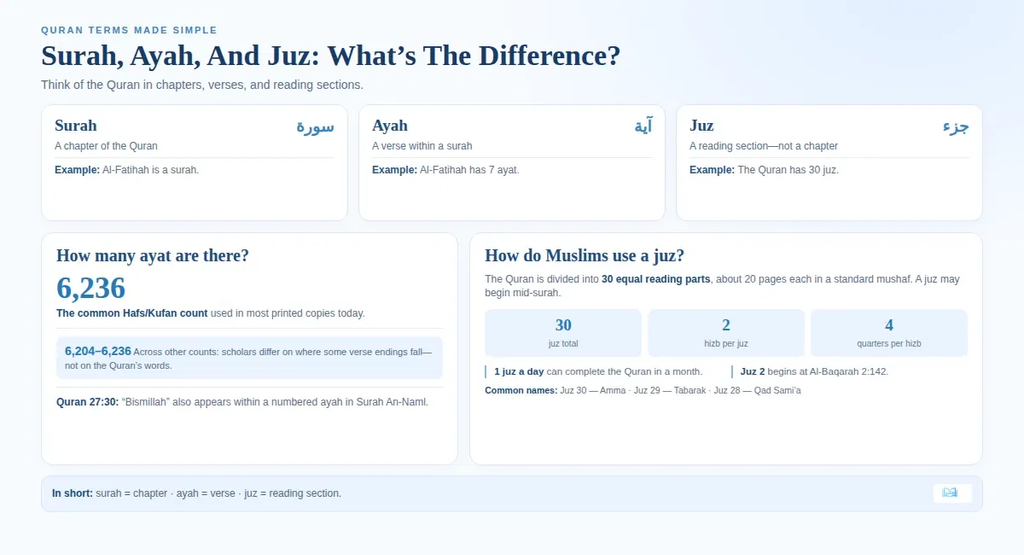
Many people mix up these three words. A surah is a chapter, an ayah is a verse, and a juz is a reading part, as the table below shows with simple examples.
| Term | Arabic | Meaning | Example |
| Surah | سورة | Chapter | Al-Fatihah |
| Ayah | آية | Verse | Al-Fatihah has 7 ayat |
| Juz | جزء | Part or section | 30 juz in total |
How Many Ayat Are In The Quran?
The Quran has 6,236 ayat in the most common count. This is the count used in most printed copies today. It is called the Kufan count, and it goes with the Hafs way of reading.
Other counts exist, and they differ a little. The scholar Al-Dani said all scholars agree on at least 6,000 ayat. They differed on the rest, with totals such as 6,204, 6,219, and 6,236.
Why do the counts differ? Scholars learned where each verse ends from their teachers, in a chain that goes back to the Prophet ﷺ. One group may end a verse in one place, while another group ends it a little later.
So the only difference is where the verse breaks fall. The words of the Quran are exactly the same in every count. Nothing is added, and nothing is missing.
Here is a fact many students enjoy. “Bismillah” appears inside one surah as part of a verse. You can find it in Surah An-Naml, verse 27:30, at the start of the letter that Prophet Sulayman sent.
What Is A Juz And How Do Muslims Use It?
A juz is one of 30 equal parts of the Quran. In a standard printed copy, each juz is about 20 pages long. The juz was made to help people read, not to mark chapters.
That is why a juz can start in the middle of a surah. For example, Juz 2 begins at verse 142 of Surah Al-Baqarah, not at the start of a new surah. Other juz hold many full surahs from start to end.
Each juz has two halves, and each half is called a hizb. That gives 60 hizb in the whole Quran. Each hizb is then split into four quarters.
Many Muslims read one juz every day. This way, they finish the whole Quran in one month. It is a very common habit during Ramadan.
Some juz are known by the words they begin with. Juz 30 is called Juz Amma, and Juz 29 is called Juz Tabarak. Juz 28 is called Juz Qad Sami’a.
What Happens In A Tabarak Academy Class?
Watch short videos from real lessons with real students. You’ll see how our teachers guide, correct, and encourage learners of every age
Start Your Quran Learning Journey
Join Tabark Academy today for structured online lessons with qualified tutors, customized to fit your goals.
Book Your Free Trial LessonMakki And Madani Surahs: How The 114 Are Split
Surahs are grouped by the time they came down. Makki surahs came before the Hijrah, the Prophet’s move from Makkah to Madinah, and Madani surahs came after it.
| Type | Arabic | Number | Revealed |
| Makki | مكي | 86 | Before the Hijrah |
| Madani | مدني | 28 | After the Hijrah |
| Total | 114 |
How Scholars Decide If A Surah Is Makki Or Madani
Most scholars look at the time a surah came down, not the place. The key event is the Hijrah. Anything that came down before it is Makki.
Anything that came down after the Hijrah is Madani, even if it came down in Makkah. Many people miss this point. They think “Makki” simply means “came down in Makkah.”
Here is a clear example. A verse of Surah Al-Ma’idah came down at Arafah, near Makkah, during the Prophet’s last Hajj. This is reported in Sahih al-Bukhari 45. Since it came after the Hijrah, Al-Ma’idah is still a Madani surah.
Based on this rule, the well-known count is 86 Makki surahs and 28 Madani surahs. This is the count used in the Quran printed in Madinah. You can see the type of every surah in the full list later in this article.
Scholars do not agree on every single surah. Some say 82 surahs are surely Makki and 20 are surely Madani. The other 12, such as Al-Fatihah and Al-Ikhlas, are in question, so some books show a small difference. This topic is part of the Quranic sciences, which you can study step by step in the Quranic Sciences (Uloom al-Quran) course.
What Makki And Madani Surahs Usually Talk About
Makki and Madani surahs often feel different when you read them. Each group came down at a different time and met different needs, as you can see in the table.
| Feature | Makki (mostly) | Madani (mostly) |
| Main topic | Belief in one God, the Last Day | Rules for worship and daily life |
| Length | Shorter | Longer |
| How people are called | “O mankind” | “O you who believe” |
| Stories of prophets | Many | Fewer |
In Makkah, the Muslims were few and faced hard times. So Makki surahs build strong faith. They talk about one God, the Day of Judgment, and the stories of past prophets.
In Madinah, the Muslims became a full community. So Madani surahs give rules for prayer, fasting, family life, and trade. They also teach how to treat neighbors and others.
These are general signs, not strict rules. Some Makki surahs have rulings in them, and some Madani surahs talk about faith. Still, the pattern helps you understand what you read.
The Longest And Shortest Surahs In The Quran
Surahs are not the same length at all, ranging from 3 verses to 286 verses. The table below shows the longest surah and the three shortest ones, so you can see both ends of that range.
| Surah | Arabic | Surah number | Verses | Length |
| Al-Baqarah | البقرة | 2 | 286 | Longest surah |
| Al-Asr | العصر | 103 | 3 | One of the three shortest |
| An-Nasr | النصر | 110 | 3 | One of the three shortest |
| Al-Kawthar | الكوثر | 108 | 3 | Shortest surah of all |
Three surahs share the smallest number of verses, but only one is called the shortest. The next section explains why.
Why Al-Kawthar Is Called The Shortest Surah
Al-Asr, An-Nasr, and Al-Kawthar each have only 3 verses. No surah in the Quran has fewer. So how do scholars decide which one is the shortest?
They look at the words. Surah Al-Kawthar (108:1-3) has fewer words and fewer letters than the other two. So it is the shortest surah in size, not only in the number of verses.
Many websites miss this detail. They say Al-Kawthar is the only surah with 3 verses, which is not true. If a quiz asks which surahs have the fewest verses, the best answer names all three.
Surah Al-Baqarah sits at the other end. With 286 verses, it is the longest surah in the Quran. It also holds the longest single verse, Al-Baqarah 2:282, which tells believers to write down their debts.
The gap in size is huge. Al-Baqarah alone fills about 48 pages in a standard printed copy, which is more than two juz. Al-Kawthar fits in just a few short lines.
Why Short Surahs Come At The End Of The Quran
Open any copy of the Quran, and you will notice a pattern. The long surahs come first, and the short ones come last. This is why the final pages of the Quran feel so different from the first ones.
This pattern leads to a surprising fact. Juz Qad Sami’a has 9 surahs, Juz Tabarak has 11 surahs, and Juz Amma has 37 surahs. Together, these last three juz hold 57 surahs.
That is exactly half of all 114 surahs. So 3 juz out of 30 hold half the surahs in the Quran. Juz Amma alone has more surahs than any other juz.
This is good news for kids and beginners. Short surahs feel easy, so a child sees progress fast. That quick progress gives young learners the push to keep going.
But keep one thing in mind. Half the surahs is only about one tenth of the whole Quran. So a child who learns these three juz has done great work, with a long road still ahead.
A patient teacher makes that road much easier for a child. In the Tabarak Academy reviews on Trustpilot, parents share that their children look forward to their lessons, and one mother wrote that the teacher is very patient and her kids really enjoy class.

How The Surahs Are Ordered In The Quran
The order of surahs in the Quran is not the order in which they came down. The first verses ever revealed were Al-Alaq 96:1-5, as told in Sahih al-Bukhari 3. Yet Al-Alaq is surah number 96 in the Quran today.
Al-Fatihah comes first in the book, but it was not the first to come down. Scholars agree that the Prophet ﷺ set the order of the verses inside each surah.
For the order of the surahs, most scholars say it also came from the Prophet ﷺ. Some say the companions set it when they gathered the Quran into one book. Either way, every Quran in the world today has the same order.
Other Interesting Facts About The Surahs
Some facts about the surahs come up again and again in classes and quizzes. These two are among the most asked, yet few articles explain them.
Which Surahs Start With Disjointed Letters?
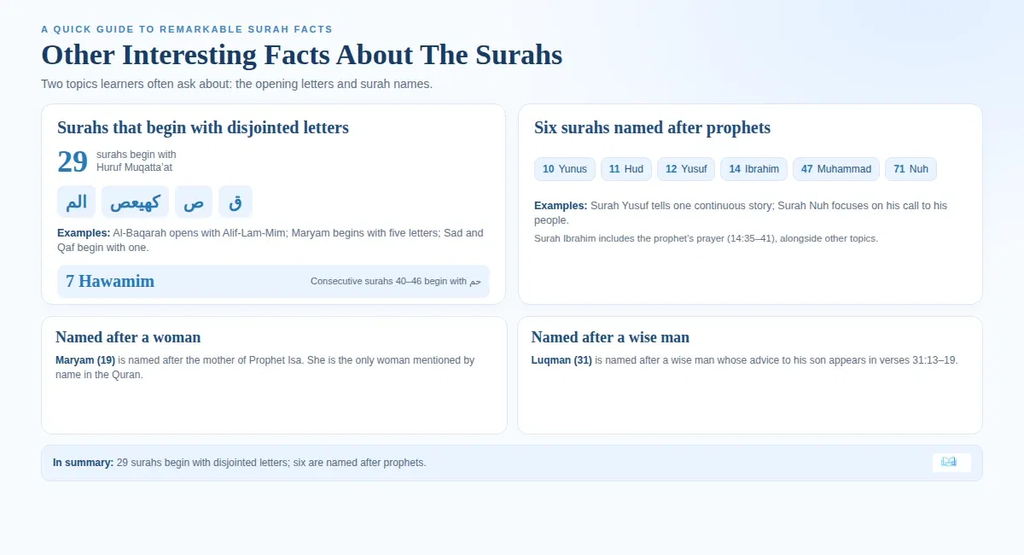
Some surahs begin with Arabic letters that are read one by one. These are called the disjointed letters, or Huruf Muqatta’at. For example, Al-Baqarah 2:1 is made of three letters: Alif, Lam, and Mim.
Based on the well-known count, 29 surahs start this way. Some start with a single letter, like Surah Sad (38) and Surah Qaf (50). Others start with more, like Surah Maryam (19), which opens with five letters.
Seven surahs in a row begin with the letters Ha and Mim. They run from Surah Ghafir (40) to Surah Al-Ahqaf (46). Scholars call this group the Hawamim.
What do these letters mean? Most scholars say Allah alone knows their full meaning. Many also point out that the Quran is made of the same letters the Arabs used every day, yet no one could make anything like it.
Some surahs even take their names from these letters. Ta-Ha (20), Ya-Sin (36), Sad (38), and Qaf (50) are all named this way.
Which Surahs Are Named After Prophets?
Six surahs carry the name of a prophet. They are Yunus (10), Hud (11), Yusuf (12), Ibrahim (14), Muhammad (47), and Nuh (71).
Some of these surahs focus on that prophet’s story. Surah Yusuf tells one full story from start to end, about Prophet Yusuf and his brothers. Surah Nuh is about Prophet Nuh calling his people to Allah.
Other surahs mention their prophet only in part. Surah Ibrahim, for example, includes a moving prayer from Prophet Ibrahim in Ibrahim 14:35-41. The surah is named after him, but it covers other topics too.
One surah is named after a woman: Surah Maryam, named after the mother of Prophet Isa. Maryam is the only woman mentioned by name in the Quran, as in Maryam 19:16.
Other surahs are named after people who were not prophets. Surah Luqman (31) is named after a wise man who gave advice to his son in Luqman 31:13-19. Kids often love this surah because the advice is simple and clear.
Full List Of The 114 Surahs In Order
Here is every surah in the Quran, in the same order you find in a printed copy. The verse counts follow the common Kufan count, and the Makki or Madani type follows the Quran printed in Madinah.
| No. | Surah | Arabic | Verses | Type |
| 1 | Al-Fatihah | الفاتحة | 7 | Makki |
| 2 | Al-Baqarah | البقرة | 286 | Madani |
| 3 | Aal-Imran | آل عمران | 200 | Madani |
| 4 | An-Nisa | النساء | 176 | Madani |
| 5 | Al-Ma’idah | المائدة | 120 | Madani |
| 6 | Al-An’am | الأنعام | 165 | Makki |
| 7 | Al-A’raf | الأعراف | 206 | Makki |
| 8 | Al-Anfal | الأنفال | 75 | Madani |
| 9 | At-Tawbah | التوبة | 129 | Madani |
| 10 | Yunus | يونس | 109 | Makki |
| 11 | Hud | هود | 123 | Makki |
| 12 | Yusuf | يوسف | 111 | Makki |
| 13 | Ar-Ra’d | الرعد | 43 | Madani |
| 14 | Ibrahim | إبراهيم | 52 | Makki |
| 15 | Al-Hijr | الحجر | 99 | Makki |
| 16 | An-Nahl | النحل | 128 | Makki |
| 17 | Al-Isra | الإسراء | 111 | Makki |
| 18 | Al-Kahf | الكهف | 110 | Makki |
| 19 | Maryam | مريم | 98 | Makki |
| 20 | Ta-Ha | طه | 135 | Makki |
| 21 | Al-Anbiya | الأنبياء | 112 | Makki |
| 22 | Al-Hajj | الحج | 78 | Madani |
| 23 | Al-Mu’minun | المؤمنون | 118 | Makki |
| 24 | An-Nur | النور | 64 | Madani |
| 25 | Al-Furqan | الفرقان | 77 | Makki |
| 26 | Ash-Shu’ara | الشعراء | 227 | Makki |
| 27 | An-Naml | النمل | 93 | Makki |
| 28 | Al-Qasas | القصص | 88 | Makki |
| 29 | Al-Ankabut | العنكبوت | 69 | Makki |
| 30 | Ar-Rum | الروم | 60 | Makki |
| 31 | Luqman | لقمان | 34 | Makki |
| 32 | As-Sajdah | السجدة | 30 | Makki |
| 33 | Al-Ahzab | الأحزاب | 73 | Madani |
| 34 | Saba | سبأ | 54 | Makki |
| 35 | Fatir | فاطر | 45 | Makki |
| 36 | Ya-Sin | يس | 83 | Makki |
| 37 | As-Saffat | الصافات | 182 | Makki |
| 38 | Sad | ص | 88 | Makki |
| 39 | Az-Zumar | الزمر | 75 | Makki |
| 40 | Ghafir | غافر | 85 | Makki |
| 41 | Fussilat | فصلت | 54 | Makki |
| 42 | Ash-Shura | الشورى | 53 | Makki |
| 43 | Az-Zukhruf | الزخرف | 89 | Makki |
| 44 | Ad-Dukhan | الدخان | 59 | Makki |
| 45 | Al-Jathiyah | الجاثية | 37 | Makki |
| 46 | Al-Ahqaf | الأحقاف | 35 | Makki |
| 47 | Muhammad | محمد | 38 | Madani |
| 48 | Al-Fath | الفتح | 29 | Madani |
| 49 | Al-Hujurat | الحجرات | 18 | Madani |
| 50 | Qaf | ق | 45 | Makki |
| 51 | Adh-Dhariyat | الذاريات | 60 | Makki |
| 52 | At-Tur | الطور | 49 | Makki |
| 53 | An-Najm | النجم | 62 | Makki |
| 54 | Al-Qamar | القمر | 55 | Makki |
| 55 | Ar-Rahman | الرحمن | 78 | Madani |
| 56 | Al-Waqi’ah | الواقعة | 96 | Makki |
| 57 | Al-Hadid | الحديد | 29 | Madani |
| 58 | Al-Mujadilah | المجادلة | 22 | Madani |
| 59 | Al-Hashr | الحشر | 24 | Madani |
| 60 | Al-Mumtahanah | الممتحنة | 13 | Madani |
| 61 | As-Saff | الصف | 14 | Madani |
| 62 | Al-Jumu’ah | الجمعة | 11 | Madani |
| 63 | Al-Munafiqun | المنافقون | 11 | Madani |
| 64 | At-Taghabun | التغابن | 18 | Madani |
| 65 | At-Talaq | الطلاق | 12 | Madani |
| 66 | At-Tahrim | التحريم | 12 | Madani |
| 67 | Al-Mulk | الملك | 30 | Makki |
| 68 | Al-Qalam | القلم | 52 | Makki |
| 69 | Al-Haqqah | الحاقة | 52 | Makki |
| 70 | Al-Ma’arij | المعارج | 44 | Makki |
| 71 | Nuh | نوح | 28 | Makki |
| 72 | Al-Jinn | الجن | 28 | Makki |
| 73 | Al-Muzzammil | المزمل | 20 | Makki |
| 74 | Al-Muddaththir | المدثر | 56 | Makki |
| 75 | Al-Qiyamah | القيامة | 40 | Makki |
| 76 | Al-Insan | الإنسان | 31 | Madani |
| 77 | Al-Mursalat | المرسلات | 50 | Makki |
| 78 | An-Naba | النبأ | 40 | Makki |
| 79 | An-Nazi’at | النازعات | 46 | Makki |
| 80 | Abasa | عبس | 42 | Makki |
| 81 | At-Takwir | التكوير | 29 | Makki |
| 82 | Al-Infitar | الانفطار | 19 | Makki |
| 83 | Al-Mutaffifin | المطففين | 36 | Makki |
| 84 | Al-Inshiqaq | الانشقاق | 25 | Makki |
| 85 | Al-Buruj | البروج | 22 | Makki |
| 86 | At-Tariq | الطارق | 17 | Makki |
| 87 | Al-A’la | الأعلى | 19 | Makki |
| 88 | Al-Ghashiyah | الغاشية | 26 | Makki |
| 89 | Al-Fajr | الفجر | 30 | Makki |
| 90 | Al-Balad | البلد | 20 | Makki |
| 91 | Ash-Shams | الشمس | 15 | Makki |
| 92 | Al-Layl | الليل | 21 | Makki |
| 93 | Ad-Duha | الضحى | 11 | Makki |
| 94 | Ash-Sharh | الشرح | 8 | Makki |
| 95 | At-Tin | التين | 8 | Makki |
| 96 | Al-Alaq | العلق | 19 | Makki |
| 97 | Al-Qadr | القدر | 5 | Makki |
| 98 | Al-Bayyinah | البينة | 8 | Madani |
| 99 | Az-Zalzalah | الزلزلة | 8 | Madani |
| 100 | Al-Adiyat | العاديات | 11 | Makki |
| 101 | Al-Qari’ah | القارعة | 11 | Makki |
| 102 | At-Takathur | التكاثر | 8 | Makki |
| 103 | Al-Asr | العصر | 3 | Makki |
| 104 | Al-Humazah | الهمزة | 9 | Makki |
| 105 | Al-Fil | الفيل | 5 | Makki |
| 106 | Quraysh | قريش | 4 | Makki |
| 107 | Al-Ma’un | الماعون | 7 | Makki |
| 108 | Al-Kawthar | الكوثر | 3 | Makki |
| 109 | Al-Kafirun | الكافرون | 6 | Makki |
| 110 | An-Nasr | النصر | 3 | Madani |
| 111 | Al-Masad | المسد | 5 | Makki |
| 112 | Al-Ikhlas | الإخلاص | 4 | Makki |
| 113 | Al-Falaq | الفلق | 5 | Makki |
| 114 | An-Nas | الناس | 6 | Makki |
How To Use The Surah Count In A Memorization Plan
Knowing there are 114 surahs can make memorizing feel easier. Follow these seven steps to turn that big number into small goals you can count, one surah at a time.
- Start with Juz Amma. Most teachers begin with Juz 30 because its surahs are short. A child can learn one in just a few days, and each new surah feels like a small win.
- Learn a small part each day. Don’t try to memorize a whole surah at once. The chunking method for Quran memorization shows how to break verses into short parts that are easy to remember.
- Repeat each verse until it sticks. Say the verse out loud many times, first while looking and then from memory. If you wonder how many times to repeat a verse to memorize it, that guide shares nine methods that work.
- Review before you mark a surah as done. A common mistake is to tick a surah off after one good reading. Short surahs fade fast, so count a surah as memorized only after it is recited well on several different days.
- Track two numbers, not one. Write down how many surahs are done, because this keeps learners motivated. Also write down how many pages or juz are done, because this shows real progress.
- Set a timeline that fits your life. Children and adults learn at different speeds. Adults can plan their own goals with a realistic Hifz timeline for adults.
- Recite to a teacher regularly. A teacher hears mistakes that a learner can’t hear on their own. The Juz 30 Memorization Course at Tabarak Academy follows these same steps, guiding your child through each short surah with steady review so it stays in memory.

Practice Exercises: Test What You Learned
Try these questions to see what you remember. Cover the answers first, then check them one by one.
- Which surah came down first? Answer: Al-Alaq.
- What is surah number 36? Answer: Ya-Sin, with 83 verses.
- What is the longest verse in the Quran? Answer: Al-Baqarah 2:282.
- Is Surah Al-Ma’idah Makki or Madani? Answer: Madani.
- How many verses are in Al-Fatihah? Answer: 7 verses.
- How many surahs carry the name of a prophet? Answer: Six.
If you got most of these right, you already know more about the surahs than many people do. If a few answers surprised you, go back to that part of the article, read it again, and try the quiz once more tomorrow.
See A Real Class Before You Join
Curious what a lesson feels like? Watch real moments from our live classes and see how our teachers keep each student focused, confident, and moving forward.
Start Your Quran Learning Journey
Join Tabark Academy today for structured online lessons with qualified tutors, customized to fit your goals.
Book Your Free Trial LessonBook A Free Trial Class At Tabarak Academy Today
Now you know how many surahs are in the Quran. The next step is to learn them, read them well, and keep them in your heart. Tabarak Academy helps kids and adults do this from home, with a real teacher in every class.
With 25 years of experience in education and 6.8K students enrolled, Tabarak Academy knows how to guide every kind of learner. Here is what you get when you join:
- Teachers certified by Al-Azhar
- Live one-on-one classes, with female teachers for women and girls
- Class days and times that you choose, any hour of the week
- Monthly checks and progress reports, so you always know how your child is doing
- Courses for every level, from Noorani Qaida to Hifz and Ijazah
Your first class is free, so you can meet the teacher before you decide. Book your free trial class and start with the surahs you love most.
Our Quran Courses
Knowing how many Surahs of the Quran is just the beginning. The real knowledge starts with the first verse you memorize. Browse our courses and choose the one that suits you perfectly.
- Online Quran Classes for Sisters
- Quran Reading Course
- Quran Recitation Course
- Online Ijazah Course
- Online Qirat Course
- Quran for Toddlers / Young Children
- Weekend Quran Classes
- Intensive Quran Course
- Al-Azhar Quran Course
- Zoom Quran Classes
Final Thoughts On The Number Of Surahs In The Quran
So, how many surahs are in the Quran? The answer is 114, from Al-Fatihah to An-Nas. If you searched how many surahs are in Quran, the answer is always the same, and every printed Quran in the world follows it.
These 114 surahs hold 6,236 ayat in the common count. They are also split into 30 juz, which makes daily reading easy. A surah is a chapter, an ayah is a verse, and a juz is a reading part.
Of the 114 surahs, 86 are Makki and 28 are Madani, based on the well-known view. Makki surahs came before the Hijrah and mostly build faith. Madani surahs came after it and mostly give rules for daily life.
Surahs also differ a lot in length. Al-Baqarah is the longest with 286 verses, while Al-Kawthar is the shortest. The last three juz hold half of all the surahs, which makes them a great place for beginners to start.
You also saw that the surahs are not arranged in the order they came down, since Al-Alaq was revealed first. Small details like the 29 surahs that open with disjointed letters, or the six surahs named after prophets, make the Quran easier to explore and remember.
Allah promised to protect His book, as He says in Surah Al-Hijr 15:9. That is why the same 114 surahs reach us today, word for word. Learning their number is a small first step toward reading, understanding, and memorizing them.
Keep the full list of surahs close by, and come back to it whenever you need to look up a surah’s number or its verses. If you are a parent, start with the short surahs at the end and celebrate every one your child learns. One surah at a time, those 114 chapters can slowly become part of your heart.
FAQs
People often have more questions after learning the number of surahs. Here are short, clear answers to the ones we hear most.
How Many Chapters Are In The Quran?
The Quran has 114 chapters, called surahs in Arabic. The first is Al-Fatihah, and the last is An-Nas.
How Many Total Ayahs Are In The Quran?
The Quran has 6,236 ayahs in the most common count. Other counts differ a little because they place some verse breaks in different spots, but the words are the same.
What Is The Difference Between Makki And Madani Surahs?
Makki surahs came down before the Hijrah, and Madani surahs came down after it. Makki surahs mostly talk about faith, while Madani surahs mostly give rules for life.
What Is A Juz In The Quran?
A juz is one of 30 equal parts of the Quran. Muslims use it for daily reading, and a juz can start in the middle of a surah.
What Are The Shortest And Longest Surahs?
The shortest surah is Al-Kawthar with 3 verses, and the longest is Al-Baqarah with 286 verses. Al-Asr and An-Nasr also have 3 verses, but Al-Kawthar has fewer words.
How Many Surahs Are In Juz Amma?
Juz Amma has 37 surahs, from An-Naba to An-Nas. It is the juz most children memorize first.
Which Surah Does Not Start With Bismillah?
Surah At-Tawbah is the only surah that does not start with “Bismillah.” Surah An-Naml has it twice, once at the start and once inside verse 30.
Which Surah Equals One Third Of The Quran?
Surah Al-Ikhlas equals one third of the Quran, as the Prophet ﷺ said in a hadith in Sahih al-Bukhari 5013. Scholars explain this as referring to its meaning and its reward.


0 Comments