


How To Test Your Own Hifz? – 5 Proven Methods
Have you ever finished reciting a page perfectly in the morning, only to stumble over the same verses two days later?
Almost every student of Qur’an memorization has lived that moment, and it rarely means the memorization was weak — it usually means it was never properly tested.
Learning how to test your own hifz is the difference between reciting what you recognize and reciting what you truly own. Reading a page again feels comfortable, but comfort is not evidence. Retrieval is.
Educational researchers call this the testing effect: pulling information out of memory strengthens it far more than putting it in again.
A large review published in Psychological Science in the Public Interest examined ten popular study techniques and found only two earned the highest rating — practice testing and distributed (spaced) practice.
In this guide, you will find five practical self-testing methods for hifz, the best way to choose between them, and the accuracy rules that stop you from grading yourself too generously.

1. Record Your Recitation and Listen With the Mushaf Open
Self-testing in hifz means recalling verses from memory — without looking at the mushaf – and only then checking yourself. It is the opposite of re-reading.
So begin by reciting your portion from memory into your phone’s voice recorder. Then play it back while following along in the mushaf with your finger.
This method catches what your ear misses in the moment: a dropped harf, a shortened madd, a wāw that should have been a fā’. Because you are no longer busy recalling, your full attention goes to accuracy.
Keep a small notebook beside you and write down every slip. After a week, you will notice the same three or four words repeating — those are your real weak points, not the whole page.
Keep your recordings in a dated folder so you can compare this week’s recitation with last month’s. Hearing your own improvement is one of the strongest motivators in the entire hifz journey.
2. Write the Verses From Memory
Take a blank sheet and write out the āyāt you have memorized, then compare your page word by word with the mushaf. Writing forces a slower, more deliberate form of recall than reciting does.
It is especially powerful for exposing similar verses. When two passages differ by a single connective — wa instead of fa, inna instead of wa inna — your pen will reveal the confusion long before your tongue does.
Start with half a page rather than a full one, and write without stopping to check yourself midway. The goal is to see what your memory produces unaided, not to produce a flawless copy.
Children respond well to this method too, particularly when it becomes a short daily habit rather than a long exercise. Many of our students at the academy pair written recall with their weekly Hifz Program session, so the teacher can see exactly where the memory is fragile.

3. Test the Openings of Verses and Pages
Open the mushaf at random, read only the first few words of an āyah in the middle of a sūrah, close the page, and continue from memory.
This tests the strongest indicator of solid hifz: linkage. Many students can recite a page from its beginning but freeze if they are started anywhere else — a sign the page is memorized as one long chain rather than as connected units.
Make the entry points progressively harder. Begin at the start of an āyah, then mid-āyah, then at the last āyah of a page, then at the last āyah of a sūrah.
Note every point where you hesitated for more than two seconds, because hesitation marks a weak link, not a lost verse. Reciting those junctions five times each usually repairs them within a single session.
4. Use Randomized Questions and Cumulative Quizzing
Write questions on one side of a card and answers on the other, then quiz yourself at random intervals. Over weeks, the stack grows, which is why this is called cumulative quizzing.
Useful question types include: What comes next? Which sūrah is this āyah in? Which juz’? Which page?, and Name the sūrahs in Juz’ ‘Amma that contain a verse beginning with these words.
Add meaning-based questions alongside word-based ones, such as what the āyah is about or what came before it. Linking words to meaning creates associations that make recall noticeably faster.
Digital tools help here as well. Interactive Qur’an quiz apps generate random verse prompts and sequence questions, which removes the bias of choosing passages you already feel confident about.
Experience Our Interactive Learning
Curious about how we teach? Watch these brief video clips from our recent live sessions to see our structured curriculum, advanced learning platform, and dynamic student-teacher interactions firsthand.
5. Practise Blind Retrieval Under Pressure
Blind retrieval means no hints, no peeking, and no starting over. If you stop, you look once at the mushaf, correct the word, and repeat it several times before continuing.
Then add difficulty on purpose. Recite while walking, while cooking, while a child is talking nearby, or — best of all — inside your ṣalāh. Memory that survives distraction is memory you can rely on.
Increase the difficulty gradually rather than all at once, since testing under heavy pressure too early only shakes confidence. One new distraction per week is enough to build real resilience.
A blind mind map works well for visual learners: sketch the sūrah’s structure with the verse openings left blank, then fill them in from memory after each revision cycle.
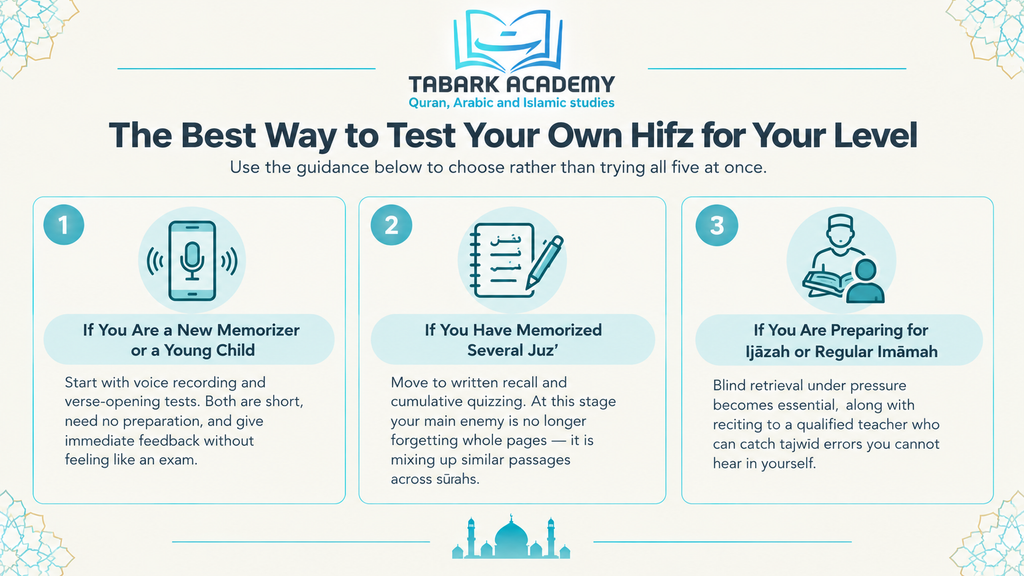
The Best Way to Test Your Own Hifz for Your Level
There is no single method that suits everyone, so the best way to test your own hifz is the one that matches your stage of memorization and your honest weak spot. Use the guidance below to choose rather than trying all five at once.
If You Are a New Memorizer or a Young Child
Start with voice recording and verse-opening tests. Both are short, need no preparation, and give immediate feedback without feeling like an exam.
For children, keep sessions under ten minutes and frame them as a challenge rather than a test. Structured weekly guidance helps enormously here — our Quran classes for kids are built around exactly this kind of light, repeated assessment.

If You Have Memorized Several Juz’
Move to written recall and cumulative quizzing. At this stage your main enemy is no longer forgetting whole pages — it is mixing up similar passages across sūrahs.
Schedule one full random-testing session each week covering older material, not only the new portion. Spaced revision plus testing is the combination the research consistently favours.
If You Are Preparing for Ijāzah or Regular Imāmah
Blind retrieval under pressure becomes essential, along with reciting to a qualified teacher who can catch tajwīd errors you cannot hear in yourself.
Self-testing shows you where the gap is; a teacher tells you why it is there. Students who combine both — daily self-assessment plus online Tajweed classes with a certified reciter — progress noticeably faster than those relying on either alone.
Read also: How to Self-Test Quran Memorization: 5 Methods
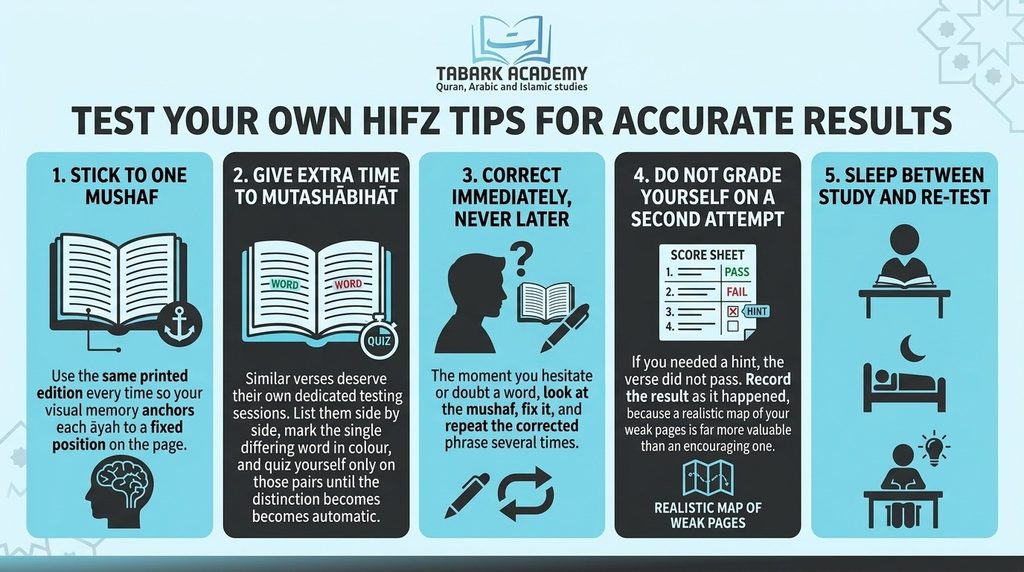
Test Your Own Hifz Tips for Accurate Results
A test is only as useful as it is honest. These test your own hifz tips protect your self-assessment from the small habits that quietly inflate your results.
1. Stick to One Mushaf
Use the same printed edition every time so your visual memory anchors each āyah to a fixed position on the page. Switching layouts mid-journey scrambles that spatial map and creates avoidable hesitations.
If you must switch editions, do it only after completing a full juz’, never in the middle of one. Give yourself two weeks of revision on the new layout before testing yourself again.
2. Give Extra Time to Mutashābihāt
Similar verses deserve their own dedicated testing sessions. List them side by side, mark the single differing word in colour, and quiz yourself only on those pairs until the distinction becomes automatic.
Keep a dedicated mutashābihāt page at the back of your notebook and add every new pair you discover. Reviewing that single page weekly prevents most of the errors that appear during ṣalāh.
Read also : Quran Hifz Plan: Managing New Memorization Ratio
3. Correct Immediately, Never Later
The moment you hesitate or doubt a word, look at the mushaf, fix it, and repeat the corrected phrase several times. Immediate feedback is what converts a mistake into long-term learning — delaying the correction lets the error settle in.
Repeat the corrected phrase together with the words before and after it, not in isolation. Fixing the connection is what stops the same mistake from returning in your next revision.
4. Do Not Grade Yourself on a Second Attempt
If you needed a hint, the verse did not pass. Record the result as it happened, because a realistic map of your weak pages is far more valuable than an encouraging one.
Use a simple three-mark system: passed, hesitated, or failed. Reviewing those marks at the end of each month shows you exactly which pages deserve your revision time.
5. Sleep Between Study and Re-Test
Memory consolidation happens during sleep, and research has shown that placing a night’s sleep between two study sessions produces stronger, longer-lasting recall than studying for the same total time without it.
The hours after Fajr and just before sleep are the most effective windows for new memorization. Memorizing at night and testing yourself the next morning lets consolidation work in your favour.
Step Inside Our Virtual Classrooms
See our engaging teaching methods in action! watch real snippets of our live classes and discover how our expert instructors make learning interactive, memorable, and inspiring for every student.
Book Your Free Trial Lesson and Test Your Hifz With a Certified Teacher
Self-testing shows you the gaps. A qualified teacher shows you how to close them — and does it in a fraction of the time.
At Tabarak Academy, every student is matched with a certified Egyptian tutor for one-to-one live sessions in Qur’an recitation, tajwīd, memorization, and Arabic. Lessons are scheduled around your timetable, for children and adults alike, with male and female teachers available.
Each session includes structured recitation, correction of tajwīd errors, and a revision plan built around the pages you actually struggle with. You receive regular progress reports, so your memorization is measured — not guessed at.
Start with a free trial lesson and see exactly where your hifz stands today.
Book your free trial lesson and begin memorizing with confidence.
Our Quran Memorization / Hifz Courses
- Online Hifz Program
- Juz 30 Memorization Course
- Hifz for Kids Course
- Hifz for Adults Course
- Hifz for Sisters Course
- Short Surah Memorization Course
- Hifz Ijazah Course

Conclusion
Knowing how to test your own hifz turns memorization from a hopeful routine into a measurable skill.
The five methods in this guide — voice recording, written recall, verse-opening tests, cumulative quizzing, and blind retrieval — all share one principle: you must retrieve before you review. Re-reading feels productive, but only recall builds durable memory.
Choose the method that matches your level rather than attempting all five at once. Beginners and children benefit most from recording and short opening tests, intermediate memorizers from writing and random quizzing, and advanced students from blind retrieval under real-life pressure. Consistency matters far more than intensity here.
Finally, protect the accuracy of your results: one mushaf, focused work on similar verses, immediate correction, honest scoring, and enough sleep between sessions.
Takeaway message: test yourself regularly, correct yourself immediately, and let a qualified teacher verify what your self-testing reveals — that combination is what carries the Qur’an from short-term recall into lifelong retention.
FAQs
How often should I test my hifz?
Test new material daily during the first week, then weekly, then monthly. Older juz’ should appear in a random test at least once every two weeks to keep the links between pages strong.
What is the difference between revision and self-testing?
Revision means reading or reciting with the mushaf available. Self-testing means recalling with nothing in front of you, then checking afterwards. Revision maintains; testing strengthens and reveals weaknesses.
Can I test my hifz without a teacher?
Yes — recording, writing, and randomized questions all work independently. However, a teacher is still needed to catch tajwīd errors your own ear cannot detect, especially in makhārij and madd lengths.
How do I stop confusing similar verses (mutashābihāt)?
Study them in pairs rather than separately. Write both verses next to each other, highlight the differing word, and quiz yourself only on that contrast until the correct version comes automatically.
What is the best way to test a child’s hifz?
Keep it short, playful, and frequent. Ask “what comes next?” from random verse openings, use small reward charts, and avoid long formal exams that create anxiety around the Qur’an.
Does writing verses really help memorization?
Yes. Writing slows recall down and engages motor memory, which exposes word-level errors that reciting often hides. Even one written page per week noticeably improves accuracy.
Sources
- Dunlosky, J. et al., “Improving Students’ Learning With Effective Learning Techniques,” Psychological Science in the Public Interest — https://journals.sagepub.com/doi/10.1177/1529100612453266
- Purdue University, “Studies show retrieval practice builds learning” — https://www.purdue.edu/newsroom/research/2011/110120KarpickeScience.html
- Mazza, S. et al., “Relearn Faster and Retain Longer: Along With Practice, Sleep Makes Perfect,” Psychological Science — https://journals.sagepub.com/doi/abs/10.1177/0956797616659930
(Internal links to be finalized manually at publication.)
Image Plan — 4 Images
Image 1 — After the introduction (hero image)
- Filename: how-to-test-your-own-hifz.jpg
- Alt text: Student testing his own hifz by reciting Quran from memory with a closed mushaf beside him
- Meta / caption: Learning how to test your own hifz turns passive revision into active, measurable recall.
- Design prompt: Warm, natural-light photograph of a young adult male student seated at a light wooden desk near a window, eyes closed, reciting from memory with his palm resting on a closed mushaf in front of him. A small notebook and pen sit to the side. Soft morning light, shallow depth of field, calm neutral tones of cream, warm beige and muted teal. Modest clothing, no facial close-up needed, respectful and serene atmosphere. 16:9 landscape, high resolution, no text overlay.
Image 2 — Inside “How to Test Your Own Hifz,” after Method 2
- Filename: writing-quran-verses-from-memory.jpg
- Alt text: Hand writing Quran verses from memory on a notebook next to an open mushaf for comparison
- Meta / caption: Writing verses from memory exposes word-level errors that reciting often hides.
- Design prompt: Overhead flat-lay photograph of a wooden desk. A ruled notebook shows handwritten Arabic script in blue ink; an open mushaf lies beside it, slightly out of focus. A pen, a highlighter, and a small cup of tea complete the scene. Soft diffused daylight, warm wood grain, cream and gold accents. Clean, uncluttered composition with negative space at the top. 4:3 ratio, photorealistic, no faces, no text overlay.
Image 3 — Inside “The Best Way to Test Your Own Hifz,” under the children’s section
- Filename: testing-hifz-for-kids-online-class.jpg
- Alt text: Child taking an online Quran memorization test with a teacher on a laptop screen
- Meta / caption: Short, playful testing sessions keep children engaged and build confidence in their hifz.
- Design prompt: Bright, cheerful photograph of a child around 8–10 years old sitting at a home desk in front of an open laptop, smiling while reciting. A mushaf rests closed beside the laptop; a colourful progress chart with stars is pinned on the wall behind. Soft warm lighting, friendly domestic setting, pastel blue and yellow accents. Teacher visible only as a blurred figure on screen. 16:9 landscape, photorealistic, no readable text on screen.
Image 4 — Just above the Hard CTA section
- Filename: book-free-trial-quran-tajweed-class.jpg
- Alt text: Adult student in a one-to-one online tajweed and Quran memorization lesson with a certified teacher
- Meta / caption: A certified teacher verifies what your self-testing reveals and corrects tajwīd errors you cannot hear.
- Design prompt: Clean, modern photograph of an adult student wearing headphones, seated at a tidy desk with a laptop showing a video lesson interface, an open mushaf and a notebook nearby. Calm home study environment, soft evening lamp light, warm neutral palette with deep green and gold accents. Professional and welcoming mood, generous empty space on the right side for a call-to-action button overlay. 16:9 landscape, photorealistic, no text overlay.
Suggested internal links (4), placed in the text above:
- Hifz Program — /courses/hifz/hifz-program/ (Method 2)
- Quran for Kids — /courses/quran/for-kid/ (beginner/child section)
- Online Tajweed Classes — /courses/tajweed/online-tajweed-classes/ (advanced section)
- Book a Free Trial Lesson — /book-a-free-trial-lesson/ (Hard CTA)
Word count: ~1,520 words (excluding the image plan).