


What Is Tafsir? A Complete Guide to Quranic Interpretation
Have you ever read a translation of the Quran and still felt unsure what a verse truly means? This is exactly why tafsir exists. In simple terms, tafsir meaning refers to the science of explaining and clarifying the words of the Quran so that its full message becomes accessible to every reader, regardless of their level of Arabic.
For anyone asking what is tafsir, the short answer is that it is the scholarly discipline dedicated to uncovering the meanings, context, and rulings embedded in the Quranic text. Muslims have relied on tafsir since the time of the Prophet Muhammad ﷺ, who personally explained unclear verses to his companions whenever they had questions.
This article walks through the tafsir meaning in both language and Islamic terminology, explores the different types of tafsir explained by classical scholars, and clarifies how tafsir differs from a closely related term, ta’wil. By the end, you will have a clear foundation for approaching Quranic interpretation as a learner.
What You Will Learn
● Tafsir is the science of explaining the meanings of the Quran, distinct from simple translation.
● Classical scholars such as Al-Zarkashi and Al-Zarqani each defined tafsir with slightly different emphases.
● Tafsir is generally divided into tafsir bil-ma’thur (transmitted) and tafsir bil-ra’y (reasoned).
● Tafsir and ta’wil are related but not identical terms, each with a distinct scholarly use.
● Learning tafsir properly requires structured guidance from qualified teachers, not self-study of translations alone.
What Is Tafsir?
Tafsir is the Islamic science that explains the meanings of the Quran, uncovering what a verse says linguistically and what it means in terms of rulings, context, and intent.
It answers the question of what is tafsir by combining language study, historical context, and juristic reasoning into a single structured discipline.
Every serious Quran learner eventually studies tafsir to move from mere recitation to genuine understanding. Without it, even a fluent reader of Arabic may recite a verse correctly while missing the reason it was revealed or the ruling it establishes.
Tafsir Meaning in Arabic
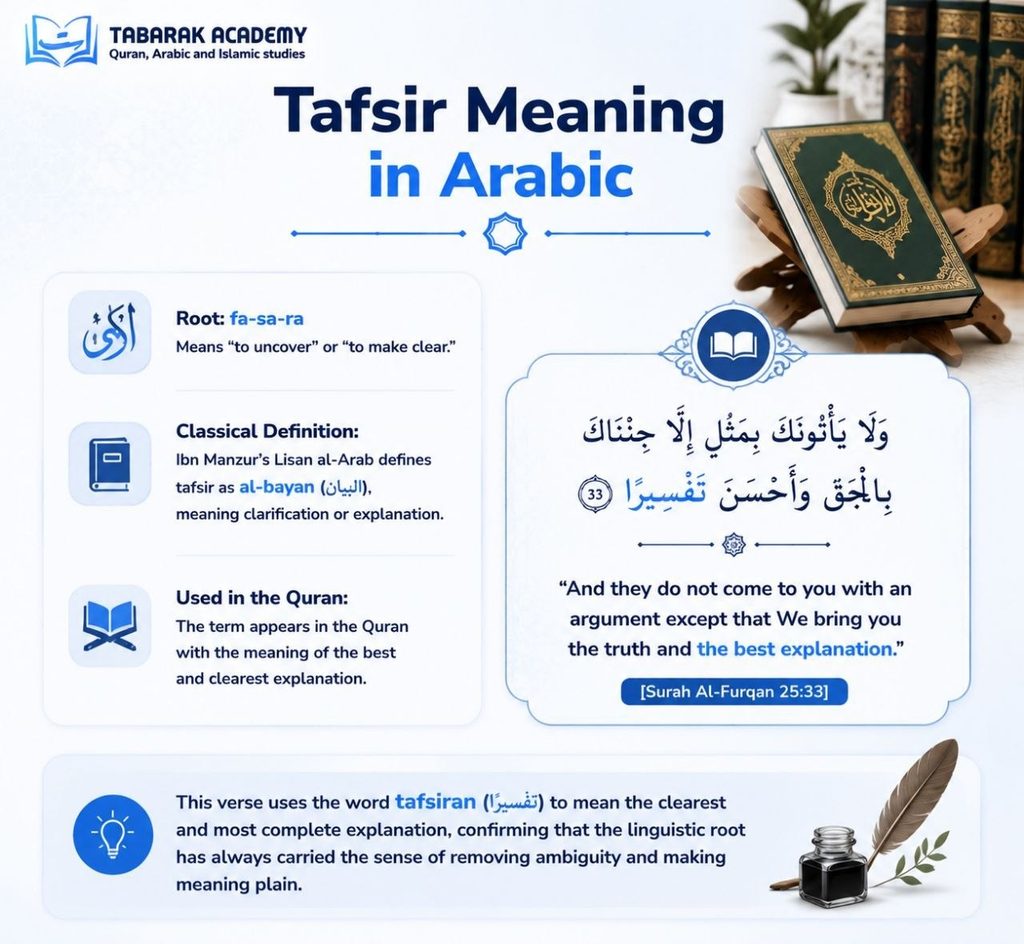
Tafsir meaning in Arabic comes from the root fa-sa-ra, which means “to uncover” or “to make clear.” Ibn Manzur’s classical dictionary, Lisan al-Arab, defines tafsir as al-bayan, meaning clarification or explanation. The term appears directly in the Quran itself, confirming that this sense of uncovering meaning is rooted in the revelation.
وَلَا يَأْتُونَكَ بِمَثَلٍ إِلَّا جِئْنَاكَ بِالْحَقِّ وَأَحْسَنَ تَفْسِيرًا
“And they do not come to you with an argument except that We bring you the truth and the best explanation.” Surah Al-Furqan 25:33
This verse uses the word tafsiran to mean the clearest and most complete explanation, confirming that the linguistic root has always carried the sense of removing ambiguity and making meaning plain.
Tafsir in Islamic Scholarly Terminology
In Islamic scholarly terminology, tafsir is defined by the scholar Al-Zarkashi as a science through which the Book of Allah, revealed to His Prophet Muhammad ﷺ, is understood, its meanings are explained, and its rulings and wisdoms are derived.
Another widely cited definition comes from Al-Zarqani, who describes tafsir as a science that examines the Quran from the perspective of its indication of Allah’s intended meaning, to the extent of human capacity.
This phrase “to the extent of human capacity” matters: it reminds learners that tafsir is a rigorous human scholarly effort to approach divine meaning, not a claim to absolute certainty in every single interpretation.
Tafseer Al Quran Course In Tabarak Academy
Why Is Tafsir Important for Quran Learners?
Tafsir is not merely an academic subject reserved for scholars; it directly shapes how Muslims worship, live, and understand their faith day to day. Without tafsir, verses about prayer, fasting, and daily conduct would remain open to guesswork rather than grounded understanding.
وَأَنزَلْنَا إِلَيْكَ الذِّكْرَ لِتُبَيِّنَ لِلنَّاسِ مَا نُزِّلَ إِلَيْهِمْ
“And We revealed to you the message that you may make clear to the people what was sent down to them.” Surah An-Nahl 16:44
This verse assigns the role of clarification directly to the Prophet Muhammad ﷺ, and by extension to the scholars of tafsir who carried this responsibility forward after him.
For a non-Arabic-speaking learner, a reliable tafsir bridges the gap between the Arabic text and daily religious practice, connecting recitation with real comprehension.
Experience Our Interactive Learning
Curious about how we teach? Watch these brief video clips from our recent live sessions to see our structured curriculum, advanced learning platform, and dynamic student-teacher interactions firsthand.
Types of Tafsir Explained
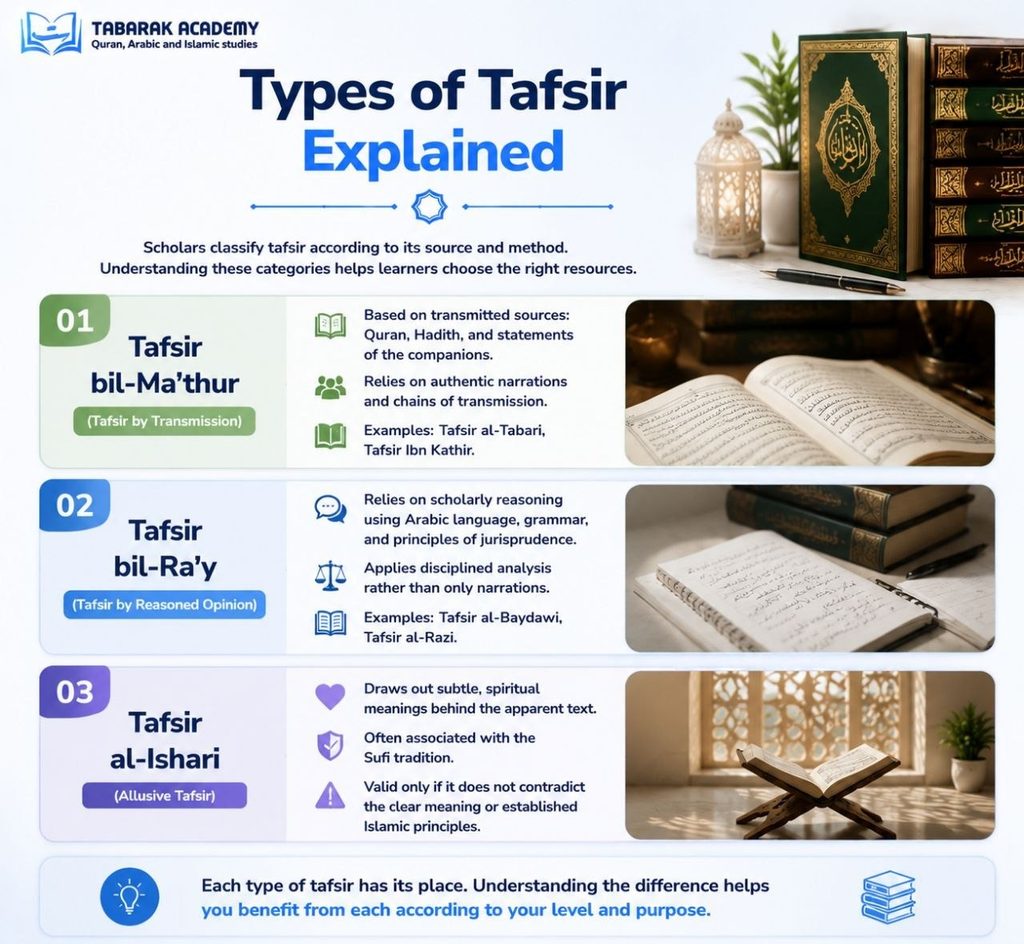
Scholars have classified tafsir according to its source and method. Understanding these categories helps learners evaluate which tafsir resources are appropriate for their level and needs, and why some tafsir books differ so much in style and depth.
1. Tafsir bil-Ma’thur (Tafsir by Transmission)
Tafsir bil-ma’thur is interpretation based on transmitted sources: the Quran explaining itself, the sayings of Prophet Muhammad ﷺ, and the statements of his companions.
Classical examples include Tafsir al-Tabari and Tafsir Ibn Kathir, both built primarily on narrated evidence rather than personal reasoning.
Read also: Tafsir Ibn Kathir vs Al-Jalalayn: Which Should Beginners Read?
2. Tafsir bil-Ra’y (Tafsir by Reasoned Opinion)
Tafsir bil-ra’y relies on scholarly reasoning grounded in Arabic language, grammar, and established principles of jurisprudence.
Works such as Tafsir al-Baydawi and Tafsir al-Razi fall under this category, applying disciplined analysis rather than only quoting earlier narrations.
3. Tafsir al-Ishari (Allusive Tafsir)
Tafsir al-ishari draws out subtle, spiritual meanings that some scholars perceive beneath the apparent text, often associated with the Sufi tradition.
This category is only considered valid when it does not contradict the plain meaning of the verse or established scholarly consensus.
What Is the Difference Between Tafsir and Ta’wil in Quran Interpretation?
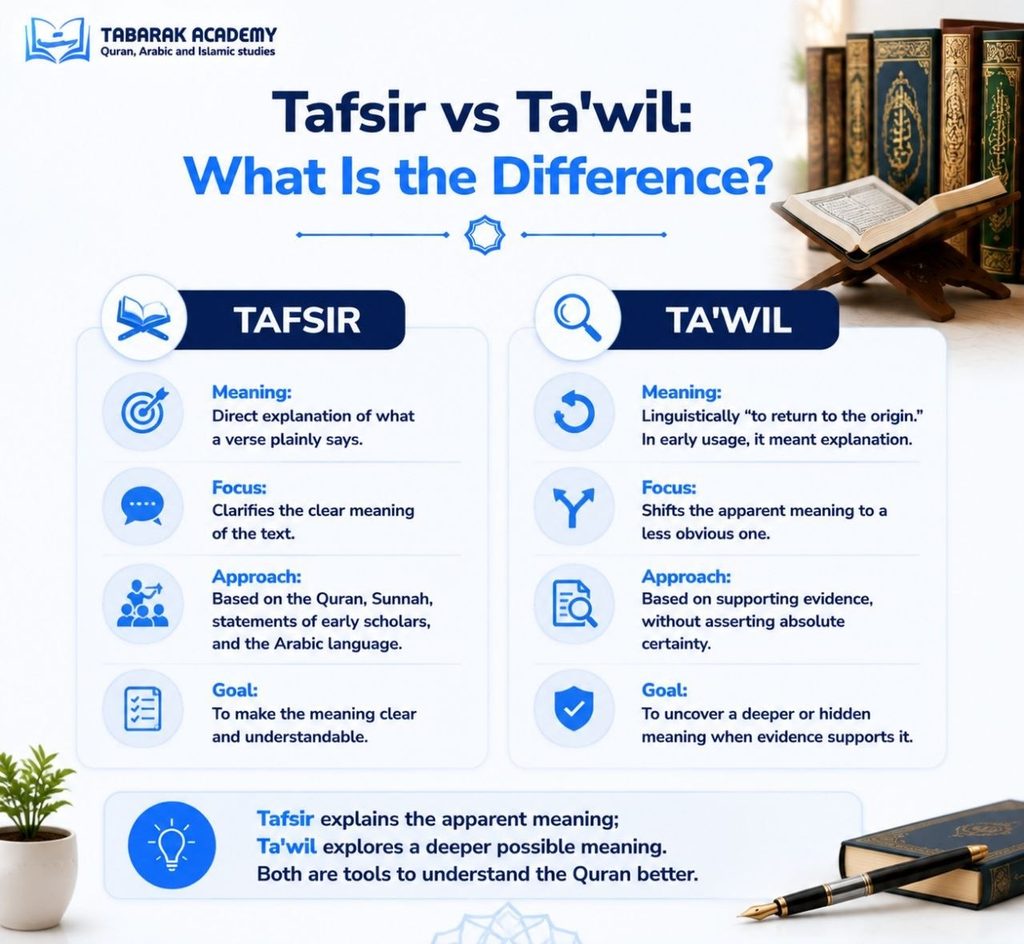
Many learners confuse tafsir with ta’wil, since both terms relate to interpreting the Quran. Ta’wil linguistically means “to return to the origin,” and in early classical usage it referred simply to explanation, much like tafsir itself.
Later scholars narrowed ta’wil to mean shifting a word’s apparent meaning to a less obvious one, based on supporting evidence, without asserting absolute certainty. Tafsir, by contrast, is generally understood as a more direct explanation of what a verse plainly says.
Read also: Trusted English Quran Translations and How to Pick One
Recognizing this distinction helps learners read scholarly commentary more accurately, especially when classical mufassirs use both terms in close succession.
Who Is Qualified to Interpret the Quran?
Not every reader of Arabic is qualified to produce tafsir. The scholar Al-Suyuti outlined strict conditions for a mufassir, including sound doctrine, mastery of Arabic grammar, and deep familiarity with the Quran, hadith, and the statements of the companions.
This is precisely why self-directed reading of translations, however sincere, cannot replace structured study. A learner benefits far more from guided lessons where a qualified teacher explains context, cross-references related verses, and corrects misunderstandings in real time.
This is one of the reasons dedicated online Quran classes exist: to connect learners with teachers trained in these very qualifications, rather than leaving them to interpret verses alone.

How Beginners Can Start Learning Tafsir Without Feeling Overwhelmed
Beginners should approach Tafsir gradually rather than starting immediately with lengthy classical commentaries.
The goal at the beginning is to build a reliable understanding of the Quran’s meanings, context, and key lessons while developing a foundation for deeper study later. A practical starting path is:
1. Begin With a Short and Reliable Tafsir Written for Beginners
Start with a concise Tafsir that explains the meaning of each passage in accessible language. This helps you understand the main message of the Ayat without becoming overwhelmed by extensive linguistic, legal, or scholarly discussions.
Begin with shorter Surahs you already recite regularly. Understanding familiar passages such as Al-Fatihah and the short Surahs of Juz’ Amma allows you to connect Tafsir directly with your daily Salah and Quran recitation.
Read also: Top 6 Easy English Tafsir Books for Absolute Beginners
2. Read the Quranic Passage Before Studying Its Tafsir
Do not treat Tafsir as a separate book disconnected from the Quran itself. First read or recite the Ayat carefully, then read their translation if needed, and finally study the Tafsir. Afterward, return to the verses and recite them again with their meaning in mind.
A simple study sequence is:
Recite the Ayat → Read the translation → Study the Tafsir → Identify the main lesson → Recite the Ayat again
This makes Tafsir part of your relationship with the Quran rather than a purely academic exercise.
3. Learn the Context and Key Themes Instead of Memorizing Explanations
As a beginner, focus first on understanding what the passage is teaching.
Ask simple questions:
- What is the main message of these Ayat?
- Who or what is being discussed?
- Is there important historical context?
- Is the passage teaching a belief, command, warning, story, or moral lesson?
- How does this passage connect with the verses before and after it?
- What lesson should I remember after studying it?
This approach develops comprehension before you move into more advanced discussions.
Read also: What Is Juz Amma? Why It’s Always Taught First
4. Keep Tafsir Study Connected to Correct Quran Recitation
Understanding and recitation should support each other. As you study the meaning of a passage, continue working on its Tajweed, Makharij, fluency, and Waqf and Ibtida’. Appropriate stopping and starting becomes particularly meaningful when you understand how the words and phrases are connected.
Instead of separating “recitation time” from “understanding time,” use the same short passage for both whenever possible.
5. Study With a Qualified Teacher When Explanations Become Difficult
Books and translations are useful starting resources, but beginners will eventually encounter verses involving unfamiliar terminology, historical context, linguistic nuances, or differences in scholarly explanation.
This is where a qualified teacher becomes especially valuable.
For non-Arabic speakers, a teacher can explain scholarly material in accessible language, clarify unfamiliar Arabic terms, answer questions, and help distinguish the direct meaning of an Ayah from additional interpretation or commentary.
The aim is not to read the greatest number of Tafsir pages. It is to develop a structured and reliable understanding of the Quran that becomes deeper as your knowledge grows.

Step Inside Our Virtual Classrooms
See our engaging teaching methods in action! watch real snippets of our live classes and discover how our expert instructors make learning interactive, memorable, and inspiring for every student.
Start Learning Tafsir and Quran with Tabarak Academy
Tabarak Academy offers online Quran and Tajweed classes for children, adults, and families worldwide, with qualified teachers who guide learners through correct recitation and the foundations of tafsir at a pace suited to each student.
Ready to understand the Quran more deeply? Book Your Free Trial Class and experience a personalized learning path designed for non-Arabic-speaking students.
Our Islamic Studies Courses
- Online Islamic Studies Classes
- Islamic Studies for Beginners Course
- Islamic Studies Classes for Kids
- Islamic Studies for Adults Course
- Islamic Studies for Ladies Course
- Islamic Studies for New Muslims Course
- Tafseer Al Quran Course
- Quranic Sciences (Uloom Al Quran) Course
- 5 Pillars of Islam for Kids Course
- Islamic Summer Camp

Conclusion
Understanding what is tafsir gives every Quran learner a clearer path toward genuine comprehension rather than surface-level reading. Tafsir meaning, whether traced through its Arabic root of uncovering and clarifying, or through the more technical definitions offered by scholars like Al-Zarkashi and Al-Zarqani, centers on explaining Allah’s intended message within human capacity.
Recognizing the difference between tafsir bil-ma’thur, tafsir bil-ra’y, and tafsir al-ishari, along with the distinction between tafsir and ta’wil, equips learners to engage with commentary far more confidently.
The key takeaway is simple: tafsir explained properly requires qualified guidance, not isolated reading, which is why structured lessons remain the most reliable way to build lasting understanding of the Quran.
Frequently Asked Questions About Tafsir
What is tafsir in simple words?
Tafsir is the Islamic science of explaining the meanings, context, and rulings found in the verses of the Quran. It moves beyond literal translation to clarify what a verse means and why it was revealed, drawing on Arabic language, hadith, and the statements of early scholars.
What is the difference between tafsir and translation?
Translation converts Quranic words into another language, while tafsir explains the deeper meaning, context, and rulings behind those words. A translation alone cannot capture historical context or scholarly reasoning, which is exactly what tafsir provides.
Who wrote the most famous tafsir books?
Some of the most referenced tafsir works include Tafsir al-Tabari by Ibn Jarir al-Tabari, Tafsir Ibn Kathir by Ibn Kathir, and Tafsir al-Qurtubi by Al-Qurtubi. Each reflects a distinct scholarly approach, ranging from transmitted narrations to detailed legal analysis.
Can a beginner read tafsir without a teacher?
A beginner can read simplified tafsir summaries, but classical commentary is best studied with a qualified teacher who can explain difficult terms and scholarly disagreements. Guided instruction helps prevent verses from being misunderstood outside their original context.
Is tafsir the same as ta’wil?
Tafsir and ta’wil are related but not identical. Tafsir generally refers to a direct explanation of a verse’s meaning, while ta’wil, in its later scholarly usage, refers to shifting a word’s apparent meaning to a supported alternative without absolute certainty.