

What Is Juz Amma? Meaning, Structure, And Why It’s Taught First
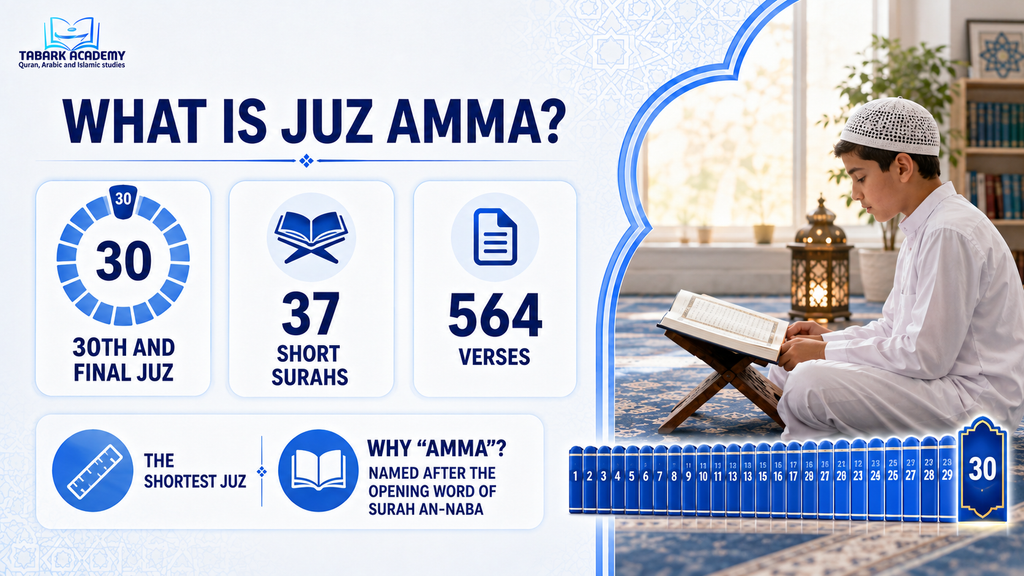
If you’ve started looking into Quran memorization, you’ve probably run into the term Juz Amma and wondered exactly what it refers to. Juz Amma is the 30th and final part of the Quran. It is made up of 37 short surahs that most Muslims encounter before any other section of the book.
Almost every child and many adult beginners start with this juz. It is the reason that makes the rest of a memorization journey much easier to plan.
This guide explains what Juz Amma is and which surahs it contains. It also illustrates what it actually teaches, and why teachers consistently start beginners here instead of anywhere else in the Quran.
What You’ll Learn In This Article
- What Juz Amma means and where it sits in the Quran’s structure
- The full range of surahs it contains, from An-Naba to An-Nas
- The central themes that run through nearly every surah in this part
- Why it’s the standard starting point for children and new memorizers
- How to approach memorizing it without common early mistakes
What Is Juz Amma?
Juz Amma is the name given to the 30th juz (part) of the Quran. The final of the 30 equal divisions used to structure memorization and recitation schedules. It covers 564 verses across 37 surahs. All of these surahs are relatively short.
Where Does Juz Amma Fit In The Quran?
The Quran is divided into 30 parts called ajzaa (singular: juz). Reciters can complete the entire book in a month, reading roughly one juz per day. Juz Amma جزء عَمَّ is the last of these 30 parts. It’s also the shortest.
Its 37 surahs fit into a fraction of the space that longer parts like Juz 1 or Juz 2 require for just two or three surahs.
Why Is It Called “Amma”?
The name of this juz comes directly from the opening word of the first surah in this part, An-Naba: “Amma yatasa’aloon” عَمَّ يَتساءلُون (“About what are they asking one another?”).
Quranic parts are traditionally named after their first distinctive word rather than a descriptive title. That is why “Amma”, not a translated phrase, became the standard name across Arabic and English sources alike.
Tabarak Academy presents a children’s memorization program around this exact part first. It follows the same reason classical teachers have for centuries. Short surahs build early confidence before longer, more demanding sections.
Read also: 3 main virtues of the Holy Quran
What Surahs Are In Juz Amma?
Juz Amma contains 37 surahs. It begins with An-Naba (The Great News) and ends with An-Nas (Mankind), the final surah in the entire Quran.
From An-Naba To An-Nas
The surahs run in the same order as they appear in the printed mushaf: An-Naba, An-Nazi’at, Abasa, At-Takwir, Al-Infitar, Al-Mutaffifin, Al-Inshiqaq, Al-Buruj, At-Tariq, Al-A’la, Al-Ghashiyah, Al-Fajr, Al-Balad, Ash-Shams, Al-Layl, Ad-Duha, Ash-Sharh, At-Tin, Al-Alaq, Al-Qadr.
Juz Amma also includes Al-Bayyinah, Az-Zalzalah, Al-Adiyat, Al-Qari’ah, At-Takathur, Al-Asr, Al-Humazah, Al-Fil, Quraysh, Al-Ma’un, Al-Kawthar, Al-Kafirun, An-Nasr, Al-Masad, Al-Ikhlas, Al-Falaq, and An-Nas.
Most run three to twenty lines in a standard mushaf, which is exactly why they’re manageable for a beginner reciting for the first time.
Read also: How Many Surahs Are In Juz Amma?
Meccan And Medinan Surahs In Juz Amma
There are only three Medinan surahs of the 37 ones. The remaining 34 are Meccan. The three Medinan surahs are: An-Nasr النصر, Al-Bayyinah البيّنة, and Az-Zalzalah الزلزلة. This is important practically, not just historically.
Meccan surahs in this juz tend to use short, rhythmic verse endings built around themes of faith and the afterlife. It is part of why they’re easier to memorize by sound before a student fully understands the meaning.
The three Medinan surahs read differently. They have longer verses and more legal and social content. They are also closer in style to what a student will encounter later in the Quran.
Read also: How To Start Memorizing The Quran As A Beginner?
Experience Our Interactive Learning
Curious about how we teach? Watch these brief video clips from our recent live sessions to see our structured curriculum, advanced learning platform, and dynamic student-teacher interactions firsthand.
What Themes Does Juz Amma Cover?
Nearly every surah in Juz Amma returns to one core idea. The Hereafter belongs to God, and every person will stand before Him for judgment.
a. The Day Of Judgment And The Afterlife
Surahs like An-Naba النبأ, Al-Infitar الانفطار, and Al-Qari’ah القارعة describe the events of the Day of Judgment in vivid, sequential imagery. For instance, the sky splitting, mountains scattering, and the earth giving up what’s buried inside it.
This isn’t incidental. It’s the organizing theme of the entire juz, repeated from different angles so that a memorizer absorbs the concept from multiple surahs rather than just one.
Read also: The Shortest Quran Surahs to Start Memorizing Right Now
b. Signs Of God’s Power In Creation
Surahs such as At-Tariq and Al-Ghashiyah point to creation itself as evidence. For example, the camel, the sky, the mountains, and the way rain brings vegetation out of dry earth.
The pattern is consistent throughout the juz: physical evidence in the natural world, followed by a reminder that the same power will bring about resurrection. A student who notices this pattern across surahs retains the meaning far better than one who memorizes each surah as an isolated block of text.
Recognizing these recurring themes is exactly what a structured teacher adds that a student memorizing alone often misses.
It’s one reason a guided program, like the ones Tabarak Academy runs for Juz Amma specifically, tends to produce faster retention than self-study from a printed mushaf alone.
Read also: Best Quran Hifz Schools for Online Quran Memorization
Why Is Juz Amma Explained To Children First?
Juz Amma is the standard starting point for children’s Quran education, and the reasoning is practical rather than arbitrary.
1. Short Surahs Help Children Build Confidence and Recitation Skills
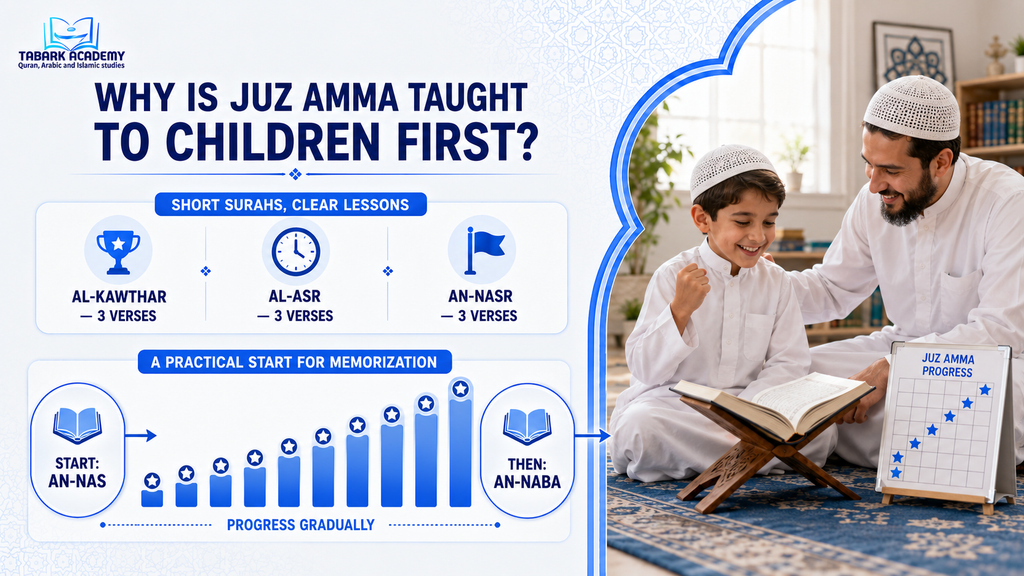
The shortest surahs in the entire Quran, Al-Kawthar, Al-Asr, and An-Nasr, sit in this juz, some as brief as three verses.
For a young child building recitation habits, a three-verse surah offers a complete, memorable win in a single sitting, which longer surahs elsewhere in the Quran simply can’t provide at the same pace.
2. Starting With the Easiest Surahs Makes Quran Memorization More Manageable
Teachers typically move backward through this juz, starting with An-Nas and working toward An-Naba, because verse length and vocabulary complexity generally increase as the juz progresses.
A common early mistake is starting straight through from An-Naba. The vocabulary and verse length there are noticeably harder than the shortest surahs near the end.
A beginner who starts there often loses momentum within the first week. Starting from the back of the juz and moving forward keeps early sessions short enough to sustain daily practice.
Read also: Online Tajweed Classes for Ladies – Learn to Recite the Quran Beautifully
Understanding Difficult Words In Juz Amma
Several early surahs in this juz include Arabic vocabulary that isn’t part of everyday speech, which is part of why a guided reading, not just repetition, matters.
In An-Naba, “mihada” refers to the earth as a resting place, likened to a cradle. In An-Nazi’at, “an-nazi’at” and “an-nashitat” describe angels drawing out souls, forcefully for disbelievers, gently for believers, a contrast that’s easy to miss without a teacher pointing it out.
In Abasa عَبَسَ, “abasa” means the Prophet’s ﷺ expression changed and darkened, part of the surah’s well-known lesson on treating every person, wealthy or not, with equal attention.
This is the layer that separates recitation from comprehension. A student can pronounce every word correctly and still miss the meaning entirely, which is why Tabarak Academy pairs memorization sessions with word-by-word meaning explanations rather than repetition alone.
Read also: Can I Memorize the Quran at 40? A Realistic Guide for Adult Learners
Start Learning Juz Amma With Guided Support
Memorizing Juz Amma on your own from a printed mushaf is possible, but most students pause within the first few weeks without correction on pronunciation, pacing, or word meaning.
Tabarak Academy runs live, one-on-one Quran memorization classes built around Juz Amma as the starting point for children and new adult learners, with certified teachers correcting recitation in real time and explaining meaning alongside each surah.
Our Quranic Arabic Courses
- Quranic Arabic Classes
- Quranic Arabic Course for Kids
- Quranic Arabic for Beginners
- Quranic Arabic Grammar Course
Our Quran Courses
- Online Quran Classes
- Online Quran Classes for Beginners
- Online Quran Classes for Kids
- Online Quran Classes for Adults
- Online Quran Classes for Men
- Online Quran Classes for Sisters
- Quran Reading Course
Conclusion
Juz Amma is the Quran’s 30th and final part, 37 short surahs, 564 verses, running from An-Naba to An-Nas. It’s built almost entirely around one message: the Hereafter belongs to God, and every person will answer for their deeds.
Its short surah length and repeated themes make it the natural entry point for children and beginners, but getting real value from it means pairing memorization with an understanding of what the words actually mean.
That combination, not just repetition, is what turns Juz Amma from a memorization exercise into a foundation for the rest of the Quran.
Frequently Asked Questions
What Is Juz Amma In Simple Terms?
Juz Amma is the 30th and last part of the Quran, containing 37 short surahs from An-Naba to An-Nas. It’s the section most Muslims, especially children, memorize first because of its short verse length.
How Many Surahs And Verses Are In Juz Amma?
Juz Amma contains 37 surahs and 564 verses in total. Most of these surahs are only a few lines long, which is why this juz is completed faster than any other part of the Quran.
Why Is It Called Juz Amma?
The name comes from “Amma,” the opening word of An-Naba, the first surah in this part. Quranic parts are traditionally named after their first distinctive word rather than a descriptive English title.
Is Juz Amma Meccan Or Medinan?
Juz Amma is mostly Meccan. Of its 37 surahs, 34 were revealed in Mecca and only three, An-Nasr, Al-Bayyinah, and Az-Zalzalah, were revealed in Medina.
Why Do Children Learn Juz Amma First?
Children start with Juz Amma because its surahs are short enough to memorize in single sessions, building consistent recitation habits before moving to the Quran’s longer parts.
What Is The Main Theme Of Juz Amma?
The main theme across nearly all of Juz Amma is the Day of Judgment and the certainty of the afterlife, reinforced through descriptions of creation as evidence of God’s power to resurrect.