

The Importance of the Arabic Language in Islam – 10 Reasons Every Muslim Should Learn It
Most Muslims recite Arabic every day in Salah, in du’a, and in Quran — yet most do so without understanding a single word. That gap between the tongue and the heart is precisely what the importance of Arabic language in Islam addresses, and closing it changes the experience of worship permanently.
Arabic is spoken by more than 400 million people across 22 countries and is one of the six official languages of the United Nations. But for Muslims, its significance runs deeper than geography: it is the language in which Allah chose to preserve His final revelation, unchanged, for over 1,400 years. Learning it is both a spiritual investment and a practical one.
This article explains exactly why the importance of learning Arabic in Islam is not limited to scholars — and what every Muslim stands to gain from it.
1. The Relationship Shared by Qur’an and Arabic language
The importance of Arabic language in Islam is grounded first and foremost in its direct relationship with the Quran.
The Quran was revealed in Arabic, and every translation of it is, by definition, an interpretation — not the Quran itself. Classical scholars unanimously describe translated versions as “the meanings of the Quran,” never the Quran. Nuance is lost, connotation shifts, and the precise weight of Arabic words cannot be fully carried into any other language.
By learning Arabic, you gain a better appreciation and acknowledgment of the Quran, its subtleties, and its meaning. When you understand the words directly, you form a deeper connection with the text. This not only assists in reading but also in memorization — and when you understand the words, implementing them in daily life becomes considerably easier.
Why No Translation Can Replace the Arabic Original?
Consider the word رَحْمَن (Ar-Rahmān). It derives from the root ر-ح-م, which simultaneously carries the meanings of mercy, womb, and encompassing tenderness — a mercy both vast and deeply intimate.
No English word holds all three dimensions at once. This is precisely why the importance of Arabic language is felt the moment recitation you have maintained for years suddenly opens into meaning.
One of the biggest challenges facing non-Arab Muslims is reading the Quran with correct Tajweed while genuinely understanding what is being recited. Both challenges are addressed through structured Online Quran & Arabic Classes that take learners from the alphabet through to Quranic comprehension — at their own pace, from home.
2. Understanding the Sunnah of Prophet Muhammad (P.B.U.H)
The Arabic language has obtained a surprising worth over the years as the whole Islamic legacy is written in it.
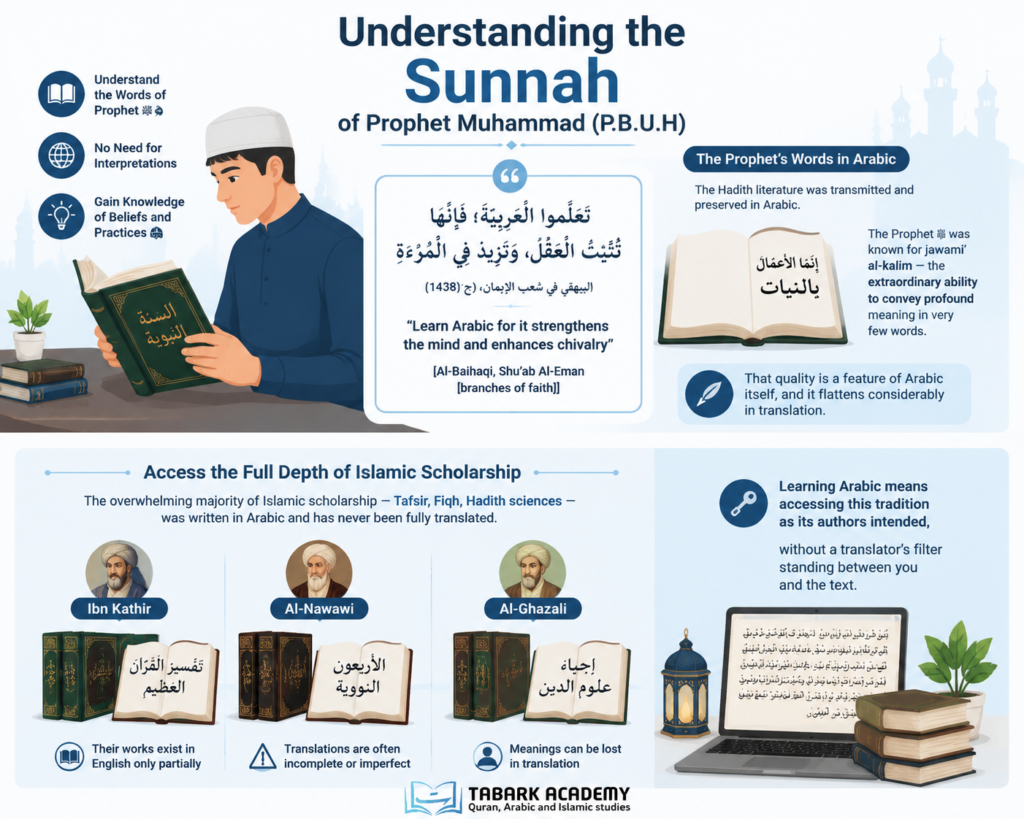
Subsequently, learning Arabic is really compensating on many levels; it permits you to comprehend the expressions of Prophet Muhammad (Peace be upon Him) and his Sunnah after looking into it further without requiring any interpretations.
Furthermore, it likewise allows you the opportunity to acquire knowledge into the Islamic convictions and habits. There is a hadith about the importance of Arabic language learning which says
“(تَعَلَّمُوا الْعَرَبِيَّةَ؛ فَإِنَّهَا تُثَبِّتُ الْعَقْلَ، وَتَزِيدُ فِي الْمُرُوءَةِ” (البيهقي في شعب الإيمان
“Learn Arabic for it strengthens the mind and enhances chivalry”
The Hadith literature was transmitted and preserved in Arabic, and the Prophet ﷺ was known for jawami’ al-kalim — the extraordinary ability to convey profound meaning in very few words. That quality is a feature of Arabic itself, and it flattens considerably in translation.
The overwhelming majority of Islamic scholarship — Tafsir, Fiqh, Hadith sciences — was written in Arabic and has never been fully translated. Scholars like Ibn Kathir, Al-Nawawi, and Al-Ghazali wrote in Arabic; their works exist in English only partially, and often imperfectly. Learning Arabic means accessing this tradition as its authors intended, without a translator’s filter standing between you and the text.
3. Connecting with Muslim Communities Across 22 Countries
The importance of Arabic language also has a deeply communal dimension. Languages are the key to the cultures and societies of different peoples.
Even basic Arabic conversation opens significant doors — it gives you the ability to communicate meaningfully with Arabic-speaking Muslims across communities worldwide, whether in Makkah during Hajj, in scholarship circles, or simply in everyday connection with fellow believers.
The companion Omar Ibn Al-Khattab (may Allah be pleased with him) addressed the Islamic Ummah and said:
“Learn Arabic for it is important for your religion.”
Arabic is spoken across 22 countries and serves as a shared formal register — Modern Standard Arabic (Fus’ha) — understood from Morocco to the Gulf.
A Muslim who learns Arabic gains access not just to a language, but to a global community and a shared civilization that spans 1,400 years — and this is precisely why the importance of Arabic language extends well beyond the individual to the entire Ummah.
Experience Our Interactive Learning
Curious about how we teach? Watch these brief video clips from our recent live sessions to see our structured curriculum, advanced learning platform, and dynamic student-teacher interactions firsthand.
Read Also: 3 main virtues of the Holy Quran
4. Achieve Complete Mindfulness in Salah
Among the most practical expressions of the importance of Arabic language in daily Muslim life is its direct effect on Salah.
Salah is the key to success in this life and the next — yet for most non-Arabic speakers, it remains an act performed with sincere hearts and near-zero comprehension. Understanding Arabic changes that completely, and it is one of the most practical reasons why learning Arabic is important for every Muslim.
When you know that Ar-Rahman means “the Endlessly Merciful” and Al-Malik means “the Sovereign King,” Surah Al-Fatihah — recited seventeen times every single day — stops being a formula and becomes a direct address to Allah. That shift in consciousness is permanent.
The Link Between Arabic Comprehension and Khushu’
Classical scholars consistently emphasized the link between comprehension and khushu’ (concentration in prayer). Ibn Al-Qayyim noted that understanding what one recites is among the foundations of presence of heart during Salah.
When your mind tracks meaning alongside recitation, distraction has far less room to enter. Improving your Arabic is one of the most productive steps you can take to transform your prayer from ritual into genuine conversation with Allah.
If deepening your Salah is a goal, beginning with structured Online Quran & Arabic Classes is the most direct path there — covering both correct recitation and the vocabulary that makes comprehension possible.
5. Correcting Misconceptions About Islam from the Source
When you understand Arabic — the language of the Quran — you can quickly identify and correct misrepresentations and factual errors about Islam. This has become increasingly important: many distorted claims about Islam rely on Quranic verses taken out of context, poor translations, or selective readings that obscure the actual meaning.
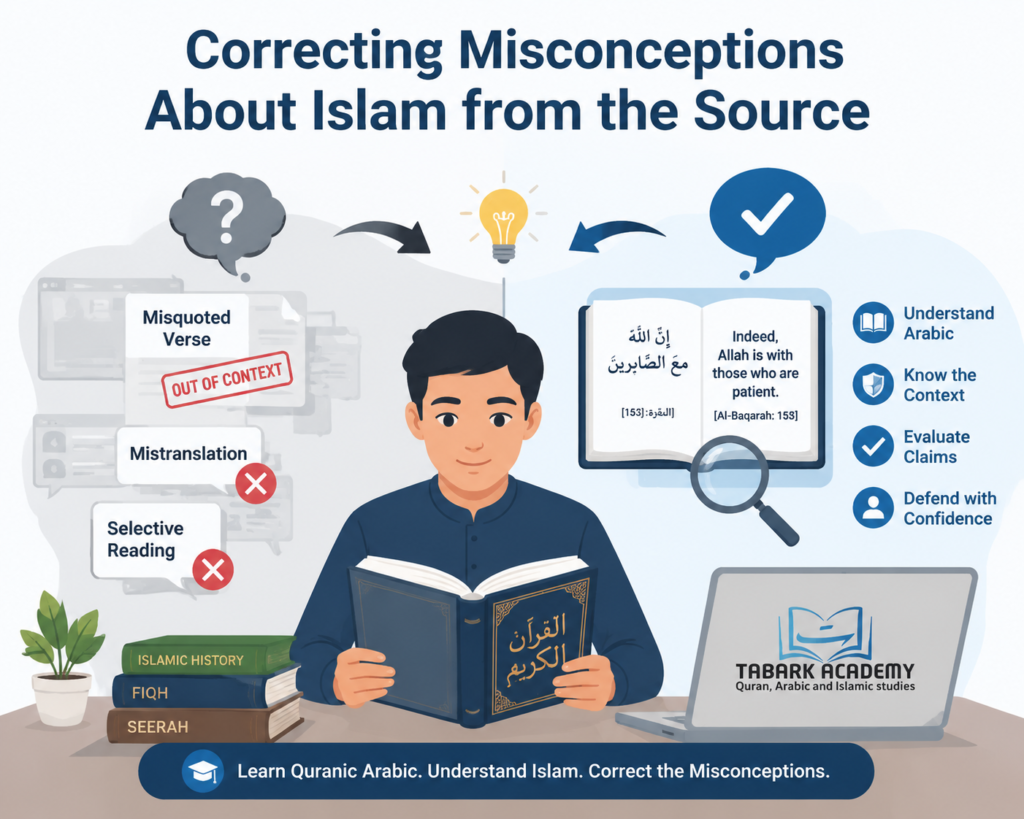
This issue is resolved directly and permanently when you have your own, genuine comprehension of both the Quran and the Arabic in which it was revealed. Many Muslims today depend entirely on interpreted versions of the Quran and Islamic teachings — which, however well-intentioned, leave them unable to evaluate claims about their own religion.
The strongest defense against misquotation is direct knowledge of the Arabic source. Students who complete even a foundational Arabic course report a measurable increase in their ability to evaluate claims about the Quran and Islamic law. Tabarak Academy’s Islamic Studies Course Online pairs Quranic Arabic with contextual Islamic knowledge, so you can read and assess — not just receive.
6. The Cognitive and Intellectual Case for Learning Arabic
Beyond the spiritual dimension, the importance of Arabic language and its role in Islamic learning has a well-documented intellectual basis.
Bilingual and multilingual individuals consistently demonstrate stronger working memory, improved analytical reasoning, and greater ability to switch between complex tasks.
Arabic in particular trains the brain in ways few other languages do. Its root-based morphology means that learning one three-letter root unlocks dozens of related words simultaneously, forcing learners to think in semantic families rather than isolated vocabulary. Bilingual research consistently shows that people who learn a second language have more commendable critical thinking capacities and are better communicators with stronger memories.
Learning Arabic also broadens cultural and intellectual horizons — it provides a vastly more global and intercultural understanding of Islamic civilization, history, and thought. It is not simply a language; it is a key to over a millennium of accumulated human and spiritual knowledge.
For those ready to build this foundation, Tabarak Academy’s Modern Standard Arabic Online Course (Fusha) is structured for non-native adult learners, progressing from foundational grammar through Quranic vocabulary at a realistic, sustainable pace.
7. Arabic Is A Religious Obligation, Not Only A Recommendation
One dimension of the importance of Arabic language in Islam that receives insufficient attention is its legal status within the Deen itself.
Imam Al-Shafi’i stated:
“It is obligatory upon every Muslim to learn from the Arabic language what allows him to make effort in fulfilling his obligations.” (Ar-Risala)
Ibn Taymiyyah went further:
“The Arabic language itself is from the religion, and knowledge of it is an obligation, because understanding the Book and the Sunnah is an obligation — and that without which an obligation cannot be fulfilled is itself obligatory.”
How Much Arabic Is Obligatory for Every Muslim?
At a minimum, every Muslim is obligated to know the Shahada, Surah Al-Fatihah, and the supplications of Salah in correct Arabic. This is the individual obligation (fard ‘ayn).
Beyond this, the community as a whole bears a collective obligation (fard kifayah) to maintain Arabic scholarship, teach it, and transmit it — because without that, the religious sciences cannot be preserved or correctly applied.
The distinction between these two levels is practically useful: it tells every Muslim precisely where their personal obligation begins, and it tells scholars and teachers where the broader communal responsibility lies.
8. Building a Correct Islamic Worldview Through Arabic Concepts
The importance of Arabic language to correct Aqidah is perhaps most visible in the concepts that Arabic alone carries fully.
The Arabic language is the vessel in which the conceptual framework of Islam was formed, and many of its core concepts cannot be fully transferred into other languages without significant loss.
Take the word تقوى (Taqwa). It is variously translated as fear, piety, or God-consciousness — yet each translation captures only a fragment. Taqwa in its full Arabic sense means to be so aware of Allah’s reality that one becomes reverential, cautious against disobedience, and oriented toward righteousness simultaneously.
No single word in English, Urdu, or French contains all of these dimensions together. The Prophet ﷺ was asked who the noblest of people are, and he replied:
أَكْرَمُهُمْ أَتْقَاهُمْ
“The noblest to Allah are the most righteous.” (Sahih Bukhari)
Concepts like Tawakkul, Ihsan, Wali, Fitnah, and Istighfar each carry layers of meaning that shape how a Muslim understands their obligations, their relationship with Allah, and their ethical framework.
A Muslim who relies entirely on translations forms their Aqidah through the lens of another language — and that lens inevitably reshapes the concepts it attempts to carry. Learning Arabic means thinking within the Quran’s own conceptual structure, not through a filtered approximation of it.
9. Arabic Preserves the Miraculous Sound of the Quran
The Quran is not only a textual miracle, it is an auditory one, and its phonetic structure exists in Arabic alone.
The rules of Tajweed — including Ghunnah (nasal resonance), Qalqalah (echo sounds), Idgham (merging), and Ikhfa (concealment) — are inseparable from the Arabic phonological system.
Every letter is articulated from a precise point (Makhraj) with defined attributes (Sifat) that exist in Arabic and have no equivalents in other languages. This acoustic architecture is itself part of the Quran’s inimitability (I’jaz).
A translation may transmit meaning, but it cannot replicate the Ghunnah on a noon mushaddad, or the Qalqalah of a qaf at the end of خَلَقَ.
These are not decorative features — they are part of the divine speech as it was revealed and transmitted orally through an unbroken chain (Sanad) from the Prophet ﷺ to every generation of reciters since.
Learning Arabic — and specifically learning Tajweed — connects you directly to that living chain of transmission, which is why the Ijazah system exists to preserve it. A Recitation of Quran with Tajweed Course is the structured entry point for any Muslim who wishes to recite as the Quran was meant to be heard.
10. Arabic Beautifies the Character and Speech of the Muslim
The tongue is how the inner world is expressed to others — beliefs, knowledge, intentions, and values all pass through it. Speaking well, in a language of precision, depth, and beauty, is a form of personal dignity.
Ibn Shubrumah, the renowned hadith scholar, is reported to have said:
“Men have never worn a garment more beautiful than Arabic.” (Al-Bayhaqi, Shu’ab Al-Iman)
This is not aesthetic sentimentality — it reflects a deep awareness that the language shaping one’s thought also shapes one’s character.
Imam Abu Mansur Al-Tha’alibi captured the ultimate motivation clearly:
“Whoever loves Allah loves His Prophet ﷺ; whoever loves the Arab Prophet loves the Arabs; and whoever loves the Arabs loves the Arabic language — in which the best of books was revealed upon the best of creation.”
Learning Arabic, at its deepest level, is not a linguistic achievement. It is an act of love — for Allah, for His Messenger ﷺ, and for the Quran that arrived in no other tongue.
If deepening your Arabic is a goal, beginning with structured Online Quran and Arabic Classes tailored to your level — whether you are starting from the alphabet or building Quranic vocabulary — is the most direct path to making that love productive.
Step Inside Our Virtual Classrooms
See our engaging teaching methods in action! watch real snippets of our live classes and discover how our expert instructors make learning interactive, memorable, and inspiring for every student.
Learn Arabic With Tabarak Academy And Connect With The Quran Directly
Arabic is not out of reach. With the right structured course, non-native speakers move from the alphabet to reading Quranic sentences in a matter of weeks — not years.
Tabarak Academy’s qualified instructors deliver live, personalized online lessons tailored to your level, your schedule, and your goals — whether that is Quran comprehension, Salah awareness, or access to classical Islamic texts.
Our Courses:
- Online Quran & Arabic Classes | Foundation
- Online Quran Memorization Course
- Modern Standard Arabic Online Course (Fusha)
- Online Ijazah Course
- Recitation Of Quran with Tajweed Course
- Islamic Studies Course Online

Conclusion
The importance of Arabic language in Islam cannot be overstated. It is the language of the Quran, the Sunnah, and 1,400 years of Islamic scholarship — and it is the key to Salah that moves the heart rather than the lips alone. Learning Arabic is not a luxury for scholars.
It is a practical step available to any Muslim willing to commit consistent time to structured study. The spiritual return — a Quran you understand, prayers you feel, and a tradition you can access directly — is proportional to the effort invested.
Whether you begin with Quranic vocabulary, Modern Standard Arabic grammar, or an [Online Ijazah Course], the importance of Arabic language will become personally felt from your very first lesson — and that first lesson is the only step that matters right now.
Frequently Asked Questions
Here are answers to the most common questions about the importance of Arabic language in Islam and how to begin learning it.
What is the importance of the Arabic language in Islam?
Arabic is the language of the Quran, the Hadith, and the entire Islamic scholarly tradition. Learning it allows Muslims to understand divine revelation directly, pray with comprehension, and access Islamic knowledge without depending on translations that inevitably carry interpretive limitations.
Why is learning Arabic important for non-Arab Muslims?
Non-Arab Muslims who learn Arabic gain direct access to the Quran’s meaning, understand their Salah fully, and can evaluate Islamic rulings and teachings without depending on intermediaries. It also removes a significant barrier to memorizing and retaining Quran, since understanding accelerates both learning and recall.
What is the best way to start learning Arabic for the Quran?
Begin with the Arabic alphabet and short Quranic vocabulary, then progress to basic grammar (Nahw and Sarf). A structured course taught by a qualified instructor — rather than an app alone — significantly accelerates the process. Most motivated adult learners reach functional Quranic reading within six to twelve months of consistent weekly study.
Does learning Arabic help with Quran memorization?
Yes, measurably. When a student understands the meaning of what they are memorizing, retention improves and the rate of forgetting drops substantially. This is why traditional hifz programs historically taught Arabic meaning alongside recitation, not after it.
Can I learn Arabic online as a complete beginner?
Yes. Structured online Arabic courses designed for non-native speakers begin from zero — the alphabet, pronunciation, and basic vocabulary — and progress at a pace set by the learner. Live one-to-one instruction is more effective than self-study for most adult learners because mistakes are corrected immediately rather than reinforced through repetition.