


Which Surahs Should I Memorize First? A Beginner’s Guide
Starting Quran memorization can feel overwhelming if you open the Mushaf at Surah Al-Baqarah and try to begin there.
The good news is that you don’t have to. If you’re wondering which surahs you should memorize first, the short answer is: start with the short surahs at the end of the Quran, known as Juz Amma, then build outward from what you already recite in your daily prayers.
This sequence is not fixed. In fact, it is a practical sequence derived from the real experience of Quran teachers and learners over many years. It matches the visual and mental memory. Short surahs build self-confidence fast.
Continuous repetition stabilizes the memorization. As a result, when the learner reaches the long surahs, the practical, continuous memorization process will be in place.
This guide illustrates that order step by step, with the reasoning behind each stage. It also helps you build a Quran memorization plan that can be applied where you are today.
1. Start With Short Surahs From Juz Amma to Build Confidence
Juz Amma جزء عَمَّ is the thirtieth and final section (Juz) of the Quran. It is made up mostly of short surahs. It’s the standard starting point for new memorizers because its surahs are brief and frequently recited in prayer. Its surahs are also easier to hold in memory before you’ve built up a routine.
Beginning here isn’t about avoiding difficulty. It’s about sequencing. A beginner who memorizes ten short surahs in a month builds a habit and a sense of progress.
A student who opens straight to Surah Al-Baqarah, which is the longest surah in the Quran, often pauses within the first two weeks because the surah requires a memorization capacity they haven’t built yet.
Read also: Is It Too Late to Learn to Read the Quran as an Adult? Practical Steps to Start Today
a. Memorize Surah Al-Fatihah First for Daily Salah
Surah Al-Fatihah is the first surah most beginners memorize. For good reason, it’s recited in every unit of every prayer.
Every Muslim already hears and repeats it multiple times a day before deliberately memorizing it. Its seven verses also introduce the core themes of the Quran, such as praise, guidance, and dependence on Allah. These recur throughout the rest of the text.
Because it’s already familiar from daily prayer, most students memorize Al-Fatihah correctly within a single sitting. This makes it a natural first success on the journey of memorization.
Read also: Best Short Surahs for Beginners to Memorize Easily
b. Start With the Shortest Juz Amma Surahs Before Longer Ones
Within Juz Amma, start with the shortest surahs toward the slightly longer ones. In other words, start from Surah An-Nas الناس at the very end of the Mushaf and move backward toward Surah An-Naba النبأ.
This order is common enough that most Quran teachers assume it as a default. However, there’s no requirement to be strict about the sequence. If a certain surah in this juz feels more difficult for you, skip it and come back later.
A recurrent mistake here is trying to memorize surahs in the order printed in the Mushaf rather than by their ease. Surah difficulty is genuinely subjective.
A surah one student finds simple can trip up another because of unfamiliar vocabulary or repeated but similarly worded verses. Choose based on what is easier for you, not what comes first on the page.
Read also: Is It Too Late to Memorize the Quran? The Honest Answer for Adult Learners

Experience Our Interactive Learning
Curious about how we teach? Watch these brief video clips from our recent live sessions to see our structured curriculum, advanced learning platform, and dynamic student-teacher interactions firsthand.
2. Prioritize Surahs You Can Recite and Review Every Day
When you have a handful of Juz Amma surahs memorized, prioritize the ones you’ll use every day. Daily repetition is what locks memorization in long-term.
These aren’t just easy to learn. They’re also easy to keep, because you naturally recite them outside of dedicated study time.
Why Surah Al-Ikhlas, Al-Falaq, and An-Nas Are Taught Together to Children
Surah Al-Ikhlas الإخلاص, Surah Al-Falaq الفلق, and Surah An-Nas الناس are typically grouped because they’re recited as a set in the morning and evening remembrances (adhkar) and before sleep.
Memorizing these three surahs early means you’re immediately using what you’ve learned, instead of storing it away until a future review session.
This is also where soft repetition does real work. Reciting these three surahs as part of your daily adhkar أذكار functions as built-in review. As a result, you reinforce them without setting aside extra memorization time.
Read also: How To Memorize The Quran?
3. Progress to Longer Surahs With Special Virtues
Several surahs have virtues mentioned in hadith. That makes them a natural next step after the basics of Juz Amma. They tend to be moderate in length.
They are longer than a short Juz Amma surah, but shorter than Al-Baqarah. Thus, they form a reasonable bridge between the two.
a. Memorize Surah Al-Mulk and Al-Kahf as Your Next Step
Surah Al-Mulk المُلك is reported in multiple hadith collections, including Al-Tirmidhi, as interceding for the one who recites it regularly. Surah Al-Kahf الكهف carries a specific virtue tied to Friday recitation, reported by Al-Hakim and Al-Bayhaqi.
Both are commonly recommended to memorize early because they’re recited often enough, weekly, in Al-Kahf’s case. That means the repetition itself supports memorization.
Practically, students often find these surahs easier than their length suggests. The familiarity from regular recitation does part of the memorization work before formal study even begins.
Read also: How To Start Memorizing The Quran As A Beginner?
b. Leave More Difficult Surahs Until Your Hifz Is Stronger
Not every moderate-length surah is a good early choice. Surahs like Yunus يونُس, Fatir فاطِر, An-Nisa النِّساء, An-Nahl النّحل, Al-Ankabut العنكبوت, and Az-Zumar الزُّمَر are generally considered harder for beginners.
Their verses are longer, their vocabulary less repetitive, and they lack the frequent-recitation advantage that surahs like Al-Mulk have. It’s worth saving these for after you’ve built a stronger memorization base.
There is one caution that’s worth noting directly. Surahs are often shared online with claimed virtues that aren’t well supported. The reported virtue of Surah Al-Waqiah الواقعة, for instance, is widely repeated in casual advice but is based on hadith that scholars classify as weak or fabricated.
When choosing surahs based on reported virtue, it’s worth checking the authenticity of the hadith rather than relying on what circulates informally.
If following this sequence alone makes you feel slow, a structured program removes the guesswork. Tabarak Academy pairs each student with a certified Hifz teacher who builds a memorization plan around exactly this kind of order, adjusted to the student’s pace.
Read also: Can I Memorize the Quran at 40? A Realistic Guide for Adult Learners
4. When to Start Memorizing Surah Al-Baqarah and Aal Imran
Surah Al-Baqarah البقرة and Surah Aal Imran آل عِمران are usually recommended once a memorizer has built a working routine, not as a starting point. Both surahs are cited in Sahih Muslim as interceding for their reciter on the Day of Judgment.
They were described in the hadith as appearing “like two clouds” shading the one who memorized them. That virtue is exactly why many memorization plans treat them as a serious mid-stage goal rather than a beginner task.
a. Why Al-Baqarah and Aal Imran Are Better for Experienced Memorizers
Despite their length, both surahs are more approachable than they first appear because they’re built around long, connected narratives rather than disconnected rulings.
Surah Al-Baqarah covers the story of Bani Israel’s encounters with Prophet Musa, followed by rulings on fasting, pilgrimage, debt, and charity. It also includes Ayat Al-Kursi and the closing verses الخواتيم.
Aal Imran addresses objections raised by the People of the Book and recounts the Battle of Uhud. Knowing the storyline in advance makes the verses easier to place in sequence. This is a technique worth using before starting either surah.
Read also: 10 Strategies Of How To Memorize Quran Fast And Never Forget
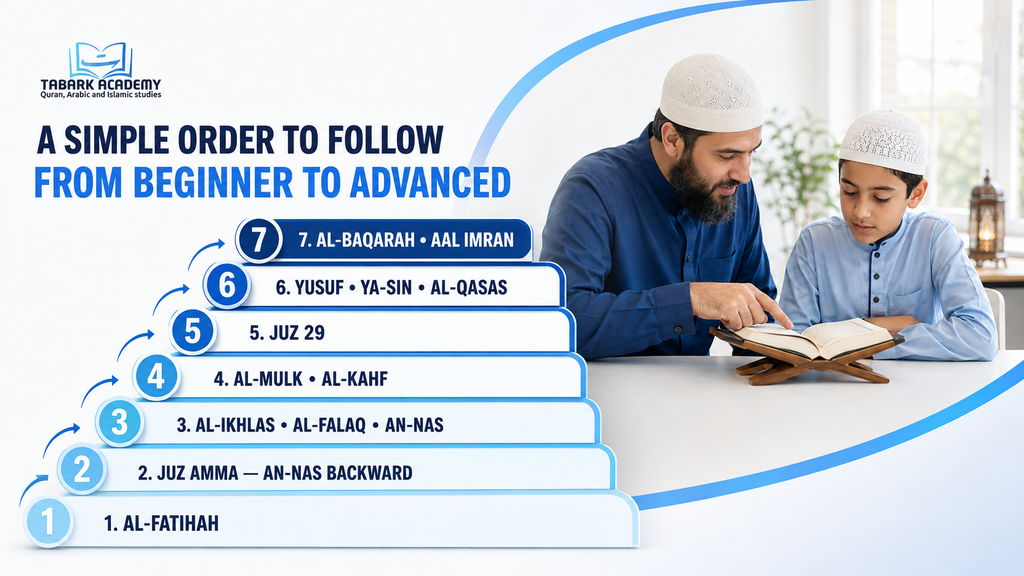
Follow a Simple Surah Memorization Order From Beginner to Advanced
This is a practical example you can follow. Surah Al-Fatihah, then the short surahs of Juz Amma from An-Nas backward, then the daily adhkar surahs (Al-Ikhlas, Al-Falaq, An-Nas if not already memorized). After that comes Al-Mulk and Al-Kahf.
The next step is Juz 29 as a whole. Then, you can start memorizing Yusuf and other narrative-heavy surahs like Ya-Sin and Al-Qasas. Finally, you can start memorizing Al-Baqarah and Aal Imran when you are sure of building a consistent daily habit.
This isn’t the only valid order. Teachers modify this according to a student’s age, memory style, and available time. However, it reflects the general logic of easy-to-hard, short-to-long, and familiar-to-unfamiliar that underlies most memorization plans.
Step Inside Our Virtual Classrooms
See our engaging teaching methods in action! watch real snippets of our live classes and discover how our expert instructors make learning interactive, memorable, and inspiring for every student.
Start Your Hifz Journey The Right Way
If you try to follow this sequence on your own, that means you have to guess, restart, or lose momentum after the first few surahs. A certified teacher can assess what you already know, build a realistic weekly plan, and correct your recitation as you go. This technique shortens the path considerably compared to self-study alone.
Tabarak Academy’s Hifz program pairs students with qualified Quran teachers for one-on-one memorization sessions, structured around exactly the kind of progression outlined above and adjusted to each student’s pace and schedule.
Our Quran Memorization / Hifz Courses
- Online Hifz Program
- Juz 30 Memorization Course
- Hifz for Kids Course
- Hifz for Adults Course
- Hifz for Sisters Course
- Short Surah Memorization Course
- Hifz Ijazah Course
Conclusion
The surahs you memorize first matter less for their difficulty ranking and more for how often you’ll use them. Starting with the short surahs of Juz Amma, Al-Fatihah, and the surahs recited in daily adhkar in particular, gets you reciting what you’ve learned almost immediately. This is what keeps memorization from fading.
From there, surahs with reported virtue like Al-Mulk and Al-Kahf bridge naturally into the longer, more demanding surahs like Al-Baqarah and Aal Imran, once a real memorization habit is built.
If you’re still asking which surahs should I memorize first, the practical answer is simple. Begin small, repeat daily, and let your existing prayer habits participate in part of the work.
Frequently Asked Questions
Which Surah Should I Memorize First As A Complete Beginner?
Surah Al-Fatihah is the standard starting point, since it’s already recited in every prayer and most beginners can memorize it in a single sitting. After that, most teachers move students into the short surahs at the end of Juz Amma.
Is It Better To Start From Surah An-Nas Or Surah Al-Baqarah?
Starting from Surah An-Nas and the other short surahs of Juz Amma is generally recommended over starting from Al-Baqarah. Al-Baqarah’s length and lower repetition in prayer make it harder to sustain motivation as a first surah.
How Long Does It Take To Memorize Juz Amma As A Beginner?
There’s no fixed timeline, since it depends on daily study time, surah difficulty, and review consistency, but many beginners complete a working memorization of Juz Amma within a few months of regular daily practice with review.
Should I Memorize Surah Al-Waqiah Early For Its Virtue?
The hadith commonly cited for Surah Al-Waqiah’s virtue are classified by scholars as weak or fabricated, despite being widely shared. It’s a fine surah to memorize for its content, but it shouldn’t be prioritized specifically for a reported virtue that isn’t well supported.
Do I Need To Understand A Surah’s Meaning Before Memorizing It?
Understanding a surah’s general meaning and storyline isn’t required, but it makes memorization noticeably easier, since connected ideas are easier to recall in order than disconnected words. Learning the story behind Surah Yusuf or Al-Baqarah before memorizing it is a common technique for this reason.
Can A Quran Teacher Help Me Build A Memorization Order?
Yes — a Quran teacher can assess which surahs you already know from prayer, identify ones that suit your memory style, and build a sequence around your available time, which typically prevents the stalled starts common with self-directed memorization.