


The Best Time of Day to Memorize Quran – Find Your Golden Hour
Have you ever read the same three verses twenty times and still forgotten them by the evening? Most Hifz students assume the problem is their memory. Very often, the real problem is the clock.
Choosing the best time of day to memorize Quran is one of the most overlooked steps in any memorization plan. The same student, using the same method, can retain twice as much simply by moving the session two hours earlier or later.
In this guide, you will learn what classical scholars recommended about Hifz timing, how to discover your own “golden hour,” and how to match your memorization time with the right place and routine.
Whether you are memorizing on your own or your child is enrolled in a structured Hifz class, the timing principles below apply the same way.
What You Will Learn
- Why the hour you memorize in affects retention as much as the method you use
- What scholars such as Shaykh Ibn Baz and Shaykh Al-Khudair advised about Hifz timing
- A simple 4-step test to discover your personal golden hour within one week
- How sleep, meals, and environment quietly decide the quality of your session
- The difference between the best time for new memorization and the best time for revision

The Best Time of Day to Memorize Quran
Traditionally, the hours around Fajr and the last third of the night are considered the strongest windows for memorization, because the mind is rested, the surroundings are quiet, and distractions are at their lowest.
Still, the ideal hour is personal, and the sections below explain both the general rule and the personal exception.
Why Timing Affects Retention
Hifz is a mental activity before it is a verbal one. The mind is the vessel that receives the verses, and a vessel already full of tasks, messages, and worries has little room left.
When you memorize during a crowded hour, the verses compete with everything else in your head. When you memorize during a quiet hour, they settle.
There is a second benefit that students rarely expect. Memorizing at a fixed hour every day builds what teachers call a memory appetite — at that exact time, the brain begins preparing itself to receive new verses before you even open the Mushaf.
What Scholars Say About Hifz Timing
Islamic scholars have long pointed to the calmest hours of the day. It states, on memorization times, that the best hours for Hifz are before and after Fajr, alongside advice to memorize slowly and consistently rather than rushing.
Shaykh Abdul Aziz Ibn Baz answered the same question differently, and his answer is the key to this whole article.
He explained that suitable times differ from person to person, and that each student should choose the hour in which the heart is most free and distractions are fewest — whether that is after Fajr, after Isha, between the two evening prayers, or during the night.
Shaykh Abdulkarim Al-Khudair added a practical note: the most suitable time is when the mind is clear, and the surroundings are still, which for most people is the late part of the night, in a small enclosed space where attention does not scatter.
Comparing Times of Day for Hifz and Revision
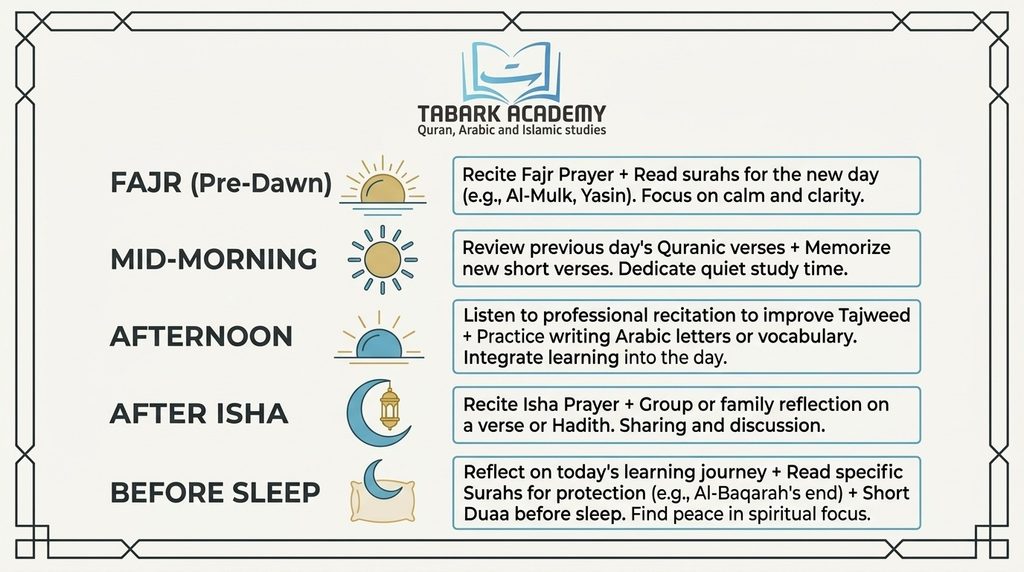
Not every hour serves the same purpose. New memorization demands peak concentration, while revision can succeed in lighter conditions.
| Time of Day | Best Use | Why It Helps |
| After Fajr | New memorization | The mind is rested, the environment is quiet, and focus is at its highest. |
| Mid-morning | Difficult or similar verses | Sustained alertness supports careful comparison of mutashabihat. |
| Afternoon | Light revision | Short review portions fit well between daily obligations. |
| After Isha | Structured review | A calm, predictable routine helps reinforce earlier pages. |
| Before sleep | Final revision | Light review before rest supports long-term retention. |
This is also why structured programs separate the two activities. In a guided online Hifz program, the teacher assigns new memorization for your strongest hour and places revision in the softer parts of your day.
Read also: How to Memorize Quran in 6 Months: Hifz Plan
How to Find Your Best Time of Day to Memorise Quran
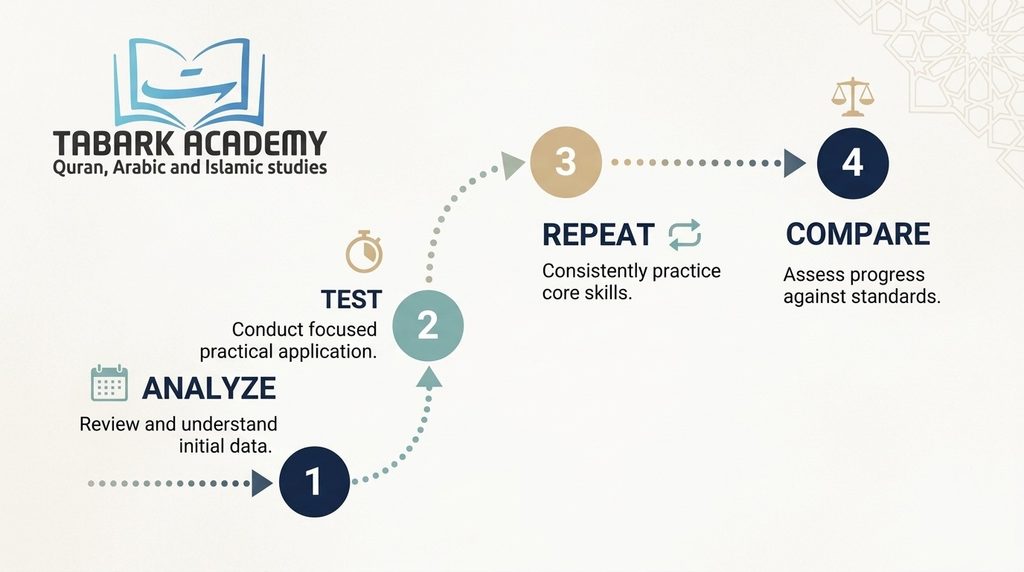
Finding your personal golden hour takes about one week and requires nothing more than honest observation. Follow these four steps in order.
Step 1: Analyze Your Daily Schedule
Look at a normal day and mark the hours when you feel the least fatigue, stress, and mental noise. Note where your heaviest tasks, commutes, and meals fall.
Select two or three candidate hours that sit far away from those pressure points and write them in a notebook.
Step 2: Test One Hour at a Time
Take your first candidate hour and memorize strictly within it for two or three consecutive days. Do not change the method, only the timing.
At the end of each session, test yourself and give your performance a grade out of ten. Record how alert, calm, or restless you felt.
Read also: Learn – Is It Better To Memorize Quran In The Morning Or At Night?
Experience Our Interactive Learning
Curious about how we teach? Watch these brief video clips from our recent live sessions to see our structured curriculum, advanced learning platform, and dynamic student-teacher interactions firsthand.
Step 3: Repeat With Your Other Options
Run the same two-to-three-day trial for each remaining candidate hour. Keep the portion size similar so the comparison stays fair.
Record the grades and short notes exactly as you did before. Patterns usually appear faster than students expect.
Step 4: Compare and Commit
Choose the hour with the highest retention grade and the fewest distractions. That is your golden time. Then protect it. Treat it as a fixed appointment rather than an optional slot, because consistency is what turns a good hour into a strong habit.
Students who memorize with a scheduled teacher often find this easier, since a booked Hifz class for adults builds the accountability that solo study lacks.
Read also: How Long Does It Take to Memorize Surah Al-Kahf?
What Makes the Top Time of Day to Memorize Quran Work
An hour is not powerful on its own. It becomes powerful when three conditions line up: your body is ready, your mind is clear, and your surroundings support you.
1. Choose a Time When Your Body Has Energy
Your Golden Time should sit far from your most exhausting activities. If you reach home at 5:00 PM drained, rest first — memorizing while fatigued wastes both the hour and the verses.
Meals matter just as much. After a heavy meal, blood flow shifts toward digestion, alertness drops, and drowsiness follows, so keep your session away from large meals.
Regular, sufficient sleep quietly does the rest. A rested brain absorbs and stores new material far more efficiently than a sleep-deprived one.
2. Memorize When Your Mind Is Clear and Focused
Review when you make most of your decisions, hold important conversations, or handle demanding work. Your memorization hour must sit outside those windows.
Distractions never disappear completely. The goal is simply to find the hour in which your mind is quieter than at any other point in your day.
Recitation accuracy also protects focus, because stumbling over pronunciation breaks concentration mid-verse. Many students strengthen this first through online Tajweed classes before increasing their daily portion.
3. Choose a Quiet Place That Supports Concentration
A perfect hour spent in a noisy room produces weak retention that fades quickly. Choose a quiet, secluded spot with no television, phone, or visual clutter.
Lighting and temperature deserve attention too. A dim room invites drowsiness and an overheated one drains energy, so aim for bright and moderately cool.
Finally, honor the space. A clean, dignified place set aside for the Quran nurtures presence of heart and deepens your connection with the verses.
Important note: Reserve your Golden Time for new memorization, since fresh material demands the most concentration. Previously memorized pages can be revised during softer hours of the day.
Read also: Learn – How Long Does It Take To Memorize Surah Yaseen?
Step Inside Our Virtual Classrooms
See our engaging teaching methods in action! watch real snippets of our live classes and discover how our expert instructors make learning interactive, memorable, and inspiring for every student.
Book a Free Trial Class and Build Your Hifz Routine
Knowing your best hour is the first half of the journey. Having a qualified teacher who plans your daily portion around it is the half that produces a Hafiz.
At Tabarak Academy, certified male and female tutors teach Quran memorization, Tajweed, recitation, and Arabic in one-to-one online sessions scheduled at the time that suits you — not a fixed classroom hour. Lessons are available for children and adults, from Noorani Qaida basics to full Hifz with Ijazah.
Your teacher sets the daily portion, corrects your recitation live, and manages your revision cycle so that nothing you memorize slips away. You keep the golden hour; we build the plan inside it.
Start with a free trial lesson, meet your tutor, and see how much clearer memorization becomes when your timing, your method, and your teacher finally agree.
Our Quran Memorization / Hifz Courses
- Online Hifz Program
- Juz 30 Memorization Course
- Hifz for Kids Course
- Hifz for Adults Course
- Hifz for Sisters Course
- Short Surah Memorization Course
- Hifz Ijazah Course

Conclusion
The best time of day to memorize Quran is not a single hour that suits every student. Scholars consistently point to the calm periods around Fajr and the last third of the night, yet they also emphasize that each person should choose the hour in which the heart is freest and the surroundings quietest.
Test your candidate hours for a week, grade your retention honestly, and commit to the winner. Pair that hour with good sleep, light meals, and a quiet, well-lit place.
Takeaway Message: Consistency beats intensity. A modest daily portion memorized at your golden hour, reviewed regularly, will always outperform a large portion memorized at the wrong time.
Read also: Realistic Plan – How Long Does It Take to Memorize Surah Al-Baqarah?
FAQs
Is Fajr really the best time to memorize the Quran?
For most people, yes. The mind is rested, the environment is quiet, and few obligations compete for attention. However, scholars note the ideal hour differs by person, so night owls may retain more after Isha or in the last third of the night.
How many verses should I memorize each day?
Start with an amount you can repeat until it is fully mastered — often three to five verses, or a quarter page. Increase only after you can recite yesterday’s portion flawlessly without looking.
Can I memorize the Quran at night?
Yes. The last third of the night is highly recommended by scholars because the surroundings are still and distractions are minimal. It suits students who are naturally alert late and can maintain a regular sleep schedule.
What is the best time to revise memorized verses?
Revision works well in lighter hours — the afternoon, after Isha, or shortly before sleep. Reserve your sharpest hour for new memorization, since fresh material demands more concentration than review.
How long does it take to memorize the Quran?
It depends on daily portion, revision discipline, and consistency. Students memorizing one page daily with steady review often complete it in two to three years, while intensive programs move faster with far more daily hours.
Does the memorization time matter for children?
Very much. Children generally focus best in the morning or shortly after a rest, and before homework fatigue sets in. Short, regular sessions at a fixed hour work better than long, irregular ones.