

Photographic Memorization Method Using the Mushaf—A Step-by-Step Guide
Do you ever recite a surah and suddenly “see” the next ayah on the page? That picture in your mind is the heart of the photographic memorization method using the mushaf.
Maybe you know a page well in the morning, but by Friday it’s gone. Or you get stuck at the same spot every time you turn the page. Most of the time, the problem isn’t your memory; you’re just using your ears and not your eyes.
This method helps you memorize the Quran with your eyes and your voice together. You learn where each ayah sits on the page. Then you use that picture to help you recall the words.
Below, you will learn what the method really is, which mushaf to use, the 7 steps, and a daily plan that keeps your hifz strong.
What You Will Learn in This Article
- What the photographic method is, and what it is not.
- How to pick the right mushaf for memorizing by sight.
- The 7 steps to memorize a new page.
- A simple daily plan to keep every page you learn.
- The common mistakes and limits to watch for.
What Is the Photographic Memorization Method Using the Mushaf?
The photographic memorization method using the mushaf is a way to memorize the Quran by picturing each page. You learn where every ayah starts and ends. You also learn the first and last word of each line. Then you recite with that picture in your mind, along with your voice.
Before you start, it helps to know what this method can and cannot do. The two parts below explain how the page picture forms and why it lasts.
Photographic Memory vs. Page Map: What You Really Build
Many websites say you can build a “photographic memory.” That is not true. No one has shown that grown-ups can save a page the way a camera does.
What you build is a page map. Your brain saves the shape of the page. It knows where each ayah begins, where the lines break, and where the verse marks sit.
Think of how you walk through your own home in the dark. You don’t see the room, but you know where everything is. A page map works the same way.
This map does not form in one try. It grows each time you see the same page, in the same place, and recite it out loud. After many rounds, you can “look” at the page in your mind and read the next word.
So the real secret is not talent. It is seeing the same page, the same way, again and again. A student with an average memory can build a strong map with steady practice.
Why Testing Yourself Makes the Map Last
Reading a page many times feels good, but it can fool you. The page seems easy because you just saw it. That does not mean you truly know it.
When you close the mushaf and recite from memory, your brain has to work harder. That hard work is what makes the words stick. This is called active recall, and it works much better than reading the page again.
Timing matters too. Say you review a page today, again in a few days, and again next week. It will stay with you longer than if you read it ten times in one sitting.
The Prophet ﷺ told us to keep reciting the Quran, because it slips away faster than a camel from its rope (Sahih al-Bukhari 5033).
So each time you test yourself and come back to a page later, you tie that rope a little tighter. Testing and spaced review are how you hold on to what you learn.
How to Choose the Right Mushaf for Memorizing by Sight
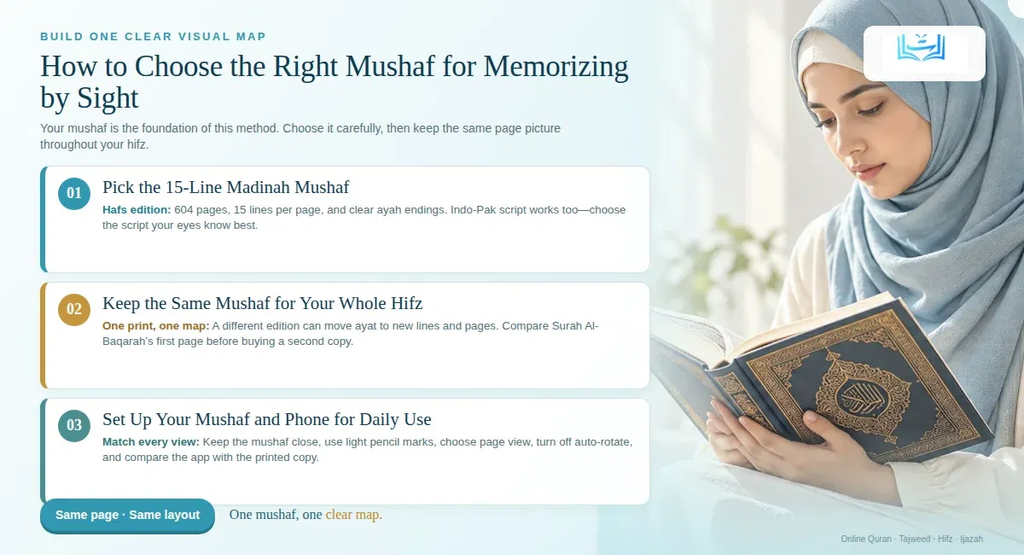
Your mushaf is the base of this whole method. If the page changes, your map breaks, so follow these three steps before you memorize a single ayah.
Step 1: Pick the 15-Line Madinah Mushaf
Start with the 15-line Madinah Mushaf in the Hafs reading. This is the most common way of reciting the Quran today. The mushaf has 604 pages, and each page has 15 lines.
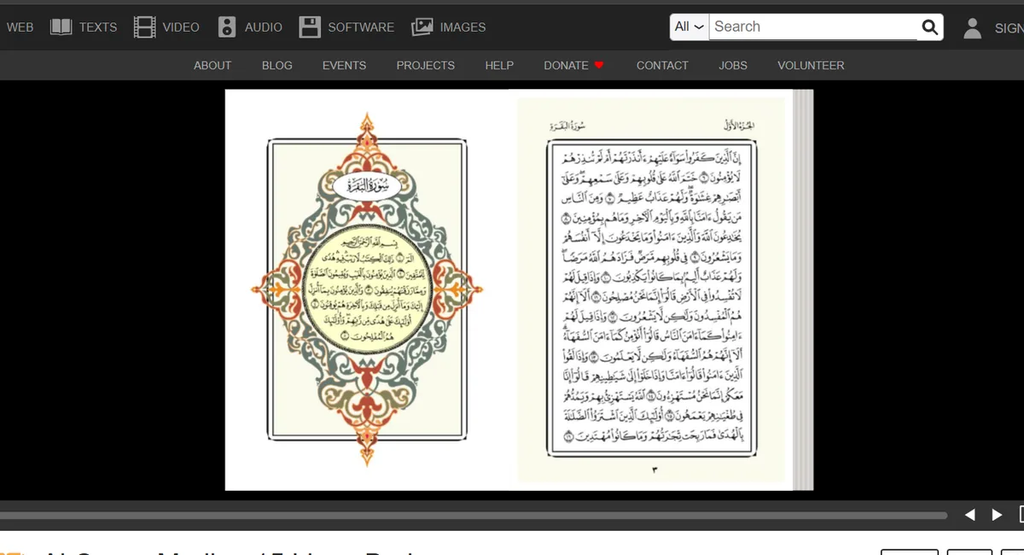
Its biggest help is how the pages end. Most pages stop at the end of an ayah. So each page feels like one full picture, with a clear start and a clear finish.
The layout also helps you plan. Nearly every juz in this mushaf is about 20 pages long. That makes it easy to set goals, like one page a day or one juz a month.
Many teachers and hifz schools use this mushaf. So it is easy to find, and easy to replace with the same edition if yours gets lost.
If you grew up reading the South Asian (Indo-Pak) script, you can pick that instead. It works well too. Just choose the one your eyes know best.
Step 2: Keep the Same Mushaf for Your Whole Hifz
Once you choose, keep that mushaf from your first page to your last. Use the same print, the same script, and the same page layout. Huffaz have followed this rule for a very long time.
Why does it matter so much? A different print moves the ayat to new lines and new pages. The map you built no longer fits what you see. You may feel lost, even on pages you knew well.
This often happens after a trip, or when a student borrows a friend’s copy. If you buy a second mushaf, make sure it is the exact same edition.
Before you buy, check the first page of Surah Al-Baqarah in both copies. If the lines start and end with the same words, the layout matches.
One mushaf gives you one clear map. Two layouts give you two maps that fight each other.
Step 3: Set Up Your Mushaf and Phone for Daily Use
Keep your mushaf in one safe place, close to where you study. When it is always within reach, you are more likely to open it every day.
If you want to mark a hard word, use a light pencil, not a pen. Heavy marks change how the page looks, and your picture of the page changes with them.
Phone apps can break your map too. Many apps move the words when you zoom in or turn the screen. In your app, choose the page view that shows the same mushaf you use, not the plain text view.
Turn off auto-rotate, so the page never flips sideways. Then compare one page in the app with your printed copy. The lines should match word for word.
Now your mushaf, at home and on your phone, shows you the same picture every time.
Step Inside Our Virtual Classrooms
See our engaging teaching methods in action! watch real snippets of our live classes and discover how our expert instructors make learning interactive, memorable, and inspiring for every student.
Start Your Quran Learning Journey
Join Tabark Academy today for structured online lessons with qualified tutors, customized to fit your goals.
Book Your Free Trial LessonRead also: How to Memorize Quran By Listening Only
How to Use the Photographic Memorization Method: 7 Steps
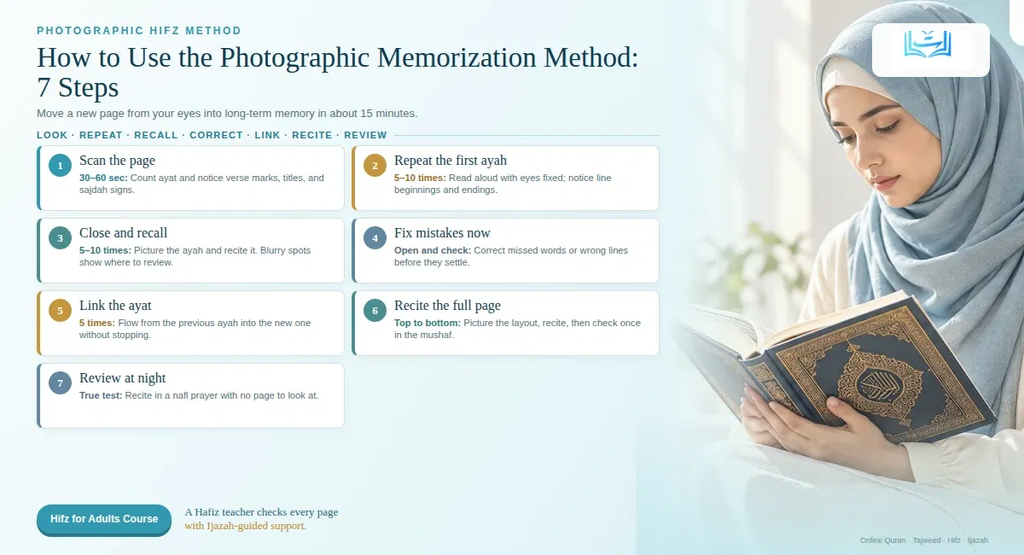
The 7 steps below move a new page from your eyes into your long-term memory. Once you get used to them, a new page takes about 15 minutes, plus a short review at night.
Steps 1 to 3: Look at the Page, Repeat, and Recall
Step 1: Scan the whole page for 30 to 60 seconds. Count the ayat. Notice where the verse marks fall. Look for clear signs, like a surah title or a sajdah mark.
Step 2: Read the first ayah out loud 5 to 10 times. Keep your eyes fixed on it. Notice the first and last word on each line. If you are new to hifz, you may need up to 20 times, and that is normal.
Step 3: Close the mushaf. Picture the ayah on the page and recite it 5 to 10 times from memory. If one part feels blurry, that is useful. It shows you just where to look again.
When the first ayah feels solid, move to the next one. Repeat the same three steps for each ayah on the page.
If an ayah is long, split it into small parts. Stop at a place where the meaning makes sense, learn each part, then join them.
Steps 4 and 5: Fix Mistakes and Link the Ayat
Step 4: Open the mushaf and check what you said. Did you miss a word? Did you put an ayah on the wrong line? Fix it now, before you go on.
This step is easy to skip, but don’t. If you skip it, you may save a wrong version in your mind. Fixing it later takes far longer than fixing it now.
Step 5: Link each new ayah to the one before it. Recite the last ayah and roll right into the new one, with no stop. Do this at least 5 times.
When the page is done, link it to the page before. Recite the last line of the old page, then go right into the new one.
Many students freeze when they turn a page, because the next page starts in a new spot. This link builds a bridge between the two pictures, so your recitation keeps flowing.
Steps 6 and 7: Recite the Full Page and Review at Night
Step 6: Recite the whole page from memory, from top to bottom. Picture the layout as you go. Then read it once from the mushaf to make sure it is right.
For a stronger test, try the blank map. Draw boxes on a sheet of paper for where each ayah sits on the page. Write the first two words of each ayah inside its box. If you can fill it without looking, your map is solid.
Step 7: Review the page again in the evening. A good way is to recite it in a nafl (extra) prayer. There is no page to look at, so it is a true test.
These steps can feel hard to follow alone at first. In the Hifz for Adults Course at Tabarak Academy, a teacher walks you through each step and checks every page you learn. The teachers are Hafiz of the Quran who hold Ijazah.

A Daily Hifz Plan for the Photographic Method
Steps help you learn a page, but a daily plan helps you keep it. This plan uses the three classic parts of hifz: sabaq (new lesson), sabqi (recent review), and manzil (old review).
The table below shows the whole day at a glance. You can move the times to fit school, work, or family.
| Time | Part of hifz | What you do | About how long |
| After Fajr | Sabaq | Learn 5 to 10 new lines with the 7 steps | 15 to 30 minutes |
| Midday | Sabqi | Recite the last 5 pages from memory | 10 to 20 minutes |
| Evening | Manzil | Review 1 juz of older pages | 30 to 40 minutes |
| Before bed | Preview | Look at and listen to tomorrow’s page | 5 to 15 minutes |
In total, the plan takes about one to two hours a day, split into four short sessions. Small sessions spread across the day are easier to keep than one long sitting, and each one gives your page map a fresh review.
Morning and Midday: New Lesson and Recent Review
Do your sabaq after Fajr, when your mind is fresh. Learn 5 to 10 new lines with the 7 steps. If you learn fast, you can try a full page.
Don’t rush, though. Some teachers say you should not learn more than one-eighth of a juz in a day. A page map needs time to settle.
If you miss your sabaq one morning, don’t skip it. Do it later in the day, even if you learn only a few lines.
At midday, do your sabqi. Recite the 5 pages before today’s lesson from memory. As your hifz grows, add more pages slowly, up to 10 and later 20.
These new pages are the weakest part of your hifz. The map is fresh, but it can fade fast. A short sabqi each day turns a new page into a strong one. Not sure how much time you can give each day? See how much time adults need for hifz per day.
Evening and Night: Old Review and Tomorrow’s Preview
In the evening, do your manzil. Recite one juz of older pages from memory. Move through everything you have learned, one juz at a time, so each page keeps coming back.
Over the years, many huffaz build up to several juz a day. Start with what you can keep up. One juz done every day beats three juz done once a week.
Before bed, preview tomorrow’s page. Listen to it about 3 times from a clear reciter, like Sheikh Al-Husary or Sheikh Al-Minshawi. Then read it from your mushaf a few times.
This short preview makes the morning much easier. The page already feels familiar, so Step 1 takes seconds instead of minutes.
A plan is easier to keep when you have support. You can read how other students and parents kept going with their hifz in the Tabarak Academy reviews. One student shared that the academy helped them memorize the Quran and that their teacher was always on time.

Mistakes That Weaken Your Page Map
The first mistake is reading in silence. Some students “see” the page well but can’t recite it smoothly. Always read out loud, so your tongue and ears learn the words too.
The second mistake is ignoring verses that look alike. Some ayat are almost the same in different surahs. Scholars call them mutashabihat. Note where each one sits on its page: top or bottom, right or left. Say that place to yourself when you review.
The third mistake is dropping a page from review once it feels easy. Easy pages fade too, just more slowly. Keep them in your manzil.
The fourth mistake is memorizing with your phone nearby. Each alert breaks your focus, and the page picture gets blurry. Put the phone in another room for those 15 minutes.
The last mistake is changing where you sit every day. The same quiet spot and the same time each day help your mind get ready to learn.
When the Photographic Method Is Not Enough
This method is a helper, not a shortcut. You still need to repeat each ayah many times. Students who expect less work often learn fast and forget fast.
Some people remember sounds better than pictures. If that is you, use the page map as a backup. Let listening and reciting out loud do most of the work.
A page map also can’t check your Tajweed. You can picture a page perfectly and still say a letter wrong or cut a long sound short. Only a trained teacher can hear and fix that. If you must study alone for a while, our 7-step system for revising the Quran without a teacher can help.
Young children who can’t read well yet should start by listening and repeating. They can add the page map later.
And if progress feels slow, take heart. The Prophet ﷺ said that a person who finds the Quran hard and keeps reciting it gets a double reward (Sahih Muslim 798).
Experience Our Interactive Learning
Curious about how we teach? Watch these brief video clips from our recent live sessions to see our structured curriculum, advanced learning platform, and dynamic student-teacher interactions firsthand.
Start Your Quran Learning Journey
Join Tabark Academy today for structured online lessons with qualified tutors, customized to fit your goals.
Book Your Free Trial LessonMemorize the Quran With a Hafiz Teacher at Tabarak Academy Today
A page map is only as good as the recitation saved inside it. At Tabarak Academy, a teacher listens to every page, fixes your Tajweed, and keeps your sabaq, sabqi, and manzil on track. Your hifz grows without hidden mistakes.
Here is what you get when you join:
- Teachers who are Hafiz of the Quran and hold Ijazah
- One-on-one live classes at your own pace, and an official Ijazah when you finish
- Monthly checks to track your progress, plus female tutors for sisters and girls
- Hifz courses made for kids, adults, and sisters
- Flexible plans, from a few classes a week to daily lessons
- A free trial class before you pay anything
Book your free trial today and memorize your first page the right way, with a teacher by your side.

Our Quran Courses
Start your Quran memorization journey today. browse our Quran courses and click Free Trial.
- Quran Recitation Course
- Online Ijazah Course
- Online Qirat Course
- Quran for Toddlers / Young Children
- Weekend Quran Classes
- Intensive Quran Course
- Al-Azhar Quran Course
- Zoom Quran Classes
Conclusion
The photographic memorization method using the mushaf is not about having a perfect camera in your head. It is about building a page map, one ayah at a time, and making it stronger every day.
The method starts with one choice: a single mushaf, best of all the 15-line Madinah Mushaf, kept from your first page to your last. Then come the 7 steps: scan, repeat, recall, fix, link, recite the full page, and review at night.
A daily plan keeps all that work safe. Sabaq brings in new pages, sabqi protects the fresh ones, and manzil keeps older pages alive. A short preview before bed makes each morning easier than the last.
Remember the limits too. Read out loud, give extra care to verses that look alike, and let a trained teacher check your Tajweed. The page map works best as a partner to your voice, not a stand-in for it.
Allah tells us He has made the Quran easy to remember (Surah Al-Qamar 54:17). With the right mushaf, a clear routine, and steady review, that ease becomes real in your own hifz, page by page.
FAQs
Students often have more questions once they start to memorize by sight. Here are short answers to help you get the most from each session.
How Should I Get Ready Before a Memorizing Session?
Make wudu, sit in a quiet place, and set a clear goal for the session. Then warm up by reciting a few pages you already know for about 10 minutes.
Should I Read the Meaning Before I Memorize a Page?
Yes, reading a short tafsir first helps the words make sense, so they stick faster. Simple books like Al-Tafsir Al-Muyassar work well for this.
What Should I Do If I Forget the Picture of a Page?
Open your mushaf and scan the page again for a minute, then recite it out loud a few times. Add that page back into your sabqi for a week until the picture feels clear again.
How Long Does It Take to Memorize the Whole Quran With This Method?
It depends on how much you learn each day. One page a day, six days a week, takes about two years, while half a page a day takes about four.
Should I Start With Juz Amma?
Yes, many students start with Juz Amma, the last juz of the Quran. Its surahs are short, so you can see a whole surah on one or two pages and finish them fast.
Is It Better to Memorize Alone or With a Partner?
Memorize alone, but recite to a partner. Saying your pages to a friend or family member each day catches mistakes you can’t hear yourself.
Should I Take a Day Off From Memorizing?
Yes, many plans keep one day a week free from new pages. Use that day to rest or to catch up on any review you missed.