


Why You Should Always Memorize From The Same Mushaf – 4 Clear Reasons
You know the page well. You’ve read it many times at home, and it flows without effort. Then one evening at the masjid, you pick up a different copy of the Quran and get stuck halfway down the page.
This happens to a lot of students, and it can be frustrating. Many of them think their memory failed. In most cases, the memory is fine. The page simply looked different from the one their eyes were used to.
This is the main reason you should always memorize from the same mushaf, and it is easy to fix once you understand it. A different copy moves the verses around, and your memory loses one of the things it relied on.
Below, you’ll find the short answer first. After that, we explain how your brain uses the page, what happens when you switch copies, when changing is fine, and how to choose a mushaf you can keep for years.
What You Will Learn In This Article
- The four main reasons one mushaf makes hifz easier.
- How your brain uses the page to remember verses.
- What changes when you move to a new copy.
- When it is fine to change, and how to do it safely.
- How to choose your mushaf and build a daily routine with it.
The Main Reasons You Should Always Memorize From The Same Mushaf
You should always memorize from the same mushaf because your mind links each verse to its spot on the page. It remembers the line, the side, and the marks near the verse. When the copy stays the same, those spots help you recall. When the copy changes, the spots move, and recall slows down.
Quran teachers have taught this rule for a very long time. Here are the four ways it helps you.
1- Your Mind Builds A Map Of Each Page
Some people say hifz students get a “photo memory.” That is not quite right. Very few people can save an exact photo of a page and read it later.
What you build is more like a map. Your mind notes if a verse is at the top or the bottom. It notes if it is on the right page or the left. It notes the line where the verse starts.
It also notes landmarks. A surah title, a juz sign, or a long verse that fills two lines all act like signposts on the map.
This map does not appear in a day. It grows over hundreds of readings across many months. Each time you open the page, one more small detail sticks.
A map only helps if the roads stay in place. That is why the copy must not change.
2- You Remember Faster When You Cannot Look
The map helps most when the mushaf is closed. This happens when you lead a prayer, pray alone at night, or recite to your teacher.
At those times, you picture the page. You know the passage turns to the next page here. You know the verse you need is halfway down on the left.
So you move on with fewer stops. You guess less. You do not have to search your memory word by word.
This matters a lot in salah. You cannot stop in the middle of a prayer to check a book. A clear picture of the page keeps your reading calm, even in long prayers.
Students often notice this first in their teacher’s class. Pages they memorized in one copy flow well. Pages they read in many copies feel shaky.
3- Similar Verses Stay Apart
The Quran has many verses that look almost the same. Some differ by one word. Some differ by one letter or a small change in order. Scholars call these verses mutashabihat, and some count about 2,000 of them.
These are the places where most students slip. You start one verse, and your tongue jumps to its twin in another surah.
The page gives you a way to tell them apart. Maybe one version sits at the top of a right page. Maybe the other sits in the middle of a left page.
When you reach that verse, your mind checks where it is, not only what it says. That small check often stops the mistake before it happens.
If you keep changing copies, both verses lose their home. That is when mix-ups become common.
4- Your Mushaf Keeps A Record Of Your Mistakes
Many teachers tell students to mark their mistakes in their own mushaf. A light pencil dot or a small line under the word is enough. Then you repeat those places more often.
Over time, your copy becomes a record of your weak spots. You open a page and see where you slipped last month. You know which lines need extra work before class.
This only works with one copy. A new mushaf has no marks. You lose months of notes and start again from zero.
Your teacher can use these marks too. They show where to test you and what to review.
In Tabarak Academy’s student reviews, learners talk about tutors who give regular feedback and monthly progress reviews. A marked mushaf makes that kind of follow-up much easier.

Step Inside Our Virtual Classrooms
See our engaging teaching methods in action! watch real snippets of our live classes and discover how our expert instructors make learning interactive, memorable, and inspiring for every student.
How Your Brain Uses The Mushaf Page To Remember Verses
The page helps your memory in two ways. First, your brain uses it as a clue to find a verse. Second, it lets your brain store each verse in two forms instead of one.
Your Brain Uses The Page As A Clue To Find Each Verse
Your brain remembers better when it sees the same things it saw while learning. The things around you act as clues that point your memory to the right place.
A well-known test shows this. Divers learned a list of words. Some learned it underwater, and some learned it on land. They remembered more when they were tested in the same place where they had learned.
In hifz, the mushaf page works like that place. The shape of the lines, the side of the page, and the spot where a verse starts all turn into clues. When you see them again, your brain knows where to look.
If you always review in the same copy, the clues never move. Your brain finds each verse faster because it has seen the same page many times.
These clues still work with the mushaf closed. When you recite from memory, you picture the page in your mind. That only helps if the page you picture is the one you studied.
Your Brain Stores Each Verse As Both Sound And A Picture
Your brain can save a verse in two forms. It saves the sound and the words. It also saves a picture of where the verse sits on the page.
Memory research shows that things saved in two forms stay longer than things saved in one. If you forget a word, the picture of the page can help you get it back. If the picture fades, the sound can carry you forward.
Many Quran teachers explain this with three doors to memory: the eye, the ear, and the tongue. Your ear hears the verse. Your tongue says it out loud. Your eye sees it on the page.
All three doors need to bring in the same verse the same way. The ear and tongue can do this with any copy, because the sound does not change. The eye can only do it if the page stays the same.
That is why one mushaf matters. It keeps the picture steady, so the sound and the picture support each other every time you review.
Start Your Quran Learning Journey
Join Tabark Academy today for structured online lessons with qualified tutors, customized to fit your goals.
Book Your Free Trial LessonWhat Happens When You Switch To A New Mushaf
A switch changes four things at once.
First, the verses move. Each print breaks its pages in its own places. A verse at the top of a page in your old copy may sit in the middle of a page in the new one. Some pages may even end in the middle of a verse.
Second, the writing may look different. Copies from different countries use different letter styles, vowel marks, and stop signs. Your eyes have to learn to read the text again.
Third, your map starts over. Now you hold two pictures of the same passage, and they fight each other. Similar verses start to blur.
Fourth, recall slows for a while. You may pause, repeat lines, or skip a verse. This does not mean your hifz is gone. Your brain is building a new map.
During this time, review matters more than ever. The Prophet ﷺ told us to keep reviewing the Quran, because it slips away faster than camels slip from their ropes (Sahih al-Bukhari 5033). The same hadith is in Sahih Muslim 791.
Is It Wrong To Use A Different Mushaf?
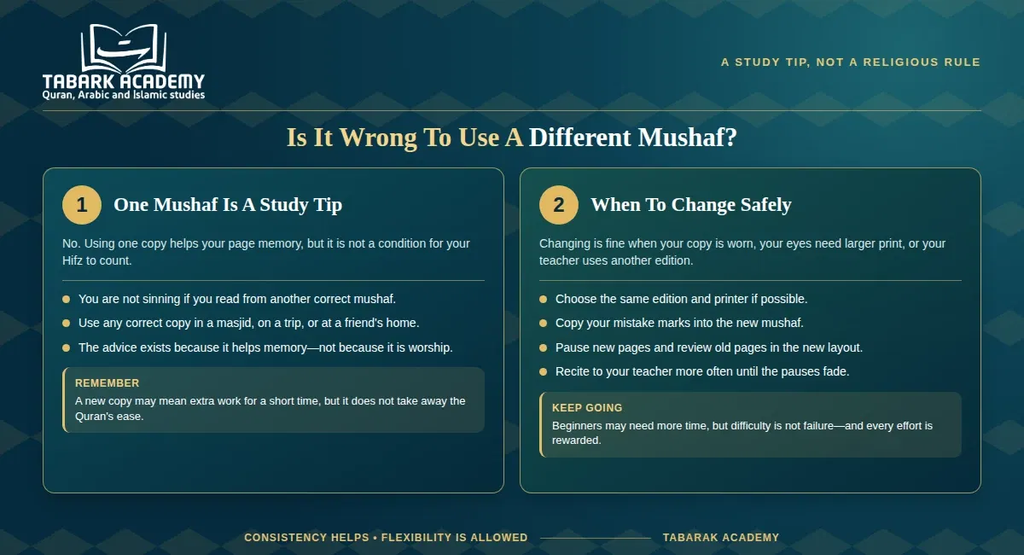
No, it is not wrong to use a different mushaf. Using one copy is a study method that helps your memory, not a religious rule. Some students still feel guilty when they have to change their copy, so the two sections below explain what the rule means and when changing is fine.
What Scholars Say About Using One Mushaf
Using one mushaf is a way to study. It is not an act of worship. It is not a condition for your hifz to count.
Scholars teach it because it works, not because a verse or hadith orders it. No report tells us that the Companions all used one copy, or that they read their daily portions from a copy at all.
So you are not sinning if you read from another mushaf. You can read from any correct copy in the masjid, on a trip, or at a friend’s home.
The rule is about your hifz study. It helps your memory, so keep it when you can.
Allah reminds us that He made the Quran easy to remember (Surah Al-Qamar 54:17). A new copy cannot take that ease away from you. It only means a little more work for a short time.
When And How To Change Your Mushaf Safely
Some reasons to change are good ones. Your copy may be torn or too worn to read. Your eyes may need larger print. Your teacher may use a different edition.
Students who finished hifz years ago and review often feel a switch much less. Their memory of the words is very strong, so they need the page less. Beginners still lean on the page, so a switch costs them more.
If you must switch, use a plan. First, buy the same edition from the same printer if you can. Then copy your mistake marks into it during the first week.
If the layout is new, stop adding new pages for a while. Spend that time reviewing your old pages in the new copy. Recite to your teacher more often until the pauses fade.
Do not lose heart if it feels hard. The Prophet ﷺ said the one who reads the Quran with difficulty gets two rewards (Sahih al-Bukhari 4937).
Read also: Photographic Memorization Method Using the Mushaf
How To Choose The Best Mushaf For Memorizing
The best time to choose your mushaf is before you memorize your first page. Here is a quick look at the most common types so you can see which fits you.
| Mushaf Type | Lines Per Page | Writing Style | Best For |
| Madinah Mushaf (Hafs) | 15 | Madinah style | Most students around the world |
| Indo-Pak Mushaf | 13, 15, or 16 | South Asian style | Students in South Asian communities |
| Warsh Mushaf | Varies by printer | North African style | Students who learn the Warsh reading |
Once you know your type, two checks help you choose the exact copy.
1- Pick Full Verses On Every Page And Clear Print
Look for a mushaf where each page starts and ends with a full verse. Many teachers call this the “huffaz mushaf.” The most common one is the Madinah Mushaf from the King Fahd Complex.
It has 15 lines on each page and 604 pages in all. Each juz takes about 20 pages.
This makes planning easy. You can set goals by page or by juz without counting lines. You can also tell at a glance how much you have left.
Next, check the print. The letters should be clear and well spaced. Your eyes should not feel tired after half an hour.
Finally, pick a printer that keeps the same layout in every new print. Then, if your copy wears out, you can buy one that looks exactly the same.
2- Match Your Teacher’s Way Of Reading
The Quran is read in a few authentic ways passed down from the Prophet ﷺ. Your mushaf must follow the same way that your teacher teaches you.
Most students learn the Hafs reading. Many students in North and West Africa learn Warsh or Qalun. These readings differ in some words and marks.
Here is one example. In Surah Al-Fatiha, Hafs reads “Maaliki yawmid-deen” with a long “aa.” Warsh reads “Maliki” with a short “a.” A Warsh copy will show the word one way, while a Hafs teacher expects the other.
If your copy does not match your teacher, your eyes learn one text while your ears learn another. That leads to mistakes that are hard to fix later. So ask your teacher which edition to buy before you start.
If you are not sure which copy fits you, the Hifz for Adult course at Tabarak Academy begins with this step. Your tutor checks your reading and your goals, then helps you choose a mushaf before your first page.

How To Use Your Mushaf Every Day
Owning one mushaf is the first step. How you use it each day decides how strong your hifz becomes.
1- Keep One Place And One Time For Hifz
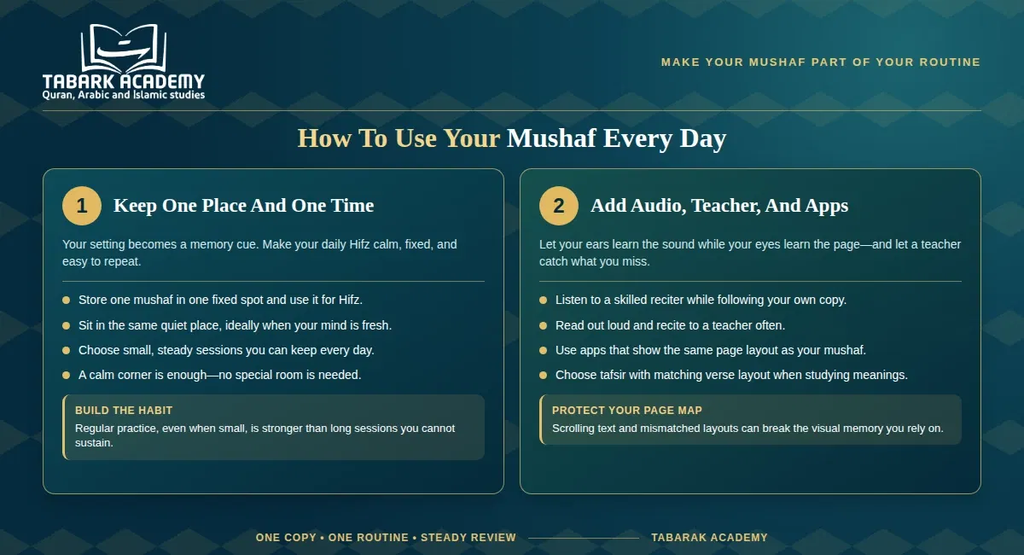
Your setting helps your memory, so keep it the same. Store your mushaf in one fixed spot at home. Use it for hifz, review, and your daily reading, so your eyes see the same pages every day.
Try to sit in the same seat each time. Pick a quiet time when your mind is fresh, like after Fajr. Avoid memorizing right after a big meal, when your body is busy and your mind feels slow.
You do not need a special room. In Turkey, some old Quran schools have tiny rooms, about two meters wide, with high ceilings. They were built centuries ago so students could focus on review with nothing around them. A small, calm corner at home works the same way.
Small, steady sessions beat long ones you cannot keep. The Prophet ﷺ said the deeds Allah loves most are the ones done regularly, even if small (Sahih al-Bukhari 6465).
Not sure how much time to give? Read How Much Time Do Adults Need For Hifz Per Day? If you are starting later in life, Hifz For Adults Over 40 gives a realistic plan.
2- Add Audio, A Teacher, And Matching Apps
Listen to a skilled reciter while you follow along in your own copy. Your ears learn the sound while your eyes learn the page.
Then read out loud. Students who memorize silently often stumble when they recite aloud in front of others.
Recite to a teacher often. A teacher hears mistakes you miss, like a dropped word or a wrong vowel. Between classes, you can check yourself with the steps in How To Test Your Own Hifz. For days with no teacher, How To Revise Quran Without A Teacher gives you a clear system.
Be careful with phone apps. Only use an app that shows the same pages as your printed copy. Apps with scrolling text break your map.
The same goes for tafsir books. If you read meanings while you memorize, pick a tafsir that prints the verses in the same layout as your mushaf.
Experience Our Interactive Learning
Curious about how we teach? Watch these brief video clips from our recent live sessions to see our structured curriculum, advanced learning platform, and dynamic student-teacher interactions firsthand.
Start Your Quran Learning Journey
Join Tabark Academy today for structured online lessons with qualified tutors, customized to fit your goals.
Book Your Free Trial LessonStart Your Hifz Today With Tabarak Academy’s Certified Tutors
The right mushaf gives you a strong start. Real progress needs correct reading, a steady plan, and a teacher who hears every verse. Here is what Tabarak Academy gives you:
- 25 years of experience teaching Quran online to children, adults, and families.
- Tutors with a verified Al-Azhar ijazah, so you learn from a trusted chain.
- Private 1-on-1 live classes, with full attention on you and no group sessions.
- Female tutors for sisters and girls, at no extra cost.
- Flexible times, with morning, afternoon, evening, and weekend slots.
- Monthly progress reports, so you always know where you stand.
- A clear path to ijazah for students who want to go further.
- A free trial class, confirmed within 24 hours, with no card and no commitment.
Your tutor will help you choose your mushaf, set a daily goal you can keep, and track your weak pages week by week. Book your free trial class now and memorize your next page the right way.

Our Quran Courses
Start your Quran memorization journey today with one click.
- Online Quran Classes
- Online Quran Classes for Beginners
- Online Quran Classes for Kids
- Online Quran Classes for Adults
- Online Quran Classes for Men
- Online Quran Classes for Sisters
- Quran Reading Course
Conclusion: One Mushaf Gives Your Hifz A Steady Base
Why you should always memorize from the same mushaf comes down to how memory works. Your mind ties each verse to a place on the page. That place turns into a reminder you can use in prayer, in class, and when you recite alone.
One copy also guards you from common problems. Similar verses stay apart. Your mistake marks stay in one place. Your eyes, ears, and tongue all meet the verse the same way each day.
A switch has a real cost. Verses move, the writing may change, and the map in your mind starts again. For a while, recall feels slower, even though your hifz is still there.
Still, this is a study tip, not a religious rule. If your copy wears out, your eyes need bigger print, or your teacher uses another edition, change it. Do it with a plan, slow down new pages, and recite to a teacher more often.
Your next step is simple. Choose a clear mushaf with full verses on each page that matches your teacher’s reading. Keep it in one place and use it at one time each day. Pair it with good audio and a good teacher.
Stay with that one copy for months and years. Page by page, it will carry your whole hifz.
FAQs
Students often have more questions once they start using one mushaf. Here are short, clear answers to the ones we hear most.
Is It Allowed To Write Marks In My Mushaf?
Many teachers allow light pencil marks to help with hifz, as long as you treat the mushaf with respect. Keep marks small and neat. If you are unsure, ask your teacher or a trusted scholar.
Does The Size Of The Mushaf Matter For Hifz?
Yes, it matters more than most people think. Pick a medium size that fits in your bag and has clear print. A copy you can carry every day is a copy you will actually use.
Is A Color-Coded Tajweed Mushaf Good For Hifz?
Yes, it can help beginners spot tajweed rules while they memorize. Choose one with the standard 15-line layout. Once you start with it, keep it for your whole hifz.
Should Children Follow The Same Mushaf Rule?
Yes, the same rule helps children, and starting with one copy early avoids a switch later.
What If My Quran School Uses A Different Mushaf Than I Use At Home?
Use the same edition in both places. Ask the school which copy they use, then buy that one for home. Two different copies split your memory between two maps.
Can I Memorize From A Mushaf With An English Translation?
You can, but many teachers advise against it for hifz. Translation copies often change the page layout. Use a plain Arabic copy for memorizing and read the translation separately.
Should I Use My Hifz Mushaf For Daily Reading Too?
Yes, reading from your hifz copy helps your page map grow stronger. Many students use it for both hifz and daily reading. Just keep it with you so you never need to reach for another copy.