


Best Mushaf for Hifz – Which Quran Copy Should You Memorize From?
If you’re looking for the best mushaf for hifz, you’re already off to a good start. A lot of people skip this step. They pick up whatever copy is lying around the house and dive right in.
And honestly, who could blame them? Choosing a mushaf sounds like a tiny detail. But here’s the thing: the copy you choose becomes the picture of the Quran you carry in your mind. Every verse you learn gets linked to a spot on a page in that book.
Talk to any hafiz, and you’ll hear something like this: “I can still see where that verse sits.” Maybe it’s near the top of the right page. Maybe it’s just before a new juz. That memory comes from using the same mushaf every single day.
Allah made the Quran easy to remember, and the right mushaf helps you enjoy that ease. The wrong one can trip you up in sneaky ways. You might mix up similar verses, lose your place when you turn the page, or notice your phone app doesn’t match your book.
So let’s make this simple. Below, you’ll find which mushaf works best for most students, how the main types compare, and what to check in size, paper, and binding. You’ll also learn one easy rule that keeps your hifz strong for years to come.
What You Will Learn in This Article
- Why most huffaz memorize from a 15-line mushaf.
- How to choose between Uthmani and Indo-Pak script.
- Which size, paper, and binding hold up best.
- When special hifz editions are worth it.
- Why you should keep one mushaf from start to finish.
What Is the Best Mushaf for Hifz?
For most people, the best mushaf for hifz is the 15-line Madinah Mushaf. It has the clearest layout for memorizing, and it’s the copy most hifz teachers use around the world.
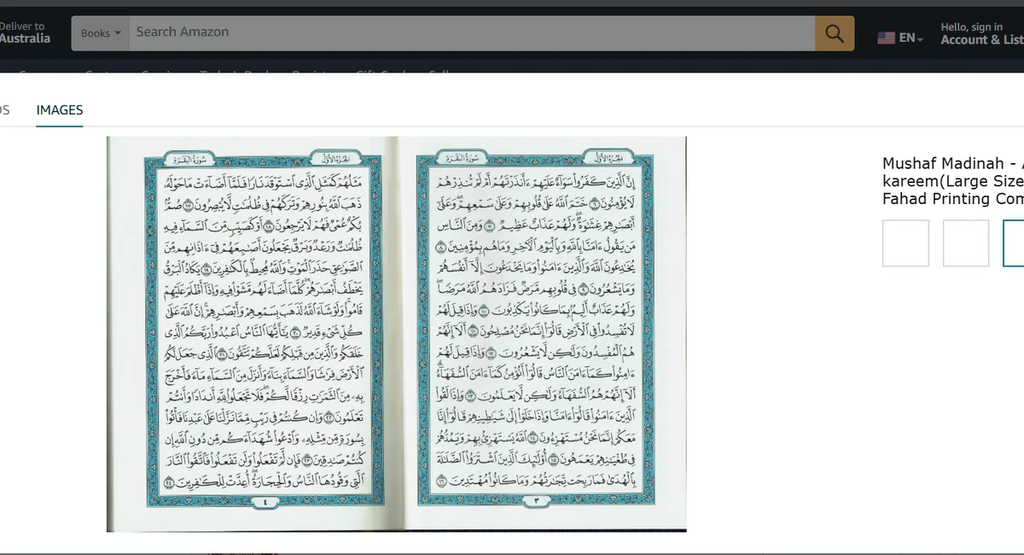
There’s just one exception. If you grew up reading the Quran in Indo-Pak script, stick with the 15-line Indo-Pak mushaf instead. Your eyes already know that script, so you’ll read faster and make fewer mistakes.
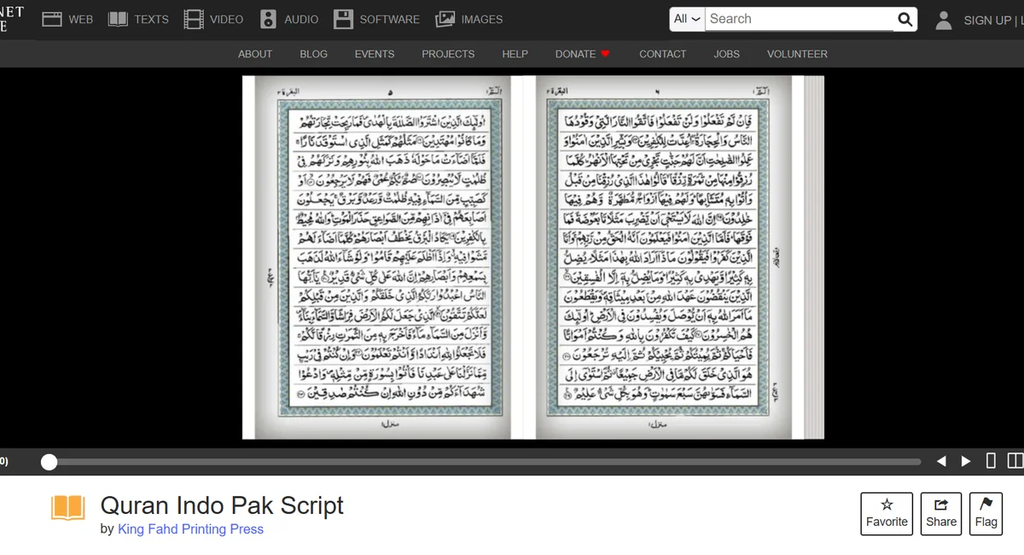
Here’s a quick way to decide:
- You’re new to reading the Quran, or you learned with Uthmani script, the style used in most Arab countries: choose the 15-line Madinah Mushaf.
- You learned to read with Indo-Pak script, as many people in South Asia and the UK do: choose the 15-line Indo-Pak mushaf.
Below, you’ll see why the Madinah Mushaf is the top pick for most students, and how to tell if the Indo-Pak copy is the better fit for you.
Why the Madinah Mushaf Is the Top Pick for Most Students
The Madinah Mushaf is printed by the King Fahd Complex in Madinah. It has 604 pages, with 15 lines on each page. It follows Hafs, the way of reciting that most Muslims use today.
The biggest reason it works so well is how the pages are built. Every page starts with a new verse and ends at the end of a verse. You never have to flip the page halfway through an ayah. Each juz also starts at the top of a page and runs about 20 pages.
This makes your hifz easy to plan. When your teacher says “learn one page today,” you know exactly how much that is. Goals like “one juz a month” turn into a clear number of pages.
It also helps your memory. Because each verse always sits in the same spot, your mind starts to save a picture of every page. That’s why many huffaz say they can “see” a verse as they recite it. A clean, steady page makes that picture sharper and easier to keep.
When the Indo-Pak Mushaf Is the Better Choice
Indo-Pak script is the style of Quran writing used in India, Pakistan, Bangladesh, and many UK madrasahs. The letters are thicker, and there are extra small marks to help with reading. If this is the script you learned as a child, it will feel natural and easy on your eyes.
In that case, the 15-line Indo-Pak mushaf is the smarter choice. Like the Madinah Mushaf, each page ends at the end of a verse. So you still get the clean layout that makes memorizing easier.
Just know that the two copies are not the same inside. The Indo-Pak mushaf has a different number of pages, so the same verse lands on a different page in each one. That’s why it’s important to choose one and stay with it.
Still not sure which script is yours? Try this quick test. Open both and read one page aloud from each. The one where you pause and stumble less is the right one for you.
If you’re an adult starting from zero, our guide on how to memorize Quran as an adult beginner walks you through the first steps.
Experience Our Interactive Learning
Curious about how we teach? Watch these brief video clips from our recent live sessions to see our structured curriculum, advanced learning platform, and dynamic student-teacher interactions firsthand.
Start Your Quran Learning Journey
Join Tabark Academy today for structured online lessons with qualified tutors, customized to fit your goals.
Book Your Free Trial LessonTop Mushaf for Hifz: How the Main Types Compare
Below is a quick look at the mushaf types students ask about most. Use it to find the copy that fits your needs, then read on for the two special hifz editions.
| Mushaf Type | Script | Lines per Page | Best For | Notes |
| Madinah 15-line | Uthmani | 15 | Most students, new huffaz | Global standard, 604 pages |
| Indo-Pak 15-line | Indo-Pak | 15 | South Asian learners | Ends each page on a verse, familiar script |
| Taj 16-line | Indo-Pak | 16 | Traditional South Asian readers | Different page layout from the 15-line copies |
| Color-coded tajweed | Uthmani or Indo-Pak | 15 | Students learning tajweed | Rules are marked in color |
| Large print | Uthmani | 15 | Weak eyesight, long sessions | Less eye strain |
| Pocket size | Uthmani or Indo-Pak | 15 | Travel | Too small for hifz sessions |
| Al-Hifz Al-Muyassar | Uthmani | 15 | Visual learners, students who forget often | Verse links, word meanings, reflection notes |
| Al-Zahrawan | Uthmani | 15 | Advanced students | Marks for similar verses |
Two of these copies are made only for hifz. They add tools that a plain mushaf does not have.
Mushaf Al-Hifz Al-Muyassar for Students Who Forget Often
Do you memorize a page, feel great about it, and then lose it a week later? If so, Mushaf Al-Hifz Al-Muyassar might be a good fit for you.
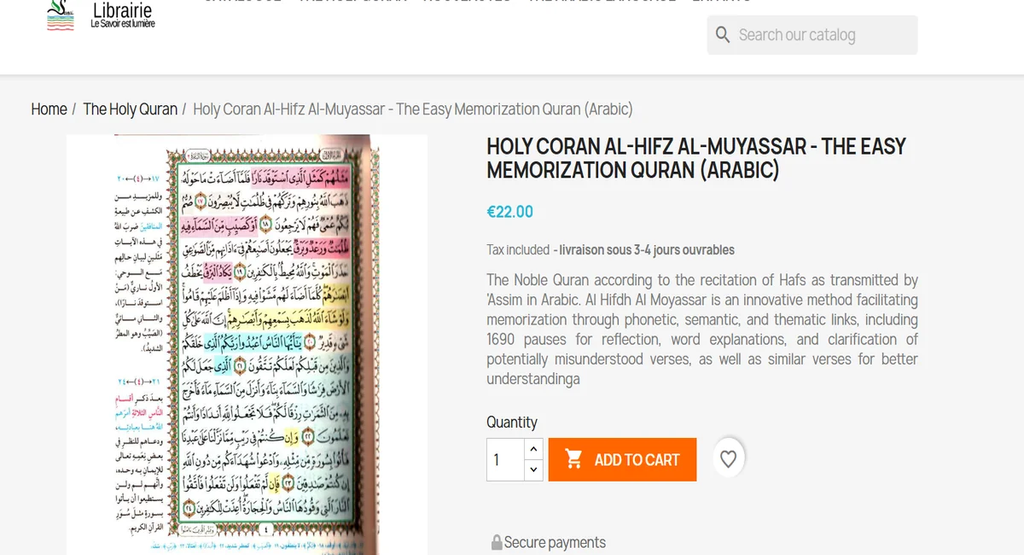
The name means “easy memorization.” It was prepared by Sheikh Muhammad Al-Sayed Madi, and it works by linking verses together by sound, by meaning, and by topic. Think of these links as little hooks. When you remember one verse, the hook helps pull the next one into your mind.
It also helps you understand what you’re memorizing. Hard words are explained, and it points out Quran words that people often get wrong. On top of that, it has 1,690 short reflection notes to help you think about the verses you learn.
Similar verses are marked in color, too. So when two passages look almost the same, you can quickly spot the one word that’s different.
This mushaf is now in its 50th printing, which shows how many students trust it. It comes in three sizes: 14 x 20, 17 x 24, and 20 x 28 cm. It’s recommended for readers aged 15 and up.
It works best for people who learn by seeing, and for students who keep losing verses or mixing them up.
Mushaf Al-Zahrawan for Mixing Up Similar Verses
Similar verses are one of the biggest problems for huffaz. In Arabic they are called mutashabihat. These are passages that look almost the same but differ by a word or two. It is easy to start in one surah and end up in another.
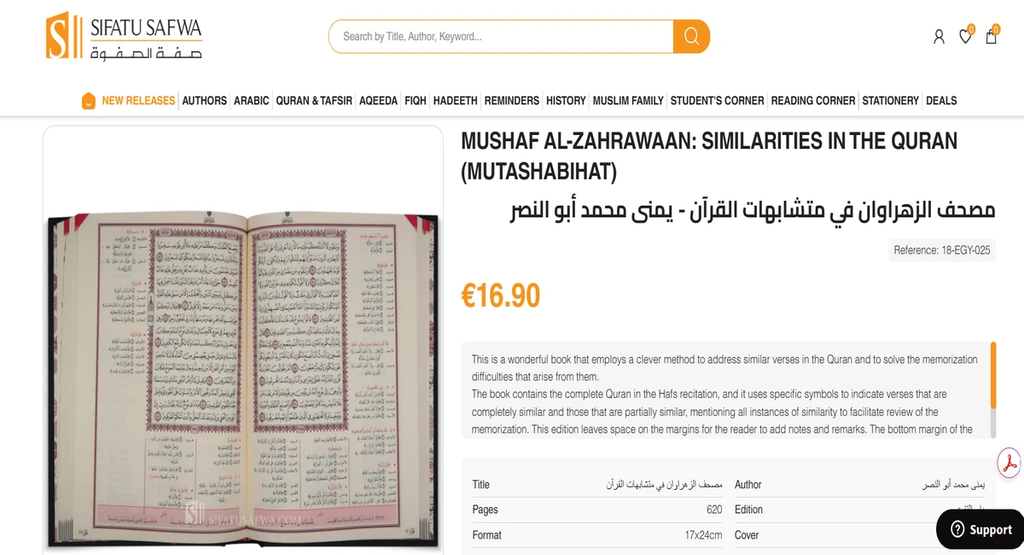
Mushaf Al-Zahrawan was made to fix this. It uses clear symbols and side notes to show where verses are alike. With these marks, you can see where each similar verse belongs.
This copy works best once you have memorized a good part of the Quran. For a beginner, too many marks can pull focus away from the words. Many teachers want you to lock in each verse in its first place before you study what looks like it.
So think of Al-Zahrawan as a tool for later. When the same few verses trip you up again and again, that is the time to open it.
Not sure when you are ready for a special edition? The Online Hifz Program at Tabarak Academy gives you a set plan for new pages and daily review. Your teacher tells you when a tool like Al-Zahrawan will help, and when your plain copy is enough.

Picking the Right Size, Paper, and Binding
Size matters more than most people think. Big print lets your eyes take in the whole page at once, so the picture in your mind is clearer.
| Size | Dimensions | Best Use | Why |
| Large | 17 x 24 cm | Hifz sessions and lessons | Less eye strain in long sessions |
| Medium | 14 x 20 cm | Daily reading and review | Easy to carry, still clear |
| Smaller than 14 x 20 cm | Travel only | Print is too small to memorize from |
Next, look at the paper. Matte paper does not shine under a lamp. Glossy paper reflects light, and that tires your eyes when you study for an hour.
Then check the binding. A sewn binding lets the mushaf lie flat on a desk or stand, so your hands stay free. Glued spines can crack and loosen when a book is opened many times a day.
Last, pick a strong cover. A hard cover protects the pages through years of daily use. Save thin, fancy covers for gifts.
Read also: Why You Should Always Memorize from the Same Mushaf
The One Mushaf Rule: Why You Should Never Switch Copies
The one mushaf rule means you pick one mushaf when you start hifz, and you keep it until you finish. Same edition, same print, same layout. This one habit protects the page picture your memory depends on.
Most students learn this rule the hard way. The two parts below explain why it matters and how to follow it.
What Happens to Your Memory When You Switch Copies
Your mind does not store a verse alone. It stores the verse along with its place on the page. When you switch copies, that place moves.
Even two copies in the same script can differ. One publisher may put a verse at the top of a page. Another may put it in the middle. Now your mind holds two maps, and they fight each other.
You feel this in small ways first. You pause at the end of a page. You forget how the next page starts. You jump to a verse that belongs somewhere else.
The Prophet (peace be upon him) warned that the Quran slips away faster than a camel freed from its rope (Sahih al-Bukhari, 5033). Memory needs a steady anchor to hold on. A fixed page is that anchor.
If you already switched and lost some pages, do not lose hope. Read how long it takes to re-memorize a juz to plan your way back.
How to Keep the Same Mushaf From Start to Finish
Sticking with one mushaf is easier when you have a plan. Follow these five steps, and your page memory will stay steady from your first lesson to your last.
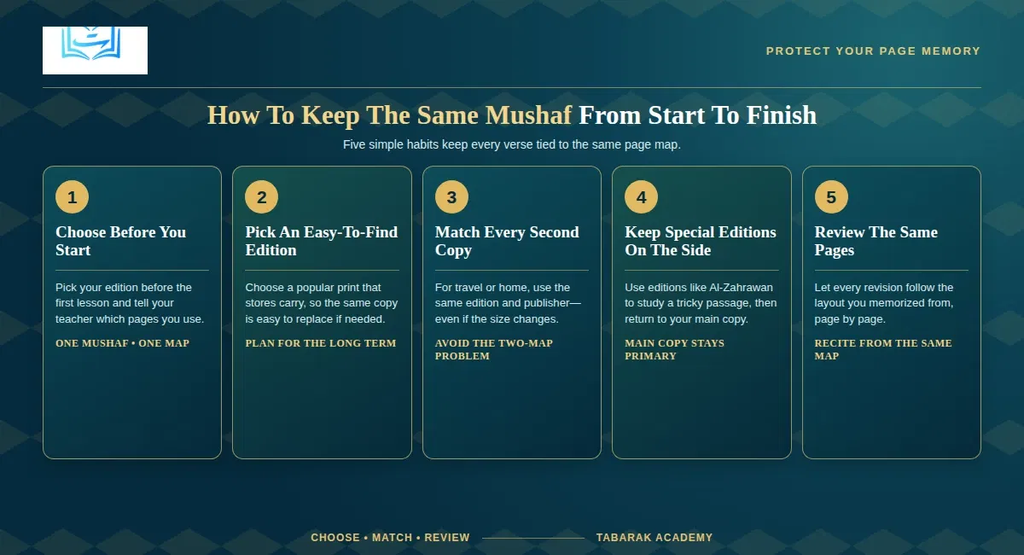
- Choose your mushaf before your first lesson. Don’t wait until you’ve already memorized a few pages. Tell your teacher which edition you’re using, so you both work from the exact same pages.
- Buy an edition that’s easy to find. Pick a popular print that most stores carry. If your copy ever wears out or gets lost, you can replace it with the very same one.
- Match any second copy to your main one. Need a copy for travel or for home? Get the same edition from the same publisher, even if the size is different. That way, every verse stays in the same spot in both books, and you avoid the two-map problem.
- Use special editions on the side only. A mushaf like Al-Zahrawan can help you study a tricky passage. Look up what you need, then go back to your main copy to recite.
- Review from the same pages, too. Your revision should follow the same layout you memorized from. Our guides on how to test your own hifz and how to revise Quran without a teacher show you simple ways to check yourself page by page.
A good teacher makes this rule easy to keep. At Tabarak Academy, our tutors listen to every verse you recite. They catch slips between similar passages early, before a small mistake becomes a habit.

Step Inside Our Virtual Classrooms
See our engaging teaching methods in action! watch real snippets of our live classes and discover how our expert instructors make learning interactive, memorable, and inspiring for every student.
Start Your Quran Learning Journey
Join Tabark Academy today for structured online lessons with qualified tutors, customized to fit your goals.
Book Your Free Trial LessonBook Your Free Hifz Trial Class With Tabarak Academy
Your mushaf gives you a steady page. A trained teacher makes sure what you memorize on that page is correct and stays strong.
Tabarak Academy has taught the Quran online for 25 years. More than 6,800 students in over 15 countries learn with us. With us, you get:
- Al-Azhar certified tutors: every tutor holds a verified ijazah from Al-Azhar.
- Private 1-on-1 classes: live lessons with one student only, never group classes.
- Female tutors: available for sisters and girls at no extra cost.
- Flexible times: morning, afternoon, evening, and weekend slots.
- Monthly progress reports: you always know how your hifz is going.
- A path to ijazah: students who qualify can work toward a hifz ijazah.
- A free first class: no card and no commitment, confirmed within 24 hours.
Meet your tutor, check your level, and start your hifz with a clear plan.

Our Quran Courses
Start you Quran memorization journey today, check Free trial and meet your teacher.
- Online Quran Classes
- Online Quran Classes for Beginners
- Online Quran Classes for Kids
- Online Quran Classes for Adults
- Online Quran Classes for Men
- Online Quran Classes for Sisters
- Quran Reading Course
Conclusion
The best mushaf for hifz is not the fanciest one. It is the one that fits how you read and how you remember. For most students, that is the 15-line Madinah Mushaf. If you grew up reading Indo-Pak script, the 15-line Indo-Pak copy will serve you just as well. Don’t worry about finding a “perfect” copy, because a clear page you know well is what really counts.
The way a copy is built matters, too. Large print, matte paper, and a sewn binding make long sessions easier on your eyes and hands. These small details add up over months of daily study. Spending a little more on a well-made copy now can save you from replacing it later.
Special copies have their place. Al-Hifz Al-Muyassar helps if you forget often or learn by seeing. Al-Zahrawan helps once similar verses start to trip you up. Both work best on top of a solid start, not in place of it. If you’re not sure whether you need one yet, your teacher can help you decide.
The biggest lesson is to stay with one mushaf. Your memory builds a map of every page. Keep that map the same, and each new page has a firm place to land. Every time you open the same pages, that map gets a little stronger.
Hifz is a long road, and it is worth every step. The Prophet (peace be upon him) said the best of people are those who learn the Quran and teach it. Every page you memorize brings you one step closer to carrying the Quran in your heart. Choose your copy with care, open it every day, and let a good teacher walk the road with you.
FAQs
Parents and students often have more questions once they pick a copy. Here are clear answers to the ones we hear most.
Which Mushaf Is Best for a Child’s Hifz?
The best mushaf for a child is a plain, large-print 15-line copy in the script the child reads in class. Use the exact same copy at home and in lessons, and skip editions full of notes.
Can I Memorize the Quran From a Phone App?
Yes, as long as the app shows fixed pages that match your printed mushaf. Turn off any scrolling view, because it moves verses around the screen.
Is a Color-Coded Tajweed Mushaf Good for Hifz?
Yes, it helps if you want to apply tajweed rules while you memorize. The colors point out the rules, but a teacher still needs to hear and correct how you say them.
Can I Use a Warsh Mushaf for Hifz?
Yes, if Warsh is how you recite, as many people in North and West Africa do. Just make sure your mushaf matches the recitation you plan to use for life.
Should I Memorize From a Mushaf With an English Translation?
It is better to memorize from an Arabic-only mushaf. Read the meaning from a separate book, so the page you memorize stays clean.
Can I Mark My Mistakes in My Hifz Mushaf?
Yes, many teachers suggest a light pencil mark next to words you often get wrong. Keep the marks small, so they guide you without covering the text.
Does My Choice of Mushaf Change How Fast I Memorize?
It can, though your daily routine matters more. A clear, steady page cuts down on mix-ups, so you spend less time fixing old pages and more time on new ones.