


Why Do I Forget What I Memorize Of The Quran?
You finish memorizing a surah, feel the satisfaction of reciting it perfectly, and then a few weeks later half the verses are gone. You open the Mushaf to check yourself and realize entire lines feel unfamiliar.
If you’ve asked yourself why do I forget what I memorize of the Quran, you’re describing one of the most common struggles among hifz students, not a personal failure.
This happens to focused students, working adults, and children alike. Below are the seven most common reasons memorized Quran fades, followed by whether any of this counts as a sin, and exactly how to prevent and recover from it.
This is one of the questions our teachers at Tabarak Academy hear most often from returning students, so the reasons below reflect what actually shows up in practice, not just theory.
Through this article we will learn about the seven specific causes of forgetting, whether forgetting the Quran is sinful, seven ways to protect memorization you already have, and a step-by-step method to recover what you’ve lost.
1. Inconsistent Revision Is Why You Forget What You Memorize Of The Quran
The Prophet ﷺ compared the Quran to a tied camel — if you don’t keep tending to it, it escapes. Memorization that isn’t reviewed on a regular cycle fades regardless of how well it was originally learned.
This is the single largest cause of forgetting reported by students at every level, and it’s rarely about a lack of effort. It’s usually about the absence of a fixed daily minimum. Reviewing “when you have time” almost always means reviewing too little, too late.

2. Reciting Only In Your Head Instead Of Reciting Aloud
Reviewing verses silently creates a false sense of mastery. Silent recall can feel complete because your mind fills in gaps automatically, but the same verse recited aloud, at a normal pace, often exposes hesitations and missing words that silent review hides.
The Quran was preserved as an oral tradition, and memorization anchored only in silent thought lacks the muscular and auditory reinforcement that makes recall reliable under pressure – such as during salah, when you can’t glance at a page to confirm you’re right.
This gap between silent and spoken recall is one of the quieter reasons behind why I forget what I memorize of the Quran, since it hides the problem until you’re tested on it.
3. Memorizing Too Quickly, Without Enough Repetition
Speed and retention move in opposite directions. A verse memorized after ten quick repetitions may be recalled correctly once, which feels like success, but without enough spaced repetition it disappears within a day.
A useful gauge: if you can recite a verse at any speed, in any order relative to what surrounds it, without hesitation, it’s genuinely learned. Stuttering, pauses, or needing the first word as a prompt are signs it isn’t there yet, no matter how many times it was “covered.”
Read Also:How To Memorize The Quran?
4. Memorizing the Words Without Learning Their Meaning
Sound without meaning fades faster than sound anchored to comprehension. When a verse carries emotional or intellectual weight because you understand its Tafseer, it becomes far harder to forget.
This is also why verses with similar wording (mutashābihāt) are the most commonly confused — understanding the context of each occurrence is what separates them in memory, rather than the sound alone.
5. No Teacher or Structured Feedback to Catch Mistakes
Memorizing alone leaves weak spots that never get corrected, because it’s genuinely difficult to hear your own mispronunciations or catch subtle errors in your own recitation. Those uncorrected errors compound over time and eventually surface as forgotten or garbled verses.
Students working through a supervised Quran Recitation Course tend to retain memorization longer than those reviewing entirely on their own, simply because someone else is listening for what they can’t hear themselves.
6. Long Breaks That Let Large Gaps Form
Weeks without recitation create large gaps that are much harder to close than the same amount of missed time spread across many short sessions.
The fix isn’t longer sessions when you return — it’s minimum viable recitation: five focused minutes daily outperforms one long weekly session by a wide margin.
Read also: The Secret to Never Forgetting the Quran You Memorized
7. Emotional and Spiritual Strain Affecting Your Focus
Heavy emotional states — guilt, shame, prolonged stress — measurably interfere with working memory, which is the mental space where information is held and processed before it’s retained.
Sin doesn’t erase memorization directly, but the disconnection and lowered attentiveness that often follow it show up as forgetting.
Scholars describe this as a loss of attachment to the Quran rather than a punishment. The remedy is consistent engagement, not
Experience Our Interactive Learning
Curious about how we teach? Watch these brief video clips from our recent live sessions to see our structured curriculum, advanced learning platform, and dynamic student-teacher interactions firsthand.
stepping further away.
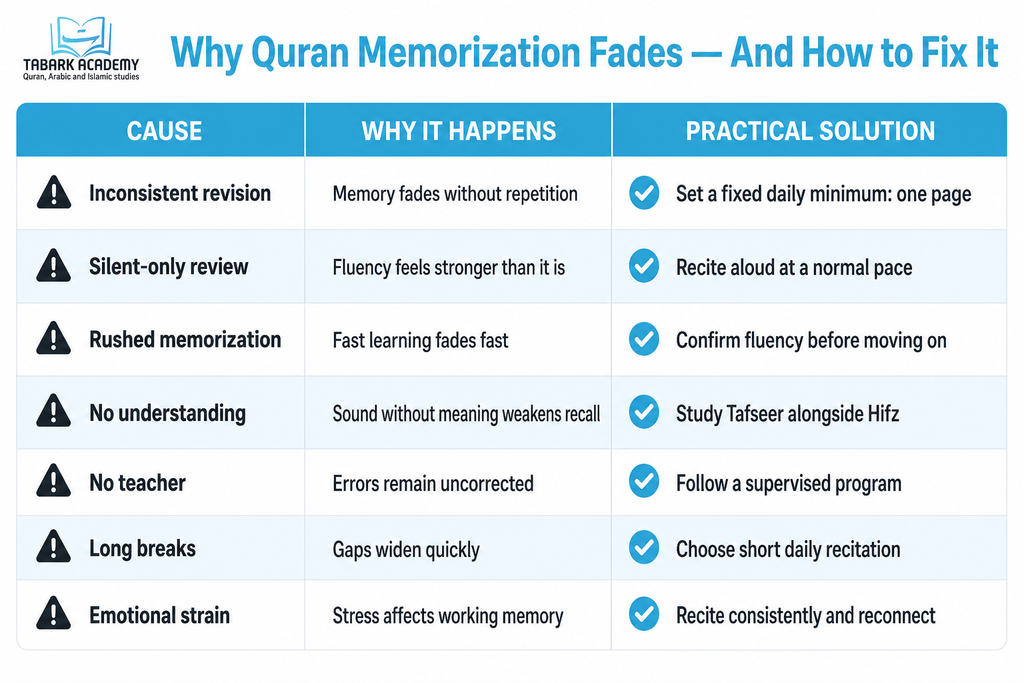
Causes Of Forgetting The Quran And Practical Solutions At A Glance
Use this table as a quick reference for why do I forget what I memorize of the Quran — matching each of the seven reasons above directly to its fix before you move on to the Islamic ruling and the prevention steps that follow.
| Cause | Why It Happens | Solution |
| Inconsistent revision | Memory fades without repetition | Fixed daily revision, minimum one page |
| Silent-only review | Fluency feels stronger than it is | Recite aloud at a normal pace regularly |
| Rushed memorization | Fast learning fades fast | Slow down; confirm fluency before moving on |
| No understanding | Sound without meaning weakens retention | Study Tafseer alongside memorization |
| No teacher | Errors go uncorrected | Enroll in a structured, supervised program |
| Long breaks | Gaps widen quickly | Short daily recitation beats long weekly sessions |
| Emotional strain | Guilt and stress affect working memory | Consistent recitation restores attachment |
Read also: Unlock Your Mind: How to Conquer Psychological Obstacles in Quran Memorization
How Can You Prevent Forgetting What You Memorize of the Quran?
Preventing Quran memorization from fading requires more than repeating a portion whenever you happen to have free time.
If you have already forgotten some of what you memorized, do not treat every weak passage as completely new material. Previous exposure and repetition can make relearning feel more familiar than the first memorization attempt.
Start by testing what you can still recall, identify the exact Ayahs and transitions that have weakened, and concentrate your repetition there.
The following habits can help protect your Hifz and reduce how much memorized Quran you lose over time.
1. Set a Daily Quran Revision Minimum You Can Maintain Consistently
Create a minimum amount of Murajaah that you complete even on your busiest days. This might be one page, several pages, or a larger portion depending on how much Quran you have memorized.
The purpose of the minimum is not to represent your ideal revision session. It is your revision floor—the amount you refuse to go below.
On days when you have more time, revise beyond that minimum. On difficult days, complete at least the minimum so that one missed session does not turn into several days without revision.
Read also : Free Quran Murajaah Timetable PDF: Custom Plans for Every Hifz Stage
2. Test Your Memorization From Memory Instead of Only Reading From the Mushaf
Looking at a familiar page can create the impression that you still know it because the words and layout feel recognizable. Actual Hifz retention is better tested when you attempt to recite without looking at the Mushaf first.
Try reciting the assigned portion completely from memory. Mark every place where you hesitate, substitute a word, confuse similar Ayahs, or need to look at the page.
Then open the Mushaf, correct those specific mistakes, repeat the weak passages, and test the entire portion from memory again.R
3. Recite Different Memorized Portions During Your Daily Salah
Salah provides regular opportunities to bring memorized Quran back into active recall. Instead of repeatedly reciting only the Surahs that already feel easiest, deliberately rotate through portions you are currently reviewing.
For example, you might select a recently memorized Surah for one prayer and an older, weaker portion for another appropriate recitation opportunity.
If you discover that an Ayah you thought was secure becomes difficult when reciting without preparation, add it to your next focused Murajaah session rather than repeatedly guessing through it.
4. Give Weak Surahs and Ayahs More Revision Than Strong Ones
Not every memorized portion requires the same amount of attention. Some pages remain fluent after relatively little review, while others repeatedly produce the same hesitation or mistake.
Keep a simple weak-portion log. Whenever you make a recurring mistake, record the Surah, Ayah, and problem—for example:
- forgetting the beginning of the next Ayah;
- confusing two similar verses;
- replacing one word with another;
- forgetting an Ayah in the middle of a passage;
- repeatedly making the same Tajweed or pronunciation error.
Weak portions should temporarily receive more frequent revision until you can recite them reliably again. This prevents you from spending equal time on material that is already strong while genuinely weak sections continue deteriorating.
Read also : The Best Strategy to Re-Memorize Forgotten Quranic Portions
5. Listen to a Skilled Quran Reciter to Reinforce the Correct Sound Pattern
Listening can support Murajaah by repeatedly exposing you to the correct sequence, pronunciation, rhythm, and transitions of the passage you are memorizing.
Choose a clear reciter and, when possible, stay with the same reciter while strengthening a particular portion. Listen while following the Arabic text, then close the Mushaf and attempt to reproduce the passage yourself.
Use listening as support for active recall rather than a replacement for it. A Surah can sound completely familiar when you hear someone else recite it while still being difficult to produce independently from memory.
6. Learn and Apply Tajweed So You Do Not Reinforce Incorrect Recitation
Hifz should preserve the Quran together with accurate pronunciation. If you repeatedly memorize a word with the wrong Makhraj, incorrect Madd length, or another recurring Tajweed error, that pronunciation can become attached to the memorized sequence and require additional work to correct later.
When revising, therefore, pay attention not only to whether you remembered the words, but also to how you pronounced them.
Working with a qualified teacher is particularly useful because some pronunciation errors are difficult to identify by yourself.
Students who need to strengthen foundational reading and pronunciation can also work through a structured Quran Reading Course alongside their memorization.
7. Study the Meaning of the Ayahs You Are Memorizing
Understanding the basic meaning of a passage gives you another way to organize what you have memorized.
Instead of remembering a Surah only as a sequence of sounds, you begin recognizing how its ideas develop: what the passage is discussing, how one Ayah connects to the next, when the subject changes, and why particular words appear.
This can be especially helpful with longer passages where several Ayahs have similar structures.
Use a reliable translation for basic understanding and consult Tafsir when you need the context or interpretation of a passage. Understanding meaning supports memorization, but it should complement—not replace—repeated recitation from memory.
Read also: How To Restart Hifz After A Long Break?
8. Pay Special Attention to Similar Ayahs That You Frequently Confuse
Similar Quranic passages can become persistent weak points in Hifz. A student may begin one Ayah correctly and then unintentionally continue with wording from a similar passage elsewhere in the Quran.
When this happens, do not simply repeat both passages many times. Compare them directly.
Place the similar Ayahs beside each other and identify the exact words where they differ. Ask yourself what comes immediately before and after each passage, and practice beginning from several different points rather than always starting from the beginning of the Surah.
9. Teach or Recite Your Memorized Quran to Someone Else
Reciting to another person creates accountability and can expose gaps that remain hidden during private revision.
If appropriate to your level, you can also explain what you are currently studying to a family member or fellow student. Explaining the meaning, identifying Tajweed rules, or describing where you repeatedly make mistakes forces you to engage with the passage more actively.
However, teaching should never become a substitute for receiving correction yourself. If you are unsure about pronunciation, Tajweed, or interpretation, verify it with a qualified teacher before passing it on.
10. Protect Old Memorization When Adding New Sabak
One of the easiest ways to forget Quran is to allow new memorization to consume all available study time.
Your daily Hifz routine should distinguish between new Sabak, recent Sabqi, and older Manzil or Dhor. If older portions repeatedly weaken while your new memorization continues growing, reduce the amount of new Sabak temporarily and give more time to revision.
Forward progress should not be measured only by how many new pages you memorize. A more useful measure is how much Quran you can still recite accurately weeks and months after memorizing it.
11. Follow a Structured Hifz Program With Regular Teacher Accountability
A teacher can hear problems that are difficult to detect during self-revision, including recurring pronunciation mistakes, weak transitions, hesitation patterns, and portions that appear memorized but are not yet stable.
Regular accountability also prevents revision from becoming random. Your teacher can determine which portions require daily attention, which can move into a longer revision cycle, and whether you are ready to add more new memorization.
The objective is not to reach a point where you never make another mistake. It is to build a revision system that detects weakness early and corrects it before a small hesitation develops into a forgotten page or Surah.
Programs like Tabarak Academy’s Online Quran Classes for Sisters build revision into every session rather than treating it as optional.
Read Also: How Much Quran Should I Revise Daily?
Is It A Sin To Forget What You Memorize Of The Quran?
Forgetting memorized portions of the Quran is not automatically a sin. Human memory naturally weakens, and a person may forget despite making a sincere effort to review and preserve what they have memorized.
The concern is greater when someone deliberately neglects the Quran after memorizing it, makes no reasonable effort to revise, and allows their memorization to disappear through persistent carelessness.
Scholars have differed over how particular reports and warnings about forgetting the Quran should be understood, so it is better not to claim that every instance of forgetting is sinful.
If you notice your Hifz becoming weak, the practical response is not to become discouraged. Return to regular Murajaah, rebuild weak portions gradually, and establish a revision routine that you can maintain consistently.
Passive Forgetting vs. Active Abandonment
Scholars draw a clear line between two situations. Passive forgetting is when verses fade due to the reasons above — natural memory limits, a demanding season of life, or age — and this is not sinful. Active abandonment is deliberately walking away from the Quran with no intention of returning to it, which classical scholars describe as blameworthy.
Ibn Taymiyyah addressed this directly: forgetting through negligence and laziness while capable of maintaining the Quran is a serious matter, and re-memorization becomes an obligation where possible.
The operative word is negligence — not the ordinary fading that comes from being human.
Allah describes the Quran as made easy to remember in Surah Al-Qamar:
“وَلَقَدْ يَسَّرْنَا الْقُرْآنَ لِلذِّكْرِ فَهَلْ مِن مُّدَّكِرٍ”
“And We have certainly made the Quran easy to remember. So is there anyone who will be mindful?” (54:17).
This verse repeats four times in the same surah, which scholars read as an invitation to continuous engagement, not a one-time achievement.
What Happens If a Hafiz Forgets the Quran?
A hafiz who reviews consistently but still loses fluency due to normal memory limits is not sinful — this is the expected human experience, even for people who take their memorization seriously.
A hafiz who stops reciting entirely and makes no effort to reconnect is in a more serious position under classical scholarship.
Either way, the door back is always open. At Tabarak Academy, several of our students returned to their hifz after five, ten, even twenty years away from regular recitation, often faster than they expected because the original learning was never fully gone.
How Do You Recover Quran You Have Already Forgotten?
Recovering forgotten memorization is not the same as starting from zero. The neural pathways built during the original memorization remain, largely dormant rather than deleted, which is why re-memorization is consistently faster than the first attempt when it’s approached in the right order.
1. Assess what you’ve actually forgotten
Sit with a Mushaf and recite aloud, surah by surah. Scholars distinguish between complete forgetting — you don’t recognize the verse at all, even reading it — and functional forgetting, where fluency is gone but recognition returns the moment you see or hear it.
Most students fall into the second category, which is recoverable far faster than they expect. Mark what comes back fluently, what comes back only with prompting, and what is genuinely blank.
Read also :How to Reclaim Your Hifz After Years of Being Away?
2. Reactivate dormant verses through listening before reciting
Spend several days listening intensively to the portions you want to recover, following along in the Mushaf. This rebuilds the sound-form of each verse before your tongue is asked to produce it independently.
3. Start from short surahs and firmly retained portions
Beginning with what comes back easily — often the short surahs used in daily salah — builds momentum instead of discouragement.
4. Prioritize revision over new recovery in your daily schedule
A structure that works well for a 30-minute daily session: roughly 15 minutes reviewing what’s already stable, 10 minutes on weak or dormant portions, and 5 minutes listening ahead to what you’ll work on next.
5. Recite recovered portions in every prayer
Rotating newly recovered surahs into voluntary prayers embeds them in a context of attentiveness that mechanical repetition alone doesn’t provide.
6. Work with a qualified teacher to correct your Tajweed as you go
Years without regular recitation often let small pronunciation errors creep in unnoticed, and a dormant verse recalled incorrectly becomes a newly memorized mistake. Pairing recovery with guided correction — the approach used in Tabarak Academy’s Online Ijazah Course — prevents that from happening.

Step Inside Our Virtual Classrooms
See our engaging teaching methods in action! watch real snippets of our live classes and discover how our expert instructors make learning interactive, memorable, and inspiring for every student.
Start Rebuilding Your Hifz With Tabarak Academy Today
If you’ve been carrying the weight of forgetting what you worked to memorize, that weight doesn’t need to stay with you. The path back is shorter than it feels, and it starts with one session, not a complete restart.
Tabarak Academy’s teachers work with students at every stage — those recovering forgotten portions, those memorizing for the first time, and those simply trying to build a revision habit that finally sticks.
Every plan is built around your actual retained memorization, not a generic curriculum.

Our Quran Courses:
- Online Quran Classes
- Online Quran Classes for Beginners
- Online Quran Classes for Kids
- Online Quran Classes for Adults
- Online Quran Classes for Men
- Online Quran Classes for Sisters
- Quran Reading Course
- Quran Recitation Course
- Online Ijazah Course
- Online Qirat Course
- Quran for Toddlers / Young Children
- Weekend Quran Classes
- Intensive Quran Course
- Al-Azhar Quran Course
- Zoom Quran Classes
- Noor Al-Bayan Course

Conclusion
Forgetting what you memorize of the Quran is an ordinary human experience, not evidence that you’ve failed or that Allah has closed a door.
The seven reasons above cover nearly every case: inconsistent revision, silent-only recall, rushing the memorization, skipping the meaning, having no teacher, long breaks, and emotional strain.
If you started this article asking why do I forget what I memorize of the Quran, the honest answer is that it’s rarely one single cause — usually two or three of these overlap at once.
None of these are sinful on their own — only walking away entirely, without intention to return, carries that weight. Once you know which reason applies to you, the fix is almost always the same: short, daily, structured engagement rather than occasional long sessions.
Recovery is consistently faster than the first memorization, and at Tabarak Academy, that recovery process is exactly what our teachers guide students through every day.

Frequently Asked Questions
Here are direct answers to the questions students ask most often about forgetting and recovering Quran memorization, based on scholarly guidance and the practical experience of our teachers at Tabarak Academy.
1. Is it a sin if I forget what I memorize from the Quran?
Natural forgetting caused by life circumstances, illness, or normal memory limits is not a sin. Scholars reserve caution specifically for deliberately and permanently abandoning the Quran with no intention of returning to it.
2. What are the main reasons I forget what I memorize from the Quran?
If you’re asking why do I forget what I memorize of the Quran, the most common reasons are inconsistent revision, reciting only silently instead of aloud, memorizing too quickly without enough repetition, learning without understanding the meaning, and going long stretches without structured review or a teacher’s feedback.
3. How long does it take to re-memorize a juz I’ve forgotten?
It varies by how much was truly forgotten versus simply dormant, but most students recover a previously memorized juz faster than they memorized it originally, often within a few weeks of structured daily revision, because the underlying memory pathways are still partly intact.
4. Can I stop forgetting the Quran again without a teacher?
Self-review alone can maintain memorization for a while, but a teacher catches pronunciation drift and weak spots that are very difficult to notice on your own. Consistent daily revision paired with a structured program is the most reliable way to keep memorization from fading again.
5. What happens if a hafiz forgets the Quran?
There’s no spiritual punishment for a hafiz who forgets despite genuine effort to review. The appropriate response is to resume revision, work with a teacher, and rebuild the connection gradually rather than treating it as a permanent loss.