


Best Revision Schedule for Hifz – The Complete Muraja’ah System
Most hifz students don’t lose their memorization because they stopped memorizing. They lost it because they stopped revising.
Building the best revision schedule for hifz is what separates students who complete the Quran and keep it for life from students who memorize thirty juz’ and watch half of it fade within a year.
This guide breaks down a complete, practical revision schedule for hifz — built on the classical sabaq, sabqi, and manzil framework that Quran teachers have used for generations.
You’ll get daily timetables, weekly structures, a recovery plan for missed days, and a realistic pace guide, all designed to work whether you’re a child in a structured hifz program or a working adult fitting revision into a packed day.
At Tabarak Academy, this is the same framework our teachers use to design personalized timetables for students at every stage of their memorization journey.
The Three-Tier Daily Revision System
This tier system gives each layer its own dedicated slot rather than leaving revision to whatever time happens to be left over.
Tier 1: Daily Review of the Newest Portion
This is the most active tier and covers the last one to three juz’ you’ve memorized. Recite this portion every day without exception, ideally right after Fajr or Asr, aloud and with attention to tajweed.
Close the mushaf and recall from memory first — only open it to correct an error, not to read along.
Tier 2: Weekly Review of the Middle Portion
This tier bridges the gap between what’s brand new and what’s old enough to be settled — typically material finished two weeks to six months ago.
Divide it across the week: if you have ten juz’ in this tier, revising roughly one and a half juz’ a day completes the full set once weekly.
A recitation partner who listens while you recite this tier catches errors you won’t hear yourself making.
Tier 3: Monthly Review of Older Memorization
Anything memorized more than six months ago belongs here. It needs less frequent attention but never zero attention — a full recitation of everything in this tier once a month, spread across roughly one juz’ a day, keeps the earliest-memorized sections from becoming the weakest part of your hifz.
Reciting this portion in nafl prayers folds the review directly into worship rather than adding it as a separate task.
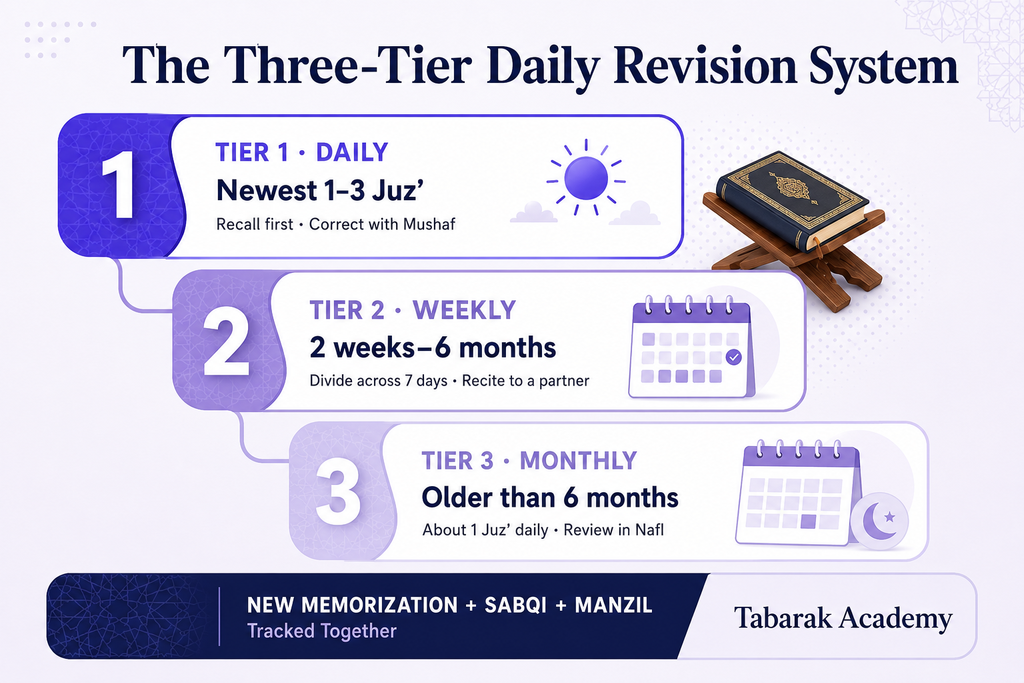
At Tabarak Academy, teachers track each student’s sabqi and manzil progress alongside new memorization, because a schedule that only monitors new pages memorized gives an incomplete — and often misleading — picture of real progress.
A Complete Daily And Weekly Hifz Timetable
With the three tiers defined, the next question is how to fit them into an actual day. The timetable below distributes sabaq, sabqi, and manzil across fixed daily windows, turning the theory above into a best revision schedule for hifz you can actually repeat every day.
Daily Schedule
This breakdown assigns each of the four sabaq/sabqi/manzil sessions to a fixed point in the day, so revision never has to compete with whatever time happens to be left over.
| Time | Duration | Activity | Purpose |
| After Fajr | 30–40 min | New memorization (sabaq), repeating each line 10–15 times aloud | Mind is clearest; highest retention window |
| Midday | 15 min | Review the morning’s new material | Consolidates before it fades |
| After Asr | 20–30 min | Sabqi and manzil rotation | Cycles recent and older material back into active memory |
| Before sleep | 5–10 min | Listen to the day’s verses via audio recitation | Reinforces auditory memory during rest |
Read more about: Daily Quran Review Schedule for Students
Weekly Structure
A weekly rhythm prevents the most common failure mode: piling up new pages without ever consolidating them.
| Days | Activity |
| Days 1–5 | New sabaq + sabqi revision of the previous week’s pages |
| Day 6 | Full weekly review — recite everything memorized that week from memory, no mushaf |
| Day 7 | Light manzil review or structured rest |
Day 6 is not optional. Students who skip the weekly consolidation session consistently report, within three to four weeks, that earlier pages in the week feel shaky while the most recent page still feels solid — the exact imbalance this session exists to prevent.
Students who want a native Arabic teacher to check tajweed accuracy during this weekly session — rather than relying on self-assessment alone — often find that a structured Quran Recitation Course closes that gap faster than solo practice.
Read Also: Can I Memorize the Quran at 40?
Experience Our Interactive Learning
Curious about how we teach? Watch these brief video clips from our recent live sessions to see our structured curriculum, advanced learning platform, and dynamic student-teacher interactions firsthand.
Building A Top Revision Schedule For Hifz Around A Layered Timeline
Beyond the daily and weekly rhythm, a best revision schedule for hifz also needs a rotation that guarantees every juz’ gets touched on a predictable cycle — not just whenever there’s spare time.
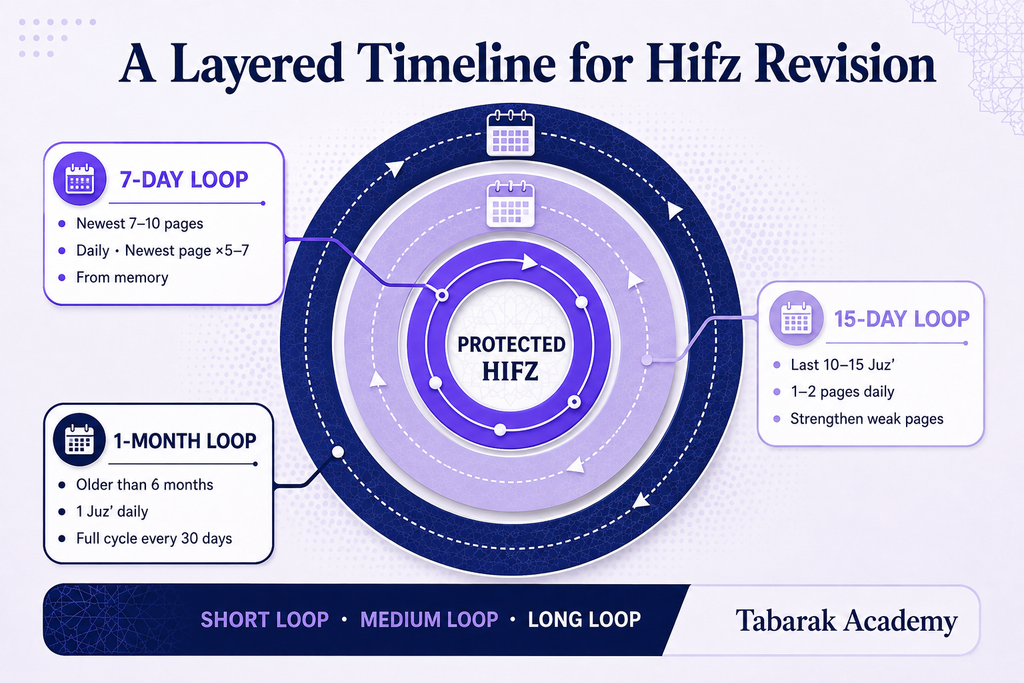
The following three-layer rotation combines a short loop, a medium loop, and a long loop into one system.
The 7-Day Short-Term Loop
This loop covers the last seven to ten pages memorized. Recite them daily, repeating the newest page five to seven times, entirely from memory.
This loop is the most intensive because this is where forgetting happens fastest — new material that hasn’t yet moved into stable long-term memory.
The 15-Day Intermediate Loop
This loop covers material too old for the 7-day loop but too recently memorized for a full monthly cycle — roughly the last ten to fifteen juz’ completed.
Reciting one to two pages daily from this range, focusing extra time on whichever pages you’ve identified as weak, closes what’s often called the “intermediate slip” — the point where material starts fading a few months after it was first solidified.
The 1-Month Long-Term Loop
This loop cycles through everything memorized more than six months ago, aiming to recite the full memorized portion once every thirty days — one juz’ a day.
It sounds demanding written out, but broken into a single daily session after Asr or Isha, it’s sustainable indefinitely and is what actually protects a completed hifz over years, not just months.
Read also : How to Balance Hifz and Revision: 5 Practical Tools
The Best Revision Schedule For Hifz If You’re A Busy Adult
The traditional model — four to six hours daily inside a dedicated institute – isn’t realistic for most adult students juggling work, family, and study. The answer isn’t to abandon hifz; it’s to build a schedule that fits the actual shape of a busy day.
Instead of one long session a packed schedule will eventually cancel, this method splits revision into three short, purpose-specific windows.
| Window | Timing | Duration | Task |
| New lesson | After Fajr | 15–20 min | Memorize 3–5 new verses, repeating each line aloud at least 10 times |
| Recent revision | Commute or lunch break | 10–15 min | Recite yesterday’s verses from memory, verify with audio |
| Old revision | After Isha or before sleep | 10–15 min | Cycle through a quarter-juz’ of older material |
Total daily commitment lands around 35–50 minutes, distributed rather than concentrated — which matches what memory research on distributed practice consistently shows: spreading review across the day produces stronger long-term retention than the same total time spent in one block.
Realistic Pace for Working Adults
On this model, at three to five verses a day, a working adult typically completes Juz’ Amma — the standard entry point for new hifz students — in three to four months.
The full Quran, maintained at this pace without interruption, takes six to seven years. That number should clarify rather than discourage: a student who starts at 30 and holds this pace carries a completed hifz for the rest of their life by 37.
Working professionals who need class times built entirely around their schedule rather than the other way around often find that Weekend Quran Classes fit this pace without requiring weekday disruption.
while parents introducing very young children to early Quran exposure alongside their own hifz journey can start them with a program built for that age group, such as classes for Quran for young children.
What to Do When You Miss a Day of Your Hifz Timetable Without Falling Behind
Every Hifz student misses a day eventually. Missing one session is usually manageable; the bigger risk is responding in a way that weakens recent memorization or disrupts the revision cycle. The next session should therefore focus on repairing the gap before adding anything new.
1. Pause New Memorization Until the Missed Revision Has Been Recovered
Treat the session after a missed day as a recovery session rather than a new-memorization session. Do not immediately add another Sabaq on top of material that has not received its scheduled review.
Complete the missed revision first so that one skipped day does not create a growing backlog.
Read also: 5 Ways to Test Your Hifz Alone at Home
2. Review Your Recent Sabqi From Memory to Find What Became Weak
Recite the material from the previous 7–14 days from memory and pay attention to every hesitation, forgotten word, incorrect transition, or verse that requires prompting.
Do not assume the entire portion needs to be relearned. The purpose of this review is to identify exactly what weakened during the interruption.
3. Isolate Weak Ayahs and Repeat Them Until Recall Becomes Stable Again
Take each Ayah that caused difficulty and work on it separately instead of repeatedly reciting the entire surrounding passage.
Repeat the weak Ayah 15–20 times, paying particular attention to the exact word or transition where the mistake occurred. Then reconnect it to the Ayah before and after it and test the passage again from memory.
4. Resume Your Normal Hifz Timetable Once Your Sabqi Is Stable Again
Once you can recite the recent Sabqi confidently again, return to your normal Sabaq, Sabqi, and Manzil rotation rather than continuing to modify the timetable because of one missed day.
The goal is to contain the disruption. A single missed session should not turn into several days of irregular revision.
Avoid These Two Catch-Up Mistakes After Missing a Hifz Session
Two responses can make a missed day more damaging than the missed session itself.
First, do not double your new memorization the following day simply to catch up. Trying to force two days of Sabaq into one session can reduce the attention and repetition given to both portions.
Second, do not abandon your Manzil cycle to create extra time for new memorization. Older memorization still needs regular revision, particularly during busy or inconsistent periods.
The objective is not to compensate for a missed day by doing everything at once. It is to restore the revision system quickly enough that one missed session remains an isolated interruption rather than the beginning of a larger Hifz backlog.
Students working without direct teacher feedback often don’t notice a weak verse until it’s fully forgotten, which is one reason a structured, teacher-supervised track — like an Online Ijazah Course — catches slippage during the session itself rather than weeks later.
Read also:Transform Your Voice for a More Beautiful Quran Recitation
Choosing Your Completion Pace: Intensive, Standard, Or Steady
The Quran spans 604 pages across 30 juz’. Which of these three paces fits depends on available time, existing tajweed foundation, and how much life disruption you can realistically absorb.
| Programme | Daily Memorization | Daily Revision | Estimated Completion | Best For |
| Intensive | ~1 full page (10–15 verses) | 45–60 min | 2–3 years | Full-time students, structured hifz schools |
| Standard | ~half a page (5–8 verses) | 20–30 min | 4–5 years | Working adults, school-age students |
| Steady | ~quarter page (3–5 verses) | 15–20 min | 6–7 years | Beginners, limited time, building Arabic alongside hifz |
Students who choose the Steady Plan and want to strengthen Arabic comprehension in parallel — rather than memorizing by sound alone — tend to retain verses more durably when they understand each word before committing it to memory, something a foundational track like the Quran Reading Course is built to support.
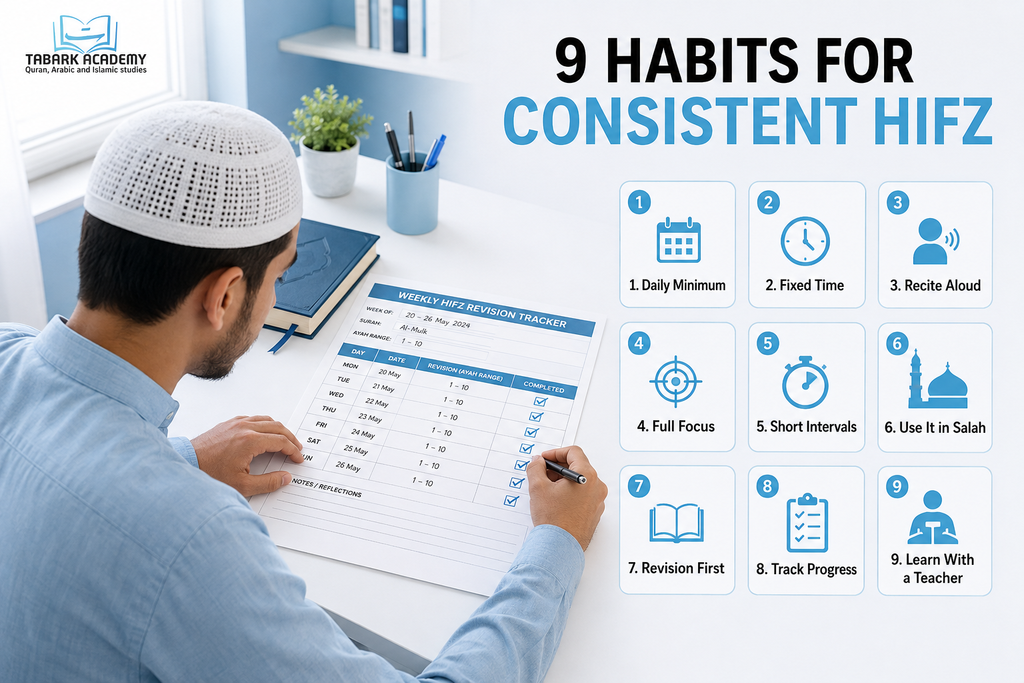
Nine Habits That Keep Any Hifz Revision Schedule Running
A timetable on paper does nothing without the habits that sustain it day to day.
- Start with a small, non-negotiable daily minimum — three verses done daily beats a full page attempted four days a week.
- Memorize at the same time every day; a fixed hour trains the mind to focus faster at that time.
- Recite aloud, always — silent reading is reading, not hifz. The tongue has to be engaged.
- Give the session full attention; no phone, no background noise, no divided focus.
- Break sessions over 30 minutes into focused intervals with short breaks to prevent late-session fatigue.
- Recite new memorization in salah the same day it’s memorized — the physical engagement of prayer locks it in further.
- On low-focus days, prioritize revision over new memorization; a well-revised page beats a poorly memorized new one every time.
- Track progress in writing — date, surah, and ayah range — for both accountability and a visible record of progress.
- Learn under a qualified teacher who hears your recitation directly and catches errors before they solidify.
That last habit is the one self-study can’t replace. No app or audio track substitutes for a teacher adjusting your pace in real time based on what they actually hear.
Which is the core of how Tabarak Academy structures its one-to-one hifz supervision, and for advanced students refining recitation styles, the Online Qirat Course extends that same teacher-led correction beyond basic tajweed.
Read Also: Is It Too Late to Memorize the Quran?
Step Inside Our Virtual Classrooms
See our engaging teaching methods in action! watch real snippets of our live classes and discover how our expert instructors make learning interactive, memorable, and inspiring for every student.
Start Building Your Personalized Hifz Revision Schedule Today
A schedule you read once and forget isn’t a revision system — it’s a document. What actually protects years of memorization is a timetable built around your real pace, checked weekly by a teacher who can hear exactly where a verse is slipping before it’s lost for good.
Tabarak Academy designs a personalized revision schedule for every hifz student – matched to your available time, your current retention level, and your completion goal – with one-to-one sessions led by qualified teachers who track your sabaq, sabqi, and manzil every week.

Our Quran Memorization / Hifz Courses
- Online Hifz Program
- Juz 30 Memorization Course
- Hifz for Kids Course
- Hifz for Adults Course
- Hifz for Sisters Course
- Short Surah Memorization Course
- Hifz Ijazah Course

Conclusion
The best revision schedule for hifz isn’t the longest one or the most complicated one — it’s the one that protects all three layers of memorization at once: what’s new, what’s recent, and what’s old.
Whether you follow the classical sabaq-sabqi-manzil structure, the 7-day/15-day/1-month rotation, or the 3-window method built for busy adults, the underlying principle stays the same: consistency in small, daily doses beats intensity applied inconsistently.
Missing a day isn’t the failure — failing to repair it immediately is. With a schedule that fits your actual life and a teacher checking your recitation regularly, hifz retention stops being a source of anxiety and becomes a routine you can sustain for years.
Tabarak Academy builds exactly that kind of personalized revision plan for students at every stage, from a child’s first juz’ to an adult completing their final one.

Frequently Asked Questions
Below are the questions students most often ask when building or adjusting a revision schedule for hifz, along with direct answers you can apply right away.
1. What is the best revision schedule for hifz?
The best revision schedule for hifz combines three layers — daily review of newly memorized verses (sabaq), a rotating review of recent pages from the past one to two weeks (sabqi), and a weekly cycle through everything memorized earlier (manzil). A schedule missing any one of these three layers will eventually let older memorization fade.
2. What should I do if I miss a day of revision?
Treat the next session as a repair session, not a forward-progress one: skip new memorization, recite everything from the past 7–14 days from memory, and isolate any verse where you hesitate for focused repetition. Handled this way, one missed day costs exactly one session and nothing more.
3. Can a working adult realistically keep up a hifz revision schedule?
Yes — the 3-window method spreads roughly 35 to 50 minutes of daily revision across a Fajr session, a commute or lunch-break review, and a short evening cycle, without requiring one long block of free time. At this pace, most working adults complete Juz’ Amma in three to four months and the full Quran in six to seven years.
4. Does Tabarak Academy help build a personalized hifz revision schedule?
Yes. Tabarak Academy’s teachers design a revision timetable matched to each student’s pace and available time, then track sabaq, sabqi, and manzil progress weekly during one-to-one online sessions with qualified instructors.
5. How many hours a day should I spend on hifz revision?
Most students need 45 to 90 minutes total, split across two or three sessions rather than one long block. A post-Fajr session for new memorization plus a shorter afternoon or evening session for sabqi and manzil covers all three layers without requiring a single extended sitting.
6. What is the best time of day to revise Quran memorization?
The period right after Fajr is generally the most productive for both new memorization and revision, since the mind is clearest and the environment is quietest. A shorter follow-up session after Asr or Isha for sabqi and manzil rounds out a complete daily revision schedule for hifz.