

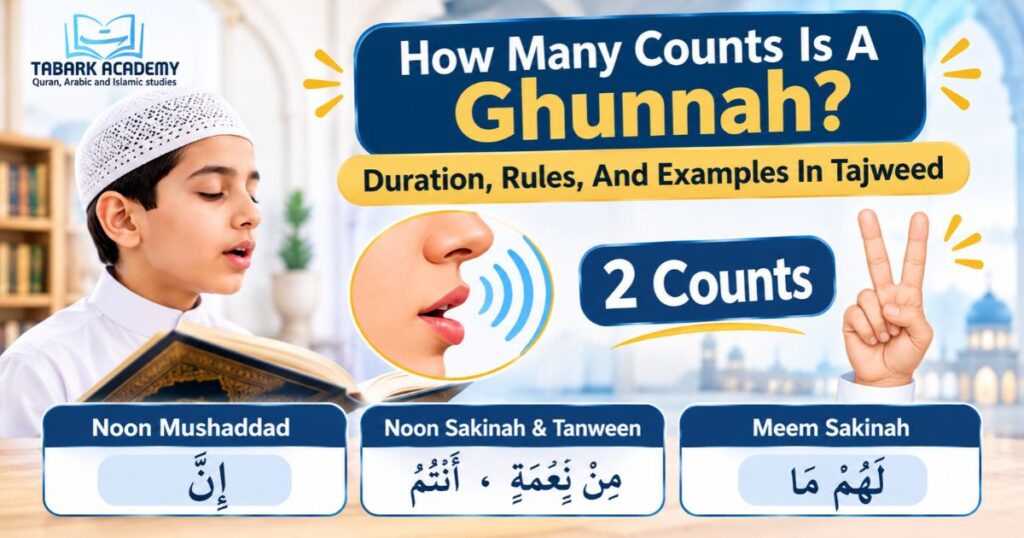
How Many Counts Is A Ghunnah? Duration, Rules, And Examples In Tajweed
A ghunnah is held for two counts — but if you have ever recited إِنَّ and wondered whether your nasal hold was too short, too long, or needed at all, the number alone does not settle it.
How many counts is a ghunnah depends on recognizing which situations demand the full, deliberate hold and which carry only the light nasal quality that Noon and Meem always have.
This guide answers how many counts is a ghunnah with precision: the fixed two-count duration, the four degrees of ghunnah classical scholars describe, every rule that triggers a confirmed ghunnah, and the exact cases where no nasal hold belongs at all.
At Tabarak Academy, ghunnah timing is one of the first corrections our teachers make in live recitation sessions, because a mistimed ghunnah changes the rhythm of an entire verse.
What you’ll learn in this article
- The exact answer to how many counts is a ghunnah, and how to measure it.
- The difference between baseline ghunnah and confirmed two-count ghunnah.
- Every Tajweed rule that requires a full ghunnah and the ones that don’t.
- The four degrees of ghunnah from strongest to lightest.
- The most common timing mistakes and a 60-second self-test.
How Many Counts Is A Ghunnah?
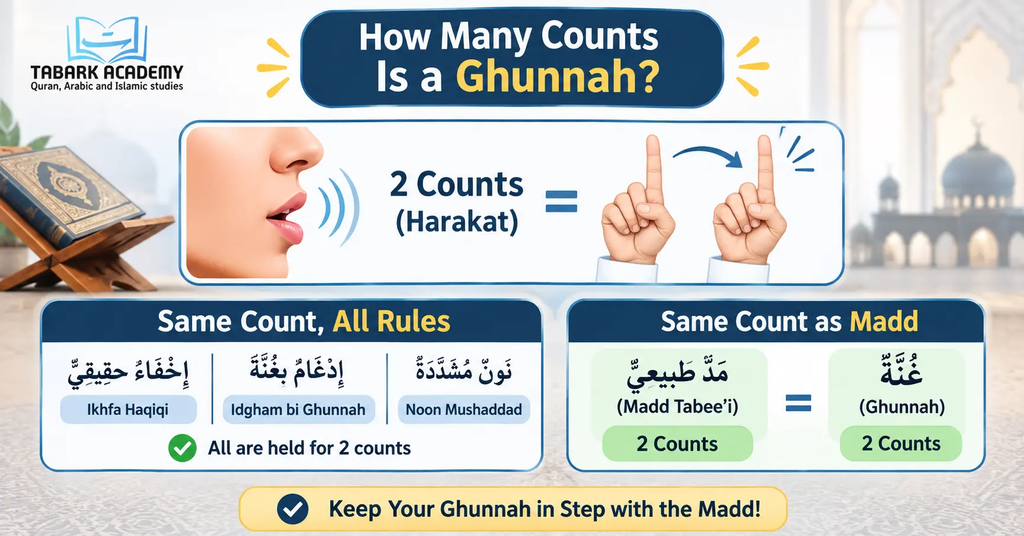
A ghunnah is held for two counts (harakat) in all of its confirmed states. One count is measured as the time it takes to raise or lower a finger once — so two counts is the time to raise and lower a finger twice, at a steady, even pace.
The answer to how many counts is a ghunnah does not change based on which rule triggered it. A ghunnah in Noon Mushaddad, a ghunnah in Idgham bi Ghunnah, and a ghunnah in Ikhfa Haqiqi are all held for the same two counts. What changes from rule to rule is only whether a confirmed ghunnah is required at all — not how long it lasts once it is.
Is the ghunnah count the same as Madd timing?
Yes, the two-count baseline for ghunnah matches the two-count baseline of natural Madd (Madd Tabee’i). They share a duration but not a mechanism: Madd lengthens a vowel through the mouth, while ghunnah resonates through the nasal passage.
Beginners often borrow the timing of their Madd from their ghunnah or vice versa, which is why one inconsistency tends to produce the other. A practical fix: set your count on a Madd word first, then carry that exact tempo into a ghunnah word without resetting.
Does recitation speed change how many counts a ghunnah is?
The count stays at two harakat, but the absolute length of each count scales with your recitation pace. In Tahqeeq (slow, deliberate recitation) a count is longer in real time than in Hadr (fast recitation), and Tadweer sits between them.
The rule practitioners apply: ghunnah must stay proportional to the Madd in the same recitation. If your natural Madd and your ghunnah no longer sound like the same length within one verse, your ghunnah timing has drifted — regardless of the pace you chose.
Does stopping or continuing change the count?
No. The ghunnah is held for the same two counts whether you stop at the word (waqf) or continue through it (wasl). Unlike Madd rules, where stopping can lengthen a vowel from two counts to four or six, ghunnah has no waqf variation to track — which makes it a stable reference point when you are drilling timing.
Baseline Ghunnah Vs. Confirmed Ghunnah: Why The Count Doesn’t Always Apply
Noon (ن) and Meem (م) are the only two Arabic letters that carry ghunnah, and they carry it permanently as a built-in characteristic (sifah). That permanent quality is not what the two-count rule refers to.
Baseline ghunnah is the light nasal colouring present every time you pronounce a Noon or Meem in any position — voweled, silent, doubled, or not. It is brief, automatic, and never measured.
Confirmed ghunnah is that same nasal quality deliberately extended and emphasized for the fixed two counts, triggered by specific rules. When a Tajweed teacher says “apply the ghunnah,” this is the version meant — and the question of how many counts is a ghunnah applies to this version only.
Missing this distinction is the single most common reason learners either hold a nasal sound on every Noon they see, or drop it entirely because they assume it is automatic.
If you want that distinction corrected in your own voice rather than in theory, Tabarak Academy runs one-to-one Tajweed sessions where a teacher hears the hold in real time and names the rule behind each correction.
The Four Degrees Of Ghunnah, From Strongest To Lightest
Classical Tajweed scholars rank ghunnah into four degrees by fullness and duration. Knowing the ranking tells you how much emphasis each situation deserves.
| Degree | Where it occurs | Strength |
| Most complete (أكمل) | Noon and Meem Mushaddad, and Idgham into ن or م | Fullest hold, two counts |
| Complete (كاملة) | Ikhfa Haqiqi, Ikhfa Shafawi, Iqlab, and Idgham into ي or و | Two counts, slightly less emphatic |
| Incomplete (ناقصة) | Noon and Meem Saakin under Izhar | Light, not held |
| Least (أنقص) | Voweled Noon and Meem | Briefest, automatic |
The practical line falls between the second and third degrees. Degrees one and two are where you count; degrees three and four are where the nose still colours the sound but you do not stop and hold.
The split inside Idgham bi Ghunnah is what places it across two degrees. When Noon Sakinah merges into ن or م the merge is complete (Idgham Kamil) — the Noon disappears entirely into a doubled letter, so the ghunnah is at its fullest.
When it merges into ي or و the merge is incomplete (Idgham Naqis) — the body of the Noon goes but its ghunnah remains as a separate quality riding on the following letter. The count is two in both, but the first feels heavier in the mouth, and learners who flatten the two cases together usually under-hold the ن and م version.
Two refinements practitioners apply inside the held degrees: ghunnah follows the letter after it in heaviness or lightness (tafkheem or tarqeeq), so the ghunnah before a heavy letter such as ق in مِنْ قَبْلِ is itself heavier; and the hold should never become a buzz. Excessive nasal pressure is treated as a performance error, not a sign of care.
Read also: What Is Ghunnah In Tajweed?
Which Tajweed Rules Require A Two-Count Ghunnah
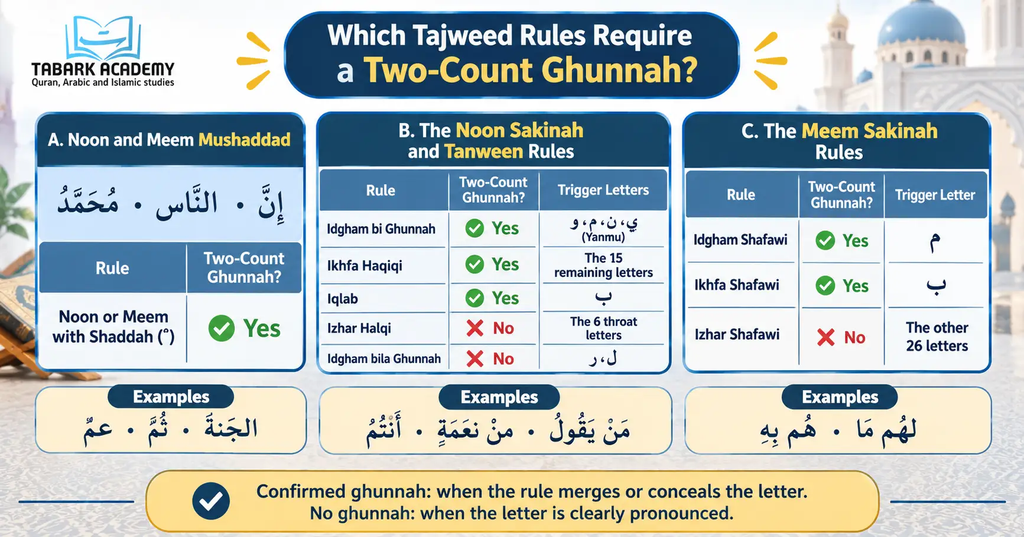
Confirmed ghunnah appears across three systems: doubled letters, the Noon Sakinah and Tanween rules, and the Meem Sakinah rules.
The pattern underneath them is consistent — when a rule merges or conceals the letter, ghunnah is confirmed; when a rule leaves the letter plainly pronounced, it is absent.
A. Noon And Meem Mushaddad
Any Noon or Meem carrying a shaddah (ّ) requires a confirmed two-count ghunnah. A doubled Noon is structurally a silent Noon followed by a voweled Noon, which is why the hold sits naturally between them.
Examples: إِنَّ (inna), النَّاس (an-naas), الْجَنَّة (al-jannah), ثُمَّ (thumma), عَمَّ (‘amma), مُحَمَّد (Muhammad).
This case is worth learning before the sakinah systems, because it depends on nothing but the shaddah. Learners who start with Noon Sakinah often never register that ghunnah has an independent trigger sitting underneath both rule systems.
Start Your Quran Learning Journey
Join Tabark Academy today for structured online lessons with qualified tutors, customized to fit your goals.
Book Your Free Trial LessonB. The Noon Sakinah And Tanween Rules
Noon Sakinah (نْ) and Tanween (ـً ـٍ ـٌ) share one set of four rules, and the following letter decides which applies. Three of the four carry a confirmed two-count ghunnah; one does not, and a fifth sub-case drops it entirely.
| Rule | Two-count ghunnah? | Trigger letters |
| Idgham bi Ghunnah | Yes | ي، ن، م، و (Yanmu) |
| Ikhfa Haqiqi | Yes | The fifteen remaining letters |
| Iqlab | Yes | ب |
| Izhar Halqi | No | The six throat letters |
| Idgham bila Ghunnah | No | ل، ر |
Examples with ghunnah: مَنْ يَقُولُ (man yaqool), مِنْ نِعْمَةٍ (min ni’mah), أَنْتُمْ (antum), مِنْ قَبْلِ (min qabli), مِنْ بَعْدِ (mim ba’di), سَمِيعٌ بَصِير (samee’um baseer) (Al-Mujadila 58:1)
The row that catches people is the last one. Two of the Idgham cases carry ghunnah and two do not, decided purely by the following letter — bi Ghunnah (with) versus bila Ghunnah (without). The name of the rule tells you the answer, so there is nothing extra to memorize.
When Idgham bi Ghunnah does not apply: Izhar Mutlaq
Idgham bi Ghunnah requires the Noon Sakinah and the Yanmu letter to sit in two separate words. When both fall inside a single word, the rule reverses: the Noon is pronounced clearly with no merging and no two-count hold. This case is called Izhar Mutlaq (absolute clarity).
It occurs in exactly four words in the Quran: الدُّنْيَا، بُنْيَان، صِنْوَان، قِنْوَان.
The reason is practical rather than arbitrary. Merging inside a single word would blur the root letters and make the word unrecognizable, so clarity is preserved to protect the meaning.
This is the most frequently missed exception in the Noon Sakinah system — learners apply Idgham to الدُّنْيَا on sight because they see نْ followed by ي, and the error survives precisely because the word is so common that nobody slows down on it.
C. The Meem Sakinah Rules
Meem Sakinah (مْ) has only three rules instead of four, and the same logic decides them: merging or concealing the Meem confirms the ghunnah, while clear pronunciation removes it.
| Rule | Two-count ghunnah? | Trigger letter |
| Idgham Shafawi | Yes | A following م |
| Ikhfa Shafawi | Yes | ب |
| Izhar Shafawi | No | The other 26 letters |
The two letters that need extra care in Izhar Shafawi
Waw (و) and Fa (ف) are the two letters where Izhar Shafawi most often collapses into an accidental Ikhfa. Waw shares its exit point with Meem — both are produced at the lips — and Fa is pronounced immediately next to it, at the inner lip against the upper teeth.
Because the articulation points are identical or adjacent, the lips tend to stay half-closed and let a nasal hum leak in. The correction is deliberate separation: close the Meem fully, release it, then begin the next letter, as in عَلَيْهِمْ وَلَا and هُمْ فِيهَا.
Adding a hold here is a substitution error, not just a timing slip — it turns a clear Meem into a concealed one and changes the rule being applied.
Where Ghunnah Is Not Held at All
Five situations require no two-count hold, only the letter’s baseline quality:
- Izhar Halqi: Noon Sakinah or Tanween before the six throat letters (ء، ه، ع، غ، ح، خ), as in مَنْ آمَنَ and عَلِيمٌ حَكِيم.
- Idgham bila Ghunnah: Noon Sakinah or Tanween merging into ل or ر, where the merge happens cleanly with no nasal resonance.
- Izhar Shafawi: Meem Sakinah before any letter other than Meem or Ba, as in عَلَيْهِمْ وَعَلَى.
- Any Noon or Meem with no shaddah and no sakinah trigger: a plain voweled letter carrying only its light inherent nasality.
- Izhar Mutlaq: Noon Sakinah followed by a Yanmu letter inside the same word — الدُّنْيَا، بُنْيَان، صِنْوَان، قِنْوَان.
Adding a held hum to these is as much an error as dropping it where it belongs.
Common Timing Mistakes and the Two-Count Self-Test
The errors that affect how many counts a ghunnah actually receives are predictable, and all four are self-correctable once named.
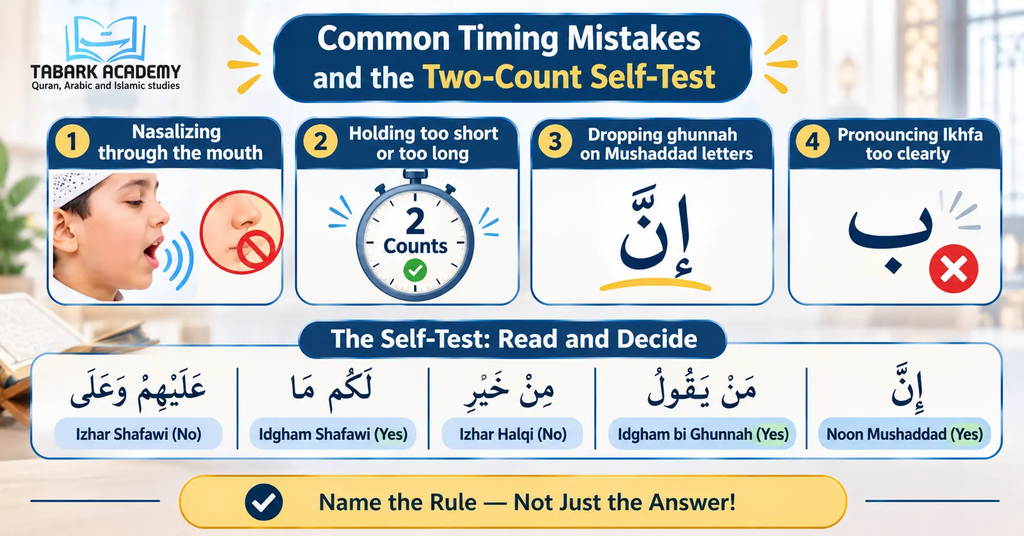
Nasalizing through the mouth. A correct ghunnah resonates behind the nose. The verification is immediate: pronounce a strong نّ while gently pinching your nose closed. If the sound blocks and distorts, the nasal passage is carrying it. If it continues unchanged, you are producing the sound in your mouth — and no amount of counting will fix it.
Holding too short or too long. Rushing toward one count or stretching toward Madd length are both treated as errors rather than stylistic choices. Inconsistency within a single recitation — two counts on إِنَّ and one on ثُمَّ — is the version teachers flag most often.
Dropping ghunnah on Mushaddad letters outside a sakinah rule. Because most curricula open with Noon Sakinah, learners sometimes never transfer the hold to a simple doubled letter.
Pronouncing Ikhfa too clearly. Over-articulating where concealment was required removes the ghunnah along with the concealment, most commonly in Ikhfa Shafawi.
60-Second Ghunnah Self-Test
Read these five words aloud and decide for each whether a two-count ghunnah applies, then name the rule: إِنَّ · مَنْ يَقُولُ · مِنْ خَيْرٍ · لَكُمْ مَا · عَلَيْهِمْ وَعَلَى.
The answers are Noon Mushaddad (yes), Idgham bi Ghunnah (yes), Izhar Halqi (no), Idgham Shafawi (yes), and Izhar Shafawi (no). If you named the rule and not just the answer, the pattern is internalized rather than memorized.
Short, isolated drills like this are how Tabarak Academy structures its Tajweed revision — one rule tested across a handful of real Quranic examples, rather than read once and left.
Read also: What Is Izhar Shafawi?
Start Your Quran Learning Journey
Join Tabark Academy today for structured online lessons with qualified tutors, customized to fit your goals.
Book Your Free Trial LessonStart Correcting Your Ghunnah With A Qualified Teacher
You cannot hear your own nasalization reliably. The brain registers what you intended to produce, not what actually left your mouth — which is why dropped and mistimed ghunnah survives for years in otherwise fluent recitation.
Tabarak Academy’s certified Tajweed teachers correct the hold in live one-to-one sessions: naming the rule, measuring the count with you, and drilling the exact words where your timing slips.
Lessons are online, scheduled around you, and taught by teachers with ijazah in Quranic recitation.
Our Tajweed Courses:
- Online Tajweed Classes
- Tajweed Course for Beginners
- Tajweed Course for Kids
- Tajweed Course for Adults
- Tajweed Course for Sisters
- Advanced Tajweed Course
- Amali (Practical) Tajweed Course
- Learn Quran with Tajweed

Conclusion
How many counts is a ghunnah — two, in every confirmed case, measured as the time to raise and lower a finger twice, and unchanged by the rule that triggered it or by stopping versus continuing.
What varies is not the duration but the trigger. Confirmed two-count ghunnah applies to Noon and Meem Mushaddad, Idgham bi Ghunnah, Ikhfa Haqiqi, Iqlab, Idgham Shafawi, and Ikhfa Shafawi.
It does not apply to Izhar Halqi, Idgham bila Ghunnah, Izhar Mutlaq, Izhar Shafawi, or to any plain Noon and Meem outside those rules.
Hold the count steady, keep it proportional to your Madd, verify the sound is nasal with the pinch test, and the rhythm of your recitation settles on its own.
Frequently Asked Questions About Ghunnah Duration
These are the questions learners raise most often once they know the two-count rule but meet cases where it seems not to fit. Each answer applies to the confirmed ghunnah states described above.
1. How many counts is a ghunnah held for?
A ghunnah is held for two counts (harakat) in all confirmed states — the time it takes to raise and lower a finger twice. The duration is fixed and does not change depending on whether the trigger is a doubled letter, a Noon Sakinah rule, or a Meem Sakinah rule.
2. Which letters produce ghunnah?
Only two: Noon (ن) and Meem (م). No other Arabic letter can carry a nasal ghunnah, which is why these two appear as the trigger letter across multiple separately-named Tajweed rules.
3. What is the difference between Idgham bi Ghunnah and Idgham bila Ghunnah?
Both are Noon Sakinah and Tanween rules, separated by the following letter. Idgham bi Ghunnah is triggered by ي، ن، م، و and carries the full two-count nasal hold; Idgham bila Ghunnah is triggered by ل or ر and has no nasal hold at all.
4. Is ghunnah the same as Madd?
No. Madd lengthens a vowel through the mouth; ghunnah is nasal resonance on Noon and Meem from the khayshoom. They share a two-count baseline duration, which is why beginners confuse the timing, but they are different qualities entirely.
5. Does every Noon and Meem get a two-count ghunnah?
No. Every Noon and Meem carries a light baseline nasal quality automatically, but the two-count hold applies only when the letter is doubled (mushaddad) or falls under Idgham bi Ghunnah, Ikhfa Haqiqi, Iqlab, Idgham Shafawi, or Ikhfa Shafawi.