

9 Practical Steps Of What To Do If You Forget A Verse During Salah
Many worshippers ask what to do if you forget a verse during salah. Their hearts race, and feel uncertain whether to stop, restart, or simply continue.
The scholarly answer is both clear and reassuring. Your prayer is almost certainly still valid, and you have several sound options depending on where in the prayer the gap occurs.
This guide walks through nine scholar-backed steps so you can respond with calm and composure, plus practical advice on building a memorization practice that reduces these moments over time.
1. The Rule That Determines What To Do If You Forget A Verse During Salah
Not every forgotten verse carries the same ruling. The response you take depends entirely on where the gap occurs, and that single distinction separates a valid prayer from one that requires correction.
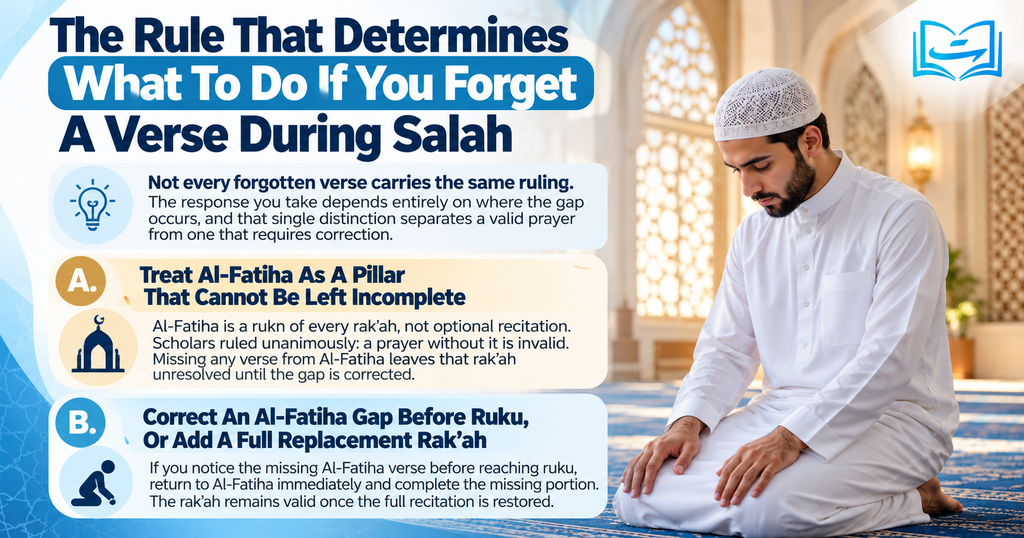
A. Treat Al-Fatiha As A Pillar That Cannot Be Left Incomplete
Al-Fatiha is a rukn of every rak’ah, not optional recitation. Scholars ruled unanimously: a prayer without it is invalid. Missing any verse from Al-Fatiha leaves that rak’ah unresolved until the gap is corrected.
Every verse recited after Al-Fatiha carries a different weight entirely. Those verses are Sunnah, not pillars, and the steps below show exactly what that distinction means for your response.
B. Correct An Al-Fatiha Gap Before Ruku, Or Add A Full Replacement Rak’ah
If you notice the missing Al-Fatiha verse before reaching ruku, return to Al-Fatiha immediately and complete the missing portion. The rak’ah remains valid once the full recitation is restored.
If you only realize the gap after bowing, that rak’ah is considered incomplete. You must add a full replacement rak’ah at the prayer’s end to account for the one invalidated by the missing pillar.
See What Do Learners Achieve in the Online Qirat Course?

2. Recognize That Reciting After Al-Fatiha Is A Sunnah, Not A Pillar
The additional surah or verses recited after Al-Fatiha are Sunnah, not fard (obligatory) or rukn (pillar). This fact is the foundation of every other step in this guide.
The Permanent Committee for Islamic Research ruled: “Whoever forgets the surah after Al-Fatiha in prayer, nothing is upon him; whether imam, follower, or praying alone; whether the prayer is obligatory or voluntary”.
Knowing this removes the anxiety that leads many worshippers to compound one small lapse into a longer and more disruptive interruption.
Experience Our Interactive Learning
Curious about how we teach? Watch these brief video clips from our recent live sessions to see our structured curriculum, advanced learning platform, and dynamic student-teacher interactions firsthand.
Start Your Quran Learning Journey
Join Tabark Academy today for structured online lessons with qualified tutors, customized to fit your goals.
Book Your Free Trial Lesson3. Continue Reading From The Very Next Verse In The Same Surah
Skip the forgotten verse and pick up directly from the one immediately after it. The Permanent Committee confirmed: “There is no harm in reading the verse that comes after it”.
Ibn Uthaymeen also ruled on this: “You may move to the verse after it or bow; the matter is wide in scope.” Continuing forward keeps the recitation moving without unnecessary interruption.
Worshippers who want to reduce how often they reach this point will find it useful to understand why forgetting happens in the first place. Why Do I Forget What I Memorize Of The Quran identifies the core causes with direct, actionable answers.
Explore Why Serious Students Choose Tabarak Academy for Ijazah

4. Switch To A Completely Different Surah
Move to a different surah you know well and continue your recitation from there. Scholars ruled this is fully permissible, with no fault on the worshipper.
This option works best when a longer portion of the current surah feels unclear and continuing verse by verse would generate more confusion than clarity. The flexibility here is intentional and merciful.
For worshippers who switch surahs frequently, that pattern signals the need for deeper memorization of fewer surahs. A structured Best Method To Memorize Quran matched to your learning style addresses this gradually and effectively.
Read also: The Best Time of Day to Memorize Quran – Find Your Golden Hour
5. Bow Directly And Proceed To Ruku
Go into ruku without completing the verse. Ibn Baz confirmed: “He may bow if he has read what suffices; the matter is wide.” Moving directly to ruku is entirely correct and valid.
This option is most useful when an extended attempt at a forgotten verse would create prolonged silence or visible distress for the worshipper or a waiting congregation.
Responding with composure and moving forward is an act of good judgment, not a concession.
6. Accept The Congregation’s Prompt Calmly And Continue
If the imam forgets a verse, a congregation member may offer the correct wording; this is called “fath” or “talqeen” in Islamic jurisprudence. The imam should accept this calmly and continue without embarrassment.
However, all four major schools specified that the prompter must wait until the imam clearly pauses; they must not intervene while he is still attempting to recall the verse himself. Prompting too early disrupts the prayer’s composure for everyone present.
Imams leading prayer regularly benefit most from formally certified recitation guidance. Working toward How to Get Ijazah gives imams both verified accuracy and the confidence that comes with a connected chain of transmission.

7. Move To Ruku Promptly When No Prompt Is Offered
If no congregation member provides fath, the imam should proceed to ruku without prolonged silence or repeated attempts at the forgotten verse.
Al-Aini noted: “It is disliked for the imam to compel them to prompt; rather he should bow if it is the right time, or move to another verse.” A smooth transition to ruku serves the congregation far better than extended hesitation.
Imams who lead prayers regularly will find that a Best Revision Schedule for Hifz keeps memorized material accessible under the added pressure of leading others in salah.
Tabarak Academy‘s certified instructors serve students across the USA, UK, Canada, Australia, UAE, Germany, Malaysia, Bahrain, Egypt, and the Gulf region.
Discover What does the Online Quran Classes for Kids cover?

8. Stop Saying “Astaghfirullah” Inside The Prayer For Forgetting A Verse
Some worshippers say “Astaghfirullah” instinctively when they forget a verse. The Permanent Committee for Islamic Research explicitly ruled against this.
Their guidance: “It is not prescribed to seek forgiveness for this; rather, he should try to recall the forgotten part; if he cannot, he should skip past it.” Saying “Astaghfirullah” in this context is an unsanctioned addition to the prayer.
9. Omit The Prostration Of Forgetfulness For A Non-Fatiha Verse
Sujood al-sahw (prostration of forgetfulness) is not required when the forgotten verse is outside Al-Fatiha. Scholars were unanimous on this point.
Since reciting after Al-Fatiha is Sunnah rather than a pillar, missing part of it does not meet the conditions that make sujood al-sahw obligatory. Adding it in this case is an unwarranted addition to the prayer structure.
Worshippers who find themselves uncertain about prayer-related rulings benefit from building literacy in both recitation and jurisprudence.
What Is Tajweed provides a grounded starting point for understanding how correct recitation connects to confident, valid prayer.
Pray With What You Know Confidently Is The Long-Term Solution
One piece of practical advice from scholars stands above everything else: recite in prayer only what you have memorized well.
The Permanent Committee stated that worshippers should avoid reciting in prayer what they have not yet firmly retained, to prevent confusion from recurring.
Understanding the Arabic meaning of what you recite deepens retention significantly.
When you know what each phrase means, the words become rooted in comprehension rather than surface repetition, making them far harder to forget under the pressure of prayer.
This connection between Arabic understanding and the Quran recitation is one of the most overlooked keys to confident, uninterrupted salah.
Those experiencing frequent forgetting during salah benefit from a structured, repeatable revision approach. A Daily hifz Revision Guide provides a practical system that keeps memorized material accessible every time you stand in prayer.
Step Inside Our Virtual Classrooms
See our engaging teaching methods in action! watch real snippets of our live classes and discover how our expert instructors make learning interactive, memorable, and inspiring for every student.
Start Your Quran Learning Journey
Join Tabark Academy today for structured online lessons with qualified tutors, customized to fit your goals.
Book Your Free Trial LessonStart Your Journey With Tabarak Academy Today
Tabarak Academy offers certified, qualified Quran and Arabic teachers who have helped thousands of students across multiple countries build confident, accurate recitation from the ground up.
Whether you are memorizing your first surahs or preparing for formal certification, their expert-led programs are designed to meet you exactly at your level.
Browse the full course list below and find the right starting point for your journey.
Our Courses:
- Online Quran Memorization Course
- Hifz for Kids Course
- Hifz Course for Sisters
- Tajweed Course for Kids
- Arabic Reading Course
- Hifz Ijazah Course
- Quran Recitation Course
- Weekend Quran Classes
- Zoom Quran Classes
Book a Free One Day Trial Now and start learning online with a qualified teacher.

Conclusion
Forgetting a verse during salah is a universal experience, not a failure of faith. These nine steps move from the most important ruling to the most practical response, giving you a clear path for every situation you may face inside the prayer.
The foundational principle holds everything together: Al-Fatiha is a pillar, and everything recited after it is Sunnah. Omitting a Sunnah recitation carries no burden, does not invalidate the prayer, and does not require a prostration of forgetfulness.
The three valid responses when you forget outside Al-Fatiha, the imam-specific rules, and the two mistakes to avoid all follow naturally from this single ruling.
The long-term answer is quiet and consistent: memorize only what you know with confidence, revise regularly, deepen your Arabic comprehension, and work with qualified teachers.
Those teachers can correct your recitation before gaps appear in prayer. When you pray from a place of genuine certainty, the fear of forgetting fades, and salah becomes what it was always meant to be.
Frequently Asked Questions
Does Forgetting A Verse During Salah Invalidate My Prayer?
No, your prayer is not invalidated. Verses recited after Al-Fatiha are Sunnah, not pillars. Omitting or forgetting a Sunnah element does not affect the validity of the prayer in any way.
Is Sujood Al-Sahw Required When I Forget A Verse Outside Al-Fatiha?
No prostration of forgetfulness is required. Scholars are unanimous that sujood al-sahw is not obligated for omitting a Sunnah recitation. You simply continue the prayer and proceed normally.
Can A Congregation Member Correct The Imam When He Forgets A Verse?
Yes, this is permitted and is called fath or talqeen. A follower may prompt the imam when the imam pauses and appears stuck. All four madhabs agree that the follower should not prompt while the imam is still actively trying to recall the verse.
Should I Say “Astaghfirullah” When I Forget A Verse In Prayer?
No. The Permanent Committee for Islamic Research and Ifta clarified that saying “Astaghfirullah” at that moment is not prescribed. The correct responses are to try to recall, move to the next verse, switch to another surah, or proceed to ruku.
Which Surahs Should I Recite In Prayer To Avoid Forgetting?
Recite only surahs you have memorized with full confidence. The Permanent Committee stated clearly that a worshipper should avoid reciting what is not firmly memorized. Begin with what is secure, revise consistently, and expand your repertoire gradually.
Does This Ruling Apply To Both Obligatory And Voluntary Prayers?
Yes. The Permanent Committee confirmed that this ruling applies equally to obligatory and voluntary prayers, whether you are praying as an imam, a follower in congregation, or alone.