


10 Common Tajweed Mistakes Beginners Make And How To Fix Each
If your Quran recitation doesn’t sound quite the way you want it to, you’re not failing – you’re just making some of the common Tajweed mistakes beginners make, and almost every learner makes them at first.
Tajweed is the set of rules that governs correct pronunciation in Quranic Arabic, and most beginners repeat the same handful of errors without realizing it, simply because no one has pointed them out yet.
The good news is that every one of these mistakes is fixable. None of them require natural talent or a childhood spent speaking Arabic — they require knowing exactly what to listen for and practicing it correctly. This guide breaks down the ten mistakes beginners make most often and shows you precisely how to correct each one.
At Tabarak Academy, this is the exact list of issues our Tajweed instructors correct most frequently in new students. Below, you’ll find the mistake, why it happens, and the specific fix.
1. Mispronouncing Letters At The Wrong Makhraj
Every Arabic letter has a specific point of origin in the mouth or throat, called its makhraj. Beginners, especially non-native Arabic speakers, often approximate a letter’s sound by ear instead of producing it from its correct physical position.
This shows up most with letters that don’t exist in other languages: خ (kha), غ (ghain), ق (qaf), ع (‘ayn), and ض (dhad).
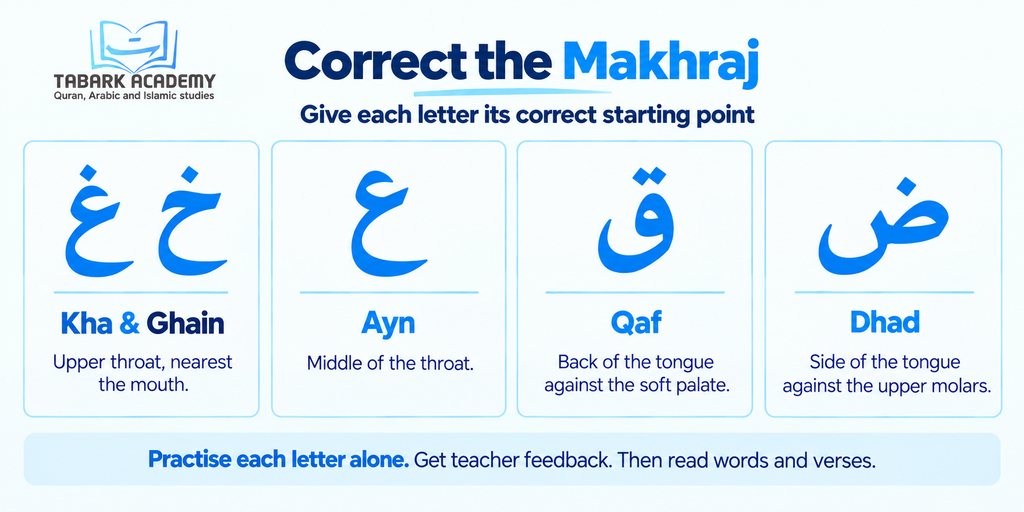
A learner might replace ض with د (dal), or pronounce ع weakly because it originates from the middle of the throat — one of the hardest sounds for new reciters to place correctly.
How to fix it: Learn where each letter is physically produced — throat, tongue, lips, or teeth — rather than guessing from the written shape.
Practice each difficult letter in isolation for a few minutes daily before reading full verses. A Tajweed Course for Beginners that starts with individual letters, rather than jumping straight to Surahs, makes this correction far faster than self-study.
2. Confusing Similar-Sounding Letters
Several Arabic letters sound close to non-native ears but come from completely different articulation points and carry different weight.
The pairs beginners mix up most often:
- س (Seen) and ص (Saad): Seen is light and forward; Saad is heavy and pulled back
- ت (Ta) and ط (Taa): Ta is light; Taa is deep and emphatic
- ح (Haa) and ه (Haa): one is a sharp throat sound, the other a soft breath
- د (Dal) and ض (Dhad): Dhad needs the tongue’s sides against the upper molars
How to fix it: Isolate the pair, say both letters back-to-back slowly, and record yourself. Comparing your recording to a correct recitation makes the difference audible in a way that reading a rule never will.
3. Ignoring Heavy And Light Letters (Tafkheem And Tarqeeq)
Arabic letters split into two groups by weight: heavy letters, pronounced with a deeper, fuller sound, and light letters, pronounced thinner and more forward. The heavy letters are خ ص ض غ ط ق ظ.
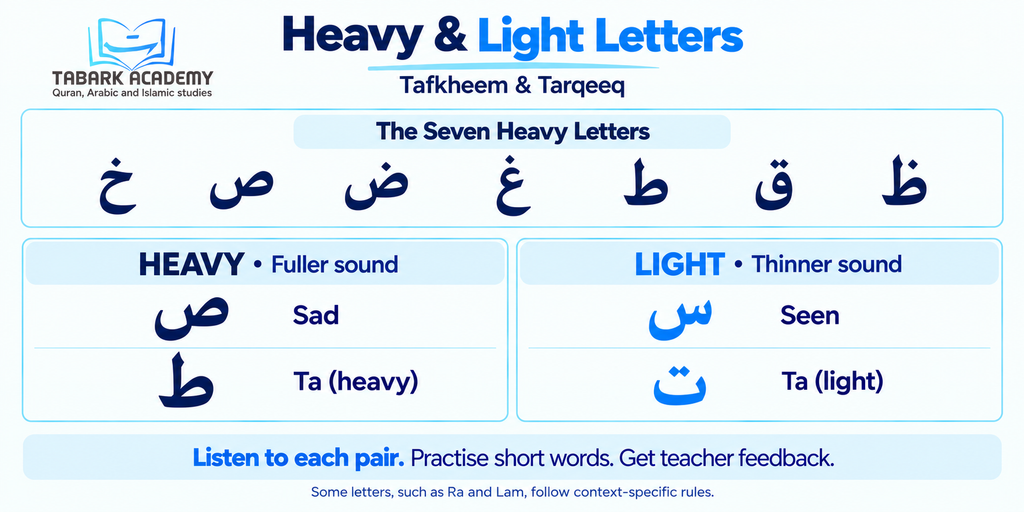
A common beginner error is flattening heavy letters into their light equivalents — reading ص like س, or ط like ت — because the learner is focused on the letter’s written shape rather than its required mouth position.
How to fix it: Listen to a qualified reciter pronounce a heavy letter, then a light one, back-to-back, and notice where your tongue and jaw move differently.
Practicing short words that isolate one heavy letter at a time — rather than full verses — makes the contrast easier to internalize.
Structured, guided sessions like Online Tajweed Classes give you this kind of side-by-side correction in real time, which is difficult to replicate from a book or an app alone.
Experience Our Interactive Learning
Curious about how we teach? Watch these brief video clips from our recent live sessions to see our structured curriculum, advanced learning platform, and dynamic student-teacher interactions firsthand.
4. Skipping Or Misapplying Ghunnah (The Nasal Sound)
Ghunnah is a nasal sound required on ن (Noon) and م (Meem) when they carry a shaddah, and in several Noon Sakinah and Meem Sakinah rules. It’s produced through the nose, held for roughly two counts, and it’s one of the easiest features to skip entirely if you’ve never had it corrected.
Beginners typically make one of three errors: dropping the nasal sound completely, holding it far too long, or applying it in words where it isn’t required at all.
How to fix it: Practice the nasal hum on its own — mouth closed, sound through the nose — before attaching it to a word.
Then apply it to short Quranic examples where Noon or Meem carries a shaddah, and check the timing stays consistent rather than growing or shrinking with each repetition.
Read Also: 17 Makharij of Arabic Letters
5. Incorrect Madd (Elongation)
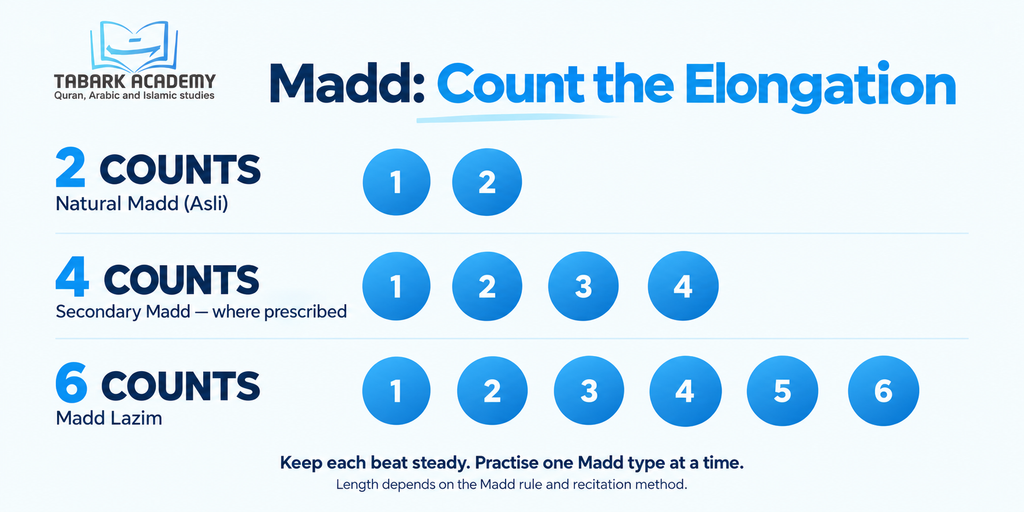
Madd letters — ا, و, and ي — each require a specific, countable length of elongation, and getting this wrong is one of the most common Tajweed mistakes beginners make, because it’s also one of the hardest to self-correct without a reference.
Natural Madd (Madd Asli) is held for two counts. Secondary Madd (Madd Far’i) can extend to four or six counts depending on what follows the letter — a hamzah, a sukoon, or a shaddah.
Beginners often compress a required six-count Madd into a rushed one-count vowel, or stretch a natural Madd far beyond what the rule calls for.
How to fix it: Learn the Madd types one at a time rather than all at once. Tap your finger or use a metronome app to build a consistent internal count, and practice short passages that contain only one Madd type before mixing them.
6. Missing Qalqalah (the Echo Sound)
Qalqalah is a slight bouncing echo required on five letters — ق ط ب ج د — whenever one of them carries a sukoon.
Beginners almost always fall into one of two extremes: pronouncing the letter completely flat with no echo, or exaggerating the bounce into an unnatural jolt.
How to fix it: Practice stopping on each Qalqalah letter individually until the echo happens naturally and quietly, without added movement of the jaw. Once it’s consistent in isolation, apply it inside full words and verses.
Getting a second opinion on whether your Qalqalah sounds too strong or too weak is genuinely difficult to do alone — this is exactly the kind of detail a live instructor catches instantly that a self-check never will.
It’s one of the specific things covered early in Tabarak Academy’s Tajweed Course for Beginners.
7. Confusing Noon Sakinah and Tanween Rules
When Noon Sakinah (نْ) or Tanween (ً ٍ ٌ) appears, the sound that follows depends on which letter comes next. There are four rules, and beginners frequently know their names but can’t identify which one applies while actually reading.
The four rules break down by what happens to the Noon sound:
- Izhar (clear pronunciation): the Noon is pronounced clearly with no change.
- Idgham (merging): the Noon sound merges into the following letter.
- Iqlab (converting): before ب, the Noon sound converts into a hidden Meem.
- Ikhfa (hiding): the Noon is partially hidden while the nasal Ghunnah is kept.
How to fix it: Memorize the specific letters that trigger each rule, then practice with Quranic examples that isolate one rule at a time rather than trying to apply all four simultaneously on your first attempt.
8. Misapplying Meem Sakinah Rules
Meem Sakinah (مْ) follows a similar logic to Noon Sakinah, with three rules instead of four: Ikhfa Shafawi, Idgham Shafawi, and Izhar Shafawi.
The common mistake is pronouncing every Sakinah Meem the same way regardless of the letter that follows it — for example, treating a Meem before ب the same as a Meem before any other letter, when it actually requires a hidden pronunciation.
How to fix it: Learn which letter triggers which of the three rules, then drill Quranic examples of each one separately before reading them mixed together in a full verse.
Read also: Can I Learn Tajweed on My Own? Self-Study Guide
9. Stopping And Starting At The Wrong Places (Waqf And Ibtida)
Correct recitation isn’t only about pronunciation — where you pause matters just as much. Many beginners stop wherever they run out of breath instead of at a point where the meaning is actually complete, and stopping mid-phrase can shift or obscure what the verse is saying.
The Quran includes Waqf symbols (م، لا، ج، صلى, and others) that mark where stopping is required, preferred, or best avoided. Beginners frequently read past these symbols without registering them.
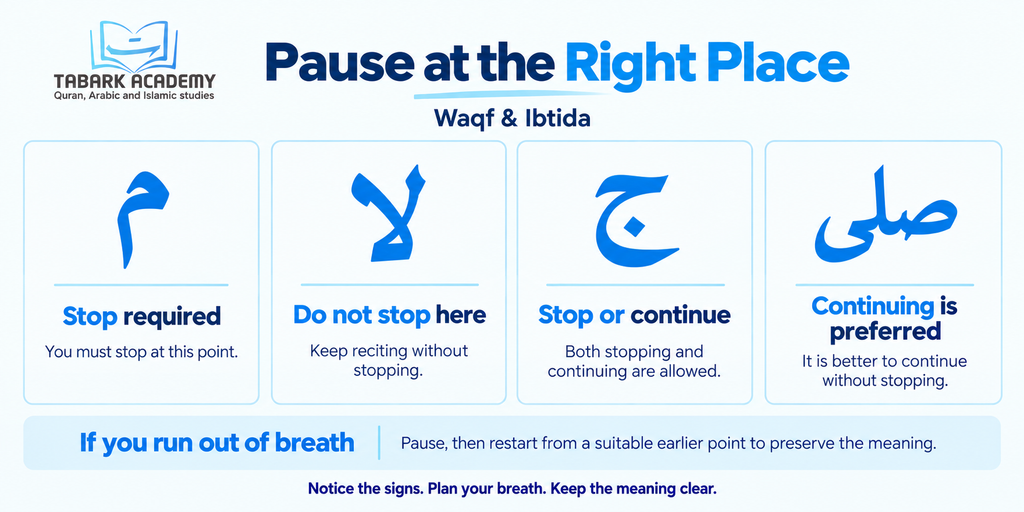
How to fix it: Learn the basic Waqf symbols and actively look for them as you read, rather than reading text and ignoring the marks around it. Plan your breathing around these points instead of stopping reactively when you run out of air.
If Waqf placement is something you want corrected alongside pronunciation, that’s built into full-verse practice in Learn Quran with Tajweed, where reading and rule application happen together rather than as separate lessons.
10. Rushing Recitation Without a Feedback Loop
This is the mistake underneath most of the other nine. Reading quickly to get through more pages sacrifices the clarity every other rule depends on — and reading without anyone checking your recitation means small errors get repeated until they become permanent habits.
This matters most for parents guiding young children through their first Quran lessons, since a mistake left uncorrected in early childhood is far harder to unlearn later.
A structured Tajweed Course for Kids builds correction into every session from the start, rather than waiting until habits are already set.
How to fix it: Slow down before you speed up. Accuracy at a slower pace naturally leads to fluency — rushing before the rules are automatic does not. And build in a feedback loop: a teacher who corrects you live, or at minimum, recording yourself and comparing it to a qualified reciter.
Which Mistakes to Fix First?
Not every one of the common Tajweed mistakes beginners make carries equal weight, and beginners often spend their limited practice time on the wrong one.
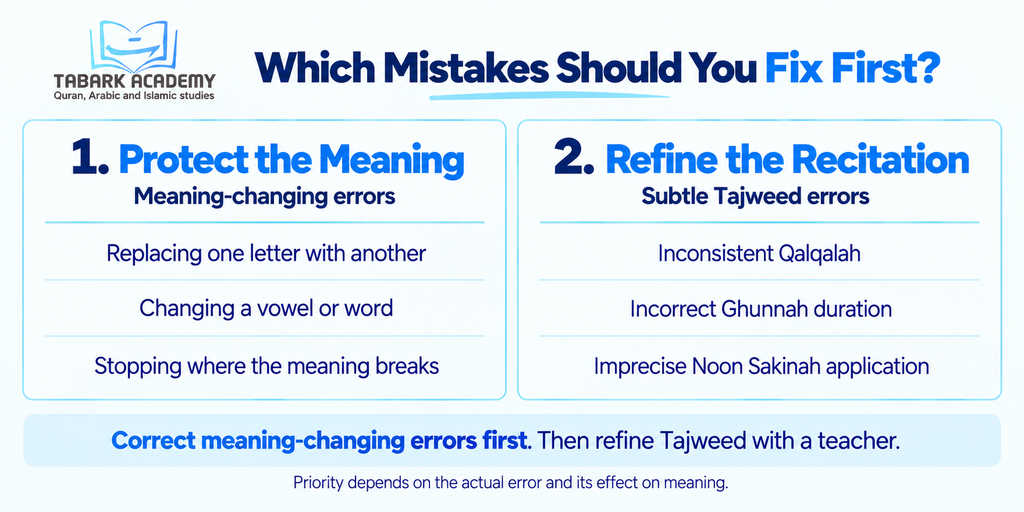
A practical way to prioritize: separate mistakes that can change a word’s meaning from mistakes that only affect how polished the recitation sounds.
Meaning-changing errors — confusing similar letters, misapplying Noon Sakinah rules, or stopping at the wrong point — take priority, because they affect what the verse actually communicates.
Sound-only errors, like an inconsistent Qalqalah bounce, matter for correctness and fluency but carry less urgency. Fix the meaning-changing mistakes first, then refine the rest.
Read Also: Online Hifz Academy
Start Correcting Your Tajweed Today with Tabarak Academy
Reading about these mistakes is the easy part — hearing them in your own recitation is the hard part, and that’s exactly where a qualified teacher makes the difference between books and apps.
Tabarak Academy’s certified instructors listen to your recitation live, catch the specific mistake as it happens, and correct it on the spot — whether that’s a Makharij error, a rushed Madd, or a missed Waqf.
Whether you’re an adult beginner or enrolling your child, there’s a structured path built around real-time correction, not guesswork.
Step Inside Our Virtual Classrooms
See our engaging teaching methods in action! watch real snippets of our live classes and discover how our expert instructors make learning interactive, memorable, and inspiring for every student.

Conclusion
Every one of the common Tajweed mistakes beginners make comes down to the same root cause: missing feedback.
Whether it’s a Makharij error, a rushed Madd, a skipped Ghunnah, or a Waqf placed in the wrong spot, none of these are permanent — they’re habits formed without correction, and habits can be replaced with the right guidance and consistent practice.
The fastest path forward isn’t reading more about Tajweed rules. It’s applying them out loud, regularly, with someone qualified to catch what you can’t hear in your own voice. That’s the gap Tabarak Academy is built to close, one corrected mistake at a time.
Our Tajweed Courses
- Online Tajweed Classes
- Tajweed Course for Beginners
- Tajweed Course for Kids
- Tajweed Course for Adults
- Tajweed Course for Sisters
- Advanced Tajweed Course
- Amali (Practical) Tajweed Course
- Learn Quran with Tajweed
- Learn Quran with Tajweed for Kids
- Learn Quran with Tajweed for Sisters

Frequently Asked Questions
These are the questions beginners ask most often once they start noticing their own common Tajweed mistakes beginners make and want to know how serious each one is and how fast it can be fixed.
1. What is the most common Tajweed mistake beginners make?
The most common mistake is mispronouncing letters at the wrong Makharij, especially letters like ض, ظ, ع, and ق that don’t exist in most other languages. This happens because learners approximate the sound by ear instead of learning the letter’s exact articulation point.
2. Can Tajweed mistakes change the meaning of a verse?
Yes, some can. Confusing similar letters, misapplying Noon Sakinah rules, or stopping at the wrong point in a verse can shift or obscure the intended meaning, which is why these errors should be corrected before purely stylistic ones like Qalqalah timing.
3. Why do beginners keep repeating the same Tajweed mistakes?
Mistakes get repeated when there’s no feedback loop — the learner reads, assumes it sounds correct, and moves on without anyone identifying the actual error, so the incorrect pronunciation becomes a habit instead of getting corrected early.
4. Does Tabarak Academy correct Tajweed mistakes for beginners specifically?
Yes. Tabarak Academy’s Tajweed Course for Beginners is built around live, one-on-one correction of exactly these mistakes, starting from individual letters and building up to full verses with a certified instructor.
5. How long does it take to fix common Tajweed mistakes?
There’s no fixed timeline — it depends on the mistake and how regularly you practice, but short daily sessions with active correction produce faster, more lasting results than occasional long ones. Consistency matters more than the total number of hours.
6. Can I learn to avoid these mistakes without a teacher?
Self-study can build familiarity with the rules, but most beginners can’t hear their own Makharij or Madd errors without an outside reference, which is why a qualified teacher or structured course speeds up correction significantly.