


9 Honest Reasons Why Do I Forget The Quran But Remember Other Things
Many Muslims ask Why Do I Forget The Quran But Remember Other Things? You can recite a song lyric you heard fifteen years ago without any effort.
You remember every colleague’s name, your childhood address, and dozens of unrelated facts. But the surah you spent weeks memorizing has already slipped away.
This contrast is frustrating, especially when you genuinely want to build a lasting relationship with the Quran. The good news is that the reasons behind this pattern are specific and fixable.
This article identifies exactly why do I forget Quran but remember other things happens, and gives you a practical, actionable fix for each cause.

1. The First Reason why do I forget Quran but remember other things is that You Are Skipping Daily Murajaah
Murajaah is the systematic daily review of previously memorized portions. Without it, even strong memorization deteriorates within days, regardless of how solid it felt when you first completed it.
Most memorizers focus exclusively on new material and treat review as secondary. This creates a leaking pattern: new verses enter while old ones quietly pour out the back.
A structured Daily Murajaah Plan For Hifz Students transforms review from an afterthought into the backbone of lasting hifz retention.
Fix: Split every Quran session into two parts. New memorization first, rotating review of older sections second. Never let the review portion be cut, even when time is limited.
Check What does the Short Surah Memorization Course cover?

2. You Are Memorizing Sounds Without Understanding Quranic Arabic
This is the most overlooked reason why English-speaking memorizers in the USA, UK, Canada, Australia, Germany, and the Gulf region struggle to retain their hifz. Memorizing in a language you do not understand forces your brain to store abstract sound sequences with no meaning attached.
Without a semantic anchor, a single missing sound is enough to break the entire chain of recall. Nothing else holds the verse in place when that one thread snaps.
Many students ask themselves: If I Learn Arabic, Will I Understand The Quran? The answer is yes, and your hifz stability will improve dramatically alongside your comprehension.
A. Arabic Meaning Creates Multiple Memory Anchors That Hold Each Verse In Place
When you understand what a verse means, your brain builds at least four anchors simultaneously: the sound, the meaning, the mental image of the concept, and the emotional response. All four hold the verse in long-term storage.
Without Arabic understanding, only the sound anchor exists. When it weakens, the verse disappears entirely. This single factor explains most long-term hifz loss among non-Arabic speakers.
Exploring the importance of the Arabic language for Quran retention reveals exactly why meaning-based memorizers consistently outperform sound-only memorizers in durability and recall speed.
B. Understanding Arabic Opens Dimensions Of Quran Comprehension That Strengthen Retention Further
Learning Quranic Arabic transforms hifz from mechanical repetition into genuine engagement with divine speech. Thematic connections between surahs, recurring patterns, and word relationships become visible, providing additional mental anchors.
This deeper engagement is not a luxury added on top of memorization; it is a structural reinforcement of it. Committing to Learn Arabic Language alongside your hifz is one of the most strategic decisions you can make for long-term retention.
Tabarak Academy offers dedicated Quranic Arabic programs designed for English-speaking students across the USA, UK, UAE, Malaysia, and beyond.
Their structured courses build the linguistic foundation that transforms hifz from fragile to firmly retained, without requiring you to pause your memorization journey.
Experience Our Interactive Learning
Curious about how we teach? Watch these brief video clips from our recent live sessions to see our structured curriculum, advanced learning platform, and dynamic student-teacher interactions firsthand.
Start Your Quran Learning Journey
Join Tabark Academy today for structured online lessons with qualified tutors, customized to fit your goals.
Book Your Free Trial Lesson3. You Have No Structured Hifz Plan To Keep Your Review Organized
Random memorization, even when practiced daily, produces fragile results. Without a clear tracking system, you cannot see which pages are weakening, which are solid, and where the review backlog is growing.
The absence of structure means you always react to forgetting rather than prevent it. This cycle is exhausting and is the primary reason motivated students eventually feel stuck.
A clear roadmap for How To Memorize The Quran? with daily targets, weekly assessments, and tracked weak spots changes the entire trajectory of your hifz experience.
Fix: Assign specific pages to specific days of the week. Schedule a brief weekly self-test without the mushaf. Double your review time on any pages that consistently produce hesitation during recall.
Meet the Tutors Delivering the Intensive Quran Course

4. You Are Not Reciting Your Memorized Portions During Salah
Salah is the most powerful built-in review tool available to every Muslim memorizer. Yet most people default to familiar short surahs in every prayer, even after memorizing far longer portions.
Using your memorized portions in Salah activates memory through spiritual attention, physical posture, and emotional presence simultaneously. The brain tags this combination as deeply significant.
Applying Strategies To Revise Memorized Quran within your prayer structure gives your hifz daily reinforcement that no separate practice session can fully replicate.
Fix: Begin reciting newly memorized portions in Tahajjud and Sunnah prayers. Progress to Fardh prayers where appropriate. Even one new page per day in Salah creates a reinforcement loop that compounds over weeks.
Read more: How To Memorize The Quran Without A Teacher: 10 Helpful Steps
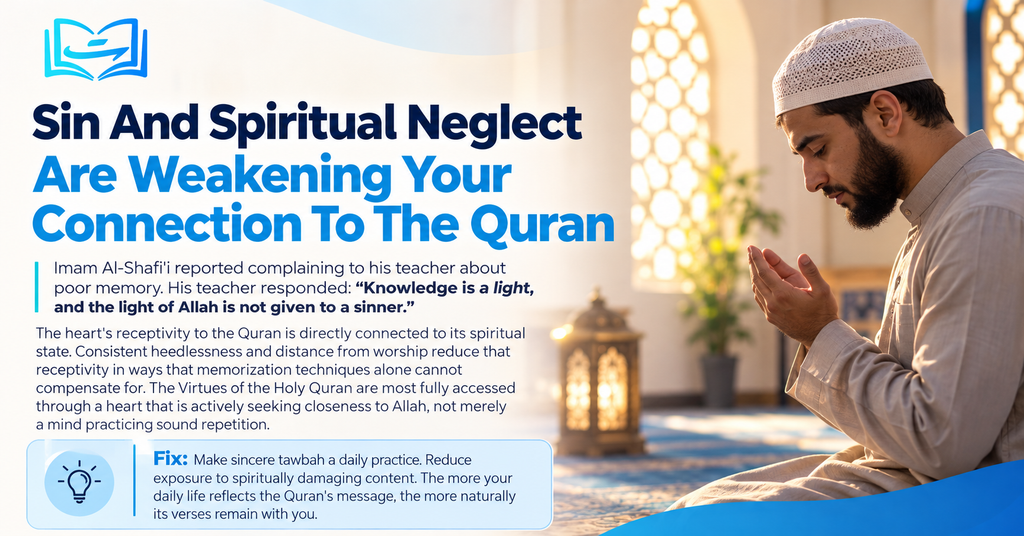
5. Sin And Spiritual Neglect Are Weakening Your Connection To The Quran
Imam Al-Shafi’i reported complaining to his teacher about poor memory. His teacher responded: “Knowledge is a light, and the light of Allah is not given to a sinner.”
Scholars have returned to this principle across centuries because it reflects a consistent spiritual reality.
The heart’s receptivity to the Quran is directly connected to its spiritual state. Consistent heedlessness and distance from worship reduce that receptivity in ways that memorization techniques alone cannot compensate for.
The Virtues of the Holy Quran are most fully accessed through a heart that is actively seeking closeness to Allah, not merely a mind practicing sound repetition.
Fix: Make sincere tawbah a daily practice. Reduce exposure to spiritually damaging content. The more your daily life reflects the Quran’s message, the more naturally its verses remain with you.
6. You Are Memorizing Verses Without Building Thematic Context First
Memorizing individual verses without understanding the surah’s overall message leaves your brain with no framework to attach them to. Context is what gives isolated information a reliable address in long-term memory.
Without contextual understanding, a single broken trigger, typically forgetting the opening word of a verse, causes the entire sequence to collapse. There is nothing else to redirect you back to the correct place.
Reading a reliable Quran Tafseer in English before beginning a new surah gives your memorization a thematic map that makes verses significantly easier to locate under pressure.
Fix: Before memorizing a new surah, read its translation and a brief summary of its core message. Build the thematic picture first, then fill it in with the Arabic text verse by verse.
Find Why Families Choose Tabarak Academy for Juz Amma Memorization Course

7. You Are Not Applying Spaced Repetition To Your Revision Schedule
Spaced repetition is a memory science method where information is reviewed at increasing intervals: once within 24 hours, again after three days, then a week later, then monthly. This matches how long-term memory consolidation actually works in the human brain.
Most memorizers review material randomly or wait until they notice forgetting before reviewing again. By that point, significant decay has already occurred and recovery takes far more effort.
A. A Spaced Repetition Hifz Schedule Produces Measurably Stronger Retention
Memorize one page on Day 1. Review it on Day 2, Day 5, and Day 12. Then schedule monthly reviews from that point forward. This structure forces retrieval at precisely the moment before the memory fully fades.
The Best Revision Schedule for Hifz incorporates this memory science into a practical format designed specifically for Quran memorizers at every level and stage.
B. Applying Spaced Repetition Works Even With A Full-Time Job Or Family Responsibilities
Fifteen minutes of well-timed, tracked review consistently outperforms an hour of unfocused repetition. The discipline is in maintaining the intervals, not in extending the session length beyond what your schedule allows.
A simple notebook recording each page’s memorization date and the next three review dates is all the system requires. The Daily hifz Revision Guide provides a ready-made framework you can begin using immediately without building your own system from scratch.
Tabarak Academy‘s hifz instructors work with students across multiple time zones to implement structured revision cycles that prevent the forgetting spiral.
Whether you are just starting out or rebuilding hifz you lost years ago, their teachers track your review intervals and ensure nothing goes unreviewed for too long.
Discover How Do Students Progress Through Quran Recitation Course Curriculum?

8. Your Emotional Connection To The Verses You Are Memorizing Is Weak
The brain’s priority system heavily favors emotionally significant information. What moves you, challenges you, or fills you with awe gets consolidated into long-term memory far more effectively than emotionally neutral data.
Many memorizers approach hifz as completing an assignment. The verses become items on a checklist rather than words of Allah to absorb, and the emotional anchor that makes natural retention possible never forms.
Many students who reach this point and struggle with Psychological Barriers To Quran Memorization report that emotional disconnection was at the root of their plateau, not a lack of effort or ability.
The feeling of wanting to quit is connected to this same disconnection. Students who have worked through the experience documented in Feel Like Giving Up Hifz often find that rebuilding emotional engagement with the verses brings back motivation they thought was permanently gone.
Fix: Before each memorization session, spend sixty seconds reading the meaning of the verses you are about to memorize. Let the message land emotionally before you begin repeating the Arabic.

9. You Are Relying On One Memory System When Multiple Are Available To You
Human memory is not a single system. It includes auditory memory, visual memory, motor memory, and semantic memory. Effective hifz activates as many of these systems as possible, creating multiple retrieval pathways for each verse.
Most memorizers rely exclusively on auditory repetition. When that single pathway weakens under stress, after time away, or during illness, there is no backup system to retrieve the verse from.
A. Activating Multiple Senses Creates Stronger Retrieval Pathways For Every Verse
Use the same physical mushaf every session so visual memory maps each verse to a specific page position. Listen to a trusted reciter while following along with your eyes. Write out difficult verses by hand to engage motor memory alongside auditory learning.
Each additional system activated adds another anchor to the verse. When one pathway is temporarily blocked, the others compensate and guide recall.
This is why rebuilding hifz through How To Re-Memorize The Quran After Forgetting It often begins with listening before attempting to recite from memory.
B. Multi-Sensory Memorization Outperforms Pure Audio Repetition In Long-Term Retention
Students who use visual, auditory, and motor memory together consistently retain more than those who rely on sound repetition alone. The Salah itself demonstrates the power of this approach clearly.
Standing in prayer, reciting with your voice, picturing the mushaf page, and feeling the solemnity of standing before Allah activates every memory system at once.
This is why Stop Forgetting the Quran strategies that pair Salah recitation with structured review produce the most durable results across every demographic and age group.
Step Inside Our Virtual Classrooms
See our engaging teaching methods in action! watch real snippets of our live classes and discover how our expert instructors make learning interactive, memorable, and inspiring for every student.
Start Your Quran Learning Journey
Join Tabark Academy today for structured online lessons with qualified tutors, customized to fit your goals.
Book Your Free Trial LessonStart Your Hifz Journey Today With A Program Built For Real Results
Knowing why you forget the Quran is only half the solution. The other half is having a structured, teacher-supported environment where these fixes are built into the program rather than left entirely to willpower.
Tabarak Academy provides expert-led Quran memorization and Arabic language programs for students in the USA, UK, Canada, Australia, UAE, Germany, Malaysia, Bahrain, Egypt, and across the Gulf region.
Their qualified instructors build personalized revision plans, track your progress daily, and ensure your hifz never goes unattended long enough to fade.
Our Courses:
- Online Quran & Arabic Classes | Foundation
- Online Quran Memorization Course
- Online Ijazah Course
- Tafseer al Quran Course
- Quranic Sciences (Uloom al Quran) Course
- Islamic Summer Camp
- Hifz for Kids Course
- Hifz Course for Sisters
- Hifz for Adults Course
Book a Free One Day Trial Now and start your journey of learning the Quran to not forget it.

Conclusion
Forgetting the Quran while retaining everything else is not a character flaw or a sign of inadequate faith. It is the predictable result of specific gaps in how memorization is approached, maintained, and emotionally engaged with.
Each of the nine reasons in this article describes a solvable problem. Start with the reason that resonated most clearly in your situation, address it consistently for four to six weeks, then move to the next gap on your list.
For English-speaking students in the USA, UK, Canada, Australia, Malaysia, Egypt, and the Gulf region, the Arabic language barrier is often the root cause beneath several of the other eight reasons.
When you understand what you memorize, every other strategy in this list becomes measurably more effective. The connection between Quranic Arabic comprehension and durable hifz is not incidental; it is foundational to everything else working properly.
Frequently Asked Questions
Why Do I Forget Quran Verses Immediately After Memorizing Them?
Immediate forgetting after memorization usually means the verse moved into short-term memory without consolidating into long-term storage.
This happens when review is delayed beyond 24 hours, when no meaning is attached to the sounds, or when emotional engagement during memorization was minimal.
Is It A Sin To Forget The Quran?
Scholars distinguish between forgetting caused by deliberate abandonment and forgetting caused by human limitation or unavoidable life circumstances. The hadith that warns against forgetting refers specifically to negligent abandonment.
How Does Learning Arabic Help Me Stop Forgetting The Quran?
Arabic provides semantic anchors for every verse you memorize, meaning your brain has sound, meaning, imagery, and emotional response all attached to the same text. When one memory pathway weakens, the others remain active.
What Is The Fastest Way To Recover Hifz I Have Already Forgotten?
Begin by listening to a trusted reciter reciting the forgotten portions repeatedly before attempting to recite them yourself. This reactivates the auditory memory pathway first. Then add a visual review of the mushaf page and brief daily recitation sessions.
How Long Does It Take To Build Stable Hifz That Stops Slipping?
Most memorizers who implement consistent daily murajaah and spaced repetition report noticeable stability in their retained portions within four to six weeks. Full confidence typically develops over three to six months of structured, systematic review.