

How Long Does It Take To Learn To Read The Quran?
You open the Mushaf, see the Arabic script, and wonder: how long does it take to learn to read the Quran from where I am now? Most learners ask this before they start. A few weeks? A few years?
With 20–30 minutes of daily practice and a qualified teacher, most beginners learn to read the Quran slowly but correctly within 3 to 6 months.
Reading fluently and on your own usually takes 6 to 12 months, and applying Tajweed with confidence takes 1 to 2 years. Your starting level, weekly practice time, and teaching method decide where you fall in those ranges.
This guide from Tabarak Academy breaks down each stage, shows the time to learn to read the Quran for adults, kids, and Arabic speakers, and flags the mistakes that add months to the process.
What you’ll learn in this article
- The four stages of Quran reading and how long each one takes.
- Realistic timelines for adults, children, Arabic speakers, and Urdu/Persian readers.
- How your weekly practice time changes your total timeline.
- The common mistakes that slow learners down.
- A simple checklist to know when you’re ready to read the Mushaf alone.
How Long Does It Take To Learn To Read The Quran?
Learning to read the Quran means decoding the Arabic text correctly: recognizing letters, joining them into words, and pronouncing them with the right vowels. It doesn’t include memorization (Hifz) or understanding the meaning, which are separate goals with much longer timelines.
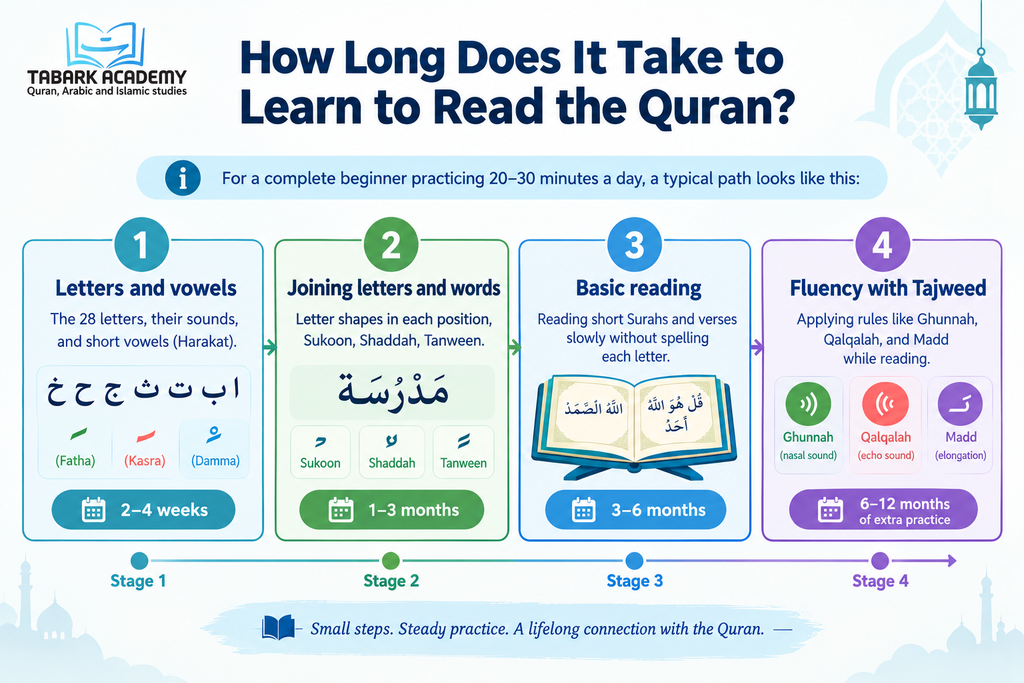
For a complete beginner practicing 20–30 minutes a day, a typical path looks like this:
| Stage | What you learn | Typical time |
| 1. Letters and vowels | The 28 letters, their sounds, and short vowels (Harakat) | 2–4 weeks |
| 2. Joining letters and words | Letter shapes in each position, Sukoon, Shaddah, Tanween | 1–3 months |
| 3. Basic reading | Reading short Surahs and verses slowly without spelling each letter | 3–6 months |
| 4. Fluency with Tajweed | Applying rules like Ghunnah, Qalqalah, and Madd while reading | 6–12 months of extra practice |
These stages overlap. Most students start basic Tajweed while still finishing the Noorani Qaida, which is why the full journey to fluent reading with Tajweed usually lands between 1 and 2 years.
Stage 1: learning the Arabic letters and short vowels
This stage teaches how each letter looks and sounds, plus the three short vowels: Fatha, Kasra, and Damma. Most beginners finish in 2 to 4 weeks.
The hard part is not memorizing 28 shapes. It’s pronunciation. Letters like ح and ه, or ص and س, sound alike to non-Arabic speakers, and a teacher needs to correct them early before they become habits.
Stage 2: Joining Letters And Reading Words
Arabic letters change shape depending on whether they sit at the start, middle, or end of a word. This stage also covers Sukoon (no vowel), Shaddah (doubled letter), Tanween, and long vowels.
This is where most learners slow down. Many move smoothly through single letters, then stall at Sukoon and join forms. Plan for 1 to 3 months here, and don’t rush it.
Stage 3: Reading Short Surahs On Your Own
Once you can sound out joined words, you start reading short Surahs, usually from Juz Amma. At first you’ll pause often and repeat words. That’s normal. You reach this stage around 3 to 6 months in. The goal is steady, correct reading, not speed.
Stage 4: Reading Fluently With Tajweed
Tajweed is the set of rules for reciting the Quran as it was revealed: correct articulation points (Makharij), elongation (Madd), nasal sounds (Ghunnah), and where to pause. Reading correctly is one skill; reading with Tajweed is the next.
Expect 6 to 12 months of structured practice to apply the core rules while reading. Refining recitation continues well beyond that.
Read Also: How Long Does It Take to Memorize Juz Amma?
The Time To Learn To Read The Quran Depends On Your Starting Point
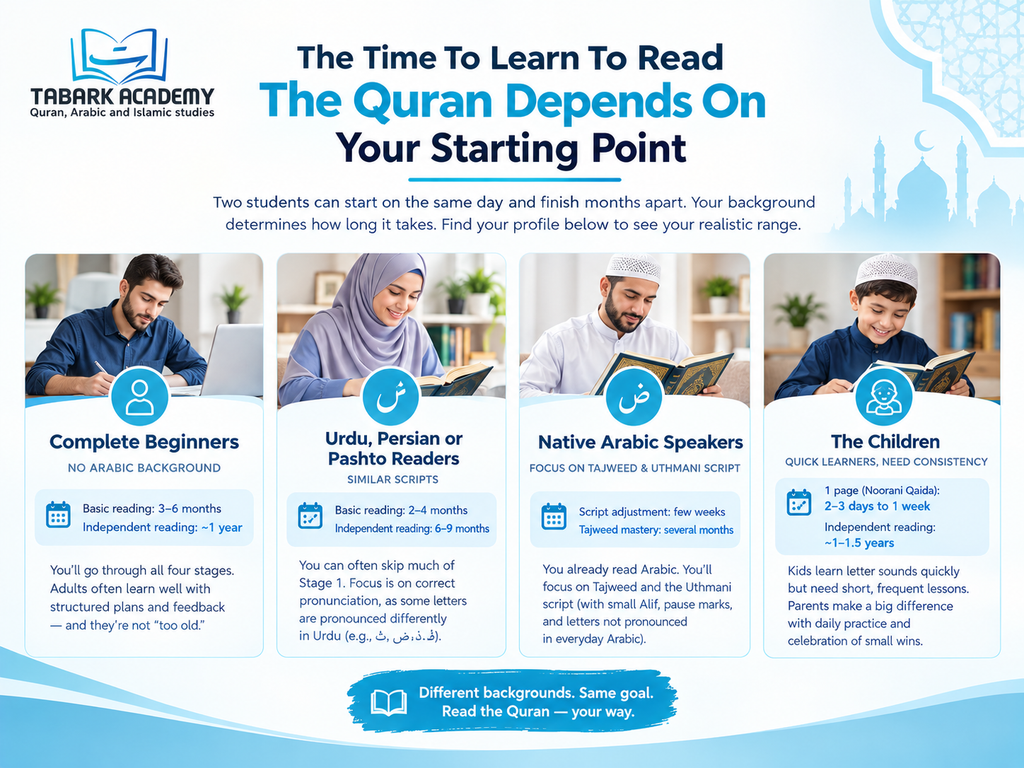
Two students can start on the same day and finish months apart. For many learners, the answer to how long does it take to learn to read the Quran depends mostly on what they already know when they begin. Use the profiles below to find your realistic range.
1. Complete beginners with no Arabic background
If you’ve never read Arabic script, you’ll go through all four stages. Expect basic reading within 3 to 6 months and independent reading within about a year of consistent practice.
Adults in this group often worry they’re “too old.” They aren’t. Adults tend to follow structured plans well and apply feedback quickly, which makes up for any memory advantage children have.
2. Urdu, Persian, or Pashto readers
These scripts share most of their letters with Arabic, so you can often skip much of Stage 1. Your main work is correcting pronunciation, since several letters are pronounced differently in Urdu than in Quranic Arabic (for example ث, ذ, ض, and ظ).
A common mistake in this group is reading “by sight” with Urdu sounds. A teacher who catches this early saves you from relearning later.
3. Native Arabic speakers
If you speak Arabic, you can already read, so the question becomes how long it takes to read the Quran correctly. Your focus is Tajweed and the Uthmani script, which uses symbols not found in everyday Arabic: the small Alif, pause marks (Waqf signs), and letters written but not pronounced.
Adjusting to the script can take a few weeks. Mastering Tajweed still needs months of guided practice, because everyday Arabic pronunciation habits don’t match recitation rules.
4. The Children
Kids often learn letter sounds quickly but need short, frequent lessons. A younger child may take 2–3 days to a week to master one page of the Noorani Qaida, which has around 16 lessons across roughly 30 pages.
Children aged 10–13 often reach independent reading in about a year and a half, while adults with a steady routine can reach it in about a year.
Parents make a real difference here. Listening to your child read for five minutes a day and celebrating small wins keeps motivation high.
If you’re starting from zero, Tabarak Academy’s Online Quran Classes for Beginners follow this exact stage-by-stage path, so you always know which skill you’re building and what comes next.
How Does Your Weekly Practice Time Change The Timeline?
Every estimate above assumes about 20–30 minutes a day, five or more days a week. So when you ask how long it takes to learn to read the Quran, the real answer scales with the minutes you actually put in. It helps to think in weekly minutes rather than months.
A simple way to estimate your own timeline: compare your weekly practice time to 150 minutes (30 minutes × 5 days).
If you practice about half of that, expect your timeline to stretch toward the top of each range or beyond. If you practice more, you can move toward the lower end.
There’s one limit: extra hours don’t compress the timeline forever. Pronunciation habits need repetition spread over days to stick, so one three-hour session a week works worse than 25 minutes a day.
| Daily practice | What to expect |
| 15 minutes | Slow, steady progress; good for building a habit around a busy schedule |
| 30 minutes | Consistent progress in reading and Tajweed; the most practical plan for most learners |
| 1 hour | Faster fluency and more time for Tajweed drills and revision |
| 2+ hours | Accelerated learning, usually for full-time or intensive students |
A balanced daily session covers three things:
- 10 minutes revising yesterday’s lesson
- 10 minutes learning something new
- 10 minutes reading aloud to a teacher or with audio
Revision is the part most students skip, and it’s the reason many feel they’re “going backward.”
Experience Our Interactive Learning
Curious about how we teach? Watch these brief video clips from our recent live sessions to see our structured curriculum, advanced learning platform, and dynamic student-teacher interactions firsthand.
Start Your Quran Learning Journey
Join Tabark Academy today for structured online lessons with qualified tutors, customized to fit your goals.
Book Your Free Trial LessonHow To Know You’re Ready To Read The Quran Independently?
Learning to read has a clear finish line. You’re ready to read the Mushaf on your own when you can do all of the following.
- Read any page of Juz Amma without spelling out individual letters
- Pronounce heavy and light letters (like ص/س and ط/ت) distinctly
- Read Sukoon, Shaddah, Tanween, and long vowels correctly without stopping
- Recognize the small Alif and the main pause marks in the Mushaf
- Apply basic Ghunnah and Qalqalah while reading
If you can tick every box, you’ve learned to read. What remains is building fluency and polishing Tajweed.
How long does it take to read the whole Quran once you can read?
The Madani Mushaf has 604 pages, 114 Surahs, 6,236 verses, and 30 Juz. A fluent reader who can read about a page a minute finishes in roughly 10–15 hours. A newer reader reading carefully with Tajweed may need 40–60 hours or more.
Reading one Juz a day finishes the Quran in 30 days, a common Ramadan goal. Reading one page a day finishes it in about two years, which suits new readers building a habit.
Common Mistakes That Add Months To Learning To Read The Quran
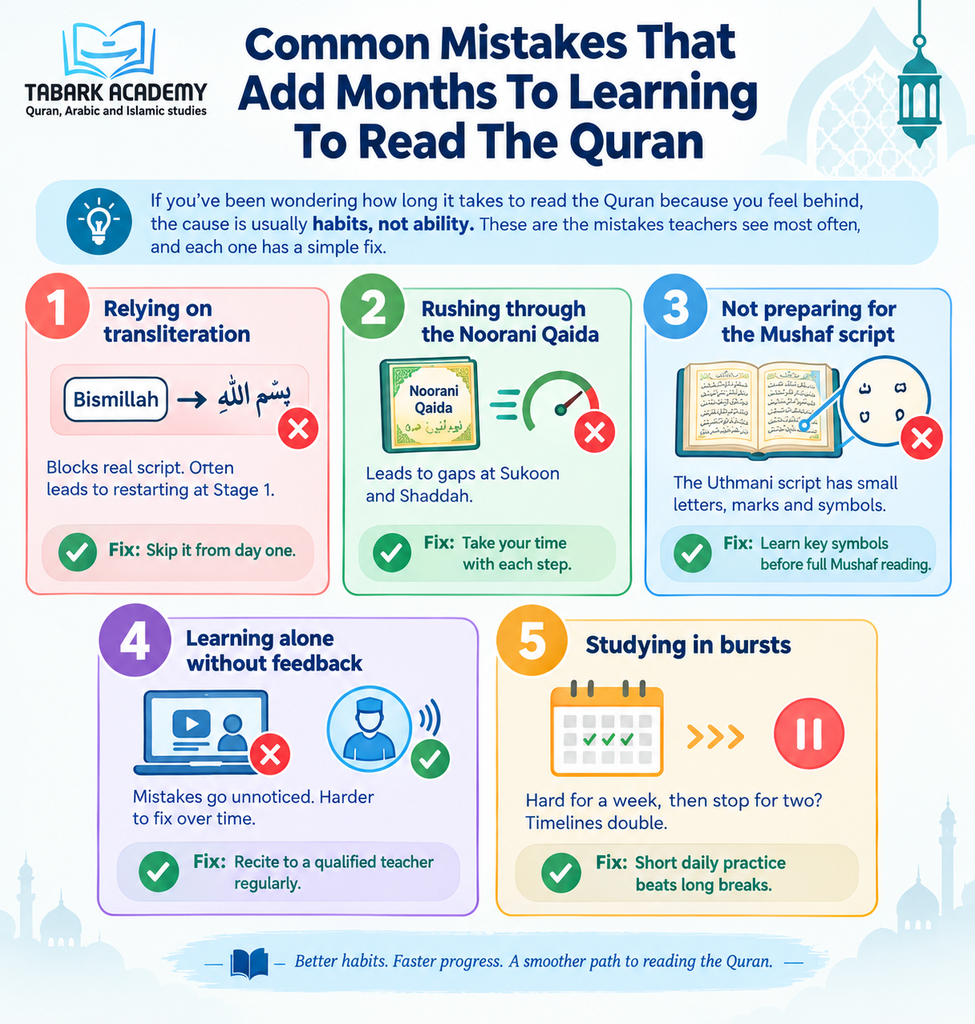
If you’ve been wondering how long it takes to learn to read the Quran because you feel behind, the cause is usually habits, not ability. These are the mistakes teachers see most often, and each one has a simple fix.
1. Relying on transliteration
Reading Arabic through English letters feels faster at first, but it blocks you from recognizing the real script. Learners who start with transliteration often have to restart at Stage 1. Skip it from day one.
2. Rushing through the Noorani Qaida
The Qaida is the bridge between letters and the Mushaf. Students who race through it to “get to the Quran” usually hit a wall at Sukoon and Shaddah, then spend more time fixing gaps than they saved.
3. Not preparing for the Mushaf script
Many students finish the Qaida, open a Madani Mushaf, and feel lost. The Uthmani script has small letters, pause marks, and spelling conventions the Qaida only touches on. Spending a few lessons on these symbols before full Mushaf reading prevents that drop in confidence.
4. Learning alone without feedback
Apps and videos help, but you can’t hear your own mistakes reliably. Without correction, a mispronounced letter repeated for months becomes very hard to undo. Reciting to a qualified teacher even a few times a week catches errors early.
5. Studying in bursts
Studying hard for a week and then stopping for two is the most common reason timelines double. Short daily practice beats occasional long sessions.
Tabarak Academy’s Quran Reading Course builds in daily revision and live correction from a teacher, which targets the exact habits that slow most self-taught learners.
Step Inside Our Virtual Classrooms
See our engaging teaching methods in action! watch real snippets of our live classes and discover how our expert instructors make learning interactive, memorable, and inspiring for every student
Start Your Quran Learning Journey
Join Tabark Academy today for structured online lessons with qualified tutors, customized to fit your goals.
Book Your Free Trial LessonRead Also: How Long Does It Take To Memorize One Page Of Quran?
Start Reading The Quran With Confidence At Tabarak Academy
You don’t need years of free time to read the Quran. You need a clear path, a teacher who corrects you from the first lesson, and a schedule you can keep. That’s what Tabarak Academy gives you.
With Tabarak Academy’s Online Quran Classes, you learn one-to-one from home, at times that fit your work, school, or family routine.
Your teacher follows the four-stage path, checks your pronunciation every session, and prepares you for the Mushaf script so you don’t stall after the Qaida. Adults, kids, complete beginners, and Arabic speakers all get a plan built around their starting point.
Our Quran Courses:
- Online Quran Classes
- Online Quran Classes for Beginners
- Online Quran Classes for Kids
- Online Quran Classes for Adults
- Online Quran Classes for Men
- Online Quran Classes for Sisters
- Quran Reading Course
- Quran Recitation Course
- Online Ijazah Course
- Online Qirat Course
- Quran for Toddlers / Young Children
Conclusion
So, how long does it take to learn to read the Quran? For most beginners practicing 20–30 minutes a day, basic reading takes 3 to 6 months, fluent independent reading takes 6 to 12 months, and confident reading with Tajweed takes 1 to 2 years.
Your starting point matters: Urdu and Persian readers can skip much of the alphabet stage, and Arabic speakers focus mainly on Tajweed and the Uthmani script. Your weekly practice time matters even more. Consistent daily sessions, regular revision, and feedback from a teacher are what keep you at the shorter end of every range.
Start small, stay consistent, and measure progress by the checklist, not the calendar. If you want a structured path with a teacher by your side, Tabarak Academy is ready to help you take the first step.

Frequently asked questions
These are the questions learners most often ask about the time to learn to read the Quran, answered briefly so you can plan your next step.
1. Can I learn to read the Quran in 3 months?
Yes, many beginners can read short Surahs slowly and correctly within 3 months with daily practice and a teacher. Fluent reading with Tajweed usually takes longer, often 1 to 2 years.
2. Is 30 minutes a day enough to learn to read the Quran?
Yes, 30 minutes a day is enough for steady progress for most learners. Split it into revision, a new lesson, and reading aloud to a teacher for the best results.
3. Can I learn to read the Quran without a teacher?
You can learn the letters on your own, but learning to read the Quran correctly is much faster with a teacher. Without feedback, pronunciation mistakes go unnoticed and become hard habits to break.
4. How long does it take to learn to read the Quran as an adult?
Most adults learn basic Quran reading in 3 to 6 months and read independently within about a year. Adults often progress steadily because they follow structured plans and apply feedback well.
5. How long does it take to finish the Noorani Qaida?
Most learners finish the Noorani Qaida in 3 to 6 months with 20–30 minutes of daily practice. Young children may need longer, since one page can take them several days to a week.
6. Do I need to learn Arabic before learning to read the Quran?
No, you don’t need to speak Arabic to learn to read the Quran. Reading means decoding and pronouncing the text correctly; understanding the meaning is a separate goal you can pursue later.