


Realistic Plan – How Long Does It Take to Memorize Surah Al-Baqarah?
You opened the Mushaf, looked at the first page of Surah Al-Baqarah, then scrolled forward and saw that it keeps going for almost fifty pages. That moment makes most people ask the same question before they start: how long does it take to memorize Surah Al-Baqarah?
The honest answer is that most committed students finish it in one to three months, and the range depends far more on your daily consistency than on your natural memory. Some finish in three weeks. Others take four months and retain it better.
This guide breaks the surah down into real numbers — verses, pages, and minutes per day — then gives you four tested memorization plans to choose from. You will also see what slows people down, how children’s timelines differ from adults’, and how to review so the surah actually stays with you.
What You Will Learn
- The realistic time to memorize Surah Al-Baqarah at four different daily paces
- Exactly how many verses and pages you need to cover per day for each plan
- The seven factors that make one person finish in 3 weeks and another in 4 months
- A daily hifz routine that combines understanding, repetition, writing, and recitation to a listener
- How to review so your memorization holds instead of slipping away

How Long Does It Take to Memorize Surah Al-Baqarah?
For a learner memorizing ten verses a day with daily review, the surah takes about 30 days. At five verses a day, it takes roughly two months, and at one page a day, it lands near 50 days.
Surah Al-Baqarah contains 286 verses spread across roughly 48 pages of the standard Madani Mushaf — about two and a half juz’. That size is why timelines vary so much between students.
The Realistic Range At A Glance
Most students who keep a fixed daily session finish somewhere between 21 days and 4 months. Anything faster than three weeks usually means full-time study; anything past four months usually means the sessions are being skipped rather than shortened.
Treat these as working estimates, not promises. Your real pace becomes clear after the first week, and that is the right moment to adjust your target rather than abandon it.
Why Al-Baqarah Takes Longer Than Other Surahs
The verses are long, and several passages are legislative — inheritance, debt, divorce, fasting — with similar phrasing that the mind blurs together. These mutashabihat (similar-sounding passages) are the real difficulty, not the page count.
Narrative sections such as the story of the cow or Talut and Jalut move quickly because they follow a storyline. Legal sections need extra repetition and, ideally, a teacher who points out the wording that distinguishes near-identical verses.
Five Factors That Shift Your Timeline
Every student’s Quran memorization journey follows a different timeline, and several factors can influence how quickly new verses are learned. Understanding these factors helps you set realistic goals, choose the right learning approach, and build a sustainable memorization routine.
1. Prior Hifz Experience And Recitation Fluency
A student who has already memorized Juz’ ‘Amma moves noticeably faster than a first-time memorizer. The reason is not the talent but the familiarity. The ear already knows Quranic rhythm, the eye already tracks Uthmani script, and the mind already knows what a finished portion feels like.
Recitation fluency works the same way from the opposite direction. If you are still decoding letters one by one, memorization stalls because every repetition costs three times the effort it should.
Fixing recitation first — through structured Tajweed courses — usually shortens the overall journey rather than lengthening it.
2. Daily Time Available
Ten verses realistically need 45–60 focused minutes including review; five verses need about 30. Be honest about the window you can protect on your busiest day, because that is the number your plan should be built on.
3. Understanding of Meaning
Students who read a simple tafsir before memorizing retain verses measurably faster than those memorizing sound alone.
Meaning gives each verse a hook, so the next line feels like a continuation of a thought rather than a random string of words.
4. Review Discipline
Without daily review, new memorization erodes within days, and you end up re-learning the same pages. Most students who feel stuck are not memorizing too slowly — they are quietly repaying the same portion two or three times over.
5. Arabic Comprehension
Knowing what the words mean turns memorization into recall instead of imitation. This is why many students pair hifz with Arabic language courses. Even a working vocabulary of the most repeated Quranic words makes long Al-Baqarah verses noticeably easier to hold.
Time to Memorize Surah Al-Baqarah: Four Plans to Choose From
Pick the plan that matches the time you can honestly protect every day, not the one that sounds most impressive. A finished surah at a slow pace beats an abandoned one at a fast pace.
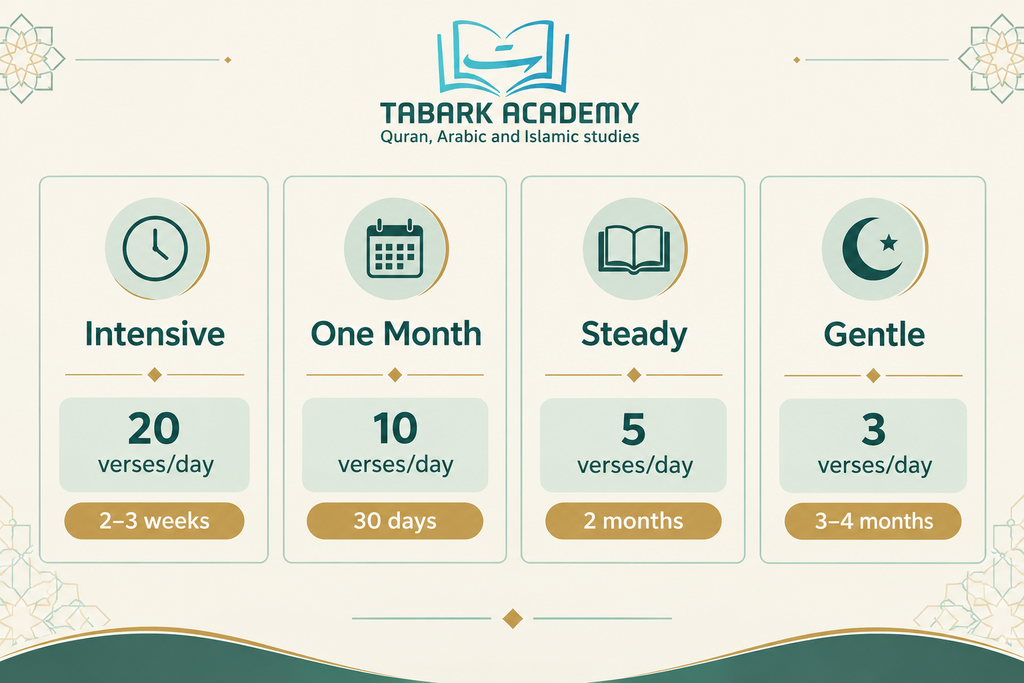
1. The Intensive Plan
This plan takes 2 to 3 Weeks to finish memorization. Students in this plan memorize 15 to 20 verses daily, which is roughly two to three hours of work including review.
This suits students in full-time hifz programs, Ramadan-intensive learners, or those on holiday with no competing commitments. The risk here is thin retention.
Anyone following this pace must schedule a full re-memorization review cycle immediately after finishing.
2. The One-Month Plan
This is the most popular option and the one most Quran teachers recommend to motivated adults. Ten verses a day for thirty days covers all 286 verses, with Friday reserved for review only.
Divide about an hour daily between fifteen minutes reading the meaning, thirty minutes repetition and writing, and fifteen minutes reviewing earlier days.
3. The Steady Plan
This plan also takes around 2 months of memorization. In this plan, you memorize five verses or one page per day. This is the strongest choice for working adults, university students, and parents, because the session fits into a thirty-minute window that rarely gets cancelled.
Retention is noticeably better at this pace because each portion gets more repetitions before the next one arrives.
4. The Gentle Plan
You can finish Surah Al-Baqarah in 3 to 4 months if you memorize three verses a day, or half a page, with two review days a week. It suits older beginners, learners with demanding jobs, and anyone who has previously started Al-Baqarah and stopped.
Slow is not a failure. The students who finish are the ones who chose a pace they could repeat on a bad day.
How Long Does It Take to Memorise Surah Al-Baqarah for Children?
Children usually need three to six months for Surah Al-Baqarah, but they retain it far longer than adults do once it is set.
Realistic Pace By Age
If your child is ages 6–9, they will do well with two to three verses a day in two short sessions rather than one long one. Ages 10–14 can manage five verses daily, and confident young huffaz sometimes reach eight.
Short sessions matter more than long ones here. Two fifteen-minute blocks beat one thirty-minute block for children under ten.
Read also: The Best Time of Day to Memorize Quran – Find Your Golden Hour
Experience Our Interactive Learning
Curious about how we teach? Watch these brief video clips from our recent live sessions to see our structured curriculum, advanced learning platform, and dynamic student-teacher interactions firsthand.
What Speeds Children Up
Listening drives children’s memorization more than reading does. Playing the same portion in one reciter’s voice repeatedly builds the melody of the verse into memory before the eyes are involved.
Structured one-to-one classes remove the biggest obstacle, which is uncorrected errors hardening into habits. Our Hifz courses for kids are built around this: a fixed daily portion, live correction, and a review schedule the parent can actually track.

The Daily Routine That Makes Any Plan Work
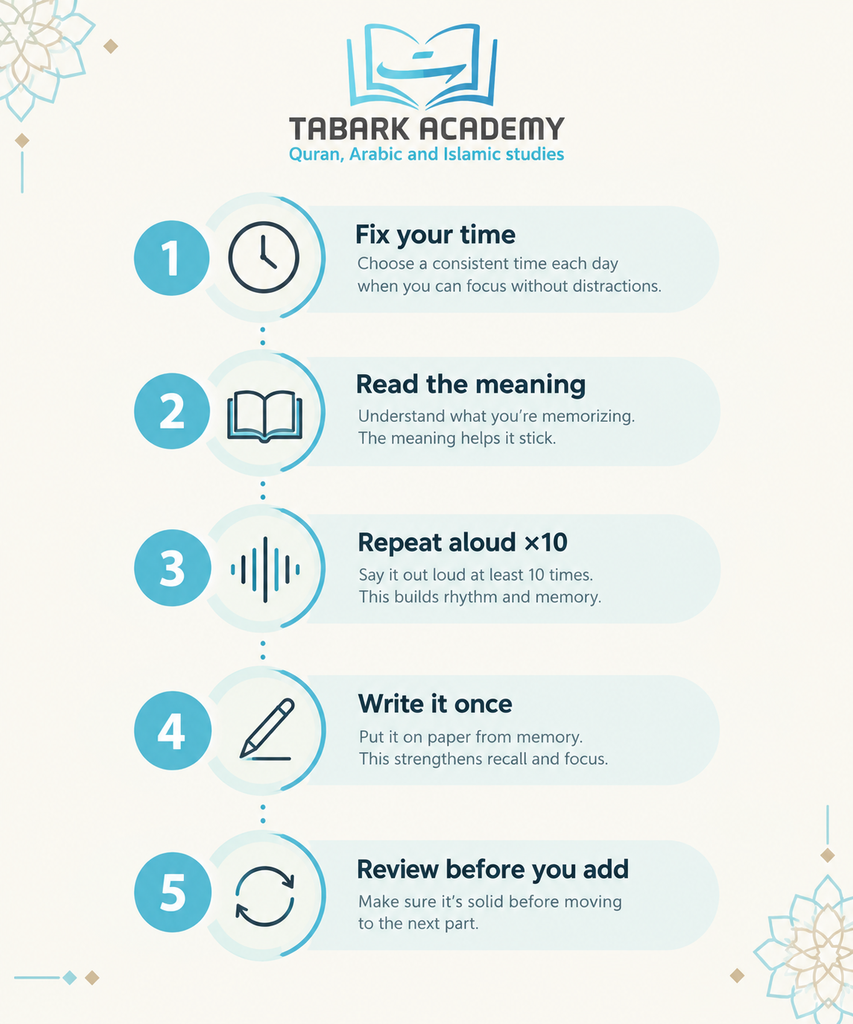
The plan sets your pace; the routine is what makes the pace survive contact with real life. These five habits appear in almost every successful hifz journey.
- Fix One Time And Protect It: Choose a slot when your mind is clearest — after Fajr, or before sleep — and keep it identical every day. A fixed time removes the daily decision of whether to memorize, which is where most plans die.
- Read The Meaning Before You Memorize: Spend a few minutes with a simple tafsir on today’s verses before repeating them. When the words carry meaning, your mind stores a connected passage instead of a string of sounds.
- Repeat Aloud, Then Write: Repeat each verse aloud at least ten times, then write it once by hand in a dedicated notebook. Writing forces attention to every letter and exposes the words you were quietly skipping.
- Recite to Someone Every Day: Recite the new portion to a teacher, a study partner, or a parent. An error caught the same day costs a minute; the same error caught a month later costs a week of correction.
- Review Before You Add: Never memorize new verses before reviewing yesterday’s. The Prophet ﷺ said: “Commit yourself to the Qur’an, for by Him in whose Hand is my soul, it is surely more prone to break away than a camel in its bind .” (Sahih al-Bukhari)
تَعَاهَدُوا الْقُرْآنَ فَوَالَّذِي نَفْسِي بِيَدِهِ لَهُوَ أَشَدُّ تَفَصِّيًا مِنَ الإِبِلِ فِي عُقُلِهَا ”.
Set a workable rule where you can review the last seven days daily, and the whole memorized portion once a week.
Read also: Learn – How Long Does It Take To Memorize Surah Yaseen?
Mistakes That Stretch Your Timeline
While setting Hifz goals is important, certain habits can slow your progress and make it harder to retain what you have memorized.
Recognizing these common mistakes early helps you protect your Hifz and stay on track toward your memorization goals.
1. Memorizing From A Different Mushaf Each Day.
Page layout is part of visual memory — commit to one Mushaf, ideally the Madani print. Your mind stores more than sound; it stores where a verse sat on the page, which line it started on, and what came directly above it.
Switching between a phone app, a pocket Mushaf, and a large print copy erases those anchors every time. Choose one edition at the start and finish the whole surah in it.
2. Skipping Review To “Catch Up.”
This is the single most common reason a one-month plan becomes a six-month plan. Missing two days feels like it can be repaired by memorizing double on the third, but new verses layered on unreviewed ones collapse together.
The faster fix is the opposite: pause new memorization for one day, secure what is already there, then resume the normal portion. You lose a day and save a fortnight.
3. Ignoring The Similar Verses.
Mark them, compare them side by side, and memorize the difference deliberately rather than hoping it sorts itself out. Al-Baqarah is full of near-identical openings and closings, and they are the passages that make a reciter freeze mid-verse.
Write the pair out together, highlight the single word that separates them, and attach a small mental cue to each one. Five minutes of deliberate comparison prevents months of confusion.
Step Inside Our Virtual Classrooms
See our engaging teaching methods in action! watch real snippets of our live classes and discover how our expert instructors make learning interactive, memorable, and inspiring for every student.
Read also: Learn – Is It Better To Memorize Quran In The Morning Or At Night?
Start Your Surah Al-Baqarah Memorization Plan This Week
Knowing the timeline is useful; having a teacher hold you to it is what finishes the surah. At Tabarak Academy, certified instructors build your daily portion around your real schedule, then track every verse you memorize and review.
Your sessions cover recitation correction, Tajweed application, and the meaning of the verses you are memorizing — so the surah settles in your memory with understanding, not just sound. Classes run one-to-one, for children and adults, at times you choose.
Book a free trial lesson and finish your first session with a written Al-Baqarah plan, your daily verse target, and a review schedule you can actually keep.
Our Quran Memorization / Hifz Courses
- Online Hifz Program
- Juz 30 Memorization Course
- Hifz for Kids Course
- Hifz for Adults Course
- Hifz for Sisters Course
- Short Surah Memorization Course
- Hifz Ijazah Course

Conclusion
How long does it take to memorize Surah Al-Baqarah? For most students, between one and three months. Ten verses a day finishes the surah in thirty days, five verses a day in about two months, and a gentler three-verse pace in three to four months.
The variable that decides your outcome is not memory ability — it is whether your daily session happens. Choosing a pace you can repeat on a difficult day will always beat an ambitious plan you abandon in week two.
Understanding the verses, writing them, and reciting them to a listener each shorten the journey measurably.
Review is what turns memorization into hifz. New verses added on top of unreviewed pages simply push the finish line further away, while a short daily review keeps everything you have earned.
Takeaway Message: Pick one realistic daily portion, protect one fixed time, and review before you add — and Surah Al-Baqarah becomes a two-month project instead of a lifelong intention.
Read also: How To Memorize The Quran In 1 Year – A Realistic Daily Plan
FAQs
How many verses are in Surah Al-Baqarah?
Surah Al-Baqarah has 286 verses across about 48 pages of the Madani Mushaf, making it the longest chapter in the Quran — roughly two and a half juz’.
Can I memorize Surah Al-Baqarah in one month?
Yes, at ten verses per day with daily review, which needs about an hour of focused work. It is achievable for motivated adults, but retention requires a full review cycle straight after finishing.
How long does it take to memorise Surah Al-Baqarah for a beginner?
A complete beginner should plan for two to four months at three to five verses daily. Beginners who first fix their recitation with a teacher usually finish faster than those who rush straight into memorizing.
Should I understand the meaning before memorizing?
Yes. Reading a short tafsir of the day’s verses first makes memorization faster and more durable, because meaning gives the mind a structure to attach the words to.
How do I stop forgetting what I memorized?
Review the last seven days every day and the full memorized portion weekly, and include Al-Baqarah in your regular recitation. Memorization without review fades within weeks.
Is it better to memorize by verse or by page?
Page-based memorization suits students with prior hifz experience because it builds visual memory of the layout. Verse-based targets are easier for beginners and for the long verses in Al-Baqarah.