

Most parents raising this question are working against two real problems at the same time. Sessions that are too long exhaust the child and build resentment toward the Quran. Sessions that are too short produce no measurable progress week after week. Both failures come from not knowing the correct daily duration for the child’s specific age and level.
How long should a child memorize Quran each day is not a single fixed number. It is a structured answer that changes with age, the amount of revision already owed, and whether the goal is full Hifz or consistent daily recitation. This article gives parents the specific figures, schedules, and principles they need.
How Long Should a Child Memorize Quran Each Day
The direct answer to how long should a child memorize Quran each day changes significantly across age groups, because attention span, retention capacity, and the balance between new memorization and revision all shift as children grow. The table below gives the core figures used by structured Hifz programs worldwide:
| Age Group | Total Daily Session | New Memorization | Revision |
| 4-6 years | 10-15 minutes | 2-3 minutes | 8-12 minutes |
| 7-10 years | 20-25 minutes | 8-10 minutes | 12-15 minutes |
| 11-12 years | 25-35 minutes | 10-12 minutes | 15-23 minutes |
| 13-16 years | 45-60 minutes | 15-20 minutes | 25-40 minutes |
Children aged 4-7 do best with 15-25 minutes daily, as their attention span is short and small calm sessions help them stay engaged without feeling overwhelmed.
Children aged 8-12 can manage 30-60 minutes daily, balancing reading, memorization, and revision together as their focus improves. Teenagers actively pursuing Hifz can sustain 45-60 minutes, provided the session remains structured rather than open-ended.
The most consistent pattern observed across Hifz programs is that parents who push children toward longer sessions in the early weeks almost always see retention collapse by the second month.
The child may appear to memorize quickly, but without sufficient repetition per verse the memorization does not stabilize. Starting conservatively and increasing gradually is not a limitation. It is the methodology that produces children who actually retain their memorization for life.
Tabarak Academy’s Hifz For Kids Course structures every child’s session length by age, with certified native Arab tutors who calibrate daily targets to each child’s current retention level, never to an arbitrary speed standard.

Begin your child’s Hifz the right way.
How Many Lines Per Day Produces Real Progress
Session length alone does not determine progress. The number of lines memorized within that session, and the repetitions each line receives before moving forward, decide whether the memorization becomes permanent or fades within 48 hours.
Children aged 7-14 should memorize 3 to 5 lines daily. Their cognitive flexibility allows rapid absorption, but overloading causes mental fatigue and retention failure. At this pace, children complete full Hifz in 5 to 7 years.
Daily repetition of 20 to 30 times per line is what strengthens neural pathways, not the number of new lines added each day.
The following table maps daily line targets to realistic Hifz completion timelines:
| Daily Lines | Session Time Required | Estimated Hifz Completion |
| 3-4 lines | 30 minutes | 7-10 years |
| 5-7 lines | 60 minutes | 4-6 years |
| 8-12 lines | 90-120 minutes | 2-4 years |
| 10-15 lines | Intensive full-time program | 2-3 years |
Children who consistently memorize 3 lines daily for 6 months without forgetting can gradually increase to 5 lines. This progression should happen every 6 to 12 months, because sudden increases shock the brain and destroy retention.
A child memorizing 5 lines per day with solid retention will complete Hifz far ahead of a child memorizing 10 lines per day with poor revision.
Experience Our Interactive Learning
Curious about how we teach? Watch these brief video clips from our recent live sessions to see our structured curriculum, advanced learning platform, and dynamic student-teacher interactions firsthand.
Start Your Quran Learning Journey
Join Tabark Academy today for structured online lessons with qualified tutors, customized to fit your goals.
Book Your Free Trial LessonWhy Revision Must Be Part of Every Single Session
Many parents treat revision as optional time that happens only when the child finishes new memorization early. This is the single most common reason children stall in their Hifz or lose large portions of what they spent months building.
Revision, called Muraja’ah, converts short-term recall into permanent retention. New memorization without daily revision disappears within weeks, regardless of how clearly the child recited it on the day it was learned. The recommended daily structure follows a clear priority order:
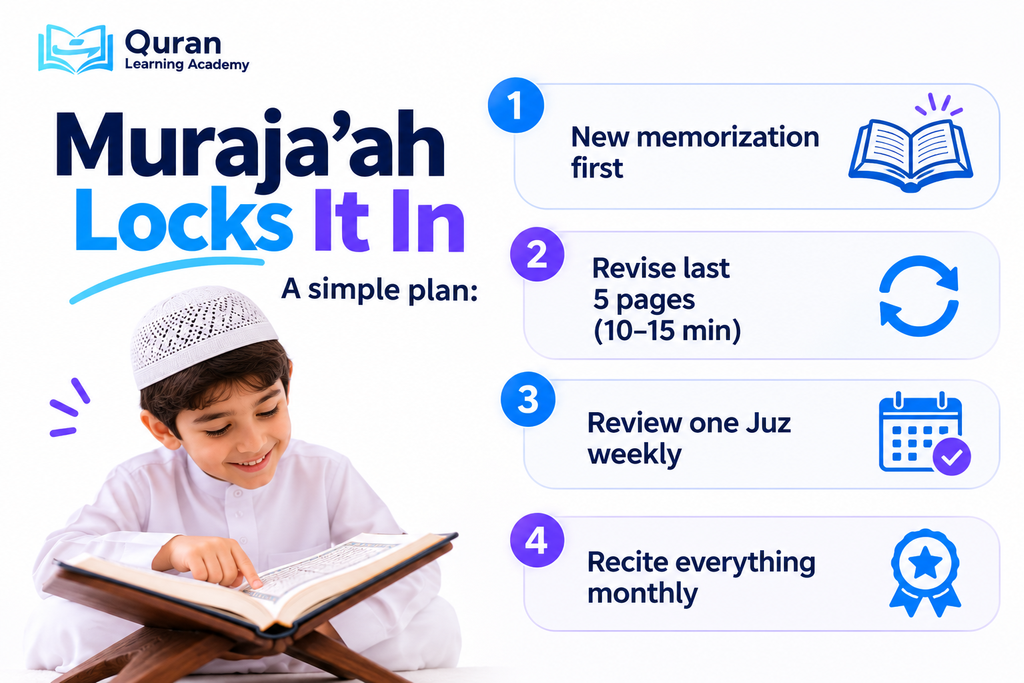
- New memorization comes first, while mental energy is at its peak.
- Revision of the last 5 memorized pages follows immediately, taking 10-15 minutes.
- A weekly full-Juz review reinforces older material before the forgetting curve erases it.
- A monthly full recitation of everything memorized confirms no earlier portion has been lost.
Revision must occupy at least 60% of the total session time. For a child with 30 minutes daily, this means 18 minutes of revision and 12 minutes of new memorization.
For a child with 60 minutes daily, 36 minutes goes to revision and 24 minutes to new material. Skipping revision on even one day weekly destroys the neural patterns built over months of consistent work.
Tabarak Academy’s Online Hifz Program builds a structured Muraja’ah system into every child’s session plan, with tutors who monitor both new progress and retention of earlier portions in every live class.

The Best Time of Day for a Child’s Daily Session
Understanding how long should a child memorize Quran each day is only half the answer. When that session happens determines whether the same duration produces strong long-term retention or weak, unstable recall.
The post-Fajr window is consistently identified by scholars and experienced Hifz instructors as the strongest memorization period. The mind has rested overnight, distraction is minimal, and retention rates in this window measurably exceed those in afternoon and evening sessions.
Where Fajr is not practical due to school start times, the early morning window before school, before any screen time, is the strongest alternative.
For school-going children, the most effective model is a split daily session:
- New memorization after Fajr: 15-20 minutes.
- Muraja’ah revision before bedtime: 10-15 minutes.
Two shorter sessions consistently outperform one longer session of the same total time. Evening sessions can supplement but should rarely carry the primary new memorization load for young children.
Read more: How to Revise Quran While Memorizing New Pages.
What the Quran and Sunnah Teach About Daily Effort
Before setting a daily session length for your child, the Islamic principle that governs all worship is worth establishing clearly: consistent small effort is more beloved to Allah than large bursts followed by abandonment.
Allah ﷻ made the Quran accessible to those who sincerely seek it. He says in Surah Al-Qamar, a verse He repeats four times in the same Surah:
“وَلَقَدْ يَسَّرْنَا الْقُرْآنَ لِلذِّكْرِ فَهَلْ مِن مُّدَّكِرٍ ”
Wa laqad yassarnal-Qur’ana lidhdhikri fahal min muddakir
“And We have certainly made the Qur’an easy for remembrance, so is there any who will remember?”
The repetition of this verse four times in a row is itself a signal that ease is available to those who approach the Quran with sincerity and structure, not to those who rush it with ambition beyond their capacity. The Prophet ﷺ confirmed this principle directly. He said:
“خُذُوا مِنَ الأَعْمَالِ مَا تُطِيقُونَ، فَإِنَّ اللَّهَ لَا يَمَلُّ حَتَّى تَمَلُّوا”
“Take on only as many deeds as you are able to, for Allah does not get tired of giving reward until you tire of doing good deeds.”
A child memorizing 3 lines daily for 8 years without forgetting a single page is carrying out this principle perfectly.
A child pushed to 10 lines daily who abandons Hifz by the third month has gained nothing. The session length that preserves love for the Quran is always the right session length.
Step Inside Our Virtual Classrooms
See our engaging teaching methods in action! watch real snippets of our live classes and discover how our expert instructors make learning interactive, memorable, and inspiring for every student.
Start Your Quran Learning Journey
Join Tabark Academy today for structured online lessons with qualified tutors, customized to fit your goals.
Book Your Free Trial LessonHow School-Going Children Can Sustain a Daily Hifz Routine
One of the most common concerns parents raise is whether a child attending school full-time can maintain a meaningful daily Hifz routine without academic performance suffering. The answer is yes, provided the schedule is fixed rather than left to whenever time is available.
A session left to whenever it fits will not happen consistently. A session anchored to a fixed daily trigger, specifically after Fajr, will happen reliably because it attaches to an existing act of worship rather than to free time that changes every day. The following schedule works practically for school-going children aged 8-12:
| Time Slot | Activity | Duration |
| After Fajr | New memorization (3-5 lines) | 15-20 minutes |
| Before bedtime | Muraja’ah of last 5 pages | 10-15 minutes |
| Once weekly | Full Juz review with parent | 20-25 minutes |
During school exam periods, the new memorization portion is suspended entirely. Only revision continues, protecting existing Hifz without academic pressure. Once exams end, new memorization resumes from exactly where it stopped. No verses are lost and no momentum needs rebuilding from scratch.
Tabarak Academy’s Tajweed Course For Kids ensures that children entering Hifz carry the correct Tajweed foundation from the start, so every line they memorize is accurate from day one and requires no painful correction later.

Claim your free trial lesson today.
Start Your Quran Journey with Tabarak Academy
Tabarak Academy has been teaching Quran memorization to children online for 25 years. Every child enrolling at Tabarak Academy is paired with a certified native Arab tutor who designs a personalized daily plan based on the child’s specific age, current level, and available daily time.
Sessions are structured as one-on-one live classes, so every error in Tajweed and Makhraj is corrected in real time. Flexible scheduling covers all global time zones, making it practical for families across North America, Europe, Asia, and beyond to maintain a consistent daily routine. A free trial class is available for every new student before any commitment.
Our Quran Courses
- Hifz For Kids Course
- Online Hifz Program
- Tajweed Course For Kids
- Quran Reading Course
- Quran Recitation Course
- Online Ijazah Course

Conclusion
The right daily session for a child is the one that builds lasting retention, not the one that covers the most pages the fastest. Children aged 4-7 need 10-15 minutes, children aged 8-12 need 20-30 minutes, and teenagers need 45-60 minutes, always with revision occupying the larger share. Consistency and correct method produce Huffaz. Ambition without structure does not.
Register now at Tabarak Academy and let a certified tutor design the right daily plan for your child from the very first session.
Read more: How Many Pages a Day to Finish Hifz in 1 Year.
Frequently Asked Questions
How long should a child memorize Quran each day at age 5?
A session of 10 to 15 minutes total is correct at age 5, with 2-3 minutes maximum for new memorization and the rest for light listening and repetition.
How long should a child memorise Quran each day if attending school full-time?
A split model works best: 15 minutes of new memorization after Fajr and 10 minutes of revision before bedtime, keeping total daily time between 20 and 25 minutes.
What happens if a child misses one day of Hifz?
Missing one day breaks the consecutive daily reinforcement that stabilizes retention, so the following day must include doubled revision rather than simply continuing from where the child stopped.
Should revision time count toward the daily Hifz session?
Yes. Revision is not separate from Hifz time. It must occupy at least 60% of every daily session because new memorization without daily revision fades within weeks.
At what age should a child begin formal Hifz?
Formal structured Hifz is most productive from age 6 onward, when a child can sit attentively, follow corrections, and sustain a focused session of 10-15 minutes consistently.
Is one long session weekly better than short daily sessions?
No. Five short daily sessions of 15 minutes each produce significantly stronger retention than one session of 75 minutes once a week, because daily exposure prevents the forgetting curve from erasing what was learned.




0 Comments