
Learning the Quran as a new Muslim may feel overwhelming at first, especially if you have no background in Arabic. However, knowing How to Learn Quran as a Revert can help you follow a clear path, starting with the Arabic letters and basic pronunciation before moving on to short surahs for prayer.
This guide explains the essential steps, realistic learning timelines, and practical habits that can help reverts build confidence and develop a lasting connection with the Quran.
1. Separate Your Three Goals Before You Begin
The single greatest source of overwhelm for reverts is treating Quran learning as one enormous, undivided task. It is actually three distinct skills, each with a different timeline and urgency level:
| Skill | What It Involves | Required for Prayer |
| Arabic script reading | Recognizing 28 letters, vowel marks, connecting forms | Yes — foundational |
| Tajweed | Pronunciation rules: Makharij, Madd, Ghunna | Gradually, not from day one |
| Arabic language | Grammar, vocabulary, conversation fluency | Never — not for prayer |
Millions of practicing Muslims worldwide recite correctly without speaking Arabic as a conversational language. Reading the Quran in Arabic is a mechanical decoding skill, not a fluency requirement. Once you understand that, the first 30 days become far less intimidating.
2. Learn the 28 Arabic Letters Before Anything Else

Every single reliable source agrees on this starting point, and for good reason. Skipping letter recognition and jumping to transliterated surahs is the most common mistake reverts make. Letters learned incorrectly in week one become pronunciation habits by week four that take months to unlearn.
The Noorani Qaida is the structured tool used for this stage with every beginner, adult or child. It groups the 28 Arabic letters by shape families, teaches their isolated, initial, medial, and final forms, and introduces the three core short vowel marks (fatha, kasra, damma) that determine how each letter sounds. Twenty minutes of daily focused practice on letters alone, nothing else, is enough for week one.
By day seven, the realistic target is recognizing all 28 letters in their isolated form and producing their sounds without stopping to think. That is the only milestone for week one. Do not move to joining letters until this is solid.
Experience Our Interactive Learning
Curious about how we teach? Watch these brief video clips from our recent live sessions to see our structured curriculum, advanced learning platform, and dynamic student-teacher interactions firsthand.
Start Your Quran Learning Journey
Join Tabark Academy today for structured online lessons with qualified tutors, customized to fit your goals.
Book Your Free Trial Lesson3. Master Short Vowels and Joining Letters
Once isolated letter recognition is stable, the next stage is reading syllables: two or three letters joined together with a vowel mark. This is where the script begins to feel like something that can actually be decoded rather than a foreign code.
The vowel marks introduced at this stage are:
- Fatha (a sound), a small diagonal mark above the letter.
- Kasra (i sound), the same mark placed below the letter.
- Damma (u sound), a small hook above the letter.
- Sukoon, indicating no vowel at all, marking a resting consonant.
Adults typically move through this stage faster than children because an adult’s phonological awareness is fully developed. The goal by the end of week two is reading two-letter syllables confidently, without pausing to recall which letter produces which sound.
Detailed Tajweed rules, Madd, Ghunna, and Ikhfa, are skipped completely at this stage. Layering Tajweed rules onto uncertain letter recognition produces errors in both simultaneously.
Read more: What to Do When Your Child Hates Quran Class.
4. Memorize Your Prayer Surahs While Learning to Read

A revert learning how to learn Quran as a revert faces a practical urgency that born-Muslim beginners rarely feel: prayer starts immediately, and prayer requires Arabic recitation.
You do not need to finish the Noorani Qaida before you can pray. You need to correctly recite four short chapters:
- Surah Al-Fatiha (7 verses): recited in every unit of every prayer, without exception.
- Surah Al-Ikhlas (112): 4 verses describing Allah’s absolute oneness.
- Surah Al-Falaq (113): 5 short verses of protection.
- Surah An-Nas (114): 6 verses, the final surah of the Quran.
These four chapters are the complete Quranic recitation requirement for valid prayer.
Learning them by listening to a slow, clear recitor like Sheikh Husary and repeating verse by verse builds the auditory familiarity that makes later written reading easier, not harder.
Allah says in the Quran, addressing His Prophet about those who recite what they can:
فَاقْرَءُوا مَا تَيَسَّرَ مِنَ الْقُرْآنِ
“so recite what is easy [for you] of the Qur’an.”
This verse establishes the principle that beginning with what you can manage is not a compromise, it is the intended path.
Regarding mistakes made while sincerely learning, the Prophet said:
“مَثَلُ الَّذِي يَقْرَأُ الْقُرْآنَ وَهْوَ حَافِظٌ لَهُ مَعَ السَّفَرَةِ الْكِرَامِ الْبَرَرَةِ، وَمَثَلُ الَّذِي يَقْرَأُ الْقُرْآنَ وَهْوَ يَتَعَاهَدُهُ وَهْوَ عَلَيْهِ شَدِيدٌ، فَلَهُ أَجْرَانِ”
“Such a person as recites the Qur’an and masters it by heart, will be with the noble righteous scribes (in Heaven). And such a person exerts himself to learn the Qur’an by heart, and recites it with great difficulty, will have a double reward.”
This hadith addresses exactly the stage you are at now. The struggle itself carries reward. You are not required to delay prayer until your pronunciation is polished.
Tabarak Academy’s Noorani Qaida For Adults is designed specifically for adult beginners with zero Arabic background who need to move from letter recognition to prayer-ready recitation in a structured, patient environment. Get your journey started correctly.

5. Move from Syllables to Full Quran Reading
Once basic letter recognition and the prayer surahs are stable, the next phase is building actual reading fluency from the Mushaf. This stage is where the learn Quran as a revert tips that truly matter become most relevant:
Start with Juz Amma (the 30th part of the Quran) because its surahs are short, the verses are brief, and many are already familiar from prayer practice. Read out loud with a teacher listening, not silently alone.
Silent reading does not catch Makharij errors, and Makharij errors that are not caught in month two become habits by month three.
The following table shows realistic timelines for each stage based on 20 to 30 minutes of daily practice and two sessions per week with a teacher:
| Stage | What You Are Doing | Realistic Timeline |
| Letter recognition | Noorani Qaida, isolated letters and short vowels | Weeks 1 to 2 |
| Joining letters and syllables | Basic word decoding with vowel marks | Weeks 2 to 4 |
| Prayer surahs memorized | Al-Fatiha and three Quls, pronunciation verified | Weeks 3 to 5 |
| Reading Juz Amma fluently | Short surahs read directly from Mushaf | Months 2 to 4 |
| Basic Tajweed application | Madd, Ghunna, Ikhfa rules applied | Months 4 to 7 |
Moving faster than this timeline is possible when practice is consistent. Moving slower is completely normal.
What determines speed above everything else is whether a teacher is correcting your recitation by ear every week, not whether you are talented or motivated.
Tabarak Academy’s Tajweed Course For Adults gives you a certified native Arab teacher correcting your Makharij in every live session, ensuring the pronunciation habits you build in this stage are correct ones.

Join your first free trial now.
6. Why a Live Teacher Changes Your Entire Trajectory
The best way to learn Quran as a revert is not through an app, not through transliteration, and not through YouTube videos alone.
The reason is specific and non-negotiable: Arabic pronunciation errors feel correct from the inside. You cannot hear your own Makharij mistakes. A teacher can.
The letters ح and هـ feel identical to an English speaker producing them in the first month. So do ق and ك, and so do ع and a plain vowel sound.
These distinctions are the difference between correctly reciting the Quran and consistently mispronouncing it, and no application can catch the difference in real time the way a trained ear does.
A qualified teacher also provides something equally important: a structured sequence.
Reverts who learn without one frequently encounter pieces of information in random order, Tajweed rules before letter fluency, memorization attempts before correct pronunciation, translation study before basic reading, and find that nothing connects into a usable skill.
A teacher who regularly works with reverts has a day-by-day map of what comes first and why.
What to look for when choosing a teacher:
- Do they begin from literal zero without assuming any prior Islamic knowledge?
- Do they correct recitation by listening, not just by having you repeat?
- Do they have experience with adult beginners who are not raised in Muslim households?
- Do they offer flexible scheduling that works across different time zones?
- Do they provide a private, comfortable environment, especially important for sisters?
Step Inside Our Virtual Classrooms
See our engaging teaching methods in action! watch real snippets of our live classes and discover how our expert instructors make learning interactive, memorable, and inspiring for every student.
Start Your Quran Learning Journey
Join Tabark Academy today for structured online lessons with qualified tutors, customized to fit your goals.
Book Your Free Trial Lesson7. The Four Habits That Sustain Progress Past Month One
Motivation carries most reverts through the first two or three weeks with tremendous energy. What replaces motivation when it fluctuates is habit, and habit is built during those first weeks, not later.
The four habits that distinguish reverts who are still reading consistently two years later from those who stopped at month three are:
- Anchoring practice to an existing daily event, most commonly Fajr prayer. The prayer is already a scheduled part of the day; adding 15 minutes of Quran reading directly after it requires no additional schedule-building effort.
- Keeping the daily session short and non-negotiable rather than long and skippable. Fifteen minutes every single day produces more progress than two hours on weekends.
- Recording yourself weekly and listening back. This is the only way a self-study learner can partially compensate for not having daily teacher feedback, and it catches errors that feel invisible during recitation.
- Reading Quran alongside its meaning. As a revert, every verse is genuinely new. Pairing recitation practice with a reliable English translation like Sahih International deepens connection to what is being recited and sustains motivation through the technically difficult early months.
Tabarak Academy’s Quran Recitation Course is built around exactly this combination of live recitation correction, structured daily practice guidance, and a teacher who adapts to your pace as an adult learner. Take the first step today.

Claim your free trial lesson today.
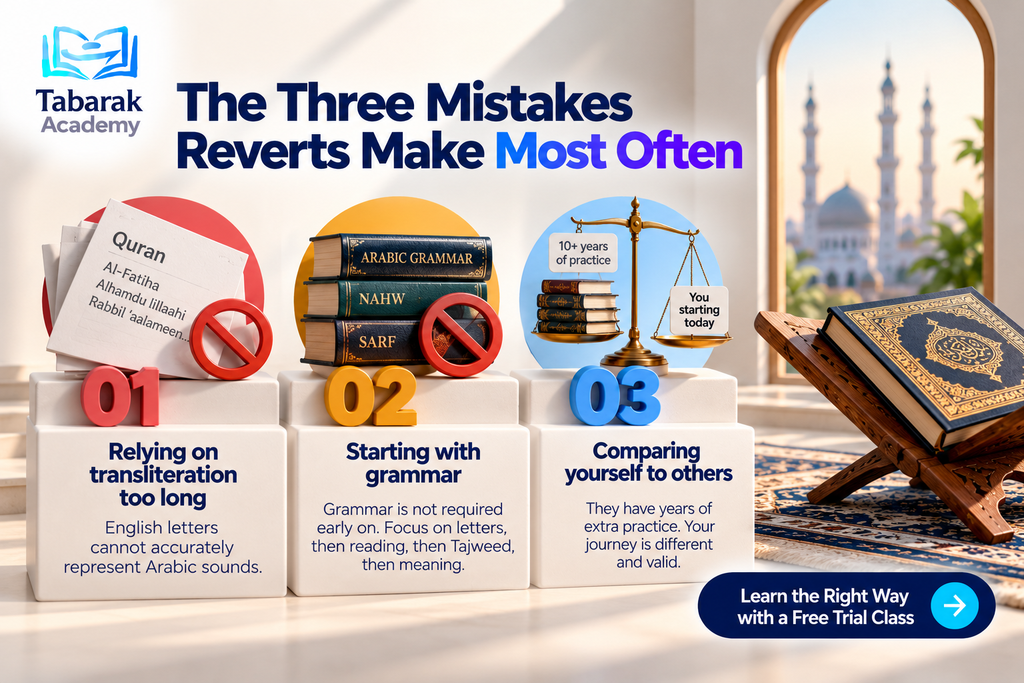
8. The Three Mistakes Reverts Make Most Often
Understanding how to learn Quran as a revert correctly means knowing specifically what to avoid. These three mistakes derail more reverts than any other:
Relying on transliteration beyond the first prayer session
English letters cannot represent the Arabic sounds ح, ع, ق, ض, or خ accurately. A revert who memorizes Al-Fatiha using transliteration and never transitions to reading actual Arabic script is cementing mispronunciations that must be unlearned later, which takes longer than learning correctly from the start would have taken.
Trying to understand Arabic grammar before building reading fluency
Arabic grammar is a multi-year undertaking comparable to learning any second language. It is not required for prayer, for reading the Quran, or for Tajweed.
Reverts who begin with grammar courses before building letter recognition and basic reading fluency end up with knowledge they cannot yet apply and a reading skill that never develops. The sequence is letters, then reading, then Tajweed, then meaning, not the reverse.
Comparing progress to born-Muslims who have been reading since childhood
A fluent recitor who grew up in a Muslim household has ten or more years of daily reading practice behind them. The gap you observe is a gap in hours, not in ability or belonging.
Read more: Quran Learning Activities for 5 Year Olds That Build Real Skills.
9. What Comes After You Can Pray and Read
Once the urgent phase is complete, prayer is established, and Juz Amma is readable with reasonable fluency, the road ahead opens considerably.
This is where the long-term Quran relationship that reverts often describe as the most spiritually transformative part of their Islam begins.
The natural progression from this point follows this order:
- Tajweed refinement: Madd rules, rules of Noon Sakin and Tanwin, Ikhfa, Idgham, and Iqlab applied to regular Quran reading.
- Juz 29 and 28 reading, then moving backward through the Quran toward Al-Baqarah.
- Short surah memorization beyond the prayer minimum, building toward Hifz of Juz Amma.
- Quranic Arabic study to begin understanding what is being recited, which transforms recitation from sound production into genuine engagement with meaning.
None of this requires urgency. The Quran is a relationship measured in decades, and reverts who begin correctly, with verified pronunciation, a daily habit, and a qualified teacher, consistently describe the later stages as gifts rather than obligations.
Tabarak Academy’s Juz 30 Memorization Course is designed for adult learners ready to move from reading to memorizing the surahs of Juz Amma with consistent teacher support.
Start Your Quran Journey with Tabarak Academy Today
Reverts at every stage, from those who have not yet learned a single Arabic letter to those already reading but needing Tajweed correction, need a teacher who starts from where they actually are, not where a classroom assumes they should be.
Tabarak Academy provides exactly this through certified native Arab tutors with deep specialization in Quran recitation, Tajweed, and Noorani Qaida.
Every session is one-on-one and live, with real-time Makharij correction that no app can replicate.
Flexible scheduling covers all global time zones, and dedicated programs are available for sisters, adults, men, and new Muslims across all learning levels. A free trial class is available before any commitment.
Our Quran Courses
- Noorani Qaida For Adults
- Tajweed Course For Adults
- Quran Recitation Course
- Juz 30 Memorization Course
- Al-Azhar Quran Course
- Online Ijazah Course
- Online Qirat Course

Take your first free trial class with a certified Arab tutor
Conclusion
Learning the Quran as a new Muslim becomes easier with a clear plan and consistent practice.
If you are exploring How to Learn Quran as a Revert, start by learning the Arabic letters, practice short surahs for prayer, and work with a qualified teacher to improve your pronunciation and Makharij.
Set aside a little time each day, review what you learn, and progress at a pace you can maintain.
FAQ
Can I learn Quran as a revert without knowing any Arabic at all?
Yes. Quran reading is a decoding skill, not a language fluency requirement. You learn to recognize letters and produce their sounds, which is achievable in weeks.
How long does it realistically take a revert to read the Quran?
With 20 to 30 minutes daily and weekly teacher sessions, most reverts reach prayer-ready recitation in 4 to 6 weeks and read Juz Amma within 4 to 8 months.
Is transliteration acceptable for prayer?
Scholars state it leads to persistent mispronunciation. Use it only for the first one or two prayer attempts, then transition to Arabic script as soon as possible.
Which surah should a revert learn first?
Surah Al-Fatiha, because it is recited in every rakah of every prayer. Follow it with Al-Ikhlas, Al-Falaq, and An-Nas, which cover the prayer recitation minimum.
Do my prayers count if my pronunciation is not perfect yet?
Yes. Scholars are consistent that a sincere beginner’s prayer is valid while learning, and the Prophet confirmed a double reward for the one who recites with difficulty while striving to improve.
Is an online teacher as effective as an in-person one?
For recitation correction, yes. A live video session allows a teacher to hear your Makharij in real time, which is the essential correction mechanism regardless of format.

0 Comments