

Balancing work, family, and Quran memorization can be challenging, especially when revision becomes difficult. A Quran memorization program for busy professionals provides a structured approach that fits demanding schedules.
With flexible study sessions and consistent revision, professionals can progress towards their memorization goals without neglecting their daily responsibilities.
The Post-Fajr Window Outperforms Every Other Time Slot

Cognitive research on memory consolidation consistently shows that the brain encodes new phonetic content most effectively in the early morning, when working memory is unloaded from the previous day’s demands.
For working adults pursuing a Quran memorization program for busy professionals, this window between Fajr and the start of the workday is the most protected and highest-value slot available.
The reason this matters in practical terms is straightforward. A professional who tries to memorize new verses after a full workday is competing with decision fatigue, mental noise from ongoing tasks, and reduced retention capacity.
The same professional who spends 15 to 20 minutes after Fajr on new memorization is working with a brain that has just completed its consolidation cycle during sleep.
The implementation requires one non-negotiable rule: no phone scrolling between Fajr prayer and the memorization block. That single barrier removed produces more consistent results than doubling the session length.
Tabarak Academy’s Online Hifz Program structures sessions specifically around working adults’ peak focus windows, with one-on-one live sessions that a certified native teacher schedules around your time zone and daily commitments.

Start your Hifz journey with a free class.
A Three-Block Daily Structure Fits Around Any Work Schedule
The single biggest structural mistake in most published memorization guides is assuming one long daily session. Professionals who work full-time rarely have that. A more survivable structure breaks the day into three short blocks:
The following schedule shows how daily time can be distributed without requiring a single uninterrupted hour:
| Block | Timing | Duration | Activity |
| Block A | After Fajr | 15 to 20 minutes | New memorization only |
| Block B | Commute or lunch break | 10 to 15 minutes | Audio listening to the same portion |
| Block C | Before sleep | 5 to 8 minutes | Recite the new portion without looking |
Block B requires no desk, no quiet room, and no setup. Listening to the assigned portion during a commute or a lunch walk reinforces the phonetic pattern of the new verses before the evening recall test.
Block C then converts passive listening into active memory by requiring the professional to recite from memory without looking, effectively testing retention at the end of the day.
This approach means the Quran memorization programme for busy professionals online fits across naturally occurring gaps in the day rather than competing for a single block of time that often disappears under workload pressure.
Experience Our Interactive Learning
Curious about how we teach? Watch these brief video clips from our recent live sessions to see our structured curriculum, advanced learning platform, and dynamic student-teacher interactions firsthand.
Start Your Quran Learning Journey
Join Tabark Academy today for structured online lessons with qualified tutors, customized to fit your goals.
Book Your Free Trial LessonThe Revision System That Prevents Forgetting
New memorization without a structured revision system produces what is commonly called one-way progress: the learner keeps moving forward while the older material quietly fades.
For a working professional, this is especially damaging because limited daily time means there is no buffer to recover forgotten portions without losing new ones.
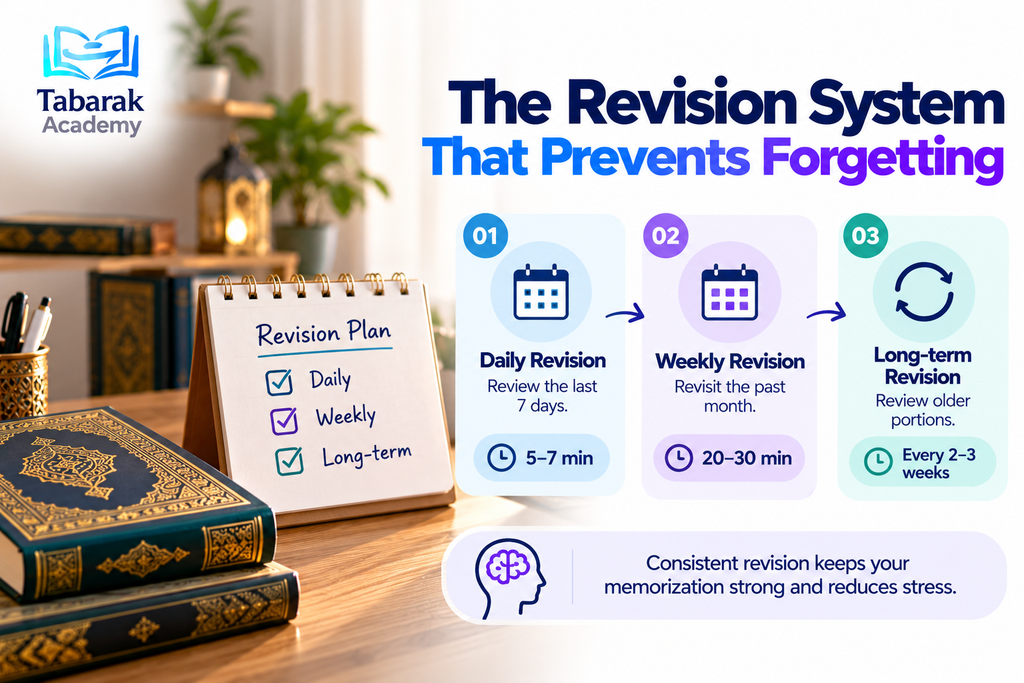
A functional revision system for a Quran memorization program for busy professionals operates across three distinct layers:
Daily revision (recent lessons):
Recite the portion memorized within the past seven days. This layer keeps fresh memorization active before it moves into passive storage. Duration: 5 to 7 minutes, preferably during Block A after completing the new lesson.
Weekly revision (the past month’s work):
One day per week, typically Friday or Sunday, is set aside for revisiting all material memorized in the past four weeks. This converts recently learned portions into reliably recalled material. Duration: 20 to 30 minutes.
Long-term revision (older portions):
Every two to three weeks, the professional returns to material memorized more than a month ago. Without this layer, older portions fade to the point where they require re-memorization, which costs more time than the revision itself would have.
Research on working memory and Quranic retention confirms that stress levels carry a significant negative relationship with memorization performance.
Building revision into the schedule before the professional feels anxious about forgotten material prevents the compounding effect of stress on recall.
Read more: How Long Should a Child Memorize Quran Each Day.
How Many Verses Should a Working Professional Memorize Each Day
One of the most common misconfigurations in any Quran memorization programme for busy professionals is selecting a daily target based on aspiration rather than tested capacity.
A professional who regularly fails to complete a five-verse daily target is not failing because of weak commitment. They have simply selected the wrong target.
The right daily amount is determined by answering three operational questions:
- Can the new portion be recited from memory the following morning without prompting?
- Is the week’s previously memorized material still accurate after seven days without review?
- Does the daily session fit within available time on the worst work day of the week, not the best?
If the answer to any of these is no, the target needs to be reduced before it is ever considered for increase. The table below gives an honest pace guide based on daily available time:
| Daily available time | Realistic weekly new memorization |
| 15 to 20 minutes | 3 to 5 short ayat |
| 30 to 40 minutes | 5 to 8 ayat |
| 45 to 60 minutes | Half a page to one page |
| 60 to 90 minutes | One to one and a half pages |
These targets assume that revision is running alongside new memorization. A professional who uses all available time for new material and allocates nothing to revision will find that older portions require re-memorization, effectively doubling their time cost.
Tabarak Academy’s Hifz For Adults Course is built around exactly this principle, with certified teachers who adjust the weekly pace based on verified retention rather than fixed page targets.

Take your first step with a free trial session.
Using Dead Time as a Revision Asset
One of the most underused advantages available to working professionals is structured dead time. A commute, a waiting room, the gap before a meeting begins, and a lunch walk are all environments where audio-based revision works without requiring any setup or a quiet space.
Dead time should be reserved exclusively for revision, not for new memorization. The reason is practical: new memorization requires active attention, repetition, and a controlled environment to establish accurate phonetic recall. Attempting new memorization while driving or walking produces imprecise recall patterns that need to be corrected later.
Revision during dead time, by contrast, simply requires replaying already familiar material to reinforce retention. The following types of dead time are consistently available to most working professionals:
- Commute by car or public transport.
- Walking between appointments or during lunch.
- Waiting time before meetings or appointments begin.
- Light household tasks in the evening.
Professionals who systematically use dead time for audio revision add between 15 and 30 minutes of reinforcement to their daily routine without changing their formal session length.
Over a working week, that represents an additional hour and a half of contact with the memorized material.
Step Inside Our Virtual Classrooms
See our engaging teaching methods in action! watch real snippets of our live classes and discover how our expert instructors make learning interactive, memorable, and inspiring for every student.
Start Your Quran Learning Journey
Join Tabark Academy today for structured online lessons with qualified tutors, customized to fit your goals.
Book Your Free Trial LessonWhat Happens When Work Gets Unusually Demanding
Every working professional experiences periods where the full memorization schedule becomes unsustainable. A product launch, a travel period, an extended deadline, or a family situation can compress available time to near zero.
A well-designed Quran memorization program for busy professionals anticipates this and builds in a three-tier response rather than an all-or-nothing approach:
- Full schedule: Used on normal working days when the standard time blocks are available.
- Short schedule: Used when work demands reduce available time. Prioritize Block A only, 10 to 15 minutes after Fajr, with revision taking priority over new memorization.
- Minimum floor: Used on the most demanding days. A single ayah recited from memory counts as a completed session. This prevents a missed day from becoming a missed week through the psychological collapse that follows a perceived full restart.
The research on consistency for busy Muslims shows that the most common failure pattern is not forgetting a lesson but treating a missed day as a signal to restart the entire schedule the following Monday. The minimum floor eliminates this pattern by keeping the habit technically unbroken even when the content is minimal.
Tabarak Academy’s Weekend Quran Classes offer a dedicated option for professionals whose weekdays are consistently unavailable, allowing the formal session with a teacher to happen on Saturdays or Sundays while the daily blocks handle revision throughout the week.

The Role of a Qualified Teacher in an Adult Memorization Program
Self-study using recordings and repetition can build a working memorization of many portions of the Quran. What self-study cannot reliably produce is accurate Tajweed, correct Makharij, and detection of subtle errors that become embedded habits over time.
For working professionals who memorize mostly alone during early morning or commute blocks, a weekly or bi-weekly session with a qualified teacher serves a specific and non-replaceable function.
The teacher session should not duplicate the daily self-study routine. Its purpose in a Quran memorization program for busy professionals is limited to three specific tasks:
- Reciting the week’s newly memorized material to verify accuracy before it becomes a fixed habit.
- Receiving correction on Tajweed and Makharij errors that the learner cannot detect from self-recitation alone.
- Setting the next week’s memorization target based on verified retention, not on how much the learner hoped to complete.
Two sessions per week of 30 minutes each, conducted online, fit within the available time of most working professionals and provide sufficient expert oversight for consistent progress.
One session per week is the realistic minimum for maintaining accountability and correcting errors before they accumulate.
Read more: How to Revise Quran While Memorizing New Pages.
A Practical Weekly Template for Working Professionals
The following weekly schedule applies the principles above to a standard five-day working week. Every element can be shifted to match individual work hours, prayer times, or family commitments:
| Day | Morning (Post-Fajr) | Dead Time | Evening |
| Monday | New lesson, 15 minutes | Audio of new lesson during commute | Recite new lesson from memory, 5 minutes |
| Tuesday | New lesson, 15 minutes | Audio of Monday and Tuesday portions | Daily revision, 8 minutes |
| Wednesday | New lesson, 15 minutes | Audio listening | Recite past three days from memory |
| Thursday | New lesson, 15 minutes | Audio listening | Weekly revision starts, 10 minutes |
| Friday | No new lesson | Audio of the full week’s portions | Extended revision, 20 minutes |
| Saturday | Teacher session or new lesson | Optional audio | Long-term revision, older portions |
| Sunday | Revision only | Audio of older portions | Rest or light review |
Friday’s structure is intentional. Removing new memorization on Friday and dedicating that day entirely to consolidating the week’s work produces stronger retention than pushing new material on a day already carrying Jumu’ah obligations and accumulated fatigue.
Tabarak Academy’s Amali Tajweed Course complements this schedule by ensuring that practical Tajweed correction happens in a structured live session while the professional handles memorization volume independently during the week.

Claim your free trial lesson today.
Start Your Hifz with Tabarak Academy
Tabarak Academy offers a dedicated Quran memorization program for busy professionals through one-on-one live sessions with certified native Arab teachers who hold Ijazah in Quran recitation.
Sessions are scheduled across all global time zones to suit working adults in North America, Europe, Asia, and beyond. Every lesson includes real-time recitation correction, a structured weekly target aligned to verified retention, and a free trial class before any commitment is required.
There is no minimum daily hours requirement. The program is built around the learner’s actual available time, family situation, and current Quran reading level.
Professionals who have never memorized beyond Juz Amma and professionals who are resuming after years of gap both have dedicated tracks available.
Our Quran Courses
- Online Hifz Program
- Hifz For Adults Course
- Weekend Quran Classes
- Amali Tajweed Course
- Online Quran Classes for Men
- Zoom Quran Classes
- Noor Al-Bayan Course

Begin your Quran journey today.
Conclusion
A Quran Memorization Program for Busy Professionals helps working adults make steady progress through short daily sessions, regular revision, and a realistic schedule that fits their responsibilities.
Using small pockets of free time and learning from a qualified teacher can strengthen retention and keep memorization on track. The key is to build a sustainable Hifz routine that supports long-term progress, even on the busiest days.
Frequently Asked Questions
Is it possible to complete a Quran memorization program for busy professionals while working full time?
Yes, professionals who dedicate 20 to 30 minutes daily to focused practice and follow a structured revision system can make consistent, measurable progress. The pace is slower than that of full-time Hifz students, but retention can remain strong with consistent practice and effective revision.
How many years does it take for a working adult to memorize the full Quran?
Memorizing three to five short ayat per day with consistent revision can help a working adult complete Juz Amma in three to four months and the full Quran in approximately six to eight years. Professionals who dedicate 45 minutes or more daily may complete memorization in three to four years.
Should revision or new memorization take priority on busy days?
Revision should take priority on busy days. New material can be postponed for a day without significantly affecting long-term progress. Missing revision allows previously memorized portions to weaken, potentially requiring additional time to restore them.
What is the minimum daily session a working professional needs to stay on track?
Reciting a single ayah accurately from memory can serve as a minimum daily session. This helps maintain the habit and prevents a missed day from becoming a reason to abandon the routine.
Does a working professional need a teacher, or is self-study enough?
A qualified teacher is essential for correcting Tajweed and Makharij. Self-study supports daily practice, while a teacher can identify persistent errors that learners may overlook when reciting alone. One or two sessions per week is a practical minimum for regular feedback.


0 Comments