


How Long Does It Take To Memorize One Surah Of The Quran?
The honest answer requires a number and a context. How long does it take to memorize one surah of the Quran ranges from twenty minutes for Surah Al-Ikhlas to six months for Surah Al-Baqarah — with every surah in between following a timeline shaped by factors you can directly influence.
Most people asking this question want a single estimate. What they actually need is a clear picture of what drives the number.
The students who complete surahs steadily, week after week, are not necessarily more gifted than those who restart the same material repeatedly. They are almost always more methodical.
The Sunnah itself points to this: the Prophet ﷺ built his relationship with the Quran on deliberate, consistent practice rather than isolated bursts of effort.
Reading about what can we learn from the life of prophet Muhammad reveals a pattern of intentional daily habit across every area of life — a model that applies directly to any serious Hifz journey.
This article gives you a practical reference guide by surah length, breaks down the ten factors that determine your actual timeline, and provides a daily system that serious memorizers rely on.
Discover Tabarak Academy’s Learn Quran with Tajweed for Kids Course

How Long Does It Take To Memorize One Surah Of The Quran?
The time it takes to memorize a Surah varies greatly depending on its length, complexity, and your daily commitment. Here’s a realistic timeline for short, medium, and long Surahs based on consistent practice.
- Short Surahs – A Few Minutes to One Week: The time depends mainly on the surah’s length and your consistency. Short surahs from Juz Amma may take 15–25 minutes to memorize initially and up to one week to achieve reliable recall with regular review.
- Medium and Long Surahs – Weeks to Months: With 20–30 minutes of daily practice, a surah like Al-Mulk may take about one week, while Al-Kahf may take 2–4 weeks. Longer surahs such as Al-Baqarah can require several months, especially when sufficient review is included for lasting retention.
1. Surah Length Determines Memorization Time
Start by counting the pages your target surah occupies in the standard Uthmani Mushaf. Most students with a working Tajweed foundation can memorize and retain one page across three to five focused sessions.
Multiply page count by that range, add one day per week for review, and you have a realistic project window. This calculation removes the common frustration of not knowing how far there is to go — and gives you a completion date to aim toward from the first session.
Begin your journey of Tajweed for Beginners Course at Tabarak Academy

2. Strong Tajweed Reduces Memorization Time
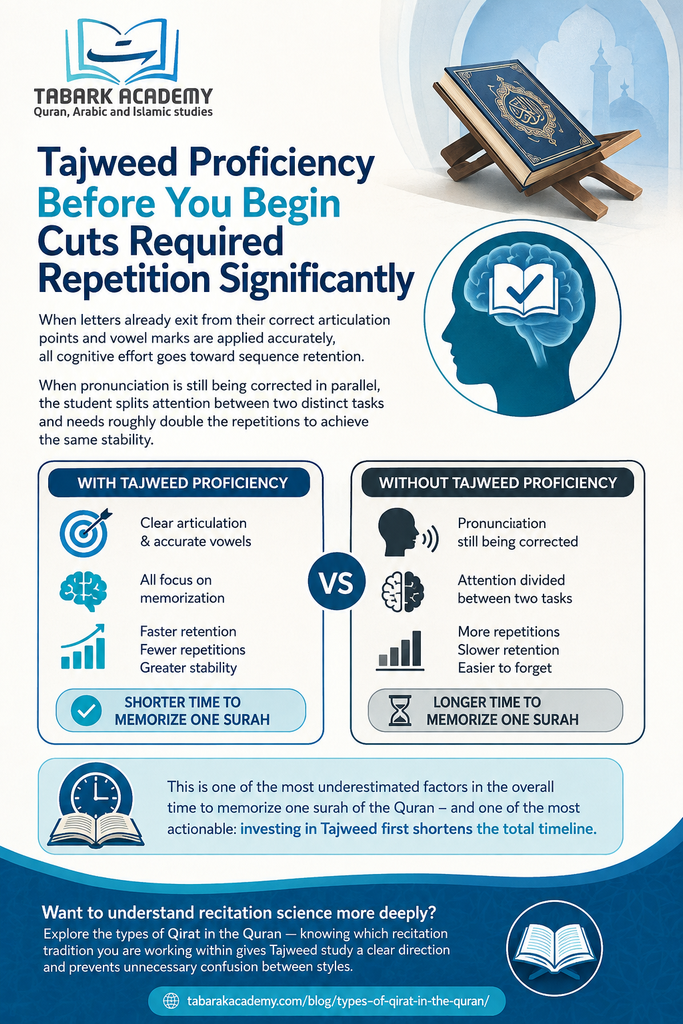
When letters already exit from their correct articulation points and vowel marks are applied accurately, all cognitive effort goes toward sequence retention.
When pronunciation is still being corrected in parallel, the student splits attention between two distinct tasks and needs roughly double the repetitions to achieve the same stability.
This is one of the most underestimated factors in the overall time to memorize one surah of the Quran — and one of the most actionable: investing in Tajweed first shortens the total timeline.
Students who want to understand recitation science more deeply will find it valuable to explore the types of Qirat in the Quran — knowing which recitation tradition you are working within gives Tajweed study a clear direction and prevents unnecessary confusion between styles.
Experience Our Interactive Learning
Curious about how we teach? Watch these brief video clips from our recent live sessions to see our structured curriculum, advanced learning platform, and dynamic student-teacher interactions firsthand.
3. Daily Commitment Determines Memorization Time
Twenty consistent minutes per day outperforms 90 minutes on weekends — every time. This is not a preference; it is how memory consolidation works. The brain encodes new material during waking hours and consolidates it during sleep, which means daily sessions create daily consolidation cycles.
A student with 20 minutes every morning creates seven consolidation events per week. A student who studies only on weekends creates one or two.
The timeline difference is substantial, and it explains why consistency is the single most important variable when asking how long does it take to memorize one surah of Quran on a full schedule.
Join our Uloom al Quran Course with a Free Trial

4. Short Daily Sessions Improve Memorization
This is one of the points on which experienced Hifz teachers across traditions agree without exception.
A student asking how long does it take to memorize one surah of the Quran while planning weekend-only sessions will take longer than one with a 15-minute daily habit — not slightly longer, but substantially so.
Seven nightly consolidation cycles per week versus one or two is not a marginal difference. Daily means daily: skipping three or four consecutive days resets recent encoding far more than most students realize until they experience it.
Explore our Online Islamic Studies Classes with first session free

5. One Reciter Strengthens Auditory Memory
Most students open the Mushaf and begin reading cold — which means they construct the audio model and the memory trace at the same time.
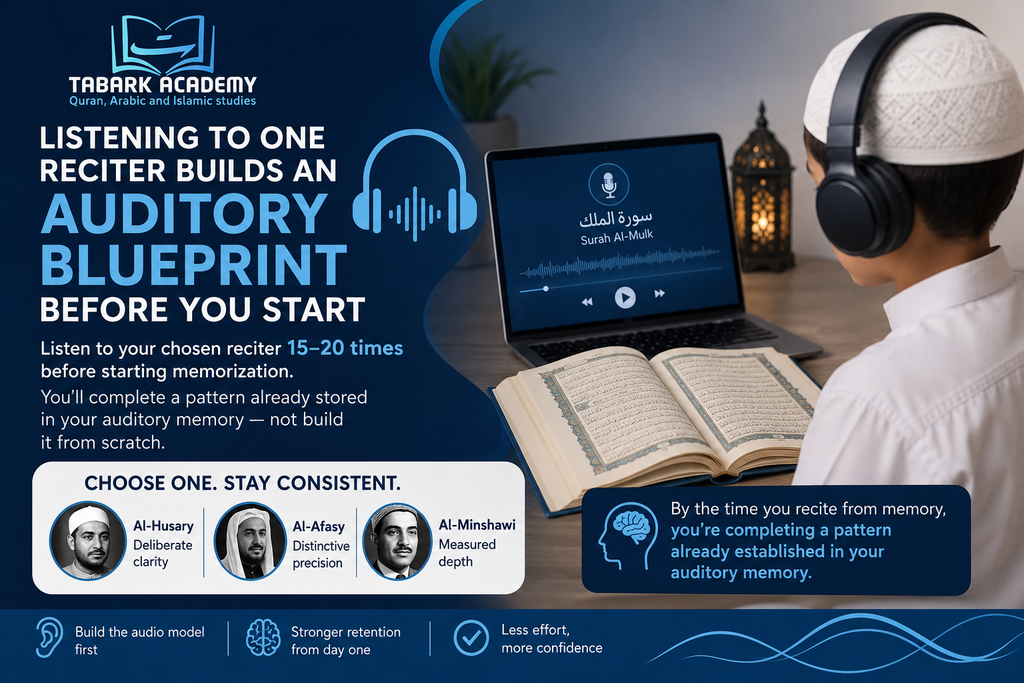
A more effective sequence: choose a single reciter and listen to your target surah fifteen to twenty times before beginning any formal memorization.
Al-Husary for deliberate clarity, Al-Afasy for distinctive precision, Al-Minshawi for measured depth — the specific choice matters less than the consistency.
By the time you sit down to recite from memory, you are completing a pattern already established in auditory memory, not building one from scratch.
6. Memorizing After Fajr Reduces Repetition
Working memory peaks in the hours immediately after waking, once sleep-dependent consolidation has finished processing the previous day’s material. Students who shift from late-evening sessions to post-Fajr consistently report needing noticeably fewer repetitions for the same retention level.
The early hours carry their own spiritual blessing — and they also carry a measurable neurological advantage that compounds across weeks and months of daily practice.

7. Arabic Vocabulary Reduces Verse Confusion
The Quran’s Arabic is structured with internal coherence: recurring root-based vocabulary, consistent sentence patterns, and thematic phrases that repeat across multiple surahs.
A student who recognizes tawbah, taqwa, rahma, sabr, and istighfar on sight processes them as meaningful units rather than arbitrary sound sequences.
This becomes critical in longer surahs, where similar verse openings and endings produce persistent sequence errors for students memorizing purely phonetically.
The importance of the Arabic language to Quran memorization is practical before it is scholarly — vocabulary recognition directly reduces cognitive load and makes mid-surah confusion measurably less frequent.
Arabic has specific structural features worth understanding in advance; the facts about the Arabic language give a grounded picture of what makes it both demanding and deeply logical as a language system.
For those ready to build this foundation alongside Hifz, choosing to learn Arabic language in parallel creates a compound benefit — each skill reinforces the other at every stage of the process.

8. Regular Review Strengthens Surah Retention
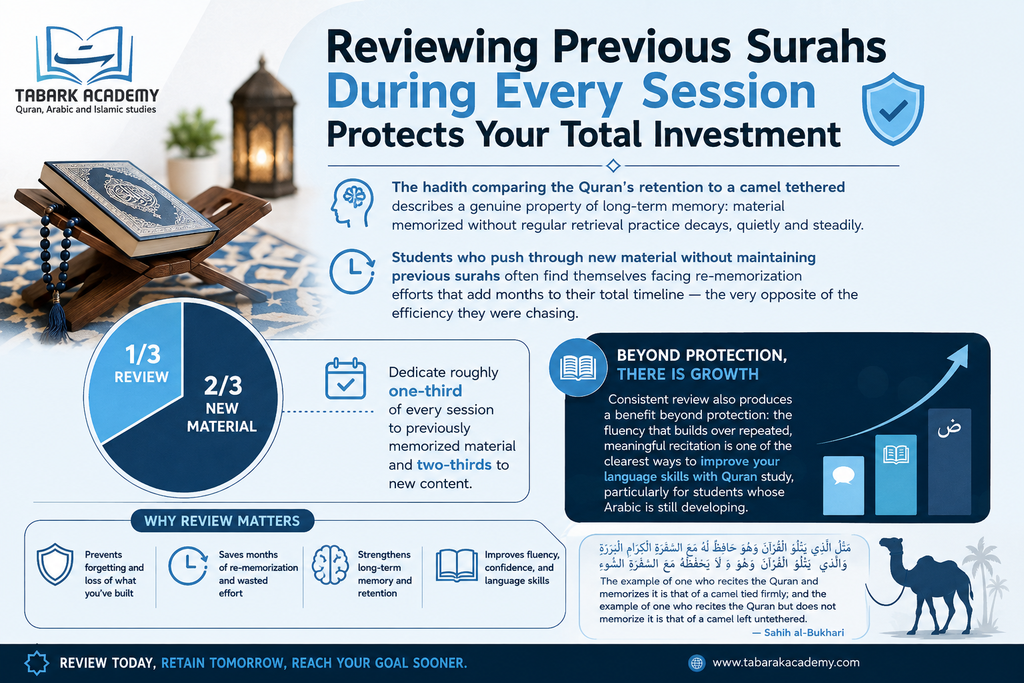
The hadith comparing the Quran’s retention to a camel tethered describes a genuine property of long-term memory: material memorized without regular retrieval practice decays, quietly and steadily.
Students who push through new material without maintaining previous surahs often find themselves facing re-memorization efforts that add months to their total timeline — the very opposite of the efficiency they were chasing.
Dedicate roughly one-third of every session to previously memorized material and two-thirds to new content.
Consistent review also produces a benefit beyond protection: the fluency that builds over repeated, meaningful recitation is one of the clearest ways to improve your language skills with Quran study, particularly for students whose Arabic is still developing.
9. A Qualified Teacher Prevents Memorization Errors
Repetition is the engine of Hifz — and it is equally effective at cementing mistakes.
A mispronounced letter or incorrect vowel mark repeated hundreds of times becomes the memorized version. Self-correction is nearly impossible once an error is that deeply encoded, because the incorrect version sounds right.
A tutor who carries the Quran with a verified chain of transmission catches these errors in the first week, before the critical window closes.
For students whose goal extends beyond completion to formal certification, learning how to get ijazah maps out exactly what the path from verified memorization to official recognition looks like.

10. Writing Verses Strengthens Memorization
Most memorization practice engages two channels: auditory (listening and reciting) and visual (reading the Mushaf).
Handwriting each verse three to five times after completing vocal repetition engages motor memory — a distinct neural pathway operating through a separate mechanism.
Students who add this step consistently demonstrate stronger recall in subsequent sessions. The additional minutes per session are modest, but the retention benefit across a complete surah accumulates significantly.
Tabarak Academy‘s Online Quran Memorization Course incorporates all ten of these factors within a structured, certified curriculum. Students work with instructors who carry their own Quran with a verified chain of transmission — which means every correction a student receives is itself rooted in unbroken scholarly tradition.
Book a Free One Trial Session in Our Juz 30 Memorization Course Now

How Long Does It Take to Memorise One Surah of the Quran?
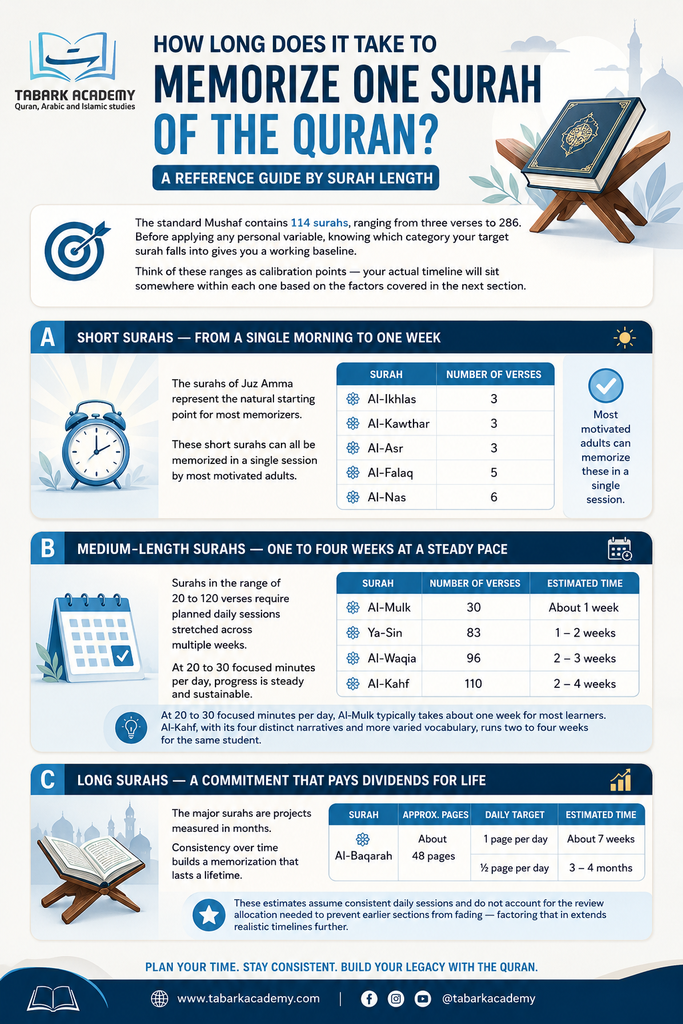
The standard Mushaf contains 114 surahs, ranging from three verses to 286. Before applying any personal variable, knowing which category your target surah falls into gives you a working baseline.
Think of these ranges as calibration points — your actual timeline will sit somewhere within each one based on the factors covered in the next section.
Read also: The Best Method To Memorize Quran
A. Short Surahs — From a Single Morning to One Week
The surahs of Juz Amma represent the natural starting point for most memorizers. Al-Ikhlas (3 verses), Al-Kawthar (3 verses), Al-Asr (3 verses), Al-Falaq (5 verses), and Al-Nas (6 verses) can all be memorized in a single session by most motivated adults.
Al-Ikhlas typically takes 15 to 25 minutes of focused repetition. Consolidating it for reliable, prayer-quality recall across multiple days requires three to five short review sessions. Not every short surah is equally straightforward.
Al-Kafirun has a repeated phrasing structure that causes sequence errors for beginners. Al-Fil and Al-Humazah introduce vocabulary that non-native Arabic speakers find less familiar.
For most Juz Amma surahs, expect one to seven days, the shorter the verse count and the more recognizable the vocabulary, the faster the completion.
B. Medium-Length Surahs — One to Four Weeks at a Steady Pace
Surahs in the range of 20 to 120 verses — Al-Mulk (30 verses), Ya-Sin (83 verses), Al-Waqia (96 verses), Al-Kahf (110 verses) — require planned daily sessions stretched across multiple weeks.
At 20 to 30 focused minutes per day, Al-Mulk typically takes about one week for most learners. Al-Kahf, with its four distinct narratives and more varied vocabulary, runs two to four weeks for the same student.
This is the category where memorization method becomes critical. Short surahs can be completed on motivation alone; medium surahs reveal whether your system actually works.
Students who build their method here find longer surahs significantly more manageable — the habits are already running.
Read also: Can I become Hafiz by myself?
C. Long Surahs — A Commitment That Pays Dividends for Life
The major surahs are projects measured in months. Al-Baqarah spans roughly 48 pages of the standard Uthmani Mushaf; at one page per day, completion arrives in approximately seven weeks. At half a page per day, the timeline extends to three to four months.
These estimates assume consistent daily sessions and do not account for the review allocation needed to prevent earlier sections from fading — factoring that in extends realistic timelines further.
Many students pursue Al-Baqarah specifically for its spiritual protection. The chapter most widely cited as a guard against black magic and harmful forces also demands the most consistent daily engagement — and that intentionality, sustained over months, tends to produce some of the most methodical memorizers.
Book a free trial class and experience Noorani Qaida with Tajweed course

Daily System That Converts Repetition Into Permanent Retention
Knowing the ten factors tells you what to optimize. This section gives you the daily sequence that applies all of them within a single session.
It can be completed in 20 to 45 minutes depending on the day’s portion, and it is designed around one governing principle: memorize once and keep it, rather than memorizing repeatedly because earlier sessions did not hold.
1. Start Every Session By Testing Yesterday
Before reading a single word, recite the previous session’s material entirely from memory. This is a retrieval test, not a warm-up reading — and it is the highest-value step in the entire method. If the material comes out clean, proceed to new content.
If it does not, that session is dedicated to consolidating what is already started; no new verses are added until the previous material is solid. This single rule prevents the slow accumulation of fragile memorization that eventually makes progress feel like running in place.
Read also: How to Teach a 5 Year Old to Memorize Quran?
2. Build New Material With The Listen-Read-Cover-Stack Sequence
Play the day’s target portion through your chosen reciter three to five times before touching the Mushaf. Then read verse one aloud twice. Cover the page. Recite from memory. If an error occurs, identify the exact word or vowel mark where it happened, correct it, and repeat until that verse is clean before moving forward.
After completing verse two the same way, recite verses one and two together from memory. After verse three, recite all three. This stacking continues through the day’s portion until the entire segment flows as a connected sequence — not as isolated verses that happen to follow each other.
The stack is what prevents the most common failure mode in medium and long surahs: knowing each verse individually but losing the thread between them.
Enroll in the Quran Recitation Course Today

3. Close With A Full Passage Recitation From Memory
Complete every session by reciting everything from the beginning of the current memorization project — not just the day’s new addition. One clean full-passage recitation at the end consolidates all partial work done during the session, builds the continuity that prayer recitation demands, and surfaces any weak links that developed during study.
It also gives you an accurate read on where the memorization actually stands, rather than where you hope it stands. For non-native Arabic speakers particularly, it pays to go in with honest expectations about the language. Arabic presents specific structural challenges that are worth understanding before they surface unexpectedly mid-surah.
Knowing 3 reasons why Arabic is difficult in advance helps set a realistic timeline and a method calibrated for the actual demands of the language — rather than one calibrated for a language that Arabic is not.
Step Inside Our Virtual Classrooms
See our engaging teaching methods in action! watch real snippets of our live classes and discover how our expert instructors make learning interactive, memorable, and inspiring for every student.
Begin Your Hifz Journey With Tabarak Academy
Tabarak Academy has supported thousands of students — children and adults, native Arabic speakers and complete beginners — in memorizing the Quran with accuracy, proper Tajweed, and lasting retention.
Every instructor holds their own Quran with a certified chain of transmission, which means the standard of recitation you learn is anchored in unbroken scholarly tradition, not personal interpretation.
Students at Tabarak consistently report that the results go further than completed surahs. The discipline, focus, and patience built through structured Hifz carry into every area of daily life. The Quran speaks directly to important reasons why morals are important — and students who memorize with understanding carry that guidance with them beyond the study session, in every conversation and decision they make.
Our Courses at Tabarak Academy
Whether your goal is a single surah memorized properly or the complete Quran, the structure, accountability, and certified instruction at Tabarak Academy make the difference between a project that stalls and one that finishes. Here’s what we offer:
Our Quran Memorization / Hifz Courses
- Online Hifz Program
- Juz 30 Memorization
- Hifz for Kids
- Hifz for Adults
- Hifz for Sisters
- Short Surah Memorization Course
- Hifz Ijazah Course
Enroll now and begin your Quran and Arabic journey with Tabarak Academy

Conclusion
The time to memorize one surah of the Quran is ultimately a product of two things: the surah you choose and the system you bring to it. Short surahs in Juz Amma can be solid within a week. Medium surahs like Al-Mulk and Al-Kahf respond to three to four weeks of structured daily effort.
Long surahs like Al-Baqarah require months of consistent, planned work — but those months produce a quality of retention and recitation that a rushed approach never does. Of the ten factors covered above, daily consistency and Tajweed proficiency carry the most weight before any session begins.
The step-by-step system applies to all ten within a single daily commitment. The method does not demand more time than you have; it demands that you use your existing time with more precision.
A qualified teacher who holds the Quran through a verified chain changes the outcome in ways that self-study cannot replicate.
Tabarak Academy offers exactly that, through programs designed for every stage, age, and starting point. The journey is yours; the structure, the instruction, and the accountability are waiting.
Frequently Asked Questions
How long does it take to memorize one surah of the Quran if I study 30 minutes per day?
At 30 minutes per day with focused method, most students complete a short surah like Al-Mulk (30 verses) in one week. A medium surah like Al-Kahf (110 verses) takes two to four weeks at the same daily commitment. These estimates assume consistent review of previously completed verses is built into the session.
Does age affect how long memorization takes?
Children typically encode new material faster due to memory plasticity, but adults compensate with greater focus, motivation, and the ability to understand what they are memorizing — which aids retention. Adults who use a structured method with daily consistency produce results comparable to children in structured programs.
Is it better to memorize one surah completely before starting another?
Yes, for most students. Switching between surahs before one is fully stable fragments the memory traces for both.
Complete each surah to the point of clean, unaided recitation — tested over at least three consecutive days — before beginning a new one.
How many repetitions does it take to memorize one verse of the Quran?
This varies by surah complexity, prior Arabic familiarity, and time of day. Most students require 20 to 40 repetitions per verse to achieve stable memorization in the first pass.
Post-Fajr sessions and strong Tajweed preparation can bring that number noticeably lower.
How do I stop forgetting what I have already memorized?
Daily review is the only reliable answer. Allocate one-third of every session to previously memorized material and use retrieval testing — recite from memory without the Mushaf — rather than passive re-reading.
Reciting memorized surahs in daily prayers is also one of the most effective review mechanisms available, because it integrates retrieval practice into an existing daily habit.