

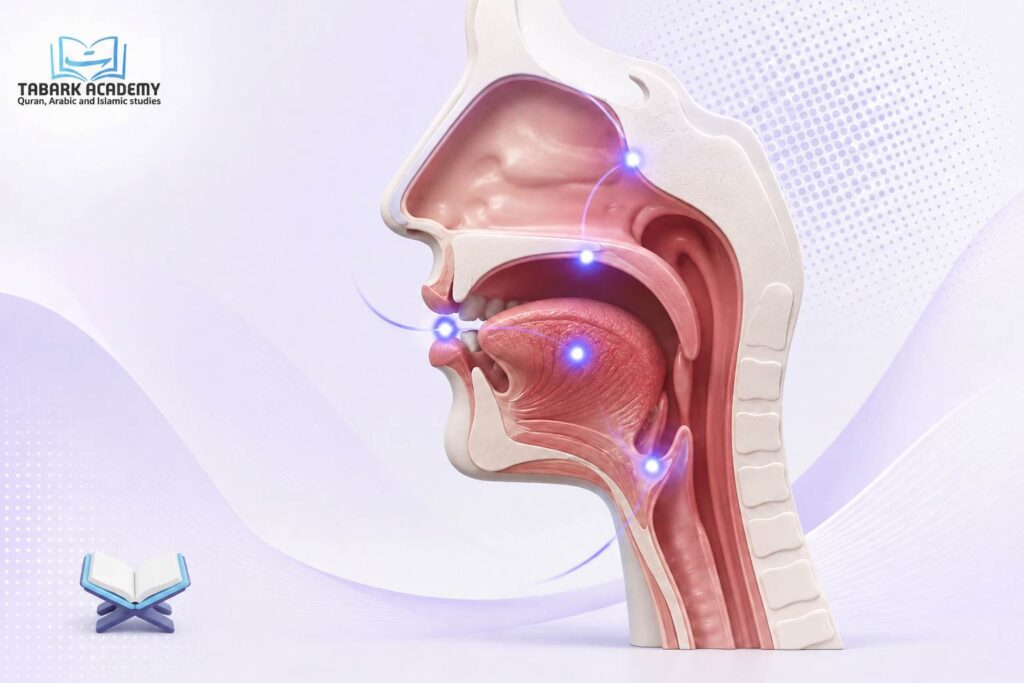
What Are the Makharij of the Arabic Letters? A Complete Guide
Have you ever mixed up the sound of ص and س while reciting Quran, only to realize later that these two letters come from completely different places in the mouth?
This is one of the most common struggles for non-Arabic-speaking Quran learners, and the answer lies in understanding the makharij of the arabic letters the precise articulation points from which every Arabic letter is produced.
In this guide, you will learn exactly what makharij of arabic letters means, how many articulation points scholars have identified, and how each Arabic letter is formed.
By the end, you will have the makharij of the arabic letters explained in a clear, practical way you can apply directly to your Quran recitation.
Whether you are just starting your Tajweed journey or trying to refine sounds you have practiced for years, mastering makharij is the foundation that every other Tajweed rule is built on.
What You Will Learn
- The exact definition of makharij and why it matters for correct Quran recitation
- The five main articulation points: Al-Jawf, Al-Halq, Al-Lisan, Ash-Shafatan, and Al-Khaishum
- How the seventeen detailed makharij are distributed across these five regions
- A simple method to identify the makhraj of any Arabic letter yourself
- Where to get personalized feedback so your pronunciation is corrected properly
What Are the Makharij of the Arabic Letters?
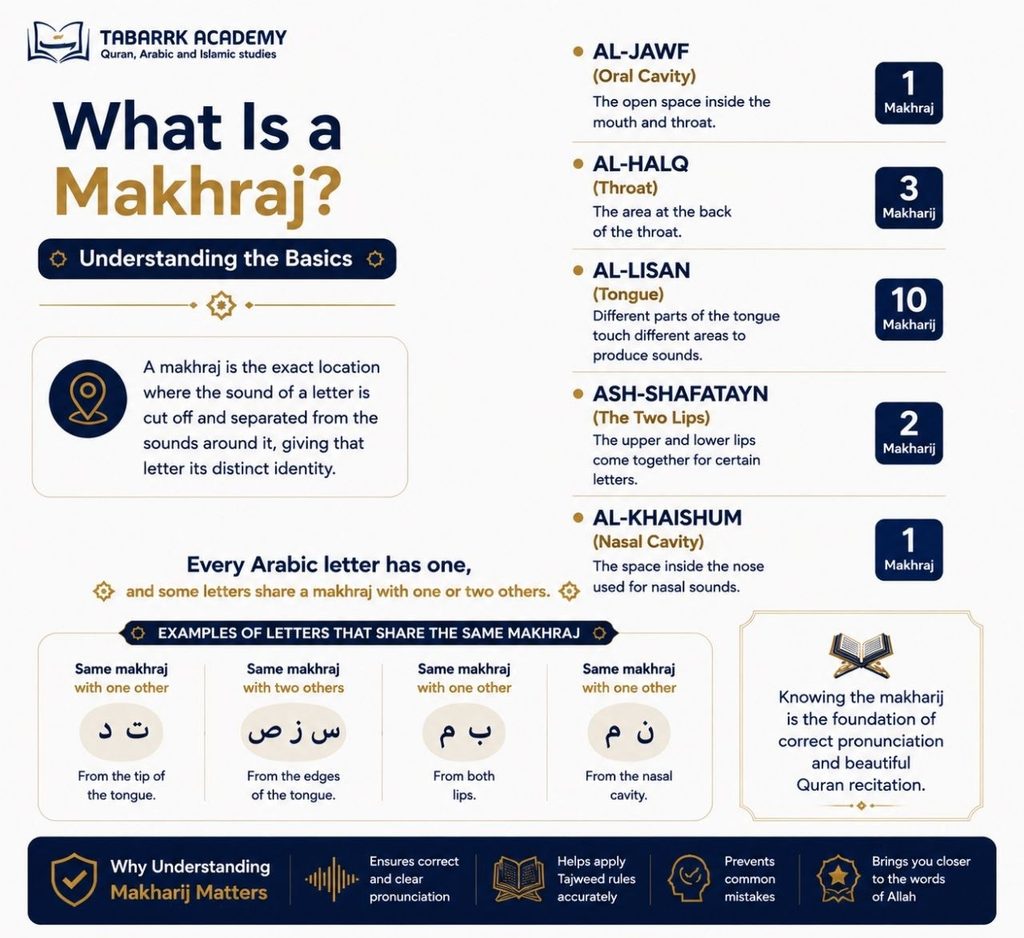
Makharij (مخارج), the plural of makhraj, is the specific point in the mouth, throat, or nasal cavity where the sound of an Arabic letter originates and is cut off.
Each of the twenty-nine Arabic letters has its own designated articulation point, which is what allows a trained reciter to distinguish between letters that sound similar to an untrained ear, such as ح and هـ, or ذ and ز.
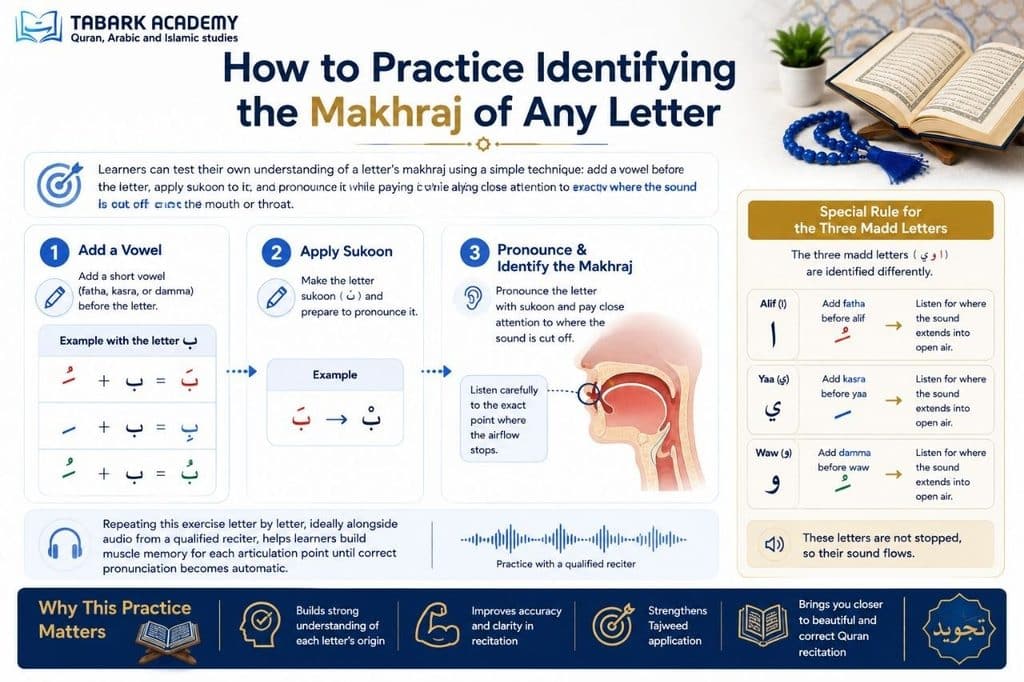
Tajweed scholars identify the makhraj of a letter by adding a vowel before it, applying sukoon (stillness) to the letter, and listening carefully for the exact point where the sound stops.
This method has been used for centuries to classify Arabic letters with precision.
Most classical scholars, including Imam Ibn al-Jazari, hold that there are seventeen detailed makharij, grouped under five general regions of the mouth, throat, and nasal cavity.
This five-part classification is the framework taught most widely in Quran recitation today.
Experience Our Interactive Learning
Curious about how we teach? Watch these brief video clips from our recent live sessions to see our structured curriculum, advanced learning platform, and dynamic student-teacher interactions firsthand.
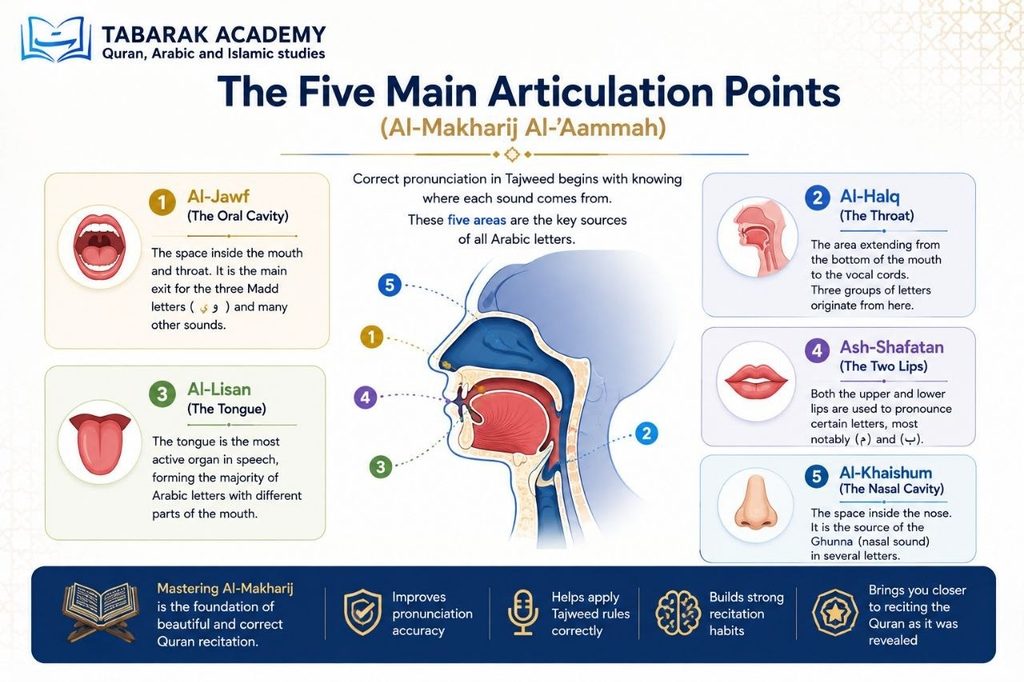
The Five Main Articulation Points (Al-Makharij Al-‘Aammah)
Before looking at the seventeen individual points, it helps to understand the five broad regions from which all Arabic letters emerge. Each region contains one or more specific makharij, and together they account for all twenty-nine letters of the Arabic alphabet.
1. Al-Jawf (The Oral Cavity)
Al-Jawf is the empty space extending from the throat through the mouth, and it produces the three long vowel letters: alif (ا) preceded by a fatha, waw (و) preceded by a damma, and ya (ي) preceded by a kasra.
These three letters are known as huruf al-madd, the letters of elongation, because their sound extends through open air instead of stopping at a fixed point in the mouth.
A well-known example containing all three madd letters together appears in the Quran:
“This is from the news of the unseen which We reveal to you.”
Surah Hud 11:49
Reciters often memorize the word نُوحِيهَا (“nuhiha”) specifically because it contains all three madd letters in one place.
2. Al-Halq (The Throat)
Al-Halq contains three specific makharij for six letters. The far end of the throat, nearest the chest, produces hamza (ء) and ha (هـ); the middle of the throat produces ain (ع) and ha (ح); and the part of the throat closest to the mouth produces ghain (غ) and kha (خ).
Because these six letters are among the most challenging for non-native Arabic speakers, throat-based sounds like ع and ح require deliberate, repeated practice to separate them from letters produced elsewhere in the mouth.
3. Al-Lisan (The Tongue)
The tongue is responsible for ten separate makharij, producing eighteen letters in total more than any other region. These points range from the back of the tongue (qaf ق and kaf ك), through the middle of the tongue (jeem ج, sheen ش, and non-elongated ya ي), to the edges and tip of the tongue.
The tip of the tongue alone accounts for several makharij, producing letters such as noon (ن), ra (ر), the group ta-dal-taa (ط د ت), seen-saad-zay (س ص ز), and tha-dhal-dhaa (ث ذ ظ). A small shift in tongue placement can change one letter into another, which is why precision here is essential.
4. Ash-Shafatan (The Two Lips)
The lips produce four letters through two makharij. The inner part of the lower lip, meeting the edges of the upper front teeth, produces fa (ف). The two lips coming together produce ba (ب) and meem (م), while the two lips parting slightly produce the non-elongated waw (و).
5. Al-Khaishum (The Nasal Cavity)
Al-Khaishum, the innermost part of the nasal passage, does not produce a full letter on its own. Instead, it is responsible for ghunnah, the nasal sound that accompanies noon (ن) and meem (م) in specific Tajweed rules such as idgham and ikhfa.
An example of strong ghunnah appears in the Quran:
“And when we heard the guidance, we believed in it.”
Surah Al-Jinn 72:13
Here, the doubled noon and meem are held with a clear nasal sound for the count of two harakahs, illustrating ghunnah in its strongest form.
Learning to hear and produce ghunnah correctly is difficult from books or videos alone, which is why students studying with a live Tajweed teacher at platforms such as Tabarak Academy often progress faster a qualified instructor can hear your ghunnah in real time and correct it instantly.
Read also: How to Say Dhad (ض) Correctly in Arabic Recitation

The Seventeen Detailed Makharij at a Glance
For quick reference, here are all seventeen detailed makharij grouped under their five main regions, along with the Arabic letters produced at each point.
| # | Region / Point of Articulation (Makhraj) | Letters Produced | Arabic |
| 1 | Al-Jawf (oral cavity) | Alif, Waw, Ya (madd letters) | ا و ي |
| 2 | Al-Halq, far throat | Hamza, Ha | ء هـ |
| 3 | Al-Halq, middle throat | Ain, Ha | ع ح |
| 4 | Al-Halq, near throat | Ghain, Kha | غ خ |
| 5 | Al-Lisan, back of tongue | Qaf | ق |
| 6 | Al-Lisan, back of tongue (lower) | Kaf | ك |
| 7 | Al-Lisan, middle of tongue | Jeem, Sheen, Ya (non-madd) | ج ش ي |
| 8 | Al-Lisan, side of tongue | Dhad | ض |
| 9 | Al-Lisan, edge of tongue | Lam | ل |
| 10 | Al-Lisan, tip of tongue | Noon | ن |
| 11 | Al-Lisan, tip of tongue | Ra | ر |
| 12 | Al-Lisan, tip of tongue / teeth | Ta, Dal, Taa | ط د ت |
| 13 | Al-Lisan, tip of tongue / teeth | Seen, Saad, Zay | س ص ز |
| 14 | Al-Lisan, tip of tongue / teeth | Thaa, Dhal, Zhaa | ث ذ ظ |
| 15 | Ash-Shafatan, lower lip / teeth | Fa | ف |
| 16 | Ash-Shafatan, both lips | Ba, Meem, Waw (non-madd) | ب م و |
| 17 | Al-Khaishum (nasal cavity) | Ghunnah, with Noon and Meem | ن م |
Read more about: The 17 Articulation Points of Arabic Letters: Complete Guide & Chart
Why Learning the Makharij of Arabic Letters Matters
Correct makharij is not a cosmetic detail mispronouncing a letter’s articulation point can change the meaning of a word in Quranic Arabic entirely. Confusing ذ with ز, or ض with د, is a real example of how a shift in makhraj changes the word itself, which is why Tajweed scholars treat makharij as foundational rather than optional.
Beyond accuracy, correct makharij also affects how naturally and confidently a person recites. Reciters who have internalized the articulation points spend less mental effort on pronunciation and more attention on meaning, reflection, and tarteel (measured, unhurried recitation).
This is precisely the skill that structured, one-on-one Quran classes are designed to build. At Tabarak Academy, certified Tajweed teachers guide learners of all ages through the makharij step by step, correcting pronunciation in real time rather than leaving students to guess from written descriptions alone.

How to Practice Identifying the Makhraj of Any Arabic Letter
Knowing the location of a Makhraj on a diagram is only the first step. You should also learn how to find that articulation point physically while pronouncing the letter. A traditional practice method is to make the target letter Sakin and place a vowelled Hamzah before it, then notice where the sound ends.
1. Make the Letter Sakin to Expose Its Articulation Point
Choose the letter you want to test, give it a Sukoon (ْ), and place a vowelled Hamzah before it.
For example:
أَبْ — أَتْ — أَجْ — أَحْ — أَعْ — أَقْ
Pronounce each combination slowly.
The point where the sound is interrupted or completed helps reveal the letter’s Makhraj. For example, when you pronounce أَقْ, you should feel Qaf forming at the back of the tongue, while أَحْ directs your attention toward the throat.
Read also: How to Pronounce the Arabic Letter Ain (ع): Tajweed Guide
2. Pay Attention to Which Speech Organs Create the Sound
Do not listen only to the sound. Pay attention to what your mouth, tongue, throat, or lips are physically doing. Ask yourself:
- Does the tongue touch the teeth or gums?
- Is the back or middle of the tongue rising?
- Are the lips closing or rounding?
- Does the sound originate from the throat?
- Can you feel nasal resonance?
This connects the theoretical Makharij chart with the physical movement required to produce each letter.
3. Test the Three Madd Letters Differently
The three Madd letters require a different approach because they do not have the same type of fixed contact point as most consonants. Practice them with the vowel that corresponds to each Madd letter:
ـَا — ـُو — ـِي
For Alif Madd, the preceding letter carries a Fathah. For Waw Madd, it carries a Dammah. For Ya Madd, it carries a Kasrah.
Listen to how the elongated sound continues through Al-Jawf, the open oral-throat cavity, rather than ending at a fixed tongue, tooth, or lip contact point.
4. Compare Letters With Neighboring Makharij
Once you can identify individual articulation points, compare letters produced from nearby areas. Useful comparisons include:
ق / ك — two neighboring back-of-the-tongue Makharij
ع / ح — the middle throat
غ / خ — the upper throat
ت / ط — similar tongue position but different Sifaat
س / ص — similar articulation area with a clear difference in heaviness
Pronounce each pair slowly before placing the letters inside Quranic words. This exercise trains you to recognize not only where a letter is produced, but also how nearby Arabic sounds remain distinct.
Read also: How Many Total Makharij Are Recognized in Tajweed?
5. Move From Isolated Letters to Quranic Words
After identifying the Makhraj in isolation, test whether you can preserve it inside actual words.
For example:
قْ → أَقْ → قُلْ → قُلْ هُوَ اللَّهُ أَحَدٌ
The Makhraj should remain stable as your recitation becomes more continuous. If you can pronounce a letter correctly by itself but lose its articulation inside an Ayah, the Makhraj has not yet become automatic.
6. Confirm Your Makhraj With a Qualified Reciter or Tajweed Teacher
Repeat the exercise while listening to a qualified Quran reciter, but do not depend on audio comparison alone.
You may hear that your pronunciation sounds different without being able to identify whether the problem comes from the Makhraj, Sifaat, vowel, or another Tajweed rule.
A qualified teacher can identify the source of the error and show you the physical adjustment needed to correct it.
With repeated practice, the goal is to move from consciously thinking about every tongue or throat position to producing each letter from its correct Makhraj naturally during Quran recitation.
Step Inside Our Virtual Classrooms
See our engaging teaching methods in action! watch real snippets of our live classes and discover how our expert instructors make learning interactive, memorable, and inspiring for every student.
Get Personalized Tajweed Feedback with Tabarak Academy
Reading about makharij is a helpful first step, but correcting your own pronunciation without feedback is nearly impossible most mistakes are inaudible to the person making them.
Tabarak Academy connects Quran learners worldwide with certified Tajweed teachers who listen to your recitation live, pinpoint exactly which makhraj needs adjustment, and guide you letter by letter until your pronunciation is accurate.

Our Tajweed Courses
- Online Tajweed Classes
- Tajweed Course for Beginners
- Tajweed Course for Kids
- Tajweed Course for Adults
- Tajweed Course for Sisters
- Advanced Tajweed Course
- Amali (Practical) Tajweed Course
- Learn Quran with Tajweed
- Learn Quran with Tajweed for Kids
- Learn Quran with Tajweed for Sisters

Conclusion
Understanding the makharij of the arabic letters is the starting point for accurate, confident Quran recitation. As covered in this guide, the seventeen detailed articulation points are organized under five main regions Al-Jawf, Al-Halq, Al-Lisan, Ash-Shafatan, and Al-Khaishum and each letter has its own precise place of origin.
The key takeaway is simple: correct makharij protects the meaning of the Quranic text and builds the foundation that every other Tajweed rule depends on.
With consistent practice and guidance from a qualified teacher, any learner regardless of native language can master these articulation points and recite with clarity and confidence.
Frequently Asked Questions
What does makharij mean in Tajweed?
Makharij means the specific points in the mouth, throat, or nasal cavity where the sound of an Arabic letter originates and is cut off.
Each of the twenty-nine Arabic letters has its own designated makhraj, and identifying them correctly is essential for accurate Quran recitation.
How many makharij are there for Arabic letters?
There are seventeen detailed makharij according to the view held by the majority of Tajweed scholars, including Imam Ibn al-Jazari. These seventeen points are grouped under five general regions: the oral cavity, the throat, the tongue, the lips, and the nasal cavity.
What is the difference between makharij and sifaat?
Makharij refers to where a letter is produced, while sifaat (characteristics) refers to how a letter sounds qualities such as heaviness (tafkheem), lightness (tarqeeq), or whisperedness (hams). Makharij and sifaat work together to define the correct pronunciation of each letter.
Can I learn makharij without a teacher?
Self-study with books and audio can introduce the concept of makharij, but most learners cannot hear their own pronunciation mistakes without external feedback.
A qualified Tajweed teacher, such as those at Tabarak Academy, can identify errors in real time that a learner would otherwise never notice.
Which Arabic letters are hardest to pronounce correctly?
Letters that share a similar makhraj are usually hardest to distinguish, including ض and ظ, ذ and ز, and ح and هـ. These letter pairs require focused practice and direct feedback to master, since the difference in articulation is often subtle to an untrained ear.