

How To Memorize The Quran In 1 Year – A Realistic Daily Plan
Most people who begin Hifz do not stop because the Quran is difficult. They stop because nobody gave them a number to hit each day.
If you have been wondering how to memorize the Quran in 1 year, the answer starts with simple arithmetic. The Mushaf contains 604 pages. Memorize two pages a day, six days a week, and you finish in roughly 50 weeks with two weeks left over for final review.
That single calculation turns a lifetime dream into a calendar you can actually follow. What decides the outcome is not talent or age, but whether you protect the same half-hour block every morning for twelve months.
In this guide, you will find the daily quota, the exact repetition method used by teachers at the Prophet’s Mosque, four weekly schedules built for real life, and the revision system that keeps Juz 1 alive while you memorize Juz 30.

1. Understand the Meaning Before Memorizing Each Page
Spend three minutes on a translation of today’s two pages before you memorize a single word. Knowing that a passage describes Musa’s confrontation with Pharaoh gives your memory a storyline to hang the wording on.
Recalling a message is far easier than recalling isolated sounds. Tafsir does something a translation alone cannot. It tells you why an ayah was revealed, who was being addressed, and what came immediately before it. That context explains why one verse follows another, and sequence is exactly what your memory struggles with most.
Keep this step short and practical. A concise tafsir such as Al-Sa’di or Ibn Kathir’s summary is enough; read it once before you begin. You are not studying for a lesson here; you are giving your mind a map of the page so the ayat arrive in the right order.
You can also mark the main ideas of the passage mentally before beginning repetition. These meaning-based connections can help you remember the order of verses when you attempt to recite the page without looking.
2. Memorize Two Pages a Day, Six Days a Week
Two pages equal one full leaf of the Mushaf, or about 15 lines per sitting if you split it. Six memorization days plus one revision day produces 12 pages weekly and around 48 pages monthly.
That pace clears 604 pages in about 50 weeks and leaves buffer time for illness, travel, and Ramadan. Resist the urge to memorize four pages on a good day. Excess volume today becomes revision debt next month, and revision debt is what collapses one-year plans.
The seventh day carries more weight than people expect. It is not a day off but a consolidation day where you recite all twelve pages of the week from memory, which is what turns a week of separate lessons into one solid block.
The key is to protect consistency rather than chase speed. Completing a manageable amount every week gives your memory time to absorb the Quran while keeping the one-year target within reach.
3. Use the Same Mushaf Throughout Your One-Year Plan
Your brain stores Hifz partly as a visual map. You remember that an ayah sat in the upper-left corner, three lines below a page break.
Switching between a 15-line Madinah Mushaf, a phone app, and a borrowed copy erases that map. Pick one printed Mushaf in week one and keep it until your final review.
The 15-line Madinah print is the usual choice for a reason. Every page begins and ends with a complete ayah, which makes page boundaries clean and gives your memory a natural stopping point at the end of each daily lesson.
Treat that copy as part of your equipment. Mark your weak spots lightly in pencil, keep it in the same bag, and carry it when you travel. A Mushaf you have handled for months becomes familiar in a way no replacement can match.
4. Set a Fixed Daily Time for New Memorization
The most reliable window is straight after Fajr, when the mind is quiet and the day has not yet made demands on you.
Place new memorization at Fajr and revision after Asr or Maghrib. Within a few weeks, your concentration begins arriving on schedule by itself.
Protect the slot the way you would protect a class you paid for. Phone on silent, door closed, no messages answered until the page is done. Most failed Hifz attempts are not lost to a lack of time but to interruptions during the time already set aside.
If Fajr is genuinely impossible, choose any hour you can defend every single day and keep it fixed. A consistent evening slot beats an inconsistent morning one, because the habit itself is doing most of the work.
5. Recite Your Daily Pages to a Qualified Teacher
Memorizing an ayah with a Tajweed error means memorizing the error alongside it, and errors set into memory are far harder to remove than to prevent.
This is the reason structured online Tajweed classes sit at the foundation of every serious Hifz plan. A certified tutor hears your two pages, corrects the makharij, and confirms the page is locked before you move on.
A teacher also carries the part of the work you cannot do alone. You cannot hear your own mistakes, and you cannot judge whether a page is truly stable or simply fresh enough to recall for another hour.
Daily recitation adds accountability that willpower does not supply. Knowing that someone will hear your two pages at a set time turns a personal goal into a commitment, and that single detail keeps most students on schedule through months four to eight, when motivation dips.
Read also: 2-Year Quran Memorization Plan: Step-by-Step Guide
The Best Way to Memorize the Quran in 1 Year: Step-by-Step Method
Knowing your quota is half the work. This is the repetition sequence that turns two pages into stable memory, adapted from the well-known method of Sheikh Abdul Mohsin Al-Qasim, Imam of the Prophet’s Mosque in Madinah.
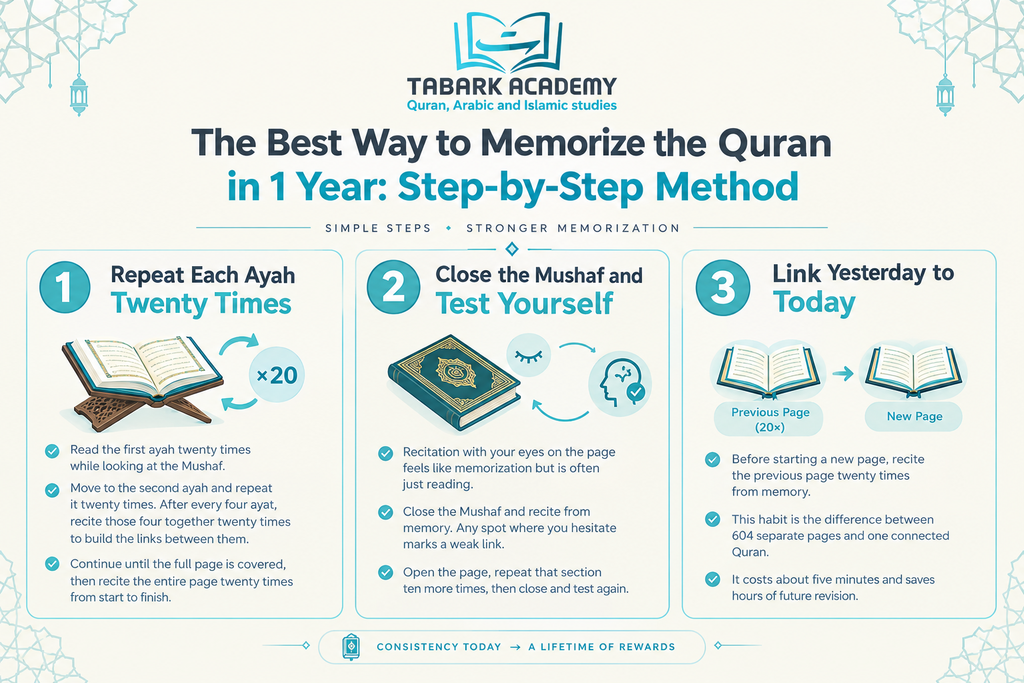
Step 1: Repeat Each Ayah Twenty Times
Read the first ayah twenty times while looking at the Mushaf. Move to the second ayah and repeat it twenty times. After every four ayat, recite those four together twenty times to build the links between them.
Continue until the full page is covered, then recite the entire page twenty times from start to finish.
Step 2: Close the Mushaf and Test Yourself
Recitation with your eyes on the page feels like memorization but is often just reading. Close the Mushaf and recite from memory. Any spot where you hesitate marks a weak link.
Open the page, repeat that section ten more times, then close and test again.
Step 3: Link Yesterday to Today
Before starting a new page, recite the previous page twenty times from memory. This habit is the difference between 604 separate pages and one connected Quran. It costs about five minutes and saves hours of future revision.
Read also: How to Hifz Quran in 6 Months: Easy Plan
How to Memorise the Quran in 1 Year Around Work, School, and Family
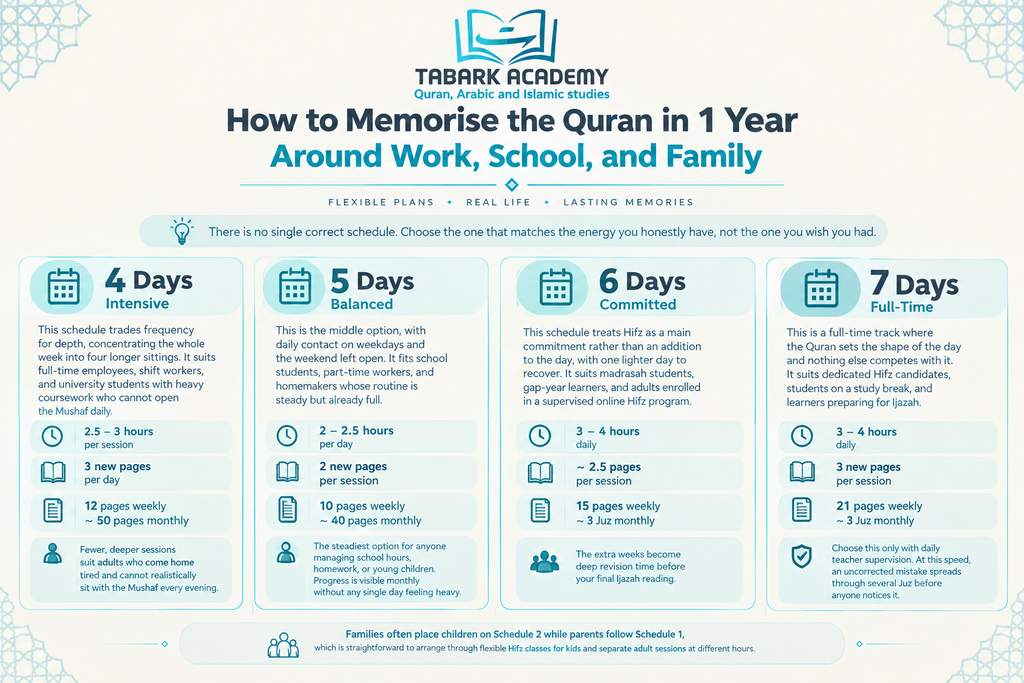
There is no single correct schedule. Choose the one that matches the energy you honestly have, not the one you wish you had.
1. Four-Day Intensive Plan for Busy Workers and Students
This schedule trades frequency for depth, concentrating the whole week into four longer sittings. It suits full-time employees, shift workers, and university students with heavy coursework who cannot open the Mushaf daily.
Four fixed days per week, 2.5–3 hours per session, three new pages each day. That produces 12 pages weekly and about 50 pages monthly.
Fewer, deeper sessions suit adults who come home tired and cannot realistically sit with the Mushaf every evening.
Read also: Memorize the Quran in 3 Years: A Practical Plan
2. Five-Day Balanced Plan for Steady Weekly Routines
This is the middle option, with daily contact on weekdays and the weekend left open. It fits school students, part-time workers, and homemakers whose routine is steady but already full.
Five days per week, 2–2.5 hours daily, two new pages per session, with one lighter day for review.
This is the steadiest option for anyone managing school hours, homework, or young children. Progress is visible monthly without any single day feeling heavy.
Experience Our Interactive Learning
Curious about how we teach? Watch these brief video clips from our recent live sessions to see our structured curriculum, advanced learning platform, and dynamic student-teacher interactions firsthand.
3. Six-Day Hifz Plan for Serious, Supervised Study
This schedule treats Hifz as a main commitment rather than an addition to the day, with one lighter day to recover. It suits madrasah students, gap-year learners, and adults enrolled in a supervised online Hifz program.
Six days per week, 2–3 hours daily, roughly 2.5 pages per session. Weekly output reaches 15 pages and monthly output around 3 Juz, completing the Quran in 10 to 11 months. The extra weeks become deep revision time before your final Ijazah reading.
Read also: How Long Does It Take to Memorize Surah Al-Kahf?
4. Seven-Day Full-Time Plan for Dedicated Hifz Students
This is a full-time track where the Quran sets the shape of the day and nothing else competes with it. It suits dedicated Hifz candidates, students on a study break, and learners preparing for Ijazah.
Seven days per week, 3–4 hours daily, three pages per session, finishing in 9 to 10 months. Choose this only with daily teacher supervision. At this speed, an uncorrected mistake spreads through several Juz before anyone notices it.
Families often place children on Schedule 2 while parents follow Schedule 1, which is straightforward to arrange through flexible Hifz classes for kids and separate adult sessions at different hours.
Memorize the Quran in 1 Year: 5 Tips That Prevent Forgetting
Memorizing is the easy half. Retaining 604 pages while adding two more every day is the real skill, and it rests on a few disciplined habits.
1. Apply the Three-Layer Revision Rule
Every session should contain three layers: today’s new page, yesterday’s page, and one older portion on rotation.
Aim for eight faces of older revisions daily alongside new memorization. This rotation keeps early Juz alive instead of burying them under newer material.
2. Pause After Every Ten Juz
When you complete 10 Juz, stop new memorization for one month and revise only, half a Juz per day.
After 20 Juz, pause for two months of revision. These pauses feel like delays but are precisely what makes the final Hifz stable rather than fragile.
Read also: How to Hifz the Quran in 5 Years Easily
3. Keep an Ayah Mistake Log
Write down only the ayat you slip on repeatedly, especially mutashabihat, the near-identical verses that appear in more than one surah.
For each pair, open both pages side by side, identify the single word that differs, and create a personal rule to distinguish them. Reviewing this short list beats rereading whole pages.
4. Use Low-Energy Days for Revision Only
Forcing new pages on an exhausted mind produces memorization that disappears within a week.
On heavy days, switch to revision-only. Over twelve months, this flexibility prevents the burnout that ends most Hifz attempts around month four.
5. Recite Your New Pages in Sunnah Prayers
Reading today’s pages during witr, nawafil, or qiyam adds several free repetitions in a state of focus. The Prophet ﷺ said, “The one who was devoted to the Qur’an will be told on the Day of Resurrection: ‘Recite and ascend (in ranks) as you used to recite when you were in the world. Your rank will be at the last Ayah you recite. [Abu Dawud and At- Tirmidhi]
“يقال لصاحب القرآن: اقرأ وارتقِ ورتل كما كنت ترتل في الدنيا، فإن منزلتك عند آخر آية تقرؤها”.
Placing your Hifz inside your worship keeps intention and memory working together. Adult learners who need a structured version of these habits usually progress faster inside a supervised Hifz program for adults, where revision is scheduled rather than left to willpower.
Step Inside Our Virtual Classrooms
See our engaging teaching methods in action! watch real snippets of our live classes and discover how our expert instructors make learning interactive, memorable, and inspiring for every student.
Start Your One-Year Hifz Journey With a Certified Tabarak Tutor
A twelve-month plan needs someone who checks your two pages every single day. That is exactly what one-to-one classes at Tabarak Academy provide, with Al-Azhar graduate tutors who hold Ijazah in Quran recitation.
Your tutor builds the schedule around your actual availability, corrects your Tajweed before errors set in, and tracks your revision cycles so no Juz slips away. Classes are available for men, sisters, and children, at hours that fit US, UK, and European time zones.
Book a free trial lesson today and finish it with a written one-year plan in hand: your daily quota, your revision rotation, and your completion date. No payment is required to start.
Our Quran Memorization / Hifz Courses
- Online Hifz Program
- Juz 30 Memorization Course
- Hifz for Kids Course
- Hifz for Adults Course
- Hifz for Sisters Course
- Short Surah Memorization Course
- Hifz Ijazah Course

Conclusion
Learning how to memorize the Quran in 1 year comes down to a fixed daily quota rather than bursts of motivation. Two pages a day across six days closes all 604 pages in roughly fifty weeks, leaving room for the final review. The number is small enough to survive a busy week, which is precisely why it works.
The method matters as much as the quota. Twenty repetitions per ayah, linking every four ayat, closing the Mushaf to test yourself, and reciting yesterday’s page before today’s are the steps that turn short-term recall into lasting Hifz.
Add the three-layer revision rule and the pauses after Juz 10 and Juz 20, and your early memorization stays as strong as your newest page.
Choose the weekly schedule that matches your real life, keep one Mushaf for the whole year, and recite daily to a qualified teacher who corrects you before mistakes harden.
Takeaway Message: consistency beats intensity every time. Show up for two pages a day, protect your revision, and twelve months from now you will be reciting the Quran from memory.
FAQs
Is it really possible to memorize the Quran in 1 year?
Yes. At two pages per day for six days a week, the full 604-page Mushaf is covered in about 50 weeks. It requires 1.5 to 3 hours daily and daily correction from a teacher, but thousands of students complete it on this timeline every year.
How many hours a day do I need to memorize the Quran in 1 year?
Plan for 1.5 to 3 hours daily, split into two sessions. Use roughly 60% of that time for new memorization after Fajr and 40% for revision after Asr or Maghrib. Full-time tracks that finish in 9 to 10 months need 3 to 4 hours.
Should I start from Surah Al-Baqarah or Surah An-Nas?
Most teachers recommend memorizing backwards, from An-Nas toward Al-Baqarah, because the shorter surahs build confidence early. Once your Hifz is complete, reverse the direction and always revise from Al-Baqarah to An-Nas.
What should I do if I fall behind schedule?
Do not attempt to memorize four or six pages to catch up, since that weakens everything you have already stored. Pause new memorization for two days, revise the pages you missed, then return to your normal quota. The buffer weeks in a one-year plan exist for this.
How do I stop forgetting what I already memorized?
Revise eight faces daily alongside new pages, keep a written log of the ayat you repeatedly confuse, and stop for a full month of revision-only after every 10 Juz. Forgetting is caused by skipped revision, not by weak memory.
Can I memorize the Quran in 1 year if I do not speak Arabic?
Yes, and many non-Arab students do. Read a translation of your daily pages before memorizing, and study basic Quranic Arabic alongside your Hifz so the wording carries meaning instead of being pure sound.