
You want to read the Quran yourself, but the Arabic script looks like a wall of unfamiliar shapes. Knowing how to learn the Quran when you do not speak Arabic is possible, and the path is far more structured than most beginners expect.
The key point: reading the Quran is a different skill from speaking Arabic. You do not need grammar or conversation to start. You need the letters, their sounds, a teacher who corrects you, and a steady routine.
This guide shows you where to start, what to learn in what order, which mistakes slow non-Arabic speakers down, and how to know when you are ready for the next step.

1. Start With The Arabic Letters If You Do Not Recognize Them
Your first goal is the 28 letters of the Arabic alphabet: their shapes, names, and sounds. Start here even if you have memorized a few short surahs by ear, since listening alone does not teach you to read the script.
Learn the letters in shape groups, because many share one base form and differ only in the number or position of dots. Ba (ب), ta (ت), and tha (ث) form one group; jeem (ج), ha (ح), and kha (خ) form another. Studying a group together trains your eye to check the dots, which is where most early misreadings happen.
Say each letter aloud as you learn it. Silent study builds recognition, but not pronunciation, and pronunciation is the harder skill for non-Arabic speakers. Practicing both from the first lesson saves you from relearning sounds later.
A quick self-test: point to letters on a chart in random order and say each one aloud. Random order matters, because reciting the alphabet in sequence tests memory, not recognition.
You are ready for Step 2 when you can name and sound every letter in random order without hesitating.
2. Join Arabic Letters Into Words
Arabic is written from right to left, and most letters change shape depending on whether they sit at the start, middle, or end of a word. Six letters (alif, dal, dhal, ra, zay, and waw) never connect to the letter that follows them, which is why a single word can look broken into pieces.
Next come the vowel marks: fatha (a), kasra (i), and damma (u), then tanween (a doubled mark that adds an “n” sound), sukoon (no vowel), shaddah (a doubled letter), and madd (a long vowel held for two counts). The Quran is printed with these marks on every letter, so once you learn them, you can sound out any word, even one you have never heard.
Practice them in a primer like the Noorani Qaida, which introduces one rule at a time using real Quranic words. Read each word letter by letter first (ka-ta-ba), then say it smoothly as a whole (kataba). Skipping the slow stage is the main reason beginners guess words instead of reading them.
You are ready for Step 3 when you can read an unfamiliar line of vowelled text slowly but correctly, without a recording to guide you.
3. Correct Your Slow, Error-Prone Reading With Makharij Practice
You can get through a verse, but a teacher would stop you on certain letters or long vowels. Focus on Makharij al-Huruf (where each sound comes from) and basic Tajweed.
Makharij are grouped into five areas: the throat, the tongue, the lips, the nasal passage, and the open space of the mouth used for long vowels. Knowing the area helps you find a sound you cannot yet produce. For example, ha (ح) and ‘ayn (ع) both come from the middle of the throat, not the mouth.
For basic Tajweed, start with three rules that appear on almost every page. The seven heavy letters (kha, sad, dad, ghayn, heavy ta, qaf, and za) are pronounced with a full, deep sound. Madd means holding long vowels for their correct length. Ghunnah is the two-count nasal sound on a doubled noon or meem.
Talaqqi, the traditional method of hearing a qualified teacher recite and repeating immediately after them, catches errors that reading from a book alone cannot. Between lessons, Sheikh Al-Husary’s teaching recording (Al-Mushaf Al-Mu’allim) pauses after each verse so you can repeat. Record yourself on the same verse and compare the two to hear exactly where your sound differs.
You are ready for Step 4 when your teacher corrects you on a few specific letters per lesson rather than on most lines.
4. Start Reciting With The Short Surahs Of Juz Amma
Juz Amma, the 30th part of the Quran, contains 37 surahs, including the shortest, such as Al-Ikhlas, Al-Falaq, and An-Nas. Short verses make it easier to practice clean pronunciation and finish a full surah early on.
Many teachers start from the end of the Mushaf with An-Nas and work backward, because the surahs grow longer gradually. Add Al-Fatiha alongside them. It is not part of Juz Amma, but it is recited in every unit of prayer, so it is the first surah worth perfecting.
Break each verse into small phrases, read each phrase until it is steady, then join them. Reading half a page correctly is more useful than racing through a full page without knowing where your errors are.
Read from the Mushaf, not from memory, even for surahs you already know by heart. This keeps your eyes and voice working together and exposes errors you picked up by ear.
You are ready for Step 5 when you can read a short surah you have not practiced before at a steady pace, with only minor corrections.
5. Add Meaning Or Memorization To Your Fluent Quran Reading
Once you read fluently, add word-by-word translation, Tafsir, Quranic Arabic, or a structured Hifz plan. Choose based on your main goal: understanding what you recite, or memorizing it accurately.
For meaning, a word-by-word translation shows which English word matches each Arabic word. Start with words that repeat in the surahs you already recite, such as Rabb (Lord) and rahmah (mercy). You will begin recognizing them across the Quran, which makes every new surah feel less foreign.
For memorization, a widely used structure divides each session into three parts: new lines (sabaq), recent lessons (sabqi), and older portions (manzil). Revising older portions alongside new ones stops memorized surahs from fading.
Keep checking your recitation at this stage, since fluent readers can carry small Tajweed errors for years without noticing them. A practical tip: read a few letters, words, and one short verse aloud to a qualified tutor in your first session. A good teacher can place you within minutes.
At Tabarak Academy, the free trial class is built for exactly this: an Al-Azhar-certified tutor listens to you read and tells you which step to start from before you commit to anything.

Experience Our Interactive Learning
Curious about how we teach? Watch these brief video clips from our recent live sessions to see our structured curriculum, advanced learning platform, and dynamic student-teacher interactions firsthand.
Start Your Quran Learning Journey
Join Tabark Academy today for structured online lessons with qualified tutors, customized to fit your goals.
Book Your Free Trial LessonArabic Sounds Non-Arabic Speakers Most Often Get Wrong
English has no equivalent for several Quranic sounds, so beginners replace them with the nearest English sound. These substitutions can change the meaning of a word, which is why teachers correct them early.
The pairs below are the ones tutors correct most often.
- Throat letters: ha (ح), kha (خ), ‘ayn (ع), and ghayn (غ): Ha (ح) comes from the middle of the throat and is breathier than the English “h.” ‘Ayn (ع) comes from the same area but is voiced, and English speakers often drop it entirely. Kha (خ) and ghayn (غ) come from the upper throat.
- Qaf (ق) versus kaf (ك): Qaf is produced further back, where the tongue meets the soft palate, giving a deeper sound. Reading qaf as “k” is one of the most common beginner errors.
- Heavy letters versus light letters: Sad (ص), dad (ض), ṭa (ط), and za (ظ) are “heavy” (tafkheem) letters, pronounced with the back of the tongue raised. Beginners often read them as their light pairs: sin (س), dal (د), ta (ت), and dhal (ذ).
- Tha (ث) and dhal (ذ): These match the “th” in “think” and “this.” Learners from South Asian and Turkish backgrounds often say “s” and “z” instead, so these need deliberate practice.
Read also: Listening Method Vs Reading Method For Quran Memorization (+ 6 Easy Daily Steps)
Common Mistakes That Slow Non-Arabic Speakers Down
Most slow progress traces back to a few habits rather than a lack of ability. Spotting them early saves months of relearning, because an error practiced for weeks takes far longer to undo than one corrected on day one.
1. Relying On Transliteration
Reading “Qul huwa Allahu ahad” in Latin letters feels faster at first. But English letters cannot show the difference between heavy and light sounds or between throat letters and their nearest English match, so errors get locked in.
The meaning can change as a result. Qalb (heart) is written with qaf (ق), while kalb (dog) is written with kaf (ك). In transliteration, the difference is a single letter that most English speakers pronounce the same way. Likewise, “h” cannot tell you whether a word uses the soft ha (ه) or the throat ha (ح).
Instead, use transliteration only during your first week or two, if at all, and move to the Arabic script as soon as you know the letters. If you must use it, cover the transliteration and read the Arabic first, checking the Latin only when you are stuck.
2. Memorizing Verses You Cannot Yet Read
Memorizing by ear before you can read the text makes it hard to check or revise yourself later. If you memorize a wrong vowel or a dropped letter from audio, you have no way to spot it without someone listening to you.
This is common among learners who memorized Al-Fatiha and a few short surahs as children. When they finally learn to read, they often find small errors they have repeated in prayer for years.
Instead, build basic reading first, then memorize what you can read steadily. When you listen to a reciter, follow the text in the Mushaf with your finger, so your ear and eye learn the verse together.
3. Switching Between Mushaf Scripts
The Uthmani (Madani) script and the Indo-Pak script mark vowels and some letters differently. One example is the small circle: in the Madani Mushaf it marks a letter that is not pronounced, while the Indo-Pak script uses a similar round mark for sukoon. A learner who switches between them can read the same sign two different ways.
Page layout also differs. The widely printed Madani Mushaf has 15 lines per page, with each page ending at the end of a verse, while Indo-Pak editions come in several layouts. If you plan to memorize, this matters, since many students recall verses by their position on the page.
Instead, pick one script and use the same printed Mushaf or app layout throughout your early study. If your local mosque or family uses one script, choosing the same one makes it easier to read along in prayer and in study circles.
4. Studying Without Someone Checking Your Recitation
Self-study can teach you letter shapes, but you cannot hear your own pronunciation errors reliably. Your ear hears the sound you intend to make, not always the sound you actually make, especially with letters your native language does not have.
Recording yourself helps, but only once you know what correct sounds like. Until then, you may compare your recording with a reciter and miss the difference completely.
Instead, have a qualified teacher check your reading regularly, even if you do most of your practice alone. In private 1-on-1 lessons at Tabarak Academy, the tutor’s full attention stays on your recitation, so a mispronounced qaf or a dropped ‘ayn gets corrected in the same minute it happens.
5. Chasing Speed Before Accuracy
Many beginners measure progress by how many pages they read. Reading fast hides errors, because the ear has no time to catch a short vowel held too long or a heavy letter read lightly.
The Quran itself encourages tartil, a measured and deliberate recitation, so slow reading is not a weakness. Fluent reciters became fast by repeating correct reading many times, not by pushing their pace early.
Instead, set your goals by accuracy: one passage read with no corrections is a better result than three passages full of small mistakes. Speed will follow naturally once the correct sounds become habit.
Read also: How to Keep Quran Memorization Strong for Life
How To Practice Between Lessons And Measure Progress
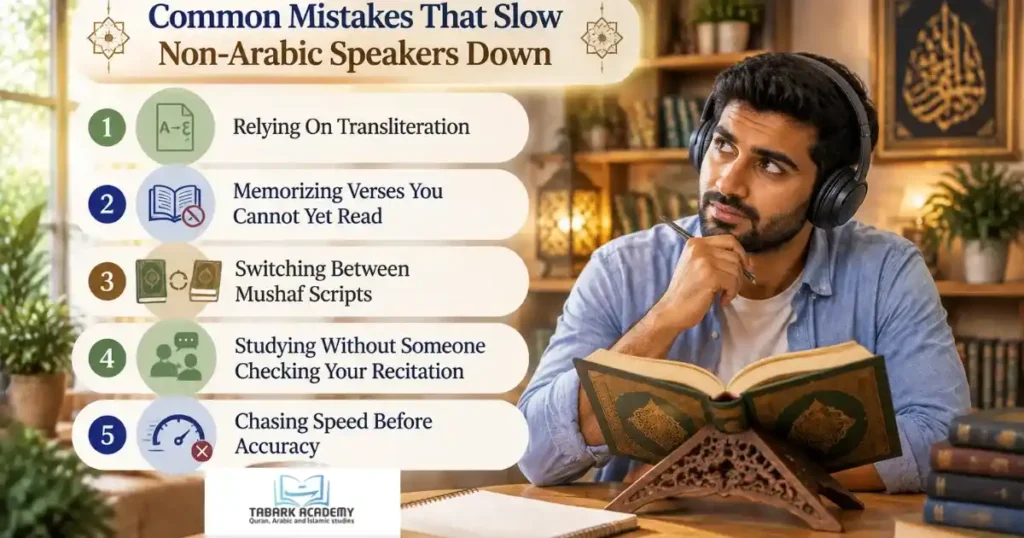
Progress happens mostly between lessons, not during them. A short daily practice keeps the sounds fresh, while one long weekly session tends to let corrections fade before you use them again.
1. A Simple Between-Lesson Routine
Ask your teacher to give you three things after every lesson: the specific error you are working on, the lines to read before the next class, and the material to revise. Write them down at the end of the lesson, so you never sit down to practice wondering what to do.
Then follow the same order in every practice session:
- Listen to a slow reciter on the passage once while following the text with your finger.
- Read the passage aloud, slowly, paying attention to the error your teacher named.
- Record yourself reading it once, then compare it with the reciter.
- Finish with a quick review of older material, so earlier lessons stay fresh.
Read aloud every day, even for 10 to 15 minutes. A short session you never skip does more than a long one you postpone, because pronunciation is a physical habit that weakens without regular use.
2. Keep A Simple Progress Log
A progress log is a short note after each practice and each lesson: what you read, which errors came up, and what your teacher corrected. It takes a minute and gives you a clear record instead of a vague feeling.
Over a few weeks, the log shows patterns. If the same letter appears in your notes again and again, such as qaf read as kaf, you know exactly what to ask about in your next lesson.
3. Signs You Are Ready For The Next Stage
You are ready to move on when you can read a new line at your level slowly, without help, and your teacher corrects you on fewer letters each time. Look for these signs together, not just one of them:
- You read an unfamiliar passage at your level, not only the one you practiced.
- Your teacher’s corrections move from basic letters to finer details, such as vowel length.
- You start catching and fixing your own mistakes before your teacher points them out.
- Your reading stays accurate on different days, not only after a long practice.
Self-correction is the strongest of these signs, since it shows your ear has learned what correct sounds like. The pace differs between learners, depending on practice time and starting level, so no fixed number of weeks applies to everyone.
4. What To Do When Progress Stalls
Most learners hit a stage where reading feels stuck. This usually means one recurring error is holding everything back, or the material has stayed at the same level for too long.
Check your log for the error that keeps returning and ask your teacher to spend one lesson on it alone. If no single error stands out, ask whether you are ready for slightly harder material, since repeating passages you already read well builds comfort but not new skill.
Read also: How Often Should A Hafiz Revise The Quran To Never Forget It
Best Way To Learn The Quran When You Do Not Speak Arabic – Teacher, App, Or Self-Study?
For most beginners, the best approach is a qualified teacher, supported by apps and recordings between lessons. Each option has a clear role.
| Option | What it does well | Where it falls short | Best used for |
| Live 1-on-1 teacher | Corrects pronunciation in real time, adjusts pace to your level | Requires scheduling and cost | Core learning at every stage |
| Apps – Tarteel | Daily practice, translation, audio on demand | Cannot fully judge subtle sound errors or Tajweed | Revision and listening between lessons |
| Self-study books and videos | Low cost, flexible | No feedback, mistakes go unnoticed | Supplementing lessons, learning letter shapes |
A useful decision rule: if no one has ever checked your recitation, start with a teacher. Apps and books work best once you know what correct sounds like.
Step Inside Our Virtual Classrooms
See our engaging teaching methods in action! Watch real snippets of our live classes and discover how our expert instructors make learning interactive, memorable, and inspiring for every student.
Start Your Quran Learning Journey
Join Tabark Academy today for structured online lessons with qualified tutors, customized to fit your goals.
Book Your Free Trial LessonBook Your Free Trial Class And Read Your First Verse With A Certified Tutor
You do not need to speak Arabic to start. You need the right first lesson. At Tabarak Academy, your tutor listens to you read, finds your starting stage, and builds a plan around your level and schedule.
Every class is private and live with an Al-Azhar-certified tutor experienced in teaching non-native speakers. Female tutors are available for sisters and girls, and you can choose morning, evening, or weekend slots that fit your work or school. Your first class is free, with no payment and no obligation.
Our Quran Courses
- Online Quran Classes
- Online Quran Classes for Beginners
- Online Quran Classes for Kids
- Online Quran Classes for Adults
- Online Quran Classes for Men
- Online Quran Classes for Sisters
- Quran Reading Course
- Quran Recitation Course
Start your Quran learning journey today and take the next step toward reading and memorizing the Quran with confidence.
Start Your Quran Learning Journey
Join Tabark Academy today for structured online lessons with qualified tutors, customized to fit your goals.
Book Your Free Trial LessonConclusion
Learning the Quran when you do not speak Arabic follows a clear order: recognize the letters and their sounds, join them into words with the vowel marks, correct your pronunciation through Makharij and Talaqqi, recite the short surahs of Juz Amma alongside Al-Fatiha, and then add meaning or memorization once your reading is fluent.
Start from the step that matches what you can read today, not from page one of a course by default. Give extra attention to the sounds English lacks, such as qaf, ‘ayn, and the heavy letters.
Avoid the habits that slow most learners down: relying on transliteration, memorizing verses you cannot yet read, switching between Mushaf scripts, chasing speed, and practicing without anyone checking your recitation.
Between lessons, a short daily routine and a simple progress log will tell you more about your progress than any fixed timeline. The main takeaway: you do not need to learn Arabic before you learn the Quran. Start reading now, with a qualified teacher who can correct you as you go.
Frequently Asked Questions
Can I Learn To Read The Quran Without Learning Arabic?
Yes, you can learn to read the Quran without learning spoken Arabic. Reading depends on letters, vowel marks, and correct pronunciation, which you can learn through a primer such as the Noorani Qaida and regular practice with a teacher.
How Long Does It Take To Learn To Read The Quran For A Non-Arabic Speaker?
The time it takes to learn to read the Quran depends on your starting level and how much you practice. Learners who practice aloud daily and receive regular correction move through the beginner stages faster than those who study only once a week.
Is It Enough To Read The Quran In English Translation?
An English translation explains the meaning, but it is not a recitation of the Quran. Muslims recite the Quran in Arabic, especially in prayer, so most learners study the Arabic text and use translation to understand it.
What Is The Best Book For Non-Arabic Speakers To Start Reading The Quran?
The Noorani Qaida is the most widely used first book for non-Arabic speakers learning to read the Quran. Noor Al-Bayan and the Baghdadi Qaida follow a similar letter-by-letter progression.
Can Adults Learn To Read The Quran From Zero?
Yes, adults can learn to read the Quran from zero. Adults often progress steadily because they can set a clear goal and practice routine, and 1-on-1 lessons let them learn at their own pace without the pressure of a group class.
How Can Parents Help A Child Who Does Not Speak Arabic Learn The Quran?
Parents help most by keeping daily practice short and consistent and by checking that lessons match the child’s age. Sitting in on lessons occasionally and asking the teacher what to practice at home keeps the child on track.


0 Comments