


Learn – Is It Better To Memorize Quran In The Morning Or At Night?
Ask ten huffaz when they memorize, and you will get two answers: right after Fajr, or in the quiet hours before sleep. Both groups are certain they have found the best time. So is it better to memorize Quran in the morning or at night — and does the answer change depending on who you are?
The short answer: the early morning, especially the period around Fajr, is generally the strongest window for new memorization, while the night is unmatched for review, reflection, and locking memorized verses into long-term memory. Classical scholars said this centuries before cognitive science measured it.
This guide breaks down the evidence for each time, what the scholars of hifz actually recommended, how memory consolidation works during sleep, and how to build a realistic daily schedule — whether you are a working adult, a student, or a parent teaching a child.
What You Will Learn
- Why the hours around Fajr (as-sahar) are considered the peak window for new memorization
- What makes night recitation uniquely powerful for retention and tadabbur (reflection)
- How sleep physically consolidates what you memorize — and how to use that
- A practical morning + night schedule you can apply from tomorrow
- How to choose the right time if you have work, school, or young children

Is It Better to Memorize Quran in the Morning or at Night?
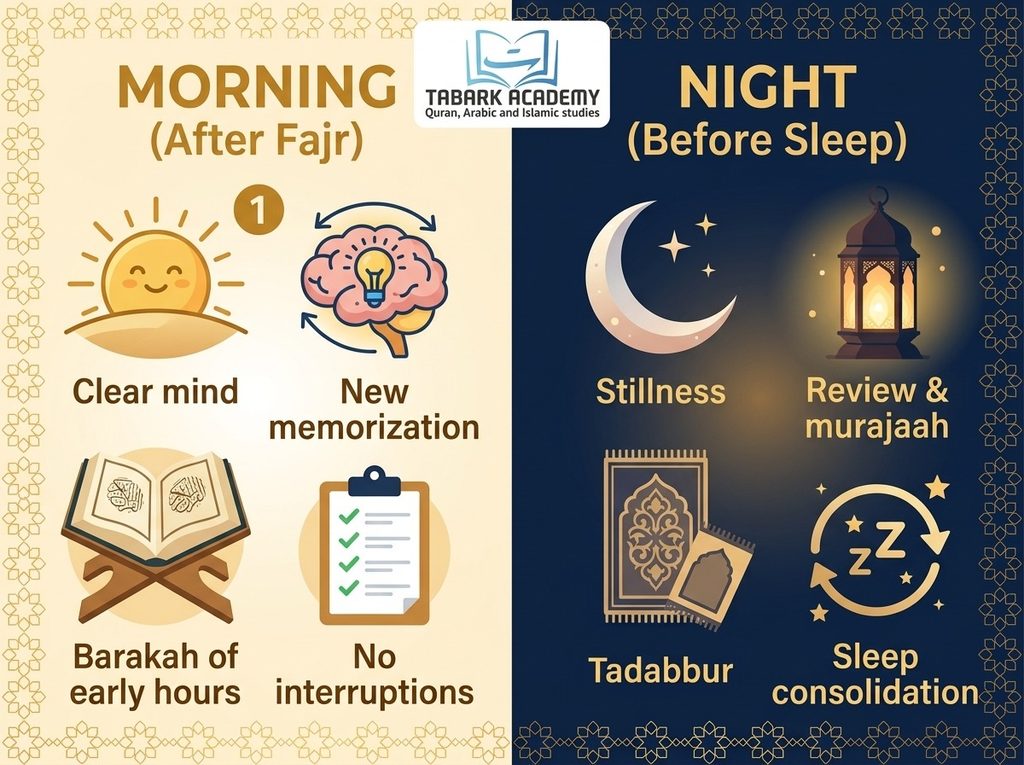
In the morning. For most people, the morning is the best time for memorizing new verses, and the night is better for reviewing them. This is not a compromise answer — it reflects how the two time windows serve two genuinely different tasks.
New memorization (hifz jadeed) demands a clear, uncluttered mind and maximum encoding capacity. That is the morning. Retention demands repetition in a quiet, undistracted state — ideally close to sleep. That is the night.
The classical hadith scholar Al-Khatib al-Baghdadi ranked the memorization hours explicitly: “The best of times are the hours before dawn (al-ashar), then midday, then the early mornings rather than the evenings — and memorizing at night is better than memorizing during the day.”
Notice that he did not choose one and discard the other. He ranked a sequence. The strongest hifz routines in history used both ends of the day.
The Rule That Overrides Both
The best time is the time when your heart is present, and your mind is rested. A Muslim who is exhausted at Fajr but sharp at 10 p.m. will memorize more at night — and that is the better time for him.
Ibn Taymiyyah (rahimahullah) established this principle broadly: what is superior in general is not necessarily superior for every person in every state. The most beneficial act for your heart is the most virtuous act for you.
Why the Early Morning Is the Strongest Time to Memorize Quran
The hours from just before Fajr until sunrise combine three advantages that no other part of the day offers simultaneously: mental freshness, spiritual barakah, and near-total absence of interruption.
1. Clarity Of Mind After Rest
Your working memory resets during sleep. When you open the mushaf after Fajr, your mind has not yet absorbed a single email, message, or worry — there is no competing information fighting for space.
This matters more than motivation. Memorization is an encoding task, and encoding quality drops sharply as the day’s cognitive load accumulates.
You can test this on yourself in a single week. Memorize the same number of lines after Fajr on three days and after Isha on three others, then count how many repetitions each session needed. Most students find the morning portion settles in noticeably fewer rounds.
2. The Barakah Of The Early Hours
The Prophet ﷺ said: “O Allah, bless my Ummah in its early mornings.” (Narrated by Sakhr al-Ghamidi; Abu Dawud; at-Tirmidhi).
اللَّهُمَّ بَارِكْ لأُمَّتِي فِي بُكُورِهَا
Scholars of hifz have long treated this as a direct invitation to begin the day with the heaviest spiritual work. Barakah here is practical: students consistently report memorizing in twenty focused morning minutes what takes them an hour after Maghrib.
The wording of the dua is also worth noticing. The Prophet ﷺ asked for blessing in the early hours themselves, not only in the work done in them. Scholars understood this to mean that the time carries an added benefit which effort alone cannot manufacture later in the day.
3. Fewer Distractions and Stronger Consistency
Morning sessions are easier to protect. Nobody schedules a meeting at 5:30 a.m., and children are still asleep — which is why so many mothers build their hifz around the Fajr window.
Morning slots also protect your hifz from the unpredictability of the day. An evening session competes with overtime, guests, and fatigue, so it is the first thing dropped when life gets busy. A session finished before sunrise is already banked, whatever the rest of the day brings.
If you are trying to establish a fixed morning slot, a structured class helps enormously. Many students in Tabarak Academy’s Online Hifz Program choose an early time slot specifically because a scheduled teacher removes the temptation to go back to sleep.

Why the Night Is the Strongest Time for Review and Retention
The night compensates for what the morning cannot give: absolute stillness, depth of reflection, and direct proximity to sleep — the phase in which memory is physically consolidated.
Stillness And Depth Of Reflection
Allah says: “Indeed, worship in the night is more impactful and suitable for recitation.” (Surah Al-Muzzammil: 6)
إِنَّ نَاشِئَةَ ٱلَّيْلِ هِىَ أَشَدُّ وَطْـًۭٔا وَأَقْوَمُ قِيلًا
Imam an-Nawawi explained in At-Tibyan that night recitation is superior because it gathers the heart, keeps you furthest from distraction and worldly errands, and protects you from showing off.
Reciting Your Hifz In Qiyam
The most effective review method ever devised is reciting what you have memorized inside your night prayer. You are not just repeating words; you are performing them under conditions that demand accuracy.
Verses recited in qiyam tend to stabilize within days. Scholars of Islamweb, answering a student torn between qiyam al-layl and hifz, advised combining them — using tahajjud as the review session for what was memorized earlier.
Sleep Consolidates What You Memorize
Whatever you rehearse in the final waking hour receives priority during overnight memory consolidation. Reviewing your portion right before sleep is, in practical terms, giving your brain a full night of free rehearsal.
This is why the classic cycle works so well when you memorize after Fajr, review after Asr, recite in qiyam or before sleep, and then re-test the next morning before adding new verses.
Read also: The Best Time of Day to Memorize Quran – Find Your Golden Hour
Experience Our Interactive Learning
Curious about how we teach? Watch these brief video clips from our recent live sessions to see our structured curriculum, advanced learning platform, and dynamic student-teacher interactions firsthand.
Morning or Night: Choose the Best Quran Memorization Time for Your Routine
The right answer depends less on the clock and more on your life structure. Here is how the choice usually resolves.
1. Working Adults: Memorize After Fajr and Review Later
Memorize a small portion after Fajr — even five lines — before work begins. Use the commute and the pre-sleep window for review. Consistency beats volume every time.
Set the target low enough that a hard day cannot break it. Three lines you complete every morning for a year will outpace a page you attempt twice a week and abandon by month three. Momentum, not ambition, is what finishes a mushaf.
2. Students: Split Hifz Across Morning, Midday, and Night
Follow al-Khatib’s full sequence: new hifz before and after Fajr, a second block around midday, and review at night. This is the classical pattern that produced huffaz in two to three years.
Keep the three blocks separated by real rest rather than stacking them into one long stretch. Spacing your sessions across the day forces your memory to retrieve the portion repeatedly from cold, which is exactly what makes it stick. Six focused hours split into three blocks beat six continuous ones.
Read also: Learn – How Long Does It Take To Memorize Surah Yaseen?
3. Children: Keep New Memorization in the Morning
Children memorize best in the morning before school, in short sessions of 10–20 minutes. Evening sessions should be light review only — never new material after a full school day.
A child who begins the day with pressure will associate the mushaf with tension, and that association lasts far longer than any portion memorized under it. Keep the session short, warm, and finished before the child asks to stop.
If you are teaching a child and struggling to find a realistic slot, structured sessions such as Hifz Classes for Kids let you fix the timing around the child’s natural peak rather than the family’s leftover time.
4. Night Learners: Build a Consistent Evening Hifz Routine
Do not force a routine that breaks in a week. Memorize at the time you are most alert, then move your review to the last hour before sleep. A steady 9 p.m. routine outperforms an abandoned 5 a.m. one.
If you still want the Fajr window, move toward it gradually rather than all at once. Shift your bedtime fifteen minutes earlier each week until waking before dawn costs you nothing in sleep. A routine built slowly survives; one imposed overnight rarely lasts past the first tiring week.
The Mistakes That Waste Both Times
Timing only works when the fundamentals are in place. Three errors cancel out any advantage the morning or night gives you.
1. Memorizing Without Correct Tajweed
Verses memorized with wrong pronunciation must be unlearned before they can be relearned — doubling the work. Correcting recitation first, through Online Tajweed Classes, prevents years of accumulated errors.
The problem compounds quietly, because a mistake repeated correctly-sounding a hundred times begins to feel right.
By the time a teacher catches it, the error is stored as firmly as the verse itself. Listening to a trusted qari before you memorize costs minutes; correcting an entrenched habit costs months.
2. Adding New Pages While Old Ones Fade
Review is not optional maintenance; it is half the work. Never add a new portion on a day you have not secured yesterday’s. A workable ratio is one part new memorization to three parts review, adjusted upward as your stored portion grows.
The moment your murajaah backlog starts spilling into the next day, pause new hifz entirely until it clears. Standing still for a week is far cheaper than losing a juz.
3. Memorizing Without Understanding The Arabic
Meaning is the strongest memory anchor there is. Students who understand the sentence structure retain noticeably longer than those memorizing sound alone. You do not need full fluency to benefit from this.
Learning the recurring vocabulary of the Quran and the basic patterns of Arabic grammar is enough to turn similar-sounding verses into distinct sentences. That single change eliminates most of the mix-ups that plague long-term huffaz.
Step Inside Our Virtual Classrooms
See our engaging teaching methods in action! watch real snippets of our live classes and discover how our expert instructors make learning interactive, memorable, and inspiring for every student.
Read also: Realistic Plan – How Long Does It Take to Memorize Surah Al-Baqarah?
Start Your Hifz with a Schedule Built Around Your Best Hours
You already know when your mind is sharpest. What most students lack is not willingness — it is a teacher, a plan, and a fixed appointment that makes showing up automatic.
Tabarak Academy offers one-to-one online classes in Quran memorization, tajweed, recitation, and Arabic language, with certified Egyptian teachers available around the clock. You choose the time slot — Fajr, midday, or late night — and your teacher builds the memorization and review plan around it.
Every student begins with a free trial session that assesses current level, corrects recitation, and sets a realistic weekly target for both hifz and murajaah. Classes are available for children, adults, men, and sisters, with male and female teachers.
Book your free trial lesson today and start memorizing at the hour that actually works for you.
Our Quran Memorization / Hifz Courses
- Online Hifz Program
- Juz 30 Memorization Course
- Hifz for Kids Course
- Hifz for Adults Course
- Hifz for Sisters Course
- Short Surah Memorization Course
- Hifz Ijazah Course

Conclusion
So, is it better to memorize Quran in the morning or at night? The morning — particularly the hours around Fajr — is the stronger window for new memorization thanks to mental clarity, freedom from distraction, and the barakah the Prophet ﷺ supplicated for.
The night is the stronger window for review, tadabbur, and consolidation, especially when your portion is recited in qiyam or just before sleep.
The most effective approach is not to choose, but to combine: memorize in the morning, review at night, and re-test the next day before moving forward. It also helps to stop treating the question as permanent.
Your best hour at twenty-five with a full-time job will not be your best hour as a parent of young children, and the schedule should move with your life. Re-examine your timing every few months and adjust it before it quietly stops working.
Read also: How To Memorize The Quran In 1 Year – A Realistic Daily Plan
FAQs
What is the best time of day to memorize Quran?
The period from before Fajr until sunrise is considered the best time for new memorization, because the mind is rested and distractions are minimal. Al-Khatib al-Baghdadi ranked the pre-dawn hours first, followed by midday, then early morning.
Can I memorize Quran at night instead of the morning?
Yes. Night memorization is valid and highly effective, especially if that is when you are most alert. Scholars considered night recitation superior for gathering the heart and reducing distraction, and reviewing before sleep improves retention.
How long should a daily Quran memorization session be?
Most students do best with 20–45 minutes of new memorization plus 15–30 minutes of review. Children need shorter sessions of 10–20 minutes. Daily consistency matters far more than long, irregular sessions.
Is it better to do qiyam al-layl or memorize Quran?
Where possible, combine them by reciting your memorized portion inside qiyam. If you must choose, qiyam al-layl is a time-bound act of worship that passes with its window, while Quran memorization can be made up at other hours.
Why do I forget what I memorized in the morning?
Forgetting usually signals insufficient review, not a bad time choice. The remedies traditionally prescribed are frequent recitation, sincere dua for retention, and reducing distractions — plus re-testing yesterday’s portion before adding anything new.
Does memorizing after Fajr conflict with the morning adhkar?
No, but the adhkar come first. Scholars, including Ibn Baz, noted that time-bound adhkar should be completed before recitation, since their window passes, while Quran recitation can be done at any hour.