


Murajaah Timetable Pdf – For Every Hifz Stage
Search “murajaah timetable pdf” and you’ll find dozens of downloadable schedules – but most students who download one still lose their memorization within months.
A murajaah timetable pdf only works if it matches your actual stage of Hifz, your daily time budget, and a structure you can repeat without burnout.
Murajaah (مراجعة) is the Arabic term for revisiting the Quran you’ve already memorized, as opposed to jadeed (new memorization). The two are not competitors for your time – they are two separate jobs that both need a place on your schedule.
This guide walks through how to build, structure, and print a murajaah timetable that fits where you actually are, with ready-to-use tables for beginners, active memorizers, children, adults, and huffaz who have finished the whole Quran.
How to Build Your Own Murajaah Timetable PDF in Four Practical Steps
A murajaah timetable pdf doesn’t need special software — it needs a correct structure. These four steps apply whether you’re building a one-page weekly grid or a full 30-day cycle.
1. Identify Your Hifz Stage Before Setting the Revision Plan
Your stage determines everything else about your timetable, because a student memorizing new pages daily needs a completely different balance than a student who has finished the whole Quran and is only maintaining it.
2. Set the Right Jadeed-to-Murajaah Ratio for Your Hifz Level
The right split between new memorization and revision depends on how much of the Quran you’ve already memorized, not on personal preference.
| Stage | Jadeed (new) | Murajaah (old) | Total daily time |
| Active memorization (under 15 Juz) | 60% | 40% | 60–90 minutes |
| Mid-Hifz (15–25 Juz) | 40% | 60% | 75–105 minutes |
| Final stretch (25–30 Juz) | 20% | 80% | 60–90 minutes |
| Post-Hifz (revision only) | 0% | 100% | 45–60 minutes |
Students who try to keep an even 50/50 split during the final stretch almost always find their earliest Juz starting to fade, even while they’re still finishing the last few pages. Shifting to roughly 80% revision at that stage protects the work already done.
3. Structure Each Daily Murajaah Session Into Three Revision Layers
A daily murajaah session works best as three short layers rather than one long block: a five-minute warm-up reciting the last few ayaat from the previous session, followed by 15–25 minutes of core revision reciting the day’s assigned portion from memory with your eyes closed, and finishing with 5–10 minutes of targeted repetition on whichever verses you stumbled on.
Skipping the warm-up is the mistake we see most often at Tabarak Academy — students who jump straight into the day’s portion make noticeably more errors in the opening verses than students who use that short overlap from the day before.
Reciting your murajaah portion out loud with correct tajweed rather than silently is also worth building into this structure early, which is exactly what our Quran Recitation Course trains alongside revision habits.
4. Turn Your Murajaah Plan Into a Simple Printable PDF
A murajaah timetable only earns its name once it leaves your head and becomes something you can check off.
Lay it out as a simple table with columns for the day, the assigned Juz or Surah, a checkbox for completion, and a short note field for weak spots — one page per week keeps it printable without becoming cluttered.
30-Day Murajaah Timetable for Reviewing the Full Quran
A 30-day murajaah timetable is a practical way to review the entire Quran because its 30 Juz map naturally onto 30 days. Revising one Juz per day completes a full Quran revision cycle every month, following a rhythm many Muslims already recognize from Ramadan.
| Day | Juz | Approximate pages |
| 1 | Juz 1 | Pages 1–21 |
| 2 | Juz 2 | Pages 22–41 |
| 3 | Juz 3 | Pages 42–61 |
| 4 | Juz 4 | Pages 62–81 |
| 5 | Juz 5 | Pages 82–101 |
| 6–10 | Juz 6–10 | Pages 102–201 |
| 11–15 | Juz 11–15 | Pages 202–301 |
| 16–20 | Juz 16–20 | Pages 302–401 |
| 21–25 | Juz 21–25 | Pages 402–501 |
| 26–30 | Juz 26–30 | Pages 502–604 |
Each Juz averages roughly 20 pages, and at a moderate recitation pace of 1–1.5 pages per minute, one Juz takes about 15–20 minutes to revise. That’s a realistic daily minimum even for working adults and parents managing a full schedule.
This cycle suits post-Hifz students maintaining a completed Quran, or anyone with 30 minutes of uninterrupted daily time and no new memorization to add. If you’re still adding new pages, the 7-day timetable below fits better.
Read Also: How to Stop Forgetting the Quran?
Step Inside Our Virtual Classrooms
See our engaging teaching methods in action! watch real snippets of our live classes and discover how our expert instructors make learning interactive, memorable, and inspiring for every student.
7-day murajaah timetable for students still memorizing
A 7-day murajaah timetable for students still memorizing helps balance new Quran memorization with frequent revision of older Juz. The shorter cycle brings previously memorized portions back regularly without stopping progress on new pages.
| Day | Jadeed (new) | Murajaah (old revision) | Total session |
| Saturday | ½ page | Juz 1 + Juz 2 | 60 minutes |
| Sunday | ½ page | Juz 3 + Juz 4 | 60 minutes |
| Monday | ½ page | Juz 5 + Juz 6 | 60 minutes |
| Tuesday | ½ page | Juz 7 + Juz 8 | 60 minutes |
| Wednesday | ½ page | Juz 9 + Juz 10 | 60 minutes |
| Thursday | Consolidate the week’s new pages | Juz 11 + Juz 12 | 75 minutes |
| Friday | No new memorization | Juz 13 + Juz 14 (plus Surah Al-Kahf) | 45 minutes |
This pattern covers 14 Juz of revision every week. For a student who has memorized 20 Juz, that means every Juz comes back around roughly every 10 days — well inside the window most retention research treats as safe.
Reciting Surah Al-Kahf on Friday sits alongside this schedule as a separate Sunnah, encouraged in Sahih Muslim, 809 — worth keeping in the Friday session even on a lighter revision day.
Students building this habit for the first time often benefit from guided pacing rather than trial and error, which is the core of Tabarak Academy’s Online Hifz Program.
Murajaah Timetables By Learner Type
The same jadeed/murajaah principles apply to everyone, but the session length and structure need to change based on age and available time.
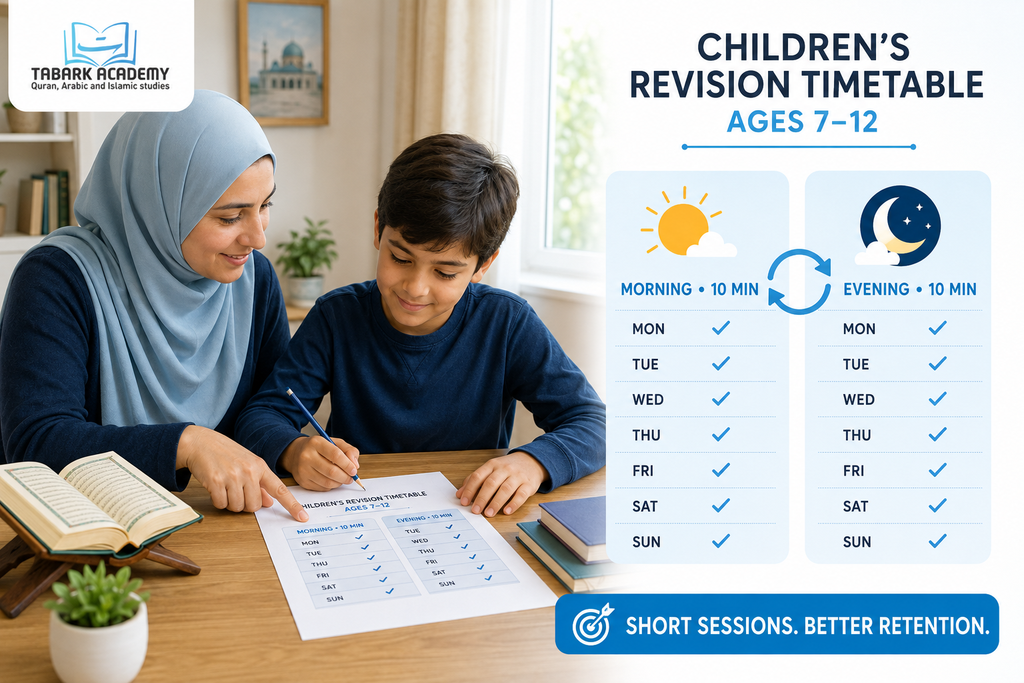
Children’s Revision Timetable (Ages 7–12)
Children aged 7–12 benefit from shorter revision sessions rather than one long block. The Tabarak Academy Children’s Murajaah Timetable splits Murajaah into a brief morning review and a short evening session, making daily revision easier to manage.
| Day | Morning | Evening | Total |
| Saturday | 10 min: review yesterday’s page | 10 min: new half-page | 20 minutes |
| Sunday | 10 min: old Juz revision | 10 min: consolidate new | 20 minutes |
| Monday | 10 min: old Juz revision | 10 min: new half-page | 20 minutes |
| Tuesday | 10 min: old Juz revision | 10 min: consolidate | 20 minutes |
| Wednesday | 10 min: old Juz revision | 10 min: new half-page | 20 minutes |
| Thursday | 15 min: weekly review test | — | 15 minutes |
| Friday | 10 min: favourite Surahs | — | 10 minutes |
Many children start Hifz with the shorter Surahs of Juz 30 before moving into longer material, which is why Tabarak Academy’s Juz 30 Memorization Course is built around exactly this split-session pacing.
For a fuller program built specifically around a child’s attention span, Hifz for Kids applies this structure across a full curriculum.
Adult Revision Timetable For Busy Schedules
Working adults do not need to follow the same revision schedule as full-time Hifz students. The Tabarak Academy Adult Murajaah Timetable is designed around shorter, consistent sessions of 20–60 minutes that can maintain and strengthen memorization alongside work and family responsibilities.
| Available time | Realistic daily target | Weekly Juz covered |
| 20 minutes | ½ Juz revision | 3–4 Juz per week |
| 30 minutes | 1 Juz revision | 7 Juz per week |
| 45 minutes | 1 Juz + new ½ page | 7 Juz + 3.5 new pages |
| 60 minutes | 1 Juz + new 1 page | 7 Juz + 7 new pages |
The most damaging habit among busy adults isn’t a short session — it’s skipping a day and then trying to make up for it with a double session later. A shorter session every single day consistently outperforms occasional long ones.
Tabarak Academy’s Hifz for Adults course is built around exactly this realistic-pacing approach for people balancing work and family.
The Weekly Partition Method For Huffaz Who Finished Memorizing
Once all 30 Juz are memorized, the focus shifts from new memorization to lifelong retention. The Tabarak Academy Huffaz Weekly Partition Timetable divides the Quran into seven daily portions, allowing Huffaz to complete a full revision cycle every week.
| Day | Surah range |
| Friday | Al-Fatihah → An-Nisa |
| Saturday | Al-Ma’idah → At-Tawbah |
| Sunday | Yunus → An-Nahl |
| Monday | Al-Isra → Al-Furqan |
| Tuesday | Ash-Shu’ara → Ya-Sin |
| Wednesday | As-Saffat → Al-Hujurat |
| Thursday | Qaf → An-Nas |
This is a heavier daily load than the 30-day cycle, so it fits students maintaining Hifz alongside advanced study — the same stage where continuing into an Ijazah becomes a natural next step, which Tabarak Academy’s Online Ijazah Course is designed for.
Read also: Simple Ways to Make Your Quran Recitation Sound Better
Common Murajaah Mistakes That Undo Months Of Work
Most Hifz students who lose ground don’t fail because the Quran is difficult — they fail because their revision system quietly collapsed while new memorization kept moving forward.
- Skipping the weakest Juz because it’s uncomfortable to recite, when it’s exactly the one that needs the most attention.
- Reviewing silently instead of reciting aloud, which hides mistakes that a listener or recording would catch.
- Compensating for a missed day with one long makeup session instead of simply resuming the normal schedule the next day.
- Treating the timetable as fixed rather than adjustable — a schedule that isn’t being followed after two weeks needs a smaller daily target, not abandonment.
Read Also: Best Revision Schedule For Hifz
Experience Our Interactive Learning
Curious about how we teach? Watch these brief video clips from our recent live sessions to see our structured curriculum, advanced learning platform, and dynamic student-teacher interactions firsthand.
Start Your Murajaah Timetable With Tabarak Academy Today
A printed schedule gives you structure, but structure without correct tajweed and steady feedback still lets errors settle into memory unnoticed.
Tabarak Academy pairs your murajaah timetable with a qualified Quran teacher who listens to your recitation, corrects mistakes as they happen, and adjusts your jadeed-to-murajaah ratio as you move through the stages above.

Our Quran Memorization / Hifz Courses:
- Online Hifz Program
- Juz 30 Memorization Course
- Hifz for Kids Course
- Hifz for Adults Course
- Hifz for Sisters Course
- Short Surah Memorization Course
- Hifz Ijazah Course

Conclusion
A murajaah timetable pdf only protects your Hifz if it matches your stage: an active memorizer needs a different daily ratio than a student in the final stretch or a Hafiz maintaining a completed Quran.
Pick the jadeed-to-murajaah split that fits where you are, structure each session into warm-up, core revision, and weak-spot targeting, and print it as something you can check off daily.
Tabarak Academy builds exactly this kind of personalized murajaah timetable into every Hifz course, so revision stops being guesswork and becomes a habit that holds.

Frequently asked questions
These are the questions students and parents ask most often when they’re building their first murajaah timetable, based on where revision plans typically break down.
1. How often should I revise and memorize the Quran?
You should revise recently memorized portions daily and older memorization at least once a week. Daily revision of new material prevents the fast, early forgetting that happens in the first few days after memorizing, while weekly cycling keeps older Juz from fading over months.
2. How long should a daily murajaah session take?
A daily murajaah session should take 30–90 minutes depending on your stage, following the jadeed-to-murajaah ratio table above. Post-Hifz students maintaining a completed Quran typically need only 45–60 minutes, while active memorizers need closer to 90.
3. What’s the biggest reason revision schedules fail?
The biggest reason is treating murajaah as optional once new memorization feels urgent. Protecting a fixed daily block for old material, even a short one, prevents the gradual fading that eventually forces a student to re-memorize Juz they thought were secure.
4. Can I make my own murajaah timetable PDF instead of downloading one?
Yes — a self-made timetable often works better because it matches your real schedule and Hifz stage. Use a simple table with day, assigned portion, a checkbox, and a notes field for weak spots, built from the ratio and structure steps in this guide.
5. Is the 30-day cycle enough to maintain a completed Quran?
For most huffaz, yes. Reviewing one Juz per day completes the entire Quran every 30 days, which is a widely used maintenance rhythm for students who have finished memorizing and are no longer adding new pages.