


Psychological Barriers To Quran Memorization – A Plan To Overcome Them

You open the mushaf with good intentions. You read the same verse five times. A minute later, you still can’t recite it back.
It isn’t your memory failing you. It’s usually one of several psychological barriers to Quran memorization working quietly in the background, pushing you to stop before you’ve really started.
These barriers aren’t weaknesses in your brain. Most are beliefs, untested assumptions about age, memory, and time. They feel true only because you’ve repeated them to yourself so often.
However, this is not the case. Let’s have a look at the five most common psychological barriers, the deeper causes behind them, and a step-by-step method for training your mind to memorize with less struggle.

5 Psychological Barriers to Quran Memorization
Psychological barriers to Quran memorization are mental blocks built on false beliefs, not facts. They stop a person from starting or continuing to memorize the Quran. They don’t come from an actual inability to memorize. They come from fear, comparison, and self-talk that pushes the brain to give up early.
The five barriers below show up most often, whether you’re memorizing alone or with a teacher.

a- The Fear Of Forgetting What You Memorize
Many people believe that anything memorized quickly disappears just as fast. So they avoid moving forward at all.
But this isn’t a memory problem. It’s a review problem in disguise. A student memorizes a page, comes back four days later, finds it gone, and decides that memorizing “doesn’t work” for him. What happened is completely normal.
New memorization is held loosely at first, and if you don’t repeat it within the first day or two, it fades. That is how every human memory works, including the memory of someone who has finished the whole Quran. It says nothing about your ability.
The practical answer is a review structure, not slower memorization. A workable version looks like this:
- Daily: recite yesterday’s new portion before you add anything new.
- Weekly: recite everything memorized in the last seven days in one sitting.
- Monthly: cycle through your older material a juz or half-juz at a time.
The fear costs you something too. A student who is scared to move on keeps repeating the same short surah for months. So, he never gets the one thing that would end the fear: a few pages that he has memorized, reviewed, and watched stay in place.
Moving forward is what fixes this, not being careful. Once you see three or four pages hold steady for a month, the fear loses its grip.
If you’ve never had a review schedule set for you, that’s usually the missing piece rather than discipline. A structured online Hifz program builds the review cycle into the plan itself, so the older material is never left to chance. This is what we’re doing for you in our Tabarak Academy.

b- The Belief That You’re “Too Old” To Memorize
The idea that memory stops responding once you pass your twenties is an assumption, not a medical fact. The brain keeps forming new memory pathways throughout life. What actually declines with age is training and repetition, not raw capacity.
Think about what really changed between you at fifteen and you at forty-five. At fifteen you memorized something almost every day — new words, formulas, lyrics, exam material. Your memory was in use, so it stayed sharp.
At forty-five, most adults go months without memorizing anything on purpose. Nothing broke. You just stopped using it, and anything you stop using feels stiff for the first few weeks you go back to it.
Adults also carry real advantages that younger memorizers don’t have:
- Comprehension. You understand context, narrative and meaning far better, and meaning is one of the strongest memory anchors available.
- Consistency. You can hold a routine for months without an adult supervising you.
- Motivation. Adults usually choose Hifz deliberately, which is a much stronger driver than being enrolled by a parent.
What adults do need is a realistic starting portion. An adult who starts with a full page a day will usually stop within two weeks and blame his age. An adult who starts with three lines a day and keeps it up for a month ends up believing the opposite.
Our Hifz for Adults course is built for that — the pace matches what a working adult can keep up with, not what a full-time student can do.
Read about: Can I Memorize the Quran at 40? A Realistic Guide for Adult Learners
c- The Belief That Your Memory Is Weak
Telling yourself “I have a weak memory” is a form of self-programming. The brain tends to perform in line with the messages it gets, whether positive or negative. Students who repeat this phrase daily often stop testing themselves. That turns the belief into a self-fulfilling prediction.
See how it works, step by step. You tell yourself your memory is weak. Because you expect to fail, you stop reciting from memory in front of people, and you stop closing the mushaf to test yourself.
But testing yourself is the very thing that makes memory stronger — far more than reading the same page again and again. By avoiding it, you drop the one habit that would have proved you wrong. Six weeks later your recall is poor, and you point at it as proof. The belief created its own evidence.
Two things break this cycle:
- Look at what you already remember: Phone numbers, directions, lines from films, what someone told you last week, du’as you’ve known since childhood. A brain that holds all of that does not have a “weak memory.” It only has an untrained Hifz habit.
- Change the sentence: Instead of “my memory is weak,” say “I’m still learning how to memorize.” One sounds permanent. The other is a skill you’re building. Your mind treats them very differently.
There’s another cause worth checking. Many students who think their memory is weak are simply struggling to read the Arabic smoothly. Every pause over a letter or a vowel uses up the focus that memorizing needs.

d- The Feeling That You Never Have Enough Time
This barrier isn’t really about the clock. It’s about not having a fixed, protected slot. A steady five minutes after Fajr beats an imagined “free hour” that never shows up.
Ask anyone who “has no time” to walk through their day honestly and you’ll usually find the same thing: the time is there, but nobody has claimed it. Free time gets taken by whatever shouts loudest — messages, errands, scrolling.
Memorization loses that race every day because it never shouts. So the fix isn’t finding more time. It’s tying your portion to something that already happens anyway.
- Tie it to a prayer you never miss — the ten minutes right after Fajr or Maghrib.
- Tie it to a drive, a school run, or the walk back from the mosque, using audio.
- Tie it to a fixed class time that someone is expecting you at.
The last one works best, because an appointment turns a good intention into a commitment. Ten minutes a teacher is waiting for you survives a busy week. Ten minutes only you know about does not.
One-on-one classes — the kind Tabarak Academy builds around your existing routine, morning, evening, or weekends — take the guesswork out of finding that slot.
Have a look at our Hifz courses, including Hifz for Sisters for students who want a female tutor and a schedule that fits around the family
.

e- The Focus On Past Failures
If you’ve started and stopped memorizing before, that history follows you into every new attempt. You expect to fail again before you’ve even opened the mushaf. Past failure is data about what didn’t work last time. It isn’t a verdict on your ability.
So look back at those attempts as lessons, not as a judgement on you. Sit down and answer one question: what was going on in the week I stopped? The answers usually come down to a few common causes, and each one has its own fix.
| What actually happened | The real cause | The fix |
| Fell behind and never caught up | The daily portion was too large | Cut the portion in half and hold it |
| Kept forgetting old surahs | No review cycle existed | Add daily + weekly review before adding new |
| Lost interest around week three | No accountability or feedback | Recite to a teacher or partner weekly |
| Reading the Arabic was slow and tiring | Weak Tajweed or decoding fluency | Fix recitation first, then resume Hifz |
| Started strong on holiday, collapsed at term time | The plan assumed unusual free time | Build the plan around your normal week |
Once you can name the cause and the fix for each past attempt, it stops working against you. It turns into a short list of things you now know how to handle.
Keep in mind: before you change your memorization method, figure out which barrier you’re actually facing — a Time Barrier, a Belief Barrier, or a Method Barrier.
Each one needs a different fix. Fixing your schedule won’t help if the real problem is negative self-talk. Changing your self-talk won’t help if the real problem is an unrealistic daily target.
Experience Our Interactive Learning
Curious about how we teach? Watch these brief video clips from our recent live sessions to see our structured curriculum, advanced learning platform, and dynamic student-teacher interactions firsthand.
Why Do These Barriers Take Hold
Psychological barriers rarely show up on their own. Spiritual habits and methodological mistakes usually feed them, making memorization harder than it needs to be.
1- Spiritual Causes That Drain Motivation
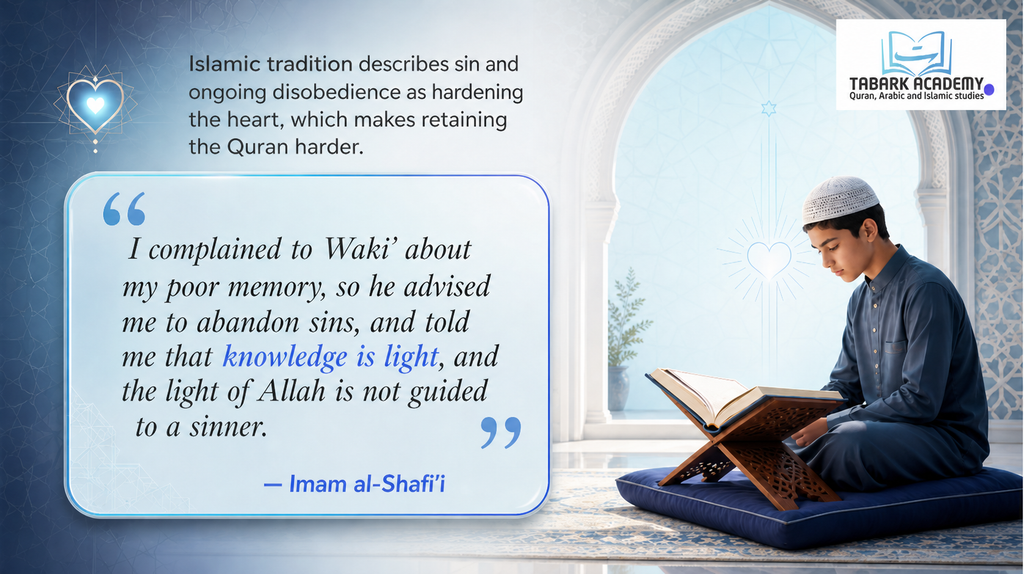
Islamic tradition describes sin and ongoing disobedience as hardening the heart, which makes retaining the Quran harder.
Imam al-Shafi’i put it directly:
“I complained to Waki’ about my poor memory, so he advised me to abandon sins, and told me that knowledge is light, and the light of Allah is not guided to a sinner.”
Scholars have always treated this as something practical, not poetic. A heart that is busy with what it shouldn’t be busy with arrives at the mushaf already full. You read the verse, but nothing stays — because your attention, not your ability, was already spent elsewhere.
Three spiritual causes do most of the damage:
- Weak sincerity. Memorizing to be called a hafiz, to win a family competition, or to hold a position in the community leaves your motivation in other people’s hands.
When nobody is watching, it disappears. Memorizing for Allah’s sake alone doesn’t need an audience, so it survives the quiet weeks.
- Constant distraction. Most of us have trained our minds, through short videos and endless scrolling, to move on every few seconds. That habit comes with you to the mushaf.
The Quran asks for calm, unhurried attention, and heavy phone use wears that down. Even fifteen minutes away from the screen before you start changes how much stays with you.
- Wanting fast results. Hifz moves slowly, and it’s meant to. A student who expects a big change in two weeks will see the normal, slow progress of the first month as failure and stop — right before the habit would have settled in.
Read also: How to Resume Quran Memorization After 5 Years
2- Practical And Methodological Mistakes
Besides the emotional side, some practical mistakes in how you memorize can slow your Hifz down just as much. Spotting these habits early helps you build a routine you can actually keep.
a. Neglecting Daily Review Of Your Quran Hifz
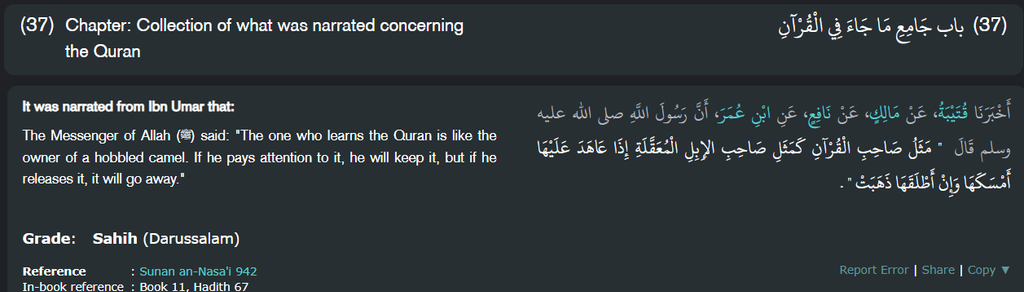
This is the biggest mistake people make when memorizing the Quran. The Prophet ﷺ compared the memorizer to a man who owns a tied-up camel:
“If he pays attention to it, he will keep it, but if he releases it, it will go away” (reported by an-Nasa’i).
The same picture appears in Sahih Muslim, where the Quran is described as slipping away from the heart faster than a tied camel escapes its rope.
The picture fits exactly. A tied camel isn’t lost. It’s still there, but it’s restless. Leave it for a few days without checking and it’s gone — not because it was never yours, but because nobody checked the rope. Review is that checking.
In practice, that means new memorization should never take up your whole session. A workable split for most students is:
- 70% review, 30% new memorization while you’re building.
- Never add a new portion before reciting yesterday’s from memory, correctly, twice.
- Treat a missed review as more urgent than a missed new page — a page you memorized and lost costs more than a page you never started.
Students who skip review don’t just forget; they lose confidence in their own memory, which feeds directly back into barrier (c) above. Review is therefore a psychological tool as much as a technical one.
Read about:: How To Memorize The Quran?
b. Memorizing Large Amounts At Once Without Solidifying Them
Memorizing a lot quickly is rarely the faster way in the end. When you rush, you skip the meaning of the verses, you never settle into the recitation, and you never reach the calm that makes verses stay.
Three things go wrong when the portion is too big:
- The verses mix together. Verses that end in a similar way (the mutashabihat) start getting confused, and you find yourself jumping from one surah into another in the middle of your recitation.
- You memorize your mistakes. A wrong letter or a wrong vowel repeated forty times becomes part of the memory itself, and fixing it later takes much longer than learning it correctly would have.
- You skip the meaning. Without meaning, you’re just memorizing sounds — and sounds with no meaning are the first thing the mind lets go of.
This is where a teacher makes the difference. A private tutor catches the wrong pronunciation on the second repetition instead of the fortieth, sets your portion based on how you actually did last week, and explains the meaning as you memorize, so every passage has something to hold on to.
Watch Tabarak Academy classes in action
Innovative Quran Memorization Method
How To Separate Memorization From Mood
One of the most damaging traps is waiting for the “right mood” or a burst of enthusiasm before you sit down to memorize. Treat it as a fixed daily commitment instead. Four shifts make that possible.

- Commit to a minimum amount of Hifz you never skip. Pick a small daily portion — even a few verses — and complete it no matter what.
Set it low enough that you could still do it on your worst day of the month, because that’s the day it has to survive. Small and consistent beats large and occasional, every time.
- Keep working even when your motivation is low. Keep reciting and reviewing during low-energy periods instead of waiting them out.
On a bad day, drop the new memorization and do review only — that keeps the chain unbroken without demanding energy you don’t have. Consistency carries memorization forward, not enthusiasm.
- Change your method when you stall. Listen to the verses daily before you try to memorize them visually from the page. Hearing them first makes the visual step easier, and it lets you use time your eyes are busy — driving, cooking, walking. Choose one reciter and stay with them, so the rhythm you memorize stays consistent.
- Stop measuring yourself against others. Focus on your own pace and circumstances. Don’t track how fast your peers are moving; you can’t see their schedule, their background in Arabic, or how many hours they actually have. Comparison adds pressure that has nothing to do with your ability to memorize.
How to Train Your Mind to Memorize
Quran teachers and counselors often describe a structured technique for preparing the mind before and during memorization. Some call it the Ten T’s Method. Each step targets a specific mental or physical habit that affects retention.
a- Prepare Your Mind the Night Before Quran Memorization
Memorization starts the night before, not when you open the mushaf. Three things belong in that time.
First, set your intention. Tell yourself simply why you are doing this and for whom. It takes ten seconds, and it answers the sincerity problem mentioned earlier.
Second, fix the way you talk to yourself. Most students carry a discouraging voice to the mushaf — this is going to be slow, I’ll forget it anyway.
Replace it with a true and encouraging one: I memorized my portion yesterday, and I’ll memorize this one too. Remind yourself of the reward waiting in every letter you’re about to recite.
Third, picture it. See yourself sitting down, opening the page, and reciting the passage smoothly to the end. The mind reacts strongly to imagined success, so the real attempt feels familiar instead of frightening.
Do this as you fall asleep, and the first repetitions the next morning usually come much easier.
Read also:Best Surahs to Memorize for Your Daily Salah
b- Warm Up Your Focus, Posture, and Breathing Before Hifz
Don’t jump straight into new Hifz. Spend about five minutes reciting something you already know well. This warms up your voice and your focus. It also starts the session with something easy instead of something hard.
Then get the physical side right:
- Posture: Sit with a straight back. Don’t bend over a low table. Slouching makes breathing harder. It also makes you sleepy within minutes.
- Mushaf position: Hold it a little raised and to your left. Teachers link this eye position with the parts of the brain used for storing and recalling. It also keeps the page in the same place in front of you.
That matters more than students expect. Much of Hifz is remembering where on the page a verse sits. For the same reason, stick to one printing of the mushaf.
- Surroundings: Put your phone in another room. Don’t leave it face-down next to you. One notification costs you far more than the seconds it takes to read it.
- Breath: Take one slow, deep breath through your nose. Do it right before you read the new verse. It slows your heartbeat and steadies your voice. It also draws a clear line between everything else and the verse in front of you

c- Use Melodic Recitation and Repetition to Strengthen Quran Memory
The mind holds on to rhythm. It picks up a tune far faster than flat, unchanging reading. That’s why someone who can’t repeat a paragraph he read yesterday can still sing a song he hasn’t heard in twenty years.
Light tarteel uses this. Give the madd its proper length, make the qalqalah clear, and raise and lower your voice at the natural stopping points. The melody becomes a second key to the memory. When the words slip away, the tune brings them back.
This is why Tajweed and Hifz belong together, not one after the other. Verses memorized with correct lengthening and correct stops keep their shape. Verses memorized flat tend to run into each other.
Repetition then does the rest. It moves what you’ve read from short-term memory into long-term memory. This pattern works well:
- Read the verse while looking at it five to seven times, with the melody.
- Cover the page and recite it from memory three times.
- Join it to the verse before it and recite both together three times.
- Recite the whole portion from the start once before you finish.
Then repeat the portion out loud during the day — after prayers, in the car, before sleeping. Repeating it silently in your head helps. Repeating it out loud helps more, because you use your hearing and your voice, not just your eyes.
d- Link Verses by Sound, Position, and Meaning to Recall Them in Order
Memorization usually breaks at the joins, not in the middle of a verse. You reach the end of an ayah and stop. Nothing links it to the next one.
So, build that link on purpose. Recite the last words of one verse and go straight into the first words of the next. Do it several times, until the join is as strong as the verses themselves.
Use whatever link works for you:
- Sound — a repeated word, a rhyme, or a shared ending between the two verses.
- Sight — where the verse sits on the page, the line number, where the page turns.
- Meaning — an order followed by its reason, a question followed by its answer, one prophet’s story followed by the next.
Meaning is the strongest link of the three. This is why even a little Arabic helps your Hifz so much. When you see that one verse answers the one before it, the order stops feeling random. It becomes a story, and stories are much harder to forget.

Then, protect what you’ve built. Review daily, weekly and monthly, as explained earlier. Slow memorization that is linked and reviewed lasts for years. Rushed memorization rarely lasts a month.
Motivational Techniques That Keep You Going
Motivation isn’t something you either have or lack — it’s something a good setup produces. These five techniques keep you going in your Quran Hifz long after the initial enthusiasm has worn off.

a- Build A Visual Progress Tracker
Draw a chart or a map of the Quran’s thirty parts. Colour in each surah as you finish it. Now your progress is something you can see.
The reason this works is simple. Memorization gives you almost nothing to show for it. You can work carefully for three weeks and feel exactly the same as when you started. A tracker fixes that.
Keep it somewhere you pass every day — inside the mushaf cover, on the fridge, next to your desk. Colour in your review days too, not only new memorization.
Those are the days that feel wasted, and they are the ones you most need to keep. And when you do stop for a week, the tracker shows you the ninety days behind you instead of the seven you misses.
b- Start A Group Memorization Challenge
Find a partner — a brother, a sister, a spouse, a friend from the mosque. Agree on the same portion and the same day to finish it. Memorizing alone becomes a friendly competition. It also gives you a push that works even when your own motivation is gone: you don’t want to be the one who didn’t do it.
A few things keep these challenges alive past the first ten days:
- Keep the portion small and the same for everyone, so nobody falls behind and gives up.
- Set a fixed time to check in — same day, same hour, every week.
- Compete on staying consistent, not on quantity. The winner is whoever missed the fewest days, not whoever memorized the most.
Families do this best. Parents memorize with their children — the children helped by an Arabic and Quran classes for kindergarten. The whole house keeps each other going.

c- Find A Weekly Recitation Partner
Set a regular session. Recite what you’ve memorized to someone who corrects your mistakes and encourages you. Knowing that someone is waiting to hear you works better than willpower.
And reciting to another person does something that reviewing alone can’t. It makes you pull the verses out of your memory under a little pressure, and that is what turns weak memory into solid memory.
There’s a second benefit. There are mistakes you can’t hear in your own recitation — a shortened madd, a missed ghunnah, a word taken from a similar verse. A trained listener hears them at once. Leave them for months and they become part of your memory.
This is why a qualified teacher is better than a friend alone. A friend keeps you committed. A teacher also keeps you correct. In a one-on-one class, that weekly recitation happens by default. You don’t have to wait for a friend to be free.
d- Link Small Rewards to Milestones
Tie a clear reward to a clear milestone — finishing a surah, finishing a juz, thirty days without missing one. This gives you something close by to look forward to. The real reward of Hifz is far greater, of course, but it’s too far away to pull you through an ordinary Tuesday.
Decide the reward before you start, and keep it reasonable. A meal out. A book you’ve been wanting. A day out with the family. A new mushaf when you finish a juz. Saying “I’ll treat myself sometime” does nothing.
This works even better with children. And it works best when the reward is something you do together, not something you buy — a trip, an activity, a day out.
Programmes like our Islamic summer camp work the same way. They tie real progress to something a child actually looks forward to.

e- Change Your Memorization Environment
Try memorizing somewhere new and quiet. The mosque. A different room. A garden. Early in the morning, before anyone else is up. This breaks the boredom of doing the same thing in the same place every day. It helps your memory too.
When you memorize in different places, the verses stop being tied to one room, and you can recall them anywhere.
The mosque is worth mentioning on its own. It takes away the distractions you can’t easily remove at home. You’re surrounded by people doing the same thing. And you went there on purpose, which changes how you sit down to memorize.
If you can’t get there every day, make a “Hifz corner” at home instead. Same place, same light, same mushaf, nothing else on the table. Let that spot mean one thing only
Step Inside Our Virtual Classrooms
See our engaging teaching methods in action! watch real snippets of our live classes and discover how our expert instructors make learning interactive, memorable, and inspiring for every student.
Book Your Free Trial Class and Start Memorizing With Confidence
You now know what has been stopping you. That’s the hard part. The next part is easier than you think — but not if you do it alone, guessing at your portion size and hoping the review sticks.
That’s what a teacher is for. At Tabarak Academy, every student sits with a private, Al-Azhar-certified tutor. Never a group class. Never a waiting list of other students between you and the correction you need.

In your very first session, your tutor will:
- Set a daily portion you can actually finish — based on your real week, not an ideal one.
- Build your review cycle for you, so nothing you memorize slips away again.
- Correct your recitation from the first repetition, before a mistake becomes permanent.
- Fit the class into your schedule — early morning, late evening, or weekends.
See what a Tabarak Academy class actually looks like before you decide anything.
Waw Maddah Rules | Tajweed Lesson
Then, book your free trial class. It costs you nothing, it takes one session, and by the end of it you’ll have something you probably haven’t had before: a plan built around you, and someone who knows exactly where you are in it.
You’ve already spent long enough believing you can’t. Let’s find out what happens when someone shows you how.
Our Quran Memorization / Hifz Courses
- Online Hifz Program
- Juz 30 Memorization Course
- Hifz for Kids Course
- Hifz for Adults Course
- Hifz for Sisters Course
- Short Surah Memorization Course
- Hifz Ijazah Course
Conclusion
Psychological barriers to Quran memorization — fear of forgetting, believing you’re too old, doubting your memory, feeling short on time, or carrying past failures — are rarely permanent. Most soften once you address the real causes behind them, whether spiritual habits or methodological mistakes.
So start with the smallest version of the right habit:
- Name your barrier honestly. Is it a Time Barrier, a Belief Barrier, or a Method Barrier? The wrong fix applied to the wrong problem is why most second attempts fail too.
- Set a daily minimum you never skip. A few lines you complete every day beats a page you manage twice a week.
- Review before you add. Recite yesterday’s portion from memory before you open anything new.
- Prepare the mind, not just the page. The Ten T’s — intention and self-talk the night before, a warm-up, correct posture, one deep breath, melodic repetition, then linking each verse to the next.
- Recite to someone weekly. Errors you can’t hear in your own recitation are the ones that set.
You don’t have to solve all of this alone either. A portion that’s too large, a missing review cycle, a mistake repeated until it stuck — these are exactly what a teacher catches early.
If you want that from the start, book a free trial class with Tabarak Academy and work one-on-one with an Al-Azhar-certified tutor at a pace built around your real schedule.
The barrier that once felt fixed usually turns out to be a habit you can retrain.
FAQs
What are the main psychological barriers to Quran memorization?
The main barriers are fear of forgetting, believing you’re too old to memorize, doubting your own memory, feeling you lack time, and carrying the weight of past failed attempts. Each one is typically a belief, not a factual limitation. Addressing the cause behind it works faster than “trying harder.”
What causes the inability to memorize the Quran?
Inability to memorize usually comes from a mix of spiritual causes — sins, weak sincerity, worldly distraction — and practical mistakes like neglecting review, memorizing too much too fast, or skipping the meaning behind the verses. Both need attention together for lasting progress.
What are some motivational ideas for memorizing the Quran?
Try building a visual progress tracker, starting a group challenge with a friend, setting a weekly recitation session with an accountability partner, linking small rewards to milestones, and changing your memorization location occasionally. These techniques target consistency, not short bursts of enthusiasm.
Can adults still memorize the Quran even if they believe their memory has weakened?
Yes. The brain keeps forming new memory pathways throughout adulthood. What typically declines is training and repetition, not raw capacity. Mental exercises like puzzles, discussion, and regular recitation practice help reactivate that capacity.
How do I stop comparing my memorization progress to other people?
Stop tracking how fast peers are progressing. Measure only your own consistency against your own starting point. Comparison adds pressure that has no bearing on your actual ability to retain the Quran.
Does memorizing too much at once make retention worse?
Yes. Memorizing large amounts in a short period without solidifying them through review is one of the most common practical causes of forgetting. A smaller daily portion backed by daily, weekly, and monthly review holds up far better over time.