


Best Surahs To Memorize For Salah
Many Muslims tend to recite the same one or two short surahs out of habit, not because those surahs are actually the best fit for that prayer. You should know the best surahs to memorize for salah and which ones belong in which prayer. That makes your recitation more varied, more correct, and easier to sustain over years of practice.
This guide focuses on the surahs every praying Muslim needs first. It also points out the short surahs that make memorization manageable, and which surahs the Sunnah recommends for each of the five daily prayers.
1. Al-Fatihah – The Surah Every Salah Requires
Surah Al-Fatihah is the opening Surah of the Quran and holds a unique place in Salah. For a Muslim who is able to recite it, learning Al-Fatihah correctly is more urgent than adding optional Surahs to a beginner’s memorization list.
The Prophet Muhammad ﷺ emphasized its necessity in prayer:
لَا صَلَاةَ لِمَنْ لَمْ يَقْرَأْ بِفَاتِحَةِ الْكِتَابِ
“There is no prayer for the one who does not recite the Opening of the Book.”— Sahih al-Bukhari (756)
For this reason, Al-Fatihah should be a beginner’s first priority. The goal is not simply to memorize its seven ayahs, but to learn their pronunciation carefully and understand their basic meanings so the Surah can be recited confidently in Salah.
Why Is Salah Invalid Without Al-Fatihah?
A Hadith Qudsi gives Surah Al-Fatihah an even deeper significance by describing the exchange that takes place between Allah and His servant during its recitation.
Abu Hurairah reported that the Prophet ﷺ said that Allah said:
قَسَمْتُ الصَّلَاةَ بَيْنِي وَبَيْنَ عَبْدِي نِصْفَيْنِ وَلِعَبْدِي مَا سَأَلَ,فَإِذَا قَالَ الْعَبْدُ: الْحَمْدُ لِلَّهِ رَبِّ الْعَالَمِينَ، قَالَ اللَّهُ تَعَالَى: حَمِدَنِي عَبْدِي
“I have divided the prayer between Myself and My servant into two halves, and My servant shall have what he has asked for.”
When the servant says, “Praise be to Allah, Lord of the worlds,” Allah says, “My servant has praised Me.”— Sahih Muslim (395a)
The hadith continues through the verses of Al-Fatihah, with Allah responding to the servant’s praise, glorification, worship, and supplication. Understanding this exchange can help a learner recite Al-Fatihah with greater attention rather than rushing through it simply from habit.
The schools of Islamic jurisprudence agree on the exceptional importance of Al-Fatihah in Salah, although they differ on some details concerning its legal ruling in particular circumstances and for particular worshippers.
For beginners, the practical lesson is clear: Al-Fatihah deserves careful memorization, correct pronunciation, and attentive recitation because of its central role in prayer and the remarkable dialogue described in this Hadith Qudsi.
Read also: Easiest Surahs to Memorize: A Beginner’s Guide
How To Memorize Al-Fatiha With Understanding?
Structured memorization with aid from a qualified teacher catches pronunciation errors in Al-Fatiha that self-study usually misses. A mispronounced vowel or dropped letter can remain uncorrected for years without a trained ear listening in real time.
Memorize Surah Al-Fatiha in short phrases rather than all seven verses at once, and pause after each phrase to recall its meaning before moving to the next.
This phrase-by-phrase method is standard practice among Quran teachers. It ties memorization to comprehension from the first repetition, instead of treating the two as separate tasks to be handled later.
This is the starting point of most guided hifz programs, including the one at Tabarak Academy, where a certified instructor reviews recitation live rather than after the fact.
2. Al-Ikhlas – Equal To A Third Of The Quran
Surah Al-Ikhlas consists of only four verses, yet the Prophet ﷺ described it as equal to one-third of the Quran. Its exceptional status makes it one of the most important short Surahs for a beginner to memorize and understand.
The Prophet ﷺ said:
وَالَّذِي نَفْسِي بِيَدِهِ إِنَّهَا لَتَعْدِلُ ثُلُثَ الْقُرْآنِ
“By Him in Whose Hand my soul is, it is equal to one-third of the Quran.”— Sahih al-Bukhari (5013)
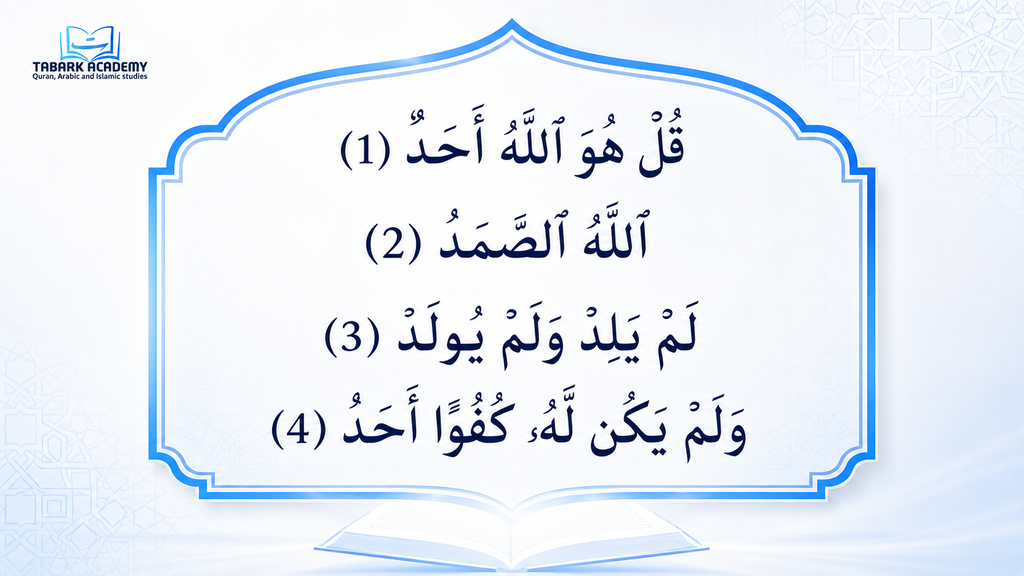
The four verses of Surah Al-Ikhlas present a concise declaration of Allah’s absolute oneness and uniqueness:
قُلْ هُوَ اللَّهُ أَحَدٌ اللَّهُ الصَّمَدُ لَمْ يَلِدْ وَلَمْ يُولَدْ وَلَمْ يَكُن لَّهُ كُفُوًا أَحَدٌ
“Say, ‘He is Allah, [who is] One, Allah, the Eternal Refuge. He neither begets nor is born, nor is there to Him any equivalent.’”— Surah Al-Ikhlas (112:1–4)
Memorizing these four verses gives beginners a short Surah with a profound lesson in Tawhid: Allah is One, completely independent, and unlike anything in His creation.
Read also: Quran Hifz Classes for Sisters – Everything You Need to Start Memorizing Today
3. Al-Mu’awwidhatayn – Al-Falaq And An-Nas
Al-Mu‘awwidhatayn (المعوذتان) refers to the two Surahs of seeking refuge: Surah Al-Falaq and Surah An-Nas.
Both are short and particularly important for beginners because memorizing them allows a Muslim to incorporate them into established daily acts of remembrance and protection.
The Prophet ﷺ instructed ‘Abdullah ibn Khubayb to recite Surah Al-Ikhlas together with Al-Mu‘awwidhatayn three times in the morning and evening:
قُلْ هُوَ اللَّهُ أَحَدٌ وَالْمُعَوِّذَتَيْنِ حِينَ تُمْسِي وَحِينَ تُصْبِحُ ثَلَاثَ مَرَّاتٍ تَكْفِيكَ مِنْ كُلِّ شَيْءٍ
“Recite ‘Say: He is Allah, One’ and Al-Mu‘awwidhatayn three times in the evening and in the morning. They will suffice you against everything.”— Sunan Abi Dawud (5082)
The exceptional status of these two Surahs is also established in an authentic narration from ‘Uqbah ibn ‘Amir. The Prophet ﷺ said:
أَلَمْ تَرَ آيَاتٍ أُنْزِلَتِ اللَّيْلَةَ لَمْ يُرَ مِثْلُهُنَّ قَطُّ قُلْ أَعُوذُ بِرَبِّ الْفَلَقِ وَقُلْ أَعُوذُ بِرَبِّ النَّاسِ
“Have you not seen verses revealed tonight, the like of which has never been seen? ‘Say: I seek refuge in the Lord of daybreak’ and ‘Say: I seek refuge in the Lord of mankind.’”— Sahih Muslim (814)
The Prophet ﷺ also recited these two Surahs in the Fajr prayer. ‘Uqbah ibn ‘Amir reported:
فَلَمَّا صَلَّى رَسُولُ اللَّهِ ﷺ صَلَاةَ الصُّبْحِ قَرَأَ بِالْمُعَوِّذَتَيْنِ
“When the Messenger of Allah ﷺ prayed the morning prayer, he recited Al-Mu‘awwidhatayn.”— Sunan an-Nasa’i (5439)
Together, Surah Al-Falaq and Surah An-Nas teach Muslims to seek Allah’s refuge from different forms of visible and hidden evil. Their brevity, regular use in the Sunnah, and clear themes of seeking protection make them especially valuable Surahs for beginners to memorize early.
Step Inside Our Virtual Classrooms
See our engaging teaching methods in action! watch real snippets of our live classes and discover how our expert instructors make learning interactive, memorable, and inspiring for every student.
4. Al-Kafirun
Surah Al-Kafirun is a powerful declaration of Tawhid and rejection of shirk. Its place in the Prophet’s ﷺ voluntary prayers makes it especially valuable for beginners who want to memorize Surahs they can regularly use in worship.
Ibn ‘Umar reported that the Prophet ﷺ frequently paired Surah Al-Kafirun with Surah Al-Ikhlas in the Sunnah prayers before Fajr and after Maghrib:
رَمَقْتُ النَّبِيَّ ﷺ أَرْبَعًا وَعِشْرِينَ مَرَّةً يَقْرَأُ فِي الرَّكْعَتَيْنِ قَبْلَ الْفَجْرِ وَالرَّكْعَتَيْنِ بَعْدَ الْمَغْرِبِ قُلْ يَا أَيُّهَا الْكَافِرُونَ وَقُلْ هُوَ اللَّهُ أَحَدٌ
“I observed the Prophet ﷺ twenty-four times reciting in the two rak‘ahs before Fajr and the two rak‘ahs after Maghrib: ‘Say: O disbelievers’ and ‘Say: He is Allah, One.’”— Jami‘ at-Tirmidhi (431)
The same pairing is authentically reported in the two rak‘ahs following Tawaf. Jabir ibn ‘Abdullah reported that the Prophet ﷺ recited:
فَقَرَأَ فِيهِمَا بِالتَّوْحِيدِ وَقُلْ يَا أَيُّهَا الْكَافِرُونَ
“He recited in them ‘Say: He is Allah, One’ and ‘Say: O disbelievers.’”— Sahih Muslim (1218a)
Together, Surah Al-Kafirun and Surah Al-Ikhlas express two complementary aspects of Tawhid: Al-Kafirun rejects false worship and religious compromise, while Al-Ikhlas affirms Allah’s absolute oneness and uniqueness.
Read also: Is It Too Late to Learn to Read the Quran as an Adult? Practical Steps to Start Today
5. Surah Al-Kawthar
Surah Al-Kawthar is the shortest Surah in the Quran by word count and a practical choice for children and beginners learning short Surahs for Salah. Despite its brevity, it carries a profound message about the abundant blessings Allah granted Prophet Muhammad ﷺ.
Ibn ‘Abbas explained Al-Kawthar as the abundant good Allah gave to the Prophet ﷺ:
الْكَوْثَرُ الْخَيْرُ الْكَثِيرُ الَّذِي أَعْطَاهُ اللَّهُ إِيَّاهُ
“Al-Kawthar is the abundant good which Allah gave to him.”— Sahih al-Bukhari (4966)
The river of Al-Kawthar in Paradise is part of this abundant good. The Prophet ﷺ described it in another narration:
هُوَ نَهَرٌ فِي الْجَنَّةِ حَافَّتَاهُ مِنْ ذَهَبٍ وَمَجْرَاهُ عَلَى الدُّرِّ وَالْيَاقُوتِ تُرْبَتُهُ أَطْيَبُ مِنَ الْمِسْكِ وَمَاؤُهُ أَحْلَى مِنَ الْعَسَلِ وَأَبْيَضُ مِنَ الثَّلْجِ
“It is a river in Paradise whose banks are of gold and whose course is over pearls and rubies. Its soil is more fragrant than musk, its water is sweeter than honey, and whiter than snow.”— Jami‘ at-Tirmidhi (3361)
Surah Al-Kawthar therefore teaches more than a short passage for memorization. It reminds Muslims of Allah’s immense blessings upon His Messenger ﷺ and connects those blessings with sincere prayer and worship of Allah alone.
Read also: Best Surahs to Memorize First: A Beginner’s Guide
6. Surah Al-Asr
Surah Al-Asr shares many of the qualities that make short Surahs valuable for beginners. In only three verses, it emphasizes the value of time and identifies the qualities necessary to avoid loss.
وَالْعَصْرِ إِنَّ الْإِنسَانَ لَفِي خُسْرٍ إِلَّا الَّذِينَ آمَنُوا وَعَمِلُوا الصَّالِحَاتِ وَتَوَاصَوْا بِالْحَقِّ وَتَوَاصَوْا بِالصَّبْرِ
“By the ˹passage of˺ time! Surely humanity is in ˹grave˺ loss, except those who have faith, do good, and urge each other to the truth, and urge each other to perseverance.”— Surah Al-Asr (103:1–3)
The Surah identifies four essential qualities: faith, righteous deeds, encouraging one another to truth, and encouraging one another to patience. Its brevity and clear structure make it manageable for beginners to memorize and recite after Al-Fatihah in Salah while reflecting on these principles.
For recitation after Al-Fatihah, Imam an-Nawawi mentions in Al-Majmu‘ that reciting a complete short Surah is preferable to reciting an equivalent portion of a longer Surah.
This also gives beginners a practical reason to prioritize complete short Surahs: they can finish a coherent passage without accidentally stopping at a point that leaves the meaning incomplete.
Read also: What Is Juz Amma? Meaning, Structure, and Why It’s First?
Which Surahs To Recite In Each Prayer?
The Sunnah teaches us general guidance on surah length by prayer time. This isn’t a fixed rule. Reciting differently is permitted. However, it reflects how the Prophet ﷺ and his companions structured their recitation across the day.
Fajr And Dhuhr – The Long Surahs
Fajr and Dhuhr are among the prayers in which longer Quranic recitation is established in the Sunnah. The Prophet ﷺ was reported to recite longer portions of the Quran in these prayers, particularly in Fajr.
Abu Barzah al-Aslami reported concerning the Prophet’s ﷺ Fajr prayer:
وَكَانَ يَقْرَأُ فِي الْفَجْرِ مَا بَيْنَ السِّتِّينَ إِلَى الْمِائَةِ آيَةٍ
“He used to recite between sixty and one hundred verses in the Fajr prayer.”— Sahih al-Bukhari (541)
Abu Sa‘id al-Khudri also described the relative length of the Prophet’s ﷺ recitation in Dhuhr:
كُنَّا نَحْزِرُ قِيَامَ رَسُولِ اللَّهِ ﷺ فِي الظُّهْرِ وَالْعَصْرِ فَحَزَرْنَا قِيَامَهُ فِي الرَّكْعَتَيْنِ الأُولَيَيْنِ مِنَ الظُّهْرِ قَدْرَ قِرَاءَةِ الم تَنْزِيلُ السَّجْدَةِ
“We used to estimate the length of the Messenger of Allah’s ﷺ standing in Dhuhr and ‘Asr. We estimated his standing in the first two rak‘ahs of Dhuhr as approximately the length of the recitation of Alif-Lam-Mim Tanzil [Surah As-Sajdah].”— Sahih Muslim (452a)
These narrations provide a stronger basis for recommending longer recitation in Fajr and Dhuhr than attributing it to concentration being naturally highest at those times, which is not itself the reason stated in these hadiths.
Read also: Easily Memorize Juz Amma With This Simple Method
Asr And Isha – The Middle-Length Surahs
Asr and Isha are generally associated in scholarly discussions with more moderate-length recitation than Fajr. The Prophet ﷺ varied his recitation, so these categories should be understood as general guidance rather than rigid requirements.
Abu Hurairah reported regarding the Prophet’s ﷺ recitation in ‘Isha:
فَمَا صَلَّيْتُ وَرَاءَ أَحَدٍ أَشْبَهَ صَلَاةً بِرَسُولِ اللَّهِ ﷺ مِنْ فُلَانٍ … وَفِي الْعِشَاءِ فِي وَسَطِ الْمُفَصَّلِ
“I have not prayed behind anyone whose prayer more closely resembled that of the Messenger of Allah ﷺ than so-and-so…” and regarding ‘Isha, “he recited from the middle of Al-Mufassal.”— Sunan an-Nasa’i (982)
The Prophet ﷺ also instructed Mu‘adh ibn Jabal to use manageable Surahs when leading ‘Isha:
فَاقْرَأْ بِالشَّمْسِ وَضُحَاهَا وَسَبِّحِ اسْمَ رَبِّكَ الأَعْلَى وَنَحْوِهَا
“Recite ‘By the sun and its brightness’ [Ash-Shams], ‘Glorify the Name of your Lord, the Most High’ [Al-A‘la], and similar Surahs.”— Sahih Muslim (465a)
These reports support moderate recitation in ‘Isha. However, examples such as Surah Ad-Duha and Surah Al-Layl should not be treated as fixed requirements for Asr or ‘Isha, since the Prophet’s ﷺ recitation varied.
Maghrib – The Short Surahs
There is a common mistake worth naming directly: consistently defaulting to Al-Ikhlas and An-Nas in every prayer, including Fajr and Dhuhr, because they’re the only surahs memorized. It isn’t invalid, but it limits both the variety of your recitation and the range of surahs you actually retain in hifz over time.
Maghrib prayer is traditionally paired with Qisar al-Mufassal. The same short surahs beginners memorize first, including Al-Ikhlas and Al-Mu’awwidhatayn. In Al-Maghrib prayer, reciting only short surahs is least likely to be seen as a shortcut, since it matches established practice rather than working around it.
Rotating in even two or three surahs from Awsat al-Mufassal noticeably widens what you’re able to recall a year later.
Read also: Can I Memorize the Quran at 40? A Realistic Guide for Adult Learners
Best Surahs For Sunnah And Voluntary Prayers
Certain Sunnah and voluntary prayers have specific surah pairings documented in hadith. That makes them a practical shortlist for memorization.
Sunnah Fajr, Maghrib, Tawaf, And Istikharah
Two authentic patterns are reported for the two rak‘ahs before Fajr. Ibn ‘Abbas reported that the Prophet ﷺ sometimes recited Surah Al-Baqarah 2:136 in the first rak‘ah and Surah Aal ‘Imran 3:64 in the second.
قُولُوا آمَنَّا بِاللَّهِ وَمَا أُنزِلَ إِلَيْنَا وَمَا أُنزِلَ إِلَىٰ إِبْرَاهِيمَ وَإِسْمَاعِيلَ وَإِسْحَاقَ وَيَعْقُوبَ وَالْأَسْبَاطِ وَمَا أُوتِيَ مُوسَىٰ وَعِيسَىٰ وَمَا أُوتِيَ النَّبِيُّونَ مِن رَّبِّهِمْ لَا نُفَرِّقُ بَيْنَ أَحَدٍ مِّنْهُمْ وَنَحْنُ لَهُ مُسْلِمُونَ
“Say, ˹O believers,˺ ‘We believe in Allah and what has been revealed to us; and what was revealed to Abraham, Ishmael, Isaac, Jacob, and his descendants; and what was given to Moses, Jesus, and other prophets from their Lord. We make no distinction between any of them. And to Allah we all submit.’”— Surah Al-Baqarah (2:136)
قُلْ يَا أَهْلَ الْكِتَابِ تَعَالَوْا إِلَىٰ كَلِمَةٍ سَوَاءٍ بَيْنَنَا وَبَيْنَكُمْ أَلَّا نَعْبُدَ إِلَّا اللَّهَ وَلَا نُشْرِكَ بِهِ شَيْئًا وَلَا يَتَّخِذَ بَعْضُنَا بَعْضًا أَرْبَابًا مِّن دُونِ اللَّهِ ۚ فَإِن تَوَلَّوْا فَقُولُوا اشْهَدُوا بِأَنَّا مُسْلِمُونَ
“Say, ‘O People of the Book! Let us come to common terms: that we will worship none but Allah, associate none with Him, nor take one another as lords instead of Allah.’ But if they turn away, then say, ‘Bear witness that we have submitted ˹to Allah alone˺.’”— Surah Aal ‘Imran (3:64)
This practice is authentically reported from the Prophet ﷺ.— Sahih Muslim (727a)
Another established Sunnah is to recite Surah Al-Kafirun in the first rak‘ah and Surah Al-Ikhlas in the second. The same two Surahs are also authentically reported from the Prophet ﷺ in the two rak‘ahs after Maghrib and after Tawaf.
Witr Prayer
A well-known three-rak‘ah Witr pattern is also established in the Sunnah. Ubayy ibn Ka‘b reported:
كَانَ رَسُولُ اللَّهِ ﷺ يُوتِرُ بِسَبِّحِ اسْمَ رَبِّكَ الأَعْلَى وَقُلْ يَا أَيُّهَا الْكَافِرُونَ وَقُلْ هُوَ اللَّهُ أَحَدٌ
“The Messenger of Allah ﷺ used to pray Witr with ‘Glorify the Name of your Lord, the Most High,’ ‘Say: O disbelievers,’ and ‘Say: He is Allah, One.’”— Sunan an-Nasa’i (1702)
Thus, the established three-Surah pattern is Al-A‘la in the first rak‘ah, Al-Kafirun in the second, and Al-Ikhlas in the third. Some narrations additionally mention Al-Falaq and An-Nas, but the three-Surah pattern above is the safer formulation when describing the well-established Witr Sunnah.
The claim that the Al-Kafirun/Al-Ikhlas pairing specifically applies to Istikharah should also be omitted unless supported separately; the authentic hadith of Istikharah prescribes two non-obligatory rak‘ahs and the du‘a, but does not specify these two Surahs.
Read also: 10 Strategies Of How To Memorize Quran Fast And Never Forget
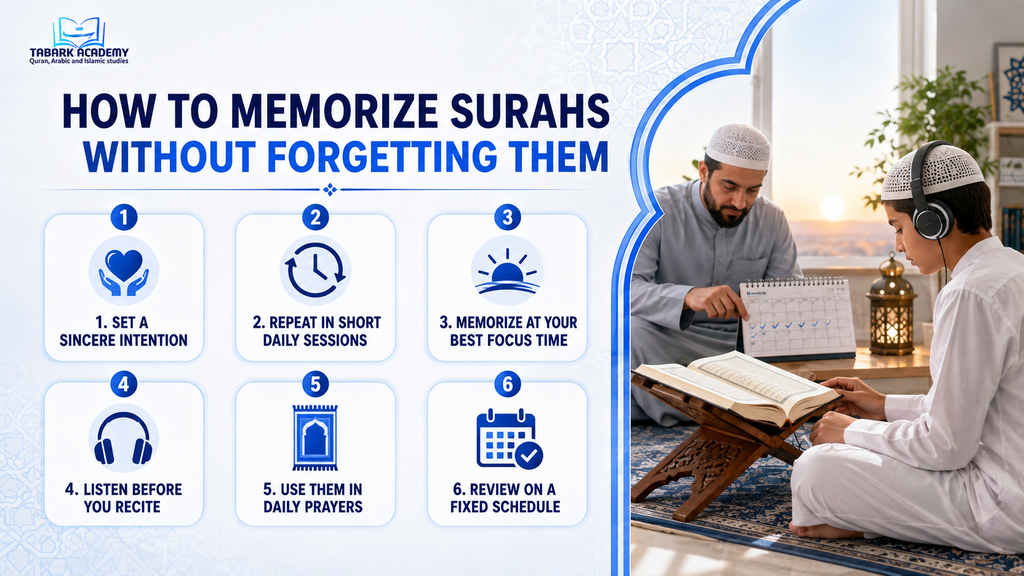
How To Memorize Short Surahs Without Forgetting Them?
Memorizing a surah and retaining it are two different skills. The second one is where most self-taught memorization fails.
1. Set A Genuine Intention First
Memorization that depends on sincere intention lasts better during the absence of motivation than memorization done purely for routine or obligation.
2. Repeat In Short, Daily Sessions
Repeating a surah several times throughout the day, rather than once in a long session, gives the memory more chances to encode it. Ten focused minutes daily consistently outperforms an hour once a week.
3. Memorize At Times Of Strong Focus
Early morning, before the day’s distractions accumulate, is widely reported by memorization teachers as the period of strongest focus for most students.
Read also: How To Memorize The Quran?
4. Listen Before You Recite
Listening to a surah recited by a reciter such as Sheikh Mahmoud Khalil Al-Husary before attempting to memorize it builds an internalized model of correct pronunciation that reading alone does not provide.
5. Apply What You Memorize Immediately
Reciting a surah that you memorized recently in your actual daily prayers, not just in isolated practice, reinforces it faster than repetition outside of salah. That’s because the context of prayer itself becomes part of the memory.
6. Review On A Fixed Schedule
The surahs that you previously memorized fade without scheduled review, even when you add new ones. A short daily review cycle of everything memorized so far prevents this from becoming a pattern.
This kind of structured, review-based approach is exactly what a guided hifz program is built to enforce. A teacher tracks what’s been memorized, what needs review, and catches slips in memorized surahs before they turn into permanent habits. That structure is difficult to maintain consistently through self-study alone.
Read also: How To Start Memorizing The Quran As A Beginner?
Start Your Hifz Journey The Right Way
Memorizing surahs correctly and keeping them in mind is more important than memorizing only the right surahs.
A teacher who reviews your recitation live, corrects pronunciation as it happens, and builds a review schedule around what you’ve already learned turns scattered memorization into lasting hifz.
Tabarak Academy connects students with qualified Quran teachers for structured, one-on-one memorization support built around your pace and schedule.
Our Quran Memorization / Hifz Courses
- Online Hifz Program
- Juz 30 Memorization Course
- Hifz for Kids Course
- Hifz for Adults Course
- Hifz for Sisters Course
- Short Surah Memorization Course
- Hifz Ijazah Course
Conclusion
The best surahs to memorize for salah start with Al-Fatiha, which no rak’ah can proceed without, followed by the short surahs of Qisar al-Mufassal that make daily recitation manageable for beginners.
From there, matching surah length to prayer time- long surahs for Fajr and Dhuhr, middle-length for Asr and Isha, short for Maghrib- and learning the specific pairings used in Sunnah and Witr prayers builds a recitation practice that’s both varied and rooted in established practice.
The surahs matter less on their own than how consistently and correctly they’re memorized, reviewed, and recited in actual prayer.
Frequently Asked Questions
Is It Valid To Recite The Same Surah In Every Prayer?
Yes, it is valid, though scholars note it is more complete to vary your recitation. If you have only memorized one or two short surahs, reciting them repeatedly does not invalidate your salah — it simply limits the variety recommended in the Sunnah.
How Many Surahs Should A Beginner Memorize Before Praying Regularly?
A beginner needs Al-Fatiha plus at least one short surah, such as Al-Ikhlas or Al-Kawthar, to begin praying independently. Additional short surahs can be added gradually as memorization becomes more comfortable.
What Is Al-Mufassal In The Quran?
Al-Mufassal refers to the final section of the Quran, starting roughly at Surah Al-Hujurat and running to Surah An-Nas, divided by scholars into long (Tiwal), middle (Awsat), and short (Qisar) subsections based on surah length.
Can I Recite Part Of A Surah Instead Of The Whole Thing?
You can, but reciting a full short surah is considered preferable to reciting only part of a longer one, since stopping mid-surah risks breaking off before a connected thought is complete.
What Surah Is Recommended For Witr Prayer?
A commonly reported pattern for three-rak’ah Witr is Al-A’la in the first rak’ah, Al-Kafirun in the second, and Al-Ikhlas with Al-Mu’awwidhatayn in the third, based on authentic hadith reports.
Does Memorizing Surahs Out Of Mushaf Order Affect My Salah?
Reciting surahs in mushaf order is the Sunnah practice, but reciting out of order is permissible, though slightly disliked according to some scholars. No clear prohibition has been established against it.