


Rememorization Plan After 5 Years Break – Your 90-Day Comeback Guide
You still remember the day you closed the Mushaf “just for this semester.” Five years later, you are searching for a re memorization plan after 5 years break, half convinced the pages are gone forever.
They are not gone. Memory research and the experience of thousands of returning students agree on the same thing: dormant memorization decays far slower than it feels, and it reactivates much faster than fresh material.
At Tabarak Academy, returning adults are one of the largest groups we teach — people who once held five juz and now hesitate to open Surah Al-Fatihah out loud.
This guide gives you the exact 90-day structure, the daily session shape, and the honest mindset shift that turns a five-year gap into a starting line instead of a verdict.
Key Highlights of This Article:
- How five years of dormancy actually affects stored memorization, and what survives.
- A phased 90-day comeback plan you can start this week.
- The daily session structure that protects old pages while you add new ones.
- Practical fixes for guilt, time pressure, and Tajweed habits that hardened during the gap.
Why A Re Memorization Plan After 5 Years Break Works Differently
A returning student is not a beginner, and treating yourself like one wastes months. Any serious re memorization plan after 5 years break has to be built on relearning speed, not first-time learning speed.
What Actually Happened To Your Memory During The Break
Your memorization did not disappear — it lost accessibility, not existence. The traces are still stored; what weakened is the retrieval path that once made verses arrive automatically.
This is why the first recitation attempt feels humiliating and the third feels familiar. Relearning something once memorized is dramatically faster than learning it cold, which is exactly why a re memorization plan after 5 years break should front-load recovery before expansion.
The spacing of your sessions matters more than their length. The ideal gap between reviews grows as the period you need to retain material grows.
Sleep does the quiet half of the work. As explained in this NIH News in Health feature on sleep and learning, deep sleep stabilises new memories, so a short session before rest often outperforms a long one at 2 a.m.
Why Restarting From Surah Al-Baqarah Is The Wrong First Move
Starting again from page one is the most common reason comebacks collapse in week three. You spend your motivation on pages you partially hold while the pages you fully hold keep fading.
Sequence matters. Recover the strongest material first, because early wins rebuild the confidence that carries you through the difficult middle stretch.
There is also a Tajweed reason. Familiar surahs let a teacher hear your pronunciation habits immediately, without the cognitive load of new memorization masking the errors.
Come back with a map, not guesswork. One free trial session with a certified Hifz teacher turns five foggy years into a written, page-by-page plan — start with the Hifz for Adults Course.

Read also: How Long Does It Take To Memorize The Quran? A Realistic Roadmap
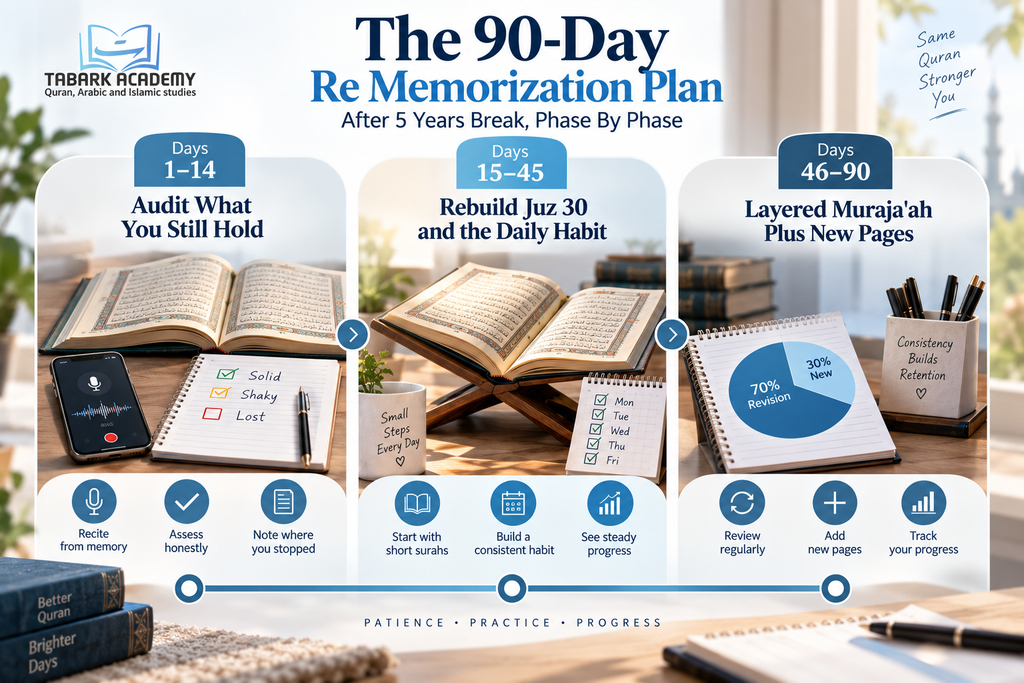
The 90-Day Re Memorization Plan After 5 Years Break, Phase By Phase
Ninety days is long enough to rebuild real retention and short enough to stay motivating. Treat the three phases below as a sequence, never as options to mix.
Days 1–14 – Audit What You Still Hold
Spend the first fortnight measuring, not memorizing. Recite from memory into your phone, page by page, and mark each page as solid, shaky, or lost.
An honest audit is the backbone of any re memorization plan after 5 years break, because it replaces the vague “I forgot everything” with a countable list. Most returning students discover 40–60% of their old pages sit in the shaky column, not the lost one.
Keep the sessions to 20 minutes and keep the Mushaf closed while reciting. Open it only to check, then note the exact ayah where your memory broke — that ayah is tomorrow’s starting point.
Experience Our Interactive Learning
Curious about how we teach? Watch these brief video clips from our recent live sessions to see our structured curriculum, advanced learning platform, and dynamic student-teacher interactions firsthand.
Days 15–45 – Rebuild Juz 30 And Rebuild The Daily Habit
Now recover, in this order: Juz 30, then Juz 29, then whatever you held beyond them. Short surahs give you high page-count wins per minute, which is precisely what a fragile new habit needs.
Aim for one page recovered per session, five sessions weekly, and stop there even when you feel capable of more. Overreaching in week four is the single most predictable cause of a second break.
If Juz 30 is where your foundation sits, the structured Juz 30 Memorization Course covers exactly this stretch with paced revision built in.

Days 46–90 – Layered Muraja’ah Plus New Pages
Only in phase three do you add genuinely new memorization. By now your retrieval speed has recovered, so new pages cost you far less effort than they would have in week one.
Split every session: roughly 70% revision of recovered pages, 30% new material. That ratio feels slow, and it is the reason returning students who follow it are still reciting in month twelve.
Track completion in writing. A simple sheet with page numbers and review dates does more for retention than any app, because it makes a missed cycle visible the same day it happens.
Recommended reading: Is It Too Late to Memorize the Quran? The Honest Answer for Adult Learners
The Daily Session Structure That Stops Old Pages From Slipping
Structure beats willpower. The whole point of a re memorisation plan after 5 years break is that each sitting protects yesterday’s gains automatically, without you deciding what to do.
The Three-Layer Revision Method
Every session runs three layers: yesterday’s page, this week’s pages, and one older page on rotation. Ten minutes, five minutes, five minutes — that is the entire architecture.
Layer one locks in what is freshest and most fragile. Layer two consolidates the current week into a block you can recite continuously rather than page by page.
Layer three is the layer everyone skips and everyone regrets skipping. Cycling one old page daily means every page you own gets revisited on a fixed schedule, which is how a re memorization plan after 5 years break stops becoming a second forgetting.
Allah, the Most High, said:
“وَلَقَدْ يَسَّرْنَا الْقُرْآنَ لِلذِّكْرِ فَهَلْ مِن مُّدَّكِرٍ”
“And We have certainly made the Quran easy to remember. So is there anyone who will be mindful?” — Surah Al-Qamar 54:17
Your revision, finally on a schedule someone else keeps. Weekly one-to-one sessions that track every page you recover — see the Online Hifz Program.

Correcting Tajweed Errors That Froze In Before Your Break
Five years of silence preserves your mistakes perfectly. Whatever you mispronounced at seventeen is still mispronounced now, and it is now wrapped inside the memory itself.
Fix pronunciation during the audit phase, not later. Re-memorizing a page with a corrected Madd or a corrected Ghunnah is straightforward; unpicking it after 200 repetitions is not.
This is the one part of the plan that genuinely cannot be self-taught, because you cannot hear an error you were never taught to hear.
Structured Online Tajweed Classes paired with focused listening will surface in one session what a year of solo practice hides.

Common Obstacles When You Return After Five Years
The obstacles are rarely about memory. Almost every stalled re memorization plan after 5 years break fails for emotional or logistical reasons, both of which are fixable.
1. Guilt And The Fear Of Forgetting All Over Again
Guilt is the heaviest bag returning students carry, and it is the least useful. The Prophet ﷺ described the situation plainly rather than harshly.
The Messenger of Allah ﷺ said:
“إِنَّمَا مَثَلُ صَاحِبِ الْقُرْآنِ كَمَثَلِ صَاحِبِ الإِبِلِ الْمُعَقَّلَةِ إِنْ عَاهَدَ عَلَيْهَا أَمْسَكَهَا وَإِنْ أَطْلَقَهَا ذَهَبَتْ”
“The example of the person who knows the Qur’an by heart is like the owner of tied camels. If he keeps them tied, he will control them, but if he releases them, they will run away.” — Sahih al-Bukhari 5031
The image is instructive, not condemning: camels that wander can be gathered again. Replace guilt with a number. “I recover one page a day” is something you can do tonight; “I ruined five years” is not.
2. Finding Time As A Working Adult Or A Busy Parent
Twenty focused minutes daily beats two hours every Saturday, and the research on spacing explains why. Consistency, not volume, is what a returning memorizer is short of.
Anchor the session to something that already happens — after Fajr, after the commute, after the children sleep. Habits attached to existing routines survive busy weeks; free-floating intentions do not.
If weekdays are genuinely impossible, structured Weekend Quran Classes at Tabarak Academy keep accountability alive without pretending your schedule is something it isn’t.
Read also: Quran Classes for Professionals: Evening Schedule

Twenty minutes. One teacher. Zero guesswork. Sessions in your timezone, morning to late evening — explore the Hifz for Sisters Course.
Rebuild Your Hifz With Tabarak Academy’s Written Progress Reports And Al-Azhar Certified Teachers
Here is what genuinely separates a comeback that lasts from one that fades: someone measuring it. At Tabarak Academy, every returning student receives monthly written assessments covering memorization accuracy, revision completion, and Tajweed consistency — so you are never guessing whether the plan is working.
That reporting matters more for returners than for beginners. You already know how it feels to drift for weeks without noticing; a documented record of pages recovered and cycles completed removes exactly that blind spot.
Behind the reports are Al-Azhar certified Huffaz tutors with verified Ijazah, teaching one-to-one in English — never in groups. Sessions come in 30, 45, or 60 minutes, two to five times weekly, and your plan is written before your first real page, sized to your actual life rather than a template.
You also keep control. Female tutors are available for sisters and girls, scheduling spans every timezone from early morning to late evening, the first class is free with no card required, and there is no lock-in contract — so a five-year gap costs you nothing to test.
Step Inside Our Virtual Classrooms
See our engaging teaching methods in action! watch real snippets of our live classes and discover how our expert instructors make learning interactive, memorable, and inspiring for every student.

Further reading: The Best Method To Memorize Quran
Start Your Quran Memorization Comeback This Week!
Book your free trial session with Tabarak Academy today. Bring nothing but your Mushaf and an honest answer to one question: which surah was the last one you knew cold?
In that first session, your teacher will run the audit with you, identify the Tajweed habits worth correcting immediately, and hand you a written phase-by-phase plan with page targets and review dates.
No card, no contract, no group class you get lost inside. Just a certified teacher, your name on a schedule, and the first page back where it belongs — claim your free class now.
Our Quran Memorization / Hifz Courses
- Online Hifz Program
- Juz 30 Memorization Course
- Hifz for Kids Course
- Hifz for Adults Course
- Hifz for Sisters Course
- Short Surah Memorization Course
- Hifz Ijazah Course

Conclusion
Five years of silence weakened your access to the Quran, not your ownership of it. Audit first, recover Juz 30 and 29 next, and only then add new pages — with 70% of every session reserved for revision.
Fix Tajweed during the audit while errors are still loose. Anchor twenty minutes to an existing daily routine, cycle one old page every single day, and let sleep finish the consolidation.
The real takeaway is this: your comeback is a scheduling problem, not a memory problem. A written re memorization plan after 5 years break, one certified teacher, and ninety consistent days are all that stands between you and the pages you thought were lost.
Frequently Asked Questions
What Is The 6446 Method?
It is a repetition-count technique where each ayah is read six times from the Mushaf, recited four times from memory, then the next ayah gets the same treatment before the pair is linked and repeated together. It works well for fresh pages but needs a separate revision cycle layered on top, which is exactly what Tabarak Academy’s three-layer Muraja’ah system adds.
How To Become A Hafiz In 2 Years?
Two years requires roughly one page daily, five to six days weekly, with half of every session spent on revision rather than new material. Tabarak Academy builds two-year tracks around 45 or 60-minute one-to-one sessions, four to five times weekly, with monthly written assessments confirming you are on pace.
Is Memorizing The Quran Difficult?
It is demanding but not difficult in the way most people fear — the hard part is daily consistency, not memory capacity. Students who memorize successfully are rarely the most gifted ones; they are the ones with a fixed schedule and a teacher who notices when a page slips.
Is Hifz Compulsory For Muslims?
Complete memorization of the Quran is not obligatory; what is required is memorizing enough to perform your prayers correctly, and scholars treat full hifz as a highly recommended virtue. Tabarak Academy therefore offers everything from short surah tracks to full hifz programs, so your goal sets the plan rather than the reverse.
How To Memorize Fast In 5 Minutes?
Five minutes is enough for one short ayah if you use active recall — read it twice, then close the Mushaf and recite it from memory until it comes out clean. Speed on day one means nothing without review on day three, which is why Tabarak Academy schedules every page you memorize into a dated revision cycle.