

Quran Classes For Non-Arabic Speakers
Quran classes for non-Arabic speakers solve a problem many learners know well: you can follow the Arabic letters on the page, but your mouth won’t produce the ض or the ع the way the reciter does. Or maybe you have never read a word of Arabic and want to start the right way.
This guide explains the four proven methods these classes use to teach recitation from zero, which sounds give non-native learners the most trouble, the learning order that prevents bad habits, and how to judge whether an online program deserves your time.
What Quran Classes For Non-Arabic Speakers Include
Quran classes for non-Arabic speakers are structured lessons that teach people whose first language isn’t Arabic to read, pronounce, understand, and memorize the Quran. They combine pronunciation correction, simplified Tajweed rules, and word meanings explained in the student’s own language, starting from the alphabet when needed.
They differ from standard Quran classes in one key way: the teacher cannot assume the student hears Arabic sounds correctly. An Arab child already tells س from ص by ear. An English, Malay, or German speaker often can’t at first, so lessons spend more time on sound before speed.
How Quran Classes For Non-Arabic Speakers Teach Recitation From Zero
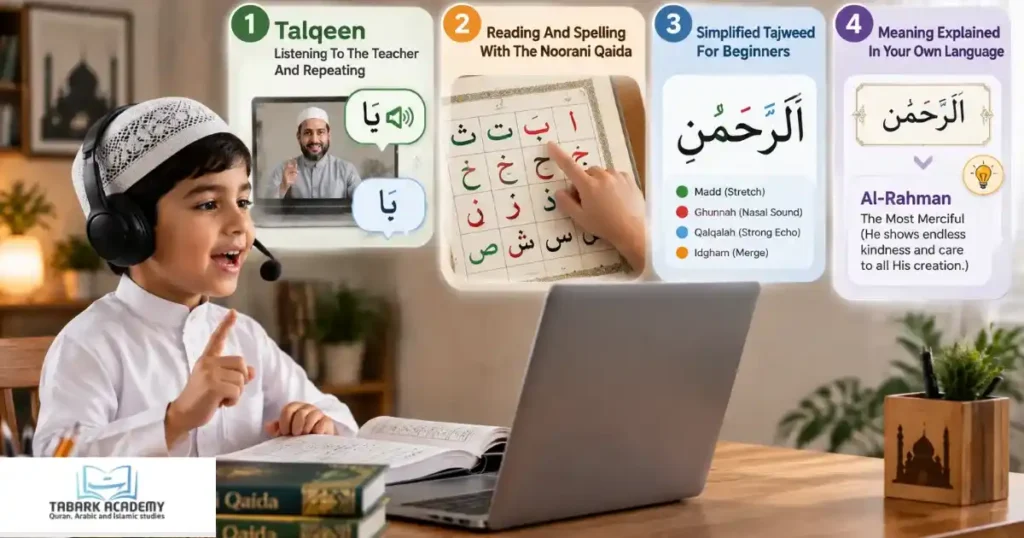
Effective programs rely on four methods that work together. Each one solves a different problem a non-native learner faces, from hearing a sound correctly to remembering what a verse means. Knowing what each method looks like in a real lesson also helps you judge whether a class is teaching you properly.
1. Talqeen – Listening To The Teacher And Repeating
Talqeen is the oral method of learning recitation by hearing a qualified teacher recite, repeating straight after, and being corrected letter by letter.
It is how the Quran has been passed down for centuries, and it matters even more for non-Arabic speakers, because no written explanation can show exactly where a sound is produced. A description like “pronounce ‘ayn from the middle of the throat” only becomes clear once you hear it, try it, and get immediate feedback.
In a well-run lesson, the teacher recites a short phrase rather than a full verse, waits for you to repeat it, and stops you on the exact letter that went wrong. If a teacher lets you read long passages without interrupting, many small errors pass without correction.
2. Reading And Spelling With The Noorani Qaida
Most beginners start with the Noorani Qaida, a primer that moves from single letters to joined letters, short vowels (fatha, kasra, damma), tanween, sukoon, and shaddah. Students build up gradually until they can read the short surahs of Juz Amma without help.
Its strength is that every lesson adds one new rule while reusing everything learned before, and the practice lines are built from real Quranic words. By the time you open the Mushaf, the words already look familiar.
Expect your teacher to have you spell words aloud before reading them, for example “kaf with fatha, ta with fatha, ba with fatha: kataba.” This spelling stage feels slow, but it is what turns guessing into actual reading.
3. Simplified Tajweed For Beginners
Tajweed is the set of rules that governs how each letter of the Quran is pronounced. For non-native learners, teachers start with the rules that most affect clarity:
- Heavy and light letters (tafkheem and tarqeeq), which separate pairs like sad (ص) and sin (س)
- Qalqalah, the slight bounce on ق ط ب ج د when they carry a sukoon
- Ghunnah, the two-count nasal sound on a doubled noon or meem
- Madd, which sets how long a vowel is held, from two counts upward depending on its position
A good beginner class teaches these rules through the verses you are already reading, not as a separate list to memorize. Rule names matter less at first than producing the correct sound, so the teacher should spend more time on your recitation than on theory.
4. Meaning Explained In Your Own Language
Before memorizing a passage, the teacher explains its key vocabulary and overall meaning in English or your first language. A verse you understand is easier to retain, and you begin reciting with attention instead of producing sounds you cannot connect to anything.
This works best in small amounts: a few key words and a short summary per passage, rather than a long Tafsir lecture. Words that repeat often, such as Rabb (Lord) and rahmah (mercy), soon become familiar across many surahs, so each new passage takes less explanation than the one before.
How To Tell Whether A Class Uses These Methods Well
During a trial class, watch for a few simple signs:
- The teacher asks you to read before deciding where you should start.
- Corrections are specific (“your qaf is too light”) rather than general (“try again”).
- You recite more than the teacher talks.
- You leave with clear practice instructions for the next lesson.
At Tabarak Academy, all four methods run in private 1-on-1 live sessions, so your tutor hears every letter you recite rather than the blended voice of a group. Several tutors, such as Nashwa Abdel Hamid, specialize in teaching Quran and Arabic to non-native speakers.
Experience Our Interactive Learning
Curious about how we teach? Watch these brief video clips from our recent live sessions to see our structured curriculum, advanced learning platform, and dynamic student-teacher interactions firsthand.
Start Your Quran Learning Journey
Join Tabark Academy today for structured online lessons with qualified tutors, customized to fit your goals.
Book Your Free Trial LessonWhich Arabic Sounds Are Hardest For Non-Arabic Speakers?
The hardest sounds are letters with no match in the learner’s first language, most often ض, ح, ع, ق, and the hamza (ء). Which ones are difficult depends on your background: ث is easy for English speakers because of the “th” in “think,” but hard for many speakers of other languages.
Learners naturally swap these letters for the closest sound they already know. Teachers address this in two ways: by training where each sound comes from, and by breaking habits that change meaning.
Which Sounds Will Be Hard For You Depends On Your First Language
Your native language decides which Arabic sounds come easily and which need extra work. Knowing your likely trouble spots in advance tells you where to focus your practice.
| Your first language | Usually easier | Usually harder |
| English | ث and ذ (as in “think” and “this”) | ح, ع, ق, خ, غ, and the heavy letters ص ض ط ظ |
| Urdu or Hindi | ق, خ, غ, and most letter shapes | ث read as “s”; ذ, ض, ظ all read as “z”; ح read as a plain “h” |
| Turkish | Arabic script vocabulary often looks familiar | ث read as “s”; ذ, ض, ظ read as “z”; ع often dropped |
| Spanish | خ (close to the Spanish “j”) | ح, ع, ق, and the heavy letters |
| French | غ (close to the French “r”) | ح, ع, ق, and ث |
Learners from Urdu and Turkish backgrounds face a hidden challenge: they recognize many letters from their own alphabet, but their language pronounces them differently. Recognition comes quickly, so the pronunciation gap is easy to overlook.
How Teachers Correct Throat And Tongue Letters
Teachers use slow repetition, break words into individual sounds, and show diagrams of the tongue, lips, and throat. A typical drill separates ه, produced from the deepest part of the throat, from ح, produced from the middle of the throat with a breathy friction.
Simple comparisons help learners find a sound they have never made:
- ه is close to the breath you use to fog up a mirror.
- ح is like the sharp breath out after tasting something very spicy, with the throat tightened.
- ع comes from the same spot as ح but with your voice on; tighten the middle of the throat while saying a long “a.”
- ق starts from a “k,” then moves the point of contact further back, where the tongue meets the soft palate.
Teachers then use minimal pairs: two words that differ by only one sound. Reading قلب and كلب, or صيف and سيف, back to back trains your ear to hear the difference before your tongue can produce it reliably.
Habits That Change The Meaning Of A Verse
Some errors are not just accents; they produce a different word. These are the ones teachers watch for first:
- Saying ق as an English “k”: قلب (heart) becomes كلب (dog).
- Thinning heavy letters: صيف (summer) becomes سيف (sword).
- Dropping or softening ‘ayn: عليم (All-Knowing) can sound like أليم (painful).
- Turning the hamza into a plain long vowel: سأل (he asked) can sound like سال (it flowed).
- Stopping mid-verse at a point that breaks the sentence, because the learner cannot yet follow Arabic sentence structure.
A well-known example of the last error is stopping after “la taqrabus-salah” (do not approach prayer) in Surah An-Nisa, verse 43, which cuts off the condition that follows. Until you can follow the meaning, stop only at the end of a verse or where your Mushaf shows a pause sign.
How To Practice Difficult Sounds On Your Own
Between lessons, practice one difficult letter at a time rather than all of them at once. Say it alone, then with each short vowel (qa, qi, qu), then inside a short word from a surah you already know.
A small mirror helps with letters you can see, such as tha (ث), where the tip of the tongue should appear between the teeth. For throat letters, recording yourself is more useful, since the difference is heard rather than seen.
Correcting these habits early takes a tutor used to non-native accents. Tabarak Academy’s tutors hold verified Ijazah, and students receive monthly progress reports that show which letters and rules are improving.
Read also: How To Learn The Quran When You Do Not Speak Arabic – 5 Proven Steps And 4 Costly Mistakes To Avoid
The Sound-First Path – The Learning Order That Works
The Sound-First Path is a simple four-stage order for non-Arabic speakers: secure the sounds, then read, then add rules and meaning, then memorize. Each stage depends on the one before it, so skipping ahead creates problems you pay for later.
- Sound: master the makharij (points of articulation) and short vowels through talqeen.
- Reading: complete the Noorani Qaida until you read short surahs fluently.
- Rules and meaning: apply core Tajweed while learning what each passage says.
- Memorization: begin Hifz with Juz Amma, using small daily portions and a fixed revision slot.
The most common mistake is starting memorization before pronunciation is stable. Every repetition of a verse also repeats its errors, so a mispronounced letter gets locked in and becomes far harder to remove than if it had been fixed during the reading stage.
Step Inside Our Virtual Classrooms
See our engaging teaching methods in action! Watch real snippets of our live classes and discover how our expert instructors make learning interactive, memorable, and inspiring for every student.
Start Your Quran Learning Journey
Join Tabark Academy today for structured online lessons with qualified tutors, customized to fit your goals.
Book Your Free Trial LessonHow To Choose Online Quran Classes For Non-Arabic Speakers
The right program depends less on its course list and more on who teaches you and how lessons run. Use the questions below before you pay for anything, and pay attention to how clearly each academy answers them. Vague answers usually mean vague teaching.
Questions About The Teacher
The teacher matters more than any other factor, because recitation is learned by imitating and being corrected by one person.
- Does the teacher hold an Ijazah with a verified chain, such as Hafs ‘an ‘Asim? An Ijazah is a certification that a teacher’s recitation has been checked by a qualified scholar, linked in an unbroken chain of teachers. Hafs ‘an ‘Asim is the most widely recited reading worldwide and the one most beginners learn.
- Has the teacher taught non-native speakers before? A teacher who has only taught Arabic speakers may not recognize the specific errors your first language causes, such as an Urdu speaker reading ض as “z.”
- Can the teacher explain meanings and corrections in a language you understand? A correction you cannot follow is a correction you cannot apply. Ask which languages the teacher uses in class.
- Will you keep the same teacher? Changing teachers often means starting over each time, because a new teacher has to learn your recurring mistakes again.
An Ijazah confirms accurate recitation, but it does not guarantee teaching skill. Ask about both: the credential and the experience with beginners like you.
Questions About How Lessons Run
The structure of each lesson decides how much of the time is actually spent correcting your recitation.
- Is there a level assessment before the first lesson? Without one, you may repeat material you already know or skip steps you still need.
- Are sessions 1-on-1, or are you in a group? In a group, the teacher divides attention between students and often hears several voices at once, so individual errors are easier to miss.
- Will you receive regular progress feedback? Written feedback, such as a monthly report, shows which letters and rules are improving and which still need work, so progress does not depend on memory or feeling.
- Will you get practice instructions after each lesson? Clear tasks between classes are where most progress happens.
Questions About Practical Fit
A good program you cannot attend consistently will not help you. These questions decide whether you will still be attending in three months.
- Is a female tutor available if you need one? This matters for many sisters and for families with daughters, so confirm availability before enrolling rather than after.
- Do class times fit your time zone and your work or school hours? Ask for specific available slots, not a general promise of flexibility.
- Can you choose the lesson length? Shorter sessions often suit young children and busy adults, while longer ones suit learners ready for more material per lesson.
- Is there a free trial, and what are the cancellation and refund terms? A trial lets you judge the teacher directly, and clear terms protect you if the fit is wrong.
Red Flags To Watch For
Some warning signs appear before the first lesson. Be cautious if an academy cannot name its teachers or their qualifications, pushes you to pay for a long package before any trial, or places every new student in the same course regardless of level.
During a trial, be cautious if the teacher lets you read long passages without stopping you, or spends most of the time talking instead of listening to you recite.
Tabarak Academy is built around these questions. Every tutor holds a verified Ijazah from Al-Azhar-certified teachers; several specialize in non-native speakers, and all lessons are private and live. The free trial includes a level assessment; female tutors are available at no extra cost, sessions run in 30-, 45-, or 60-minute options across morning, afternoon, evening, and weekend slots, and students receive monthly progress reports.
Can Apps Replace A Quran Teacher?
No, but they are useful between lessons. Apps like Tarteel use AI to flag missing or extra words while you recite from memory, and apps with color-coded Tajweed help with reading practice. They check words; they can’t coach tongue placement or catch a thin ص the way a trained ear does.
Tabarak Academy answers every question on that checklist: Al-Azhar-certified tutors with Ijazah, private 1-on-1 classes, female tutors at no extra cost, morning-to-weekend slots, and 30-, 45-, or 60-minute sessions, with students in 15+ countries.
Read also: Minimum Surahs Needed To Pray – 1 Surah You Can’t Skip And 3 Easy Ones To Learn Next
Book Your Free Trial And Start Reciting With Confidence
You don’t need to know a single Arabic letter to begin. In your free trial class, you meet an Al-Azhar-certified tutor, get your current level assessed, and leave knowing exactly which stage to begin with.
Tabarak Academy has taught Quran, Tajweed, and Arabic for 25 years to more than 6,800 students. Your trial slot is confirmed within 24 hours, with no payment and no obligation. Book your free trial now and hear the difference in your first session.
Our Quran Courses
- Online Quran Classes
- Online Quran Classes for Beginners
- Online Quran Classes for Kids
- Online Quran Classes for Adults
- Online Quran Classes for Men
- Online Quran Classes for Sisters
- Quran Reading Course
- Quran Recitation Course
- Online Ijazah Course
- Online Qirat Course
Start your Quran learning journey today and take the next step toward reading and memorizing the Quran with confidence.
Start Your Quran Learning Journey
Join Tabark Academy today for structured online lessons with qualified tutors, customized to fit your goals.
Book Your Free Trial LessonConclusion
Quran classes for non-Arabic speakers work when they combine talqeen, gradual reading with the Noorani Qaida, simplified Tajweed, and meaning explained in your own language. The sounds with no equivalent in your first language need the most attention, especially the ones that change a word’s meaning.
The single takeaway: follow the Sound-First Path and don’t rush into memorization. Choose a qualified teacher with experience teaching non-native learners, and quran classes for non-Arabic speakers online can take you from the alphabet to confident recitation.
Frequently Asked Questions
Can I Learn The Quran If I Don’t Speak Arabic?
Yes, you can learn to read and recite the Quran without speaking Arabic. Quran classes for non-Arabic speakers start with the alphabet and explain meanings in your own language, so no prior Arabic is required.
Do I Need To Learn Arabic Before Taking Quran Classes?
No, you don’t need to learn Arabic first. Reading and pronunciation are taught directly through the Noorani Qaida. Learning Quranic Arabic alongside your classes helps you understand verses more deeply, but it isn’t a prerequisite.
How Long Does It Take A Non-Arabic Speaker To Read The Quran?
It depends on how often you study and practice between lessons. Most learners read fluently once they finish the Noorani Qaida, and frequent, regular sessions move faster than occasional long ones.
Are Online Quran Classes For Non-Arabic Speakers Effective?
Yes, online Quran classes for non-Arabic speakers are effective when they are live and 1-on-1. Talqeen works over video because the teacher hears each letter you recite and corrects it immediately.
Can Children Take Quran Classes For Non-Arabic Speakers?
Yes, children can start as early as the toddler years with the Noorani Qaida. Lessons for kids use shorter sessions and games to build letter recognition and correct pronunciation step by step.
Are Female Quran Teachers Available For Sisters?
Yes, female Quran teachers are available for sisters and girls. At Tabarak Academy, families can request a qualified female tutor at no extra cost and without a waiting list.