

Repetition Method For Quran Memorization How Many Times Is Enough?
If you have ever asked about the repetition method for Quran memorization how many times to repeat a verse you are not alone. Most students repeat verses with no target number and stop when it simply feels right.
That guesswork is exactly why memorized verses vanish within 24 hours. The real answer depends not on one fixed number, but on which stage of memorization you are currently in.
This guide gives you 8 structured, scholar-backed methods with specific repetition counts, so you can apply the repetition method for Quran memorisation precisely at every stage.

1. Start With 10 To 20 Repetitions While Looking At The Mushaf
Read the verse 10 to 20 times while looking directly at the text. Each reading encodes a stronger visual memory of the word sequence in your mind before recall is attempted.
Eyes, tongue, and brain work together here. Every repetition deepens the encoding, building the foundation for reliable retrieval when the Mushaf is closed.
For a short verse or half a line, 10 repetitions is usually enough. For longer verses with complex wording, push to 20 before closing the Mushaf.
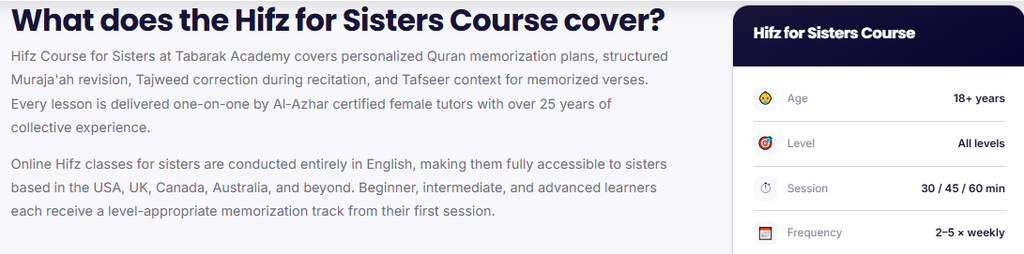
Explore What does the Hifz for Sisters Course cover?
2. Switch To 5 To 10 Repetitions When Reciting From Memory
Close the Mushaf and recite the verse from memory 5 to 10 times. This transfers what the eyes learned into what the tongue can retrieve independently, without the text as support.
Many students skip this step. They feel the verse is known after reading, move on, and find it gone within hours; because recognition is not memorization.
Students who start memorizing the Quran as a beginner are often surprised by this distinction. Recall under pressure, not recognition while reading, is what confirms real retention.
Experience Our Interactive Learning
Curious about how we teach? Watch these brief video clips from our recent live sessions to see our structured curriculum, advanced learning platform, and dynamic student-teacher interactions firsthand.
Start Your Quran Learning Journey
Join Tabark Academy today for structured online lessons with qualified tutors, customized to fit your goals.
Book Your Free Trial Lesson3. Apply The Sheikh Al-Qasim 20-Repetition Rule Per Verse
Sheikh Abd al-Muhsin Al-Qasim, imam of the Prophet’s Mosque in Madinah, recommends repeating each verse exactly 20 times before moving to the next.
After memorizing each verse 20 times, he groups 4 verses together and recites that group an additional 20 times. This creates a chain that links each verse naturally to the one beside it.
This approach is especially effective in surahs with similar-sounding verses, where mixing neighboring ayat is a common problem. The 20-repetition anchor makes each verse distinct and precise.
4. Use The Line-And-Page Cycle By Sheikh Duraid Al-Mousali
Sheikh Duraid Al-Mousali recommends reading the full page 20 times while looking at the Mushaf first, then focusing on each individual line and repeating it 10 times from memory.
This top-down approach gives the brain a structural map of the page layout before any line-level work begins. When you then focus line by line, each line already has a home in your mental framework.
Students working to memorize one page of Quran find this structure reduces confusion between lines, because the page-level overview keeps each line anchored in relation to the others.
Tabarak Academy pairs every Hifz student with a certified, Ijazah-qualified instructor who designs a structured repetition plan for their level and goals.
Why Families Choose Tabarak Academy for Juz Amma Memorization Course

Read also: How To Memorize The Quran Without A Teacher: 10 Helpful Steps
5. Build To 50 To 60 Total Repetitions For Permanent Retention
For a verse to enter long-term memory, total repetitions across initial memorization and the first review cycles must reach 50 to 60 times. This is not achieved in one sitting.
Your first session contributes 15 to 30 repetitions. The next-day review adds 5 to 10 more. Weekly revision sessions close the remaining gap over the following two to four weeks.
Students who ask why they forget what they memorize of the Quran almost always stopped reviewing before reaching this total threshold. Consistent revision is what closes the long-term retention gap.

6. Follow The Five Fortresses Method For Systematic Daily Review
The Five Fortresses method (Al-Husoun Al-Khamsah) is a classical Hifz framework that turns daily memorisation from a single task into five structured review layers working simultaneously.
A. How The Five Fortresses Method Divides Your Daily Hifz Sessions
The method divides every session into five distinct categories; new memorization, recent pages, near-term review, distant-term review, and Salah recitation. Each category runs daily, giving every portion of your Hifz regular attention.
No single session focuses on only one part of the Quran. Instead, you touch new material, reinforce recent work, and cycle through older portions, all within one structured daily block.
B. What Are The Requirements Of Repetition Of Each Fortress Category?
New memorization uses 20 to 30 combined repetitions per session. Recent pages use 5 to 10. Near-term material uses 3 to 5 repetitions. Distant review cycles each older portion once weekly.
Building your sessions around these five targets is what a best revision schedule for Hifz looks like in daily practice. No portion ever goes long enough without review to fade.
Start Hifz for Kids With a Free Trial Today

7. Use The Five T’s Framework To Structure Each Session Precisely
Dr. Yahya Al-Ghawthani’s Five T’s method breaks every session into five sequential steps; Tahyi’a (warm-up), Taskheen (activation), Tarkiz (focus), Tikrar (repetition), and Tarabut (linking).
Tikrar, the repetition step, uses 10 to 15 focused recitations of the new material. Tarabut then links the new verse to the previously memorized verse, preventing isolated, disconnected memorization.
This framework especially benefits students who struggle to stay consistent with Quran memorization because it turns every session into a complete, repeatable system rather than an improvised effort.

8. Test Your Hifz By Reciting In Salah Without Any Hesitation
The true measure of the repetition method for Quran memorization is not the count you reached. It is whether you can recite the verse in Salah, from memory, without a single pause or hesitation.
This golden rule from Quran scholars overrides all number-based debates. If you hesitate during prayer, the verse needs more work; regardless of how many repetitions you completed in the session.
Use your five daily prayers as a live Hifz audit. Any verse that causes doubt in Salah returns to stage one; begin a new repetition cycle from the looking phase for that verse.
At Tabarak Academy, we believe memorization built on the right repetition system stays with you for life. Our Hifz courses for kids, sisters, and adults include structured daily revision plans and certified Ijazah teachers.
Step Inside Our Virtual Classrooms
See our engaging teaching methods in action! watch real snippets of our live classes and discover how our expert instructors make learning interactive, memorable, and inspiring for every student.
Start Your Quran Learning Journey
Join Tabark Academy today for structured online lessons with qualified tutors, customized to fit your goals.
Book Your Free Trial LessonJoin Tabarak Academy And Start Memorizing With Precision Today
Knowing exactly how many times to repeat a verse is the foundation. The next step is a structured program and a qualified teacher who holds you accountable every session.
Tabarak Academy‘s online Hifz programs are designed for students across the USA, UK, Canada, Australia, UAE, Germany, Malaysia, Bahrain, Egypt, and the Gulf. Learn from Ijazah-certified instructors at your own pace, from home.
Browse the full course library below and find the program that matches your goals:
- Quran for Toddlers / Young Children
- Weekend Quran Classes
- Intensive Quran Course
- Recitation Of Quran With Tajweed Course
- Tafseer Al Quran Course
- Quranic Sciences Course
- Tajweed Course For Kids
- Quran Recitation Course
Start your first free trial of Quran learning journey today and take the next step toward reading and memorizing the Quran with confidence.

Conclusion
The repetition method for Quran memorization follows a clear, measurable structure. Beginners need 10 to 20 repetitions while reading, then 5 to 10 from memory, and 50 to 60 total across review cycles for permanent retention.
Scholar-designed frameworks, from Sheikh Al-Qasim’s 20-repetition rule to the Five Fortresses daily system, give every student a precise structure; not guesswork, not random repetition, but a staged process with specific counts at each step.
Understanding how long it takes to memorize the Quran becomes far more realistic once you apply the right repetition method for Quran memorisation at each stage.
The final measure remains unchanged; if you can recite in Salah without hesitation, the work is done.
Frequently Asked Questions
How Many Times Should I Repeat A Verse When Memorizing The Quran?
Repeat each verse 10 to 20 times while looking at the text, then 5 to 10 times from memory. Total repetitions across all review sessions should reach 50 to 60 for long-term, permanent retention.
What Is The Repetition Method For Quran Memorization?
The repetition method is a structured, three-stage process; reading the verse while looking, reciting from memory, and building cumulative repetitions through review cycles until the verse enters permanent long-term memory.
Which Scholar Uses The Highest Structured Repetition Count?
Sheikh Abd al-Muhsin Al-Qasim uses the most defined count; 20 repetitions per verse, then 20 additional repetitions per group of 4 verses. This layered approach produces precise, deep, and long-lasting memorization.
How Do I Know When I Have Truly Memorized A Quran Verse?
A verse is truly memorized when you can recite it in Salah, from memory, without any pause or hesitation. If doubt appears during prayer, return to the looking phase and restart a full repetition cycle.
Is 10 Repetitions Enough To Memorize A Verse Of The Quran?
Ten repetitions while looking builds a visual memory but is not sufficient for lasting retention. Add 5 to 10 recall repetitions and regular review cycles to complete the full memorization process.
Can I Memorize The Quran Without A Fixed Repetition Count?
You can begin without a fixed count, but specific repetition targets dramatically reduce forgetting. Random repetition produces uneven Hifz; structured counts give every verse the same reliable, solid foundation.