


How To Track Quran Memorization Progress? 8 Proven Methods
Most Hifz students memorize new pages every week but have no clear way of how to track Quran memorization progress to still be intact. Without a tracking system, growth in one direction silently unravels in another.
You add new verses while older sections fade, and the gap between what you think you know and what you can actually recite under pressure keeps widening. This is the most common and least-talked-about challenge in Quran memorization.
This guide walks you through eight practical methods to track Quran memorization progress with honesty and precision, from simple daily journals to digital apps to using your five daily prayers as a built-in retention test.
1. Knowing How To Track Quran Memorization Progress Start With Writing Every Session In A Dedicated Memorization Journal
Start every tracking practice with the most reliable tool: a notebook dedicated entirely to your Hifz. At the end of each session, record what you memorized, what you reviewed, and a quality rating from one to three.
Use a four-column format: date, new content covered (Surah and verse range), review content covered, and a star rating. A three-star session means full fluency with no errors. A one-star session means you needed prompts or made repeated mistakes during recitation.
These track Quran memorization progress tips work because they force honest self-evaluation instead of just marking a session complete.
Best Method To Memorize Quran consistently identifies daily self-assessment as one of the most effective practices across different memorization approaches.
Review the last two weeks of journal entries every Sunday. Patterns of low-rated sessions reveal precisely where your weekly review should focus, and that data comes from your own honest record, not guesswork.
Explore What does the Short Surah Memorization Course cover?

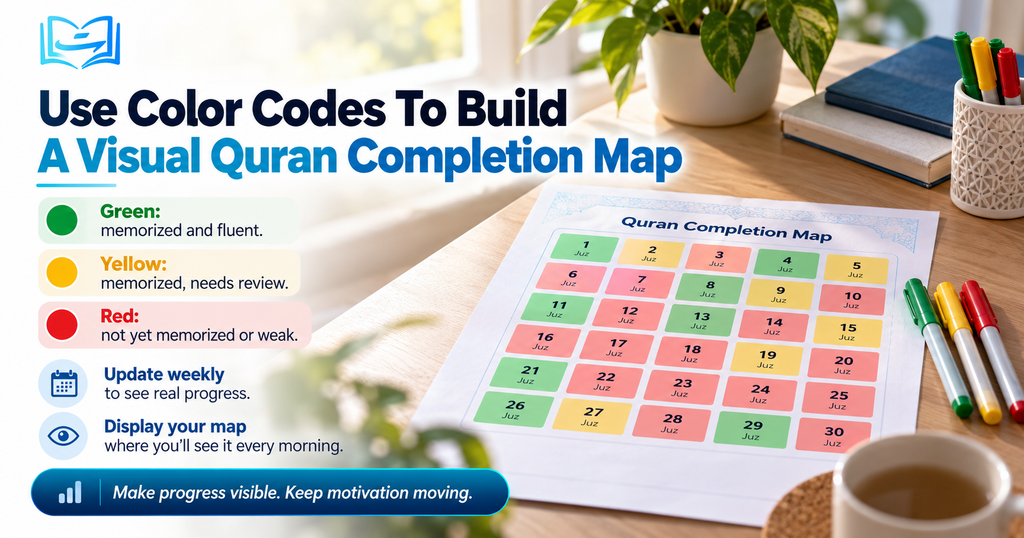
2. Use Color Codes To Build A Visual Quran Completion Map
Print a one-page Quran map divided by Juz and use three marker colors to show your status. Green means memorized and fluent. Yellow means memorized but needs review. Red means not yet memorized or significantly weak.
This system works because it removes ambiguity instantly. You don’t ask yourself whether you covered a section; the map shows you without opening a notebook or an app.
Update the map weekly, not daily. Daily changes are too small to see, but weekly updates reveal real movement.
Students who track the Quran memorization progress this way report stronger sustained motivation because progress becomes literal and visible, not just a number.
Post the map somewhere you’ll see it every morning: above your study desk, or near your prayer area. The daily visual reminder serves as both an honest progress report and a quiet prompt to keep your review rotation moving.
3. Apply The “Old Before New” Rule As Your Daily Review Framework
Follow this practitioner principle before every memorization session: always review previously memorized content before adding anything new.
This rule comes directly from classical Hifz pedagogy and is one of the most consistently applied principles among experienced teachers.
Most students reverse this order without realizing it. They memorize fresh content when energy is highest and leave review for the end, when focus is low. This habit guarantees older sections will weaken.
Strategies To Revise Memorized Quran provides structured plans for systematically reversing this pattern.
To make this rule trackable, split your daily session log into two columns: Review (old content) and New Memorization. If the review column is consistently blank, the system is failing and needs correction before adding new content.
A. Tracking Recent Memorization (Qareeba)
Recent memorization covers everything you learned within the last one to three weeks. These pages are the most at risk of fading because they haven’t been reinforced enough times to reach long-term stability.
Log each recently memorized page by recording the last date you recited it successfully without errors. Any page that goes four or more days without a clean review should be flagged immediately as a priority item.
Daily hifz Revision Guide outlines a rotation system specifically designed for keeping recent memorization solid during active memorization phases.
B. Tracking Distant Memorization (Ba’eeda)
Distant memorization covers everything you learned more than three to four weeks ago. This is where most students carry their largest blind spots, assuming older sections are solid when they’ve rarely been formally tested.
Assign each older Juz a dedicated review slot in your weekly schedule. Recite the assigned portion without looking, then rate honestly.
If you make errors on more than five ayahs per page, downgrade that section from green to yellow in your tracker. Daily Murajaah Plan For Hifz Students provides ready-to-use templates for building this rotation into a sustainable weekly system.
Experience Our Interactive Learning
Curious about how we teach? Watch these brief video clips from our recent live sessions to see our structured curriculum, advanced learning platform, and dynamic student-teacher interactions firsthand.
Start Your Quran Learning Journey
Join Tabark Academy today for structured online lessons with qualified tutors, customized to fit your goals.
Book Your Free Trial Lesson4. Choose A Digital App That Matches Your Learning Style
Use a Quran memorization app as a tracking partner, not a replacement for active review. The best apps separate new memorization from review content, send reminders when pages are due for repetition, and display a color-coded Quran map showing completion percentage by Juz.
Apps like Tarteel, Ilmify, and Ayah each serve different needs. Tarteel uses real-time audio detection to catch recitation errors. Ilmify focuses on spaced repetition scheduling, planning review intervals based on your recitation performance. Ayah offers a Juz-by-Juz visual tracker with session logging.
Tabarak Academy‘s qualified instructors help students integrate digital tools with live structured teaching, combining the consistency of technology with the real-time feedback that only a certified teacher can provide.
Their Hifz for Kids Course and programs for adults pair technology-assisted tracking with expert accountability.

A. What To Look For In A Quran Memorization App
A useful Hifz app must separate new content from review content. Without that distinction, the app records what you’ve done rather than what needs attention; a diary, not a progress tracker.
Look specifically for: a color-coded Quran map by Juz, a notes field for logging tajweed errors per ayah, and auto-scheduled review reminders based on your last recitation date.
Best Online Hifz Program explains how structured programs integrate these digital tools into daily practice effectively.
B. Three App Features That Make Tracking Effortless
First, a projected completion date: quality apps calculate how long full memorization will take at your current pace. This gives a realistic finish date and removes the vague sense of endless progress.
How Long Does It Take To Memorize One Juz provides benchmarks that make these projections more meaningful. Second, ayah-level error logging: the ability to mark specific verses as frequently misread or flagged for tajweed correction turns the app into a targeted study guide.
Third, full offline access: your tracking data must be available without the internet so that no session goes unrecorded regardless of connection.

5. Test Your Retention Through Every Prayer You Perform
Make every Salah a performance evaluation. When you recite a memorized Surah or portion in prayer, note whether you complete it without mental correction, and whether tajweed rules are applied automatically.
Prayer creates real-world testing conditions: no notes, no phone, and often mild spiritual pressure. These conditions surface weaknesses that quiet solo review consistently misses.
Improve Quran Recitation demonstrates how frequent recitation in Salah builds both fluency and long-term retention faster than review-only practice.
Log which Surahs or Juz sections you recited in each prayer and rate each honestly. A recitation that requires mental backtracking mid-prayer is a yellow, not a green. Update your tracker after each prayer accordingly.
Students who use Salah as a retention test regularly discover their weakest sections are not the ones they expected. This method is free, built into your daily schedule, and requires no extra equipment.
Discover Why Tabarak Academy Leads in Quran Recitation Training

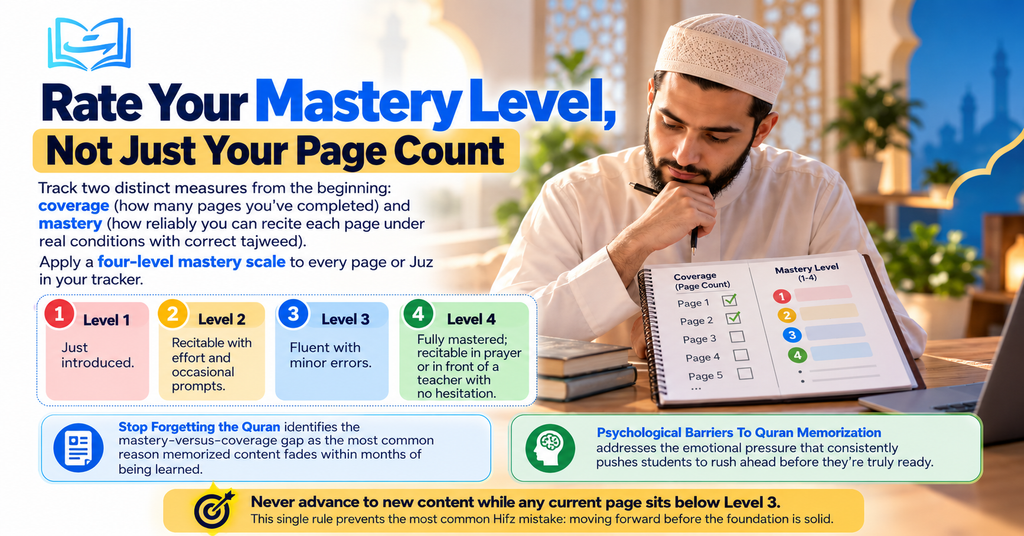
6. Rate Your Mastery Level, Not Just Your Page Count
Track two distinct measures from the beginning: coverage (how many pages you’ve completed) and mastery (how reliably you can recite each page under real conditions with correct tajweed).
Apply a four-level mastery scale to every page or Juz in your tracker. Level 1 is just introduced. Level 2 is recitable with effort and occasional prompts. Level 3 is fluent with minor errors. Level 4 is fully mastered; recitable in prayer or in front of a teacher with no hesitation.
Stop Forgetting the Quran identifies the mastery-versus-coverage gap as the most common reason memorized content fades within months of being learned.
Never advance to new content while any current page sits below Level 3. This single rule prevents the most common Hifz mistake: moving forward before the foundation is solid.
Psychological Barriers To Quran Memorization addresses the emotional pressure that consistently pushes students to rush ahead before they’re truly ready.
7. Set A Weekly Review Schedule With A Printed Checklist
Build a weekly grid with days as columns and Juz or page blocks as rows. Check each box as you complete each review session. At the end of the week, every unchecked box tells you precisely where your system broke down.
A printed checklist prevents the most persistent self-deception in Hifz: believing you’ve reviewed something when you actually haven’t.
Murajaah Timetable Pdf offers ready-made printable formats you can use immediately to build this structure into your weekly routine.
Review your checklist every Sunday evening. Identify which rows were skipped consistently over the past two or three weeks; those recurring gaps are your top review priority for the coming cycle.
Students balancing Hifz with work, school, or family duties find the checklist the most practical long-term tracking method. It requires no technology, takes under a minute to update per session, and gives a complete weekly picture at a glance.
Book your child’s first live Hifz for Kids session at Tabarak Academy now

8. Log Tajweed Errors Separately To Reveal Your Weak Spots
Keep a second log dedicated entirely to tajweed mistakes. Each time you make the same error twice in a single session, write down the specific word, the rule violated (such as ghunna, idghaam, or madd), and the ayah reference.
This error log functions as your personalized study guide. Most Hifz students track memorization volume but completely overlook tajweed errors. The result is fluently memorized content that is incorrectly recited.
What Is Tajweed explains why correct pronunciation is inseparable from valid memorization, especially for formal contexts such as ijazah examination or leading congregational prayer.
Tabarak Academy‘s ijazah-certified instructors correct tajweed errors in real time during every live session, giving students immediate feedback that no app or self-assessment checklist can replicate.
Whether you’re memorizing for the first time or How To Re-Memorize The Quran After Forgetting It after a gap, their structured programs pair expert error correction with the tracking systems this article describes.
Step Inside Our Virtual Classrooms
See our engaging teaching methods in action! watch real snippets of our live classes and discover how our expert instructors make learning interactive, memorable, and inspiring for every student.
Start Your Quran Learning Journey
Join Tabark Academy today for structured online lessons with qualified tutors, customized to fit your goals.
Book Your Free Trial LessonStart Your Hifz Journey With Tabarak Academy’s Expert Teachers Today
Most students who struggle with tracking don’t lack willpower. They lack a structured system and a qualified teacher who can see what they themselves miss about their own recitation.
Tabarak Academy‘s certified Quran and Hifz instructors provide live online sessions, personalized revision schedules, and real-time tajweed correction.
Classes are available to students in the USA, UK, Canada, Australia, UAE, Germany, Malaysia, Bahrain, Egypt, and across the Gulf region, at times that fit your schedule.
Our Courses:
- Online Quran Memorization Course
- Online Ijazah Course
- Advanced Tajweed Course
- Hifz Ijazah Course
- Hifz for Adults Course
- Online Hifz Program
- Weekend Quran Classes
Book Your Free Trial Class today and start your own personalized memorization plan, built around your current level and goals.

Conclusion
Knowing how to track Quran memorization progress is the difference between a Hifz journey that accumulates genuine knowledge and one that restarts repeatedly from the same weak foundation.
The eight methods in this article work at different levels. The journal gives you depth and reflection. The color map gives you visual clarity. The “Old Before New” rule protects everything you’ve already built.
The mastery scale tells you the truth about what you actually know. Each one addresses a gap that the others alone cannot fill.
Whether you are tracking Quran memorisation progress independently or with a teacher’s weekly guidance, the goal stays the same: an accurate, honest picture of what you truly know, and a clear path to strengthen everything that needs more time.Your Hifz deserves a system as serious as your intention.
Frequently Asked Questions
What Is the Best Way to Track Quran Memorization Progress?
The best way to track Quran memorization progress is to combine a daily session log with a weekly mastery review.
Record what you memorized and reviewed each day, rate your recitation quality honestly, and assign each Juz a mastery level from one to four weekly.
How Often Should I Review My Memorized Quran Sections?
Review recent memorization (pages from the last three weeks) every two to three days. Review older memorization (pages from more than four weeks ago) at least once per week.
Short, frequent reviews prevent forgetting far more effectively than long, infrequent catch-up sessions.
Can a Mobile App Replace a Human Teacher in Tracking My Hifz?
A mobile app tracks what you log, but it cannot hear your actual recitation quality or catch subtle tajweed errors in real time. Apps are excellent data organizers.
A qualified teacher is irreplaceable for honest, immediate feedback and accurate error correction.
How Do I Know If My Memorization Is Truly Solid?
Test it in Salah without preparation. If you can recite a portion from start to finish, with correct tajweed and no hesitation, during prayer, it qualifies as solid.
Sections that require mental correction mid-prayer need more review before being upgraded to fully mastered.
What Should I Do If I Keep Forgetting the Same Sections?
Flag those sections in your tracker and assign them to daily review for two consecutive weeks. Identify the specific ayahs where fluency breaks down and target those in isolation.
Repeated focused review on weak spots is more effective than repeating the entire Juz from the beginning.
Is It Necessary to Track Both New Memorization and Old Review Separately?
Yes. Tracking only new content gives a false picture of total Hifz strength. Tracking only reviews prevents forward progress. Separating both in your daily log ensures you build new memorization without sacrificing the portions you’ve already worked hard to retain.