


Listening Method Vs Reading Method For Quran Memorization (+ 6 Easy Daily Steps)
You just opened a new page to memorize. So what do you do first? Play a reciter and repeat after him, or read from the mushaf until the words stick? That’s the big question behind the listening method vs reading method for Quran memorization. Most students ask it in their first week of hifz. Maybe you’re asking it right now.
The good news is you don’t have to choose. Listening helps you learn a page fast and say each word right. Reading gives you a picture of the page, so it stays with you longer. Use both, then test yourself with no help. That’s what works best. The right mix can save you weeks of learning the same pages over again.
Below, you’ll see how each method works and where each one falls short. You’ll also find out which one fits your age, your reading level, and your free time. At the end, there’s a simple six-step plan you can start today. Even ten quiet minutes after Fajr is enough to begin.
What You Will Learn In This Article
- What the listening method and the reading method really mean.
- How your brain stores verses with each method.
- The strong and weak points of each one.
- Which method to start with, based on your age, level, and time.
- A six-step daily routine that uses both methods together.
Listening Method Vs Reading Method For Quran Memorization: What Each One Means
Before you pick a method, you need to know what each one asks you to do. The two methods use the same Quran, but they use a different part of your memory.
What Is The Listening Method (Talaqqi)?
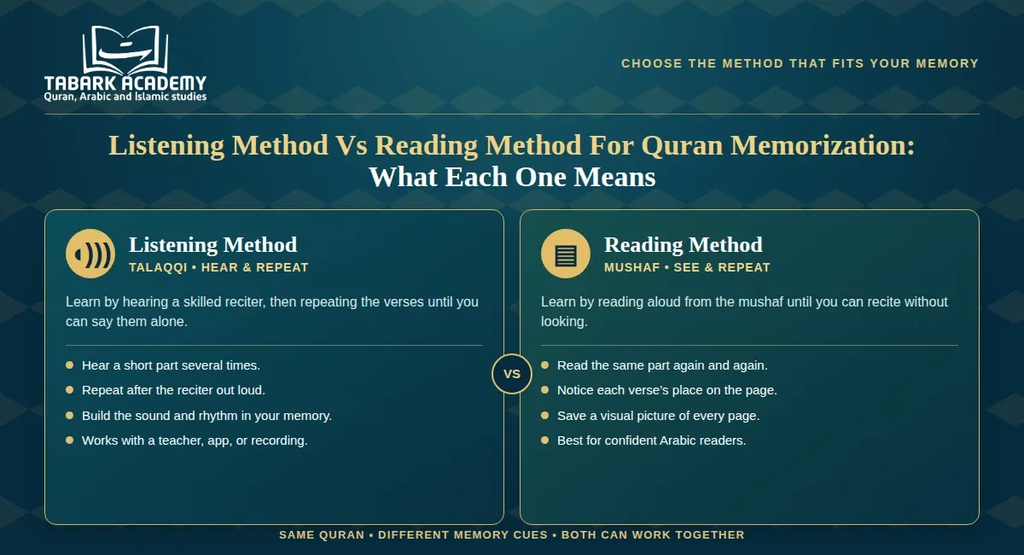
The listening method means you learn verses by hearing a skilled reciter and repeating after him. In Arabic, this is called talaqqi. It is the oldest way the Quran was taught.
The Prophet ﷺ first heard the Quran from Jibreel. Then he recited it the way he heard it. Allah told him not to rush. He was to listen first and then follow the recitation, as the Quran says in Surah Al-Qiyamah (75:16–19).
The Companions learned the same way. They sat with the Prophet ﷺ, heard him recite, and repeated it. The Prophet ﷺ also loved to hear the Quran from others. He once asked Ibn Mas’ud to recite to him, as reported in Sahih al-Bukhari (5050).
Today, you can use talaqqi with a teacher, an app, or a recording. The idea stays simple. You hear a short part, you repeat it many times, and you keep going until you can say it alone.
What Is The Reading Method?
The reading method means you learn verses by reading them out loud from the mushaf. You read the same part again and again until you can say it without looking. This method depends on your eyes more than your ears.
When you read, you notice small details. You see where a verse starts on the page. You see which line it sits on. You notice the last word at the bottom of the page.
Over time, your mind saves a picture of each page. Many people who have memorized the whole Quran say they can “see” the page while they recite. This helps them find their place when they forget a word.
The reading method works best for people who already read Arabic well. You need to say each word the right way on your own. You also need only one thing to start, which is a mushaf. That makes it easy to practice at home, at any time, with no recording.
How Your Brain Remembers Verses With Each Method
Most guides skip this part, but it explains why each method feels so different. Your brain saves a verse in one way when you hear it and in another way when you see it.
Listening Saves The Sound Of The Verse
When you listen, your brain saves the verse as sound. It keeps the reciter’s speed. It keeps where he stops and where he takes a breath. It also keeps how long he stretches each vowel.
This is why listening teaches good recitation so well. You copy the sounds before you learn the rules. Children do this with every language they learn. They hear first, then they speak.
Sound also has rhythm. Many surahs have a steady beat and verses that end with the same sound. That beat becomes a hint for your memory. When you forget a word, the flow of the verse often pulls it back.
But sound has one weak spot. It moves in one direction, from start to end. If you lose your place in the middle, sound alone does not tell you where you are. You often have to go back to the start of the verse to find it again.
Reading Saves The Picture Of The Page
When you read, your brain saves the verse as a picture. It keeps the shape of each word. It keeps the line the verse is on. It keeps the spot on the page, such as the top right or the bottom left.
People remember where things are on a page, even when they are not trying. This is a normal part of how memory works. You may forget a sentence but still remember it was near the top of the page.
That picture works like a map. If you get stuck while reciting, you can picture the page and see what comes next. This is very helpful with verses that look and sound alike.
Using Both Methods Gives Your Memory Three Roads Back
When you listen and read together, your brain saves the verse two times. It saves the sound, and it saves the picture. If one road is blocked, the other one can still bring the verse back.
There is a third road, too. When you read out loud, your mouth moves and your ears hear your own voice. Reading out loud helps people remember more than reading in silence. Your mouth, your ears, and your eyes all work on the same verse at once.
Think of it like a house with three doors. If you only use one door, you are stuck when it is locked. With three doors, you can almost always get in.
This is why the strongest plan is not “listen only” or “read only.” It is listen, read out loud, and then test yourself. Each step adds a new road. The more roads you build, the longer the verse stays with you.
Experience Our Interactive Learning
Curious about how we teach? Watch these brief video clips from our recent live sessions to see our structured curriculum, advanced learning platform, and dynamic student-teacher interactions firsthand.
Strengths And Weak Points Of Each Quran Memorization Method
Each method helps in some ways and fails in others. Knowing where each one fails helps you plan around it.
Why The Listening Method Works Well
The listening method helps you get started fast. After a few rounds of focused listening, a new page already sounds familiar. That makes the first step of memorizing feel lighter.
It also teaches you the right way to say each word. You copy the reciter’s sounds, so you pick up tajweed without studying every rule first. Tajweed means the rules for saying each letter and sound of the Quran the right way.
Listening is also the best method for people who cannot read Arabic yet. They do not have to wait months to begin. They can start with short surahs right away.
Allah tells us in Surah Al-A’raf (7:204) to listen with care and stay quiet when the Quran is recited. This kind of focused listening is the heart of the method. It is not sound playing in the background. It is careful attention to every word, from the first letter to the last.
Where Listening Alone Lets You Down
The biggest risk of listening alone is a trap that feels like success. When the audio plays, you recite along with ease. It feels like you know the page. But when the audio stops, the words often stop, too.
This happens because hearing and remembering are two different skills. Knowing a verse when you hear it is easy. Saying it from memory, with nothing to help you, is much harder.
Listening alone also gives you no picture of the page. Without that picture, verses can get mixed up. You may swap the order of two verses or jump to a verse that sounds alike.
There is one more problem. The audio can become a crutch. Some students start to wait for the reciter’s first word before they can begin. Without that small push, they freeze. The only cure is to practice starting each verse on your own, with the sound turned off.
Why The Reading Method Works Well
The reading method gives your memory a fixed home. Each verse lives in one spot on one page. That spot never moves, so your mind can always return to it.
This makes review much faster. You can flip through pages and check them one by one. You can also see which pages are weak and which are strong.
Reading also lets you mark your own mushaf. You can put a small pencil dot over a word you often forget. You can circle the first word of a verse that you mix up with another one. Each time you open the page, those marks remind you where to slow down.
The reading method also lets you work on your own. You do not need a phone or a speaker. You need only a mushaf and a quiet place. For people who already read well, this is often the best way to keep many pages strong for many years.
Where Reading Alone Lets You Down
The biggest risk of reading alone is learning a mistake. If you read a word the wrong way and repeat it 20 times, you have memorized the error. The page will not tell you that you are wrong.
Reading is also slower at the start. A new page takes more effort to learn by sight than by sound. Many beginners find it tiring and lose focus.
If you struggle when you read, do not lose hope. The Prophet ﷺ said that the one who finds reading hard but keeps trying gets two rewards, as reported in Sahih al-Bukhari (4937). Your effort counts.
Still, effort works best with someone to guide it. When another person listens to you, every repeat you make builds the right memory, not the wrong one. That is the gap reading alone cannot fill.
In Tabarak Academy’s Online Hifz Program, a certified teacher listens to you live, fixes your recitation in the moment, and builds a plan around your free time.

Start Your Quran Learning Journey
Join Tabark Academy today for structured online lessons with qualified tutors, customized to fit your goals.
Book Your Free Trial LessonListening Vs Reading Compared Side By Side
The table below puts both methods next to each other. Use it to see which one covers the gaps you have right now.
| What You Compare | Listening Method (Talaqqi) | Reading Method |
| What your memory saves | The sound, rhythm, and stops | The words and their place on the page |
| How fast you start | Faster | Slower |
| Learning the right sounds | Strong, by copying | Depends on how well you read |
| Picture of the page | Weak | Strong |
| Main risk | Feeling you know it when you don’t | Learning your own mistakes |
| What you need | A reciter or a recording | Only a mushaf |
The two columns fill each other’s gaps. What one method misses, the other one gives you.
Which Quran Memorization Method Should You Start With?
The best starting point depends on your reading level, your age, and your free time. Most people also lean on one sense more than the other, so it helps to use that strength.
| If You Are… | Start With | Why It Helps |
| Someone who remembers by sound | More listening, plus reading for order | You use your strength and add the page picture |
| Someone who remembers by sight | More reading, plus listening for sounds | You use your strength and add the right sounds |
| A child or a beginner | Listening and reading together | Good sounds and a page picture from day one |
| Not able to read Arabic yet | Listening first, reading later | You can start now while you learn to read |
| A busy adult | Listening for review, reading for new pages | Each part of your day gets the right job |
Whichever row fits you, the six steps below work the same way. Only the size of each part changes.
The Six Steps To Follow In Every Memorization Session
You already know which method suits you best. Now you need a way to use it each time you sit down with your mushaf.
The steps below work for everyone, but the size of each part and the time you spend can change. If you aren’t sure how much time to give each day, this guide on how much time adults need for hifz per day can help you plan it.
Steps 1 And 2: Listen, Then Recite Along
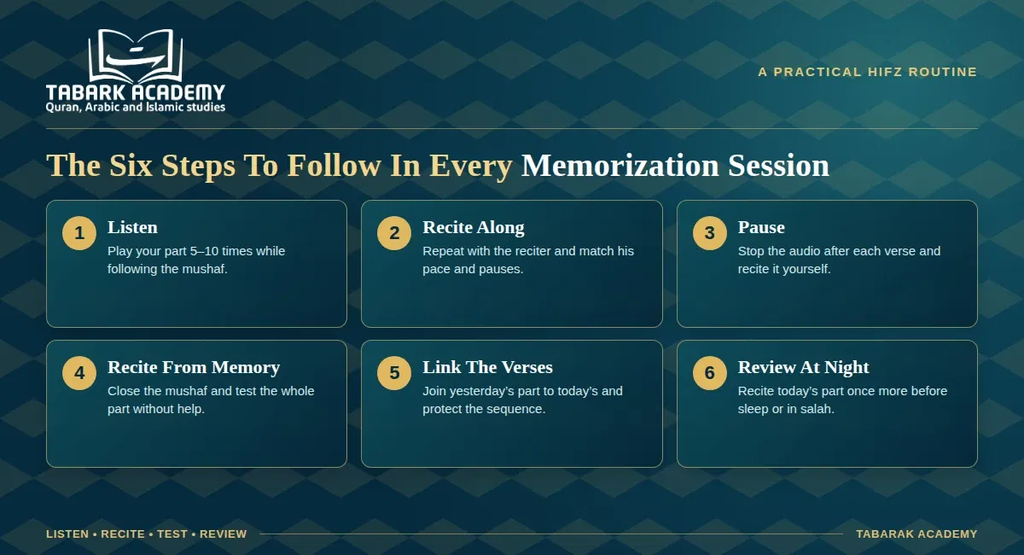
1- Listen to your part 5 to 10 times with the mushaf open. Choose a reciter who reads slowly and clearly. Follow each word with your eyes as he reads, and notice where each verse begins and ends on the page.
2- Recite along with him 5 to 10 times. Say the words out loud at the same time he does. Try to keep up with his speed, stop where he stops, and stretch the sounds the way he stretches them.
When you do both steps together, you learn how each word sounds and where it sits on the page at the same time.
Go slowly at this stage. The Quran was sent down in parts and recited at a calm pace, as Allah says in Surah Al-Isra (17:106).
If you can’t read Arabic yet, you can still do step 1 and repeat after the reciter. Many adults learn to read while they memorize, then start using the mushaf more once their reading improves.
Steps 3 And 4: Pause, Then Recite From Memory
3- Play one verse, pause the audio, and say the verse yourself. Then play it again to see if you said it right. Do this for each verse in your part.
4– Close the mushaf and turn off the audio. Recite the whole part on your own. This step tells you what you have really memorized. A part can sound familiar when the audio is on and still slip away when it is off.
If you get stuck on a verse, you don’t need to go back to the beginning. Repeat steps 2 and 3 for that verse only, then try step 4 again.
It is best not to start a new part until you can finish step 4 without any help. If you can only recite a part with the audio playing, give it another day before moving on.
For more ways to check your memory at home, read this guide on how to test your own hifz.
Steps 5 And 6: Link The Verses, Then Review At Night
5- Recite yesterday’s part and today’s part together from memory. Pay close attention to the place where the two parts meet. The last verse of yesterday’s part should lead you straight into the first verse of today’s.
Linking the parts this way keeps the verses in the right order. If you skip it, each part stays separate in your mind, and it becomes easy to lose your place when you recite a full page.
6- Before you go to sleep, recite today’s part once more without looking at the mushaf. Saying it again later in the day helps you keep it until the next morning.
Your night prayer is a good time for this step. Reciting the new verses in salah gives your practice a place in your worship. You also have no mushaf in front of you, so you find out right away whether the part is secure or needs more work tomorrow.
How To Use This Routine With Your Children
Children can follow the same six steps. The main change is that each step should be smaller and shorter than it would be for an adult.
Start with two or three short verses in each session. A child who finishes a small part feels proud and is more likely to sit down again the next day.
During steps 1 and 2, ask your child to follow the words with a finger while the reciter plays. Even if they can’t read yet, they start to remember how the page looks. Children pick up sounds quickly, so let listening do most of the work in the beginning.
For step 4, let your child recite the verses to you, a brother or sister, or even a favorite toy. Praise them for each verse they say on their own.
Step 6 fits well into bedtime. You can recite the new verses together before they sleep. Keep sessions short, and end before your child gets tired or bored.
Many families at Tabarak Academy use a routine like this with their children. You can read what parents and adult students say about their progress on Tabarak Academy’s reviews page.

Two Habits That Weaken Your Quran Memorization
Most memorization problems come from small habits, not from the method you picked. These two habits cause trouble for many students without them noticing.
Changing Your Reciter Or Your Mushaf
Every reciter has his own speed and tune. When you change reciters every week, the rhythm in your memory keeps changing, too. Your mind loses the hint it was using to remember.
Pick one slow, clear reciter for new pages. Stay with him until you finish a full juz, at least. You can enjoy other reciters for listening at other times.
The same rule goes for your mushaf. Your page picture is tied to one layout. If you memorize from one print and review from another, the lines will not match. The verse you saw at the top of the page may now sit in the middle.
That mismatch confuses your mind and slows you down. Choose one mushaf and use it for every session. Many students use the 15-line Madani mushaf, where most pages end at the end of a verse. Whatever you pick, keep it the same from your first page to your last.
Skipping Daily Revision
New pages fade fast without review. Many students feel proud of a page for a week, then find it gone a month later. The page was not weak. It just was not reviewed.
The Prophet ﷺ warned about this. He told us to keep up with the Quran, because it slips away faster than a camel that breaks free from its rope, as reported in Sahih al-Bukhari (5033).
So give review a fixed place in every session. A simple plan works well. Review the new part from today, the parts from this week, and older parts in a slow, steady cycle.
Review is where the two methods work best as a team. Use listening to refresh pages you know well. Use reading and self-testing to check them closely. If you study alone for now, this guide on how to revise the Quran without a teacher gives you a clear system to follow.
Step Inside Our Virtual Classrooms
See our engaging teaching methods in action! watch real snippets of our live classes and discover how our expert instructors make learning interactive, memorable, and inspiring for every student.
Start Your Quran Learning Journey
Join Tabark Academy today for structured online lessons with qualified tutors, customized to fit your goals.
Book Your Free Trial LessonStart Your Hifz Today With Tabarak Academy’s Certified Teachers
You now know how to mix listening and reading. The next step is to put it into practice with a teacher who knows the path well.
Here is what you get when you join Tabarak Academy:
- Teachers who are Al-Azhar certified Huffaz with verified Ijazah
- Private one-on-one classes, so you never wait while others recite
- Live correction of your recitation in every session
- A personal hifz plan built around your free time, with a three-part review system
- Monthly progress reports for you and your family
- Female Huffaz teachers for sisters and girls
- Morning, evening, and weekend times in every time zone
- A free first class with no contract and no payment needed
Tabarak Academy holds a 4.8-star rating on Trustpilot and has taught more than 6,800 students in over 15 countries. Book your free trial class now. Meet your teacher, get your personal hifz plan, and decide with no payment and no contract.

Our Quran Courses
Tabarak Academy offers private online Quran courses for kids and adults, taught one-on-one by certified teachers. They cover first-letter reading, tajweed, full hifz, and Ijazah, all at a time that suits you.
- Online Quran Classes
- Online Quran Classes for Beginners
- Online Quran Classes for Kids
- Online Quran Classes for Adults
- Online Quran Classes for Men
- Online Quran Classes for Sisters
- Quran Reading Course
Conclusion
The listening method vs reading method for Quran memorization is not a fight with one winner. Each method does a different job.
Listening saves the sound of a verse. It helps you start fast and say every word the right way. Reading saves the picture of the page. It helps you find your place and keep pages strong for a long time.
Each method also has a weak spot when you use it alone. Listening can trick you into thinking you know a page when you only know it with the audio on. Reading can lock in mistakes if no one checks you, and it can feel slow and tiring at the start. When you join them, each method covers the other’s gap.
The best plan is simple. Start with the method that fits your reading level, age, and time. Add the other method as soon as you can.
Then follow the six-step routine: listen, recite along, pause and recite, recite from memory, link the parts, and review at night. Keep one reciter and one mushaf. Give review a fixed place in every session.
Above all, remember that Allah made the Quran easy to remember, as He says in Surah Al-Qamar (54:17). Your job is to show up each day with a clear plan and a sincere heart. With steady effort and the right support, every page you learn can stay with you for life.
FAQs
Many students have the same questions when they choose a Quran memorisation method. Here are clear answers to the ones we hear most often.
Can I Memorize The Quran Without Knowing How To Read Arabic?
Yes, you can begin memorizing by listening and repeating after a reciter. You must still learn Al-Fatihah, because there is no valid prayer without it, as reported in Sahih al-Bukhari (756). Learn to read along the way so you can add the reading method later.
Which Reciter Is Best For Memorizing The Quran?
The best reciter for memorizing is one who reads slowly and clearly. Many students like Sheikh Al-Husary’s teaching recitation because each word is easy to hear. Choose one reciter and stay with him.
How Long Should A Daily Memorization Session Be?
A focused session of about 30 minutes is a good start for most learners. Short daily sessions work better than long ones once a week. Grow the time slowly as your focus gets stronger.
Should I Learn Tajweed Before I Start Memorizing?
No, you do not need to master tajweed before you start memorizing. Copying a skilled reciter teaches you most of the right sounds as you go. You can study the rules side by side with your memorizing.
At What Age Can A Child Start The Listening Method?
A child can start as soon as they can repeat short phrases after you. There is no need to wait until they can read. Keep sessions short, fun, and full of praise.
Does Writing The Verses Help With Memorization?
Yes, writing verses can help some learners remember them better. Writing slows you down and makes you look at every letter. Use it as an extra step for hard verses, not as a full method.