


How Much Time Do Adults Need for Hifz Per Day?
Most adults who start Hifz don’t stop because memorizing the Quran is too hard. They stop because they built a daily plan that only works on a quiet weekend — not on a Tuesday with a late meeting and dinner on the stove.
So how much time do adults need for Hifz per day? The practical answer is 30 to 60 minutes of focused, consistent work for most working adults, split between new memorization and revision. More hours shorten the timeline, but only if the revision load is handled — and that is where most adult schedules break.
This article gives you the daily time ranges, what each range realistically produces, how to split the minutes between Sabaq, Sabqi, and Manzil, and how to shrink the session on hard days without losing what you memorized.
What You’ll Learn in This Article
- How much time adults need for Hifz per day at three commitment levels — and the completion timeline each one produces.
- How to divide your daily session between new memorization and two types of revision.
- The best time of day for Hifz and why the post-Fajr window outperforms the same minutes spent at night.
- How to run a 5-minute “minimum day” that protects your memorization when life gets full.
- How to calculate your own Hifz timeline instead of guessing.
How Much Time Do Adults Need for Hifz Per Day?
Adults need between 30 minutes and 2 hours per day for Hifz, depending on the completion timeline they want. The minimum that produces real, retained memorization is about 30 focused minutes daily — below that, revision gets squeezed out and new pages start falling away faster than you add them.
The table below shows what each daily commitment typically produces for an adult learner with reasonable Arabic reading fluency and consistent daily revision.
| Daily time | Session type | Typical full-Quran timeline |
| 30 minutes | Light / maintenance-friendly | 5–7 years |
| 45–60 minutes | Part-time Hifz | 3–5 years |
| 90 minutes | Intensive part-time | 2–3 years |
| 2+ hours | Near full-time | 1.5–2 years |
| 4+ hours | Full-time program | 6 months–1.5 years |
These are planning estimates, not guarantees. They assume you memorize five to six days a week and revise every single day, including the days you don’t take new material.
Why 30 Minutes Is the Realistic Floor for Adults?
Thirty minutes is the floor because a Hifz session is never only new memorization. A session that doesn’t include revision isn’t a Hifz session — it’s a memorization session that will be undone within a week.
New memorization is fragile. Without reinforcement, recall of freshly memorized material begins weakening within roughly 48 hours, which is why revision has to be a daily fixture and not a weekly catch-up. In a 30-minute session, that leaves roughly 10–15 minutes for new verses and the rest for review.
Why Don’t More Hours Scale the Way Adults Expect?
Doubling your daily time does not halve your timeline. This is the single most common planning error adults make. The reason is that your revision load grows with every page you add. At 2 juz memorized, a full review cycle is quick.
At 15 juz, the same cycle eats most of a 60-minute session on its own. Adults who plan a two-year Hifz around new memorization alone hit a wall somewhere around juz 10 — not because they slowed down, but because the Manzil they built has nowhere to live in the schedule.
A practical rule: as your memorized portion grows, protect revision time first and let the new-material target shrink. Pages you keep are worth more than pages you pass through.
At Tabarak Academy, this is the point where most adult students need their plan rebuilt rather than their effort increased — and it’s exactly what a structured revision schedule with a teacher is designed to prevent.
How to Split Your Daily Hifz Time: Sabaq, Sabqi, and Manzil?
Every effective daily Hifz routine — at any time budget — contains three components. Knowing what each one does lets you scale the session up or down without breaking it.
- Sabaq is your new lesson: the verses you are memorizing today.
- Sabqi is a recent revision: everything you memorized in roughly the last week
- Manzil is past revision: all older memorized portions, cycled through on rotation.
A 30-Minute Adult Hifz Routine
This split is built for the tightest realistic schedule. New material is deliberately small so the two revision blocks still fit — if something has to shrink on a given day, it’s the Sabaq, never the Sabqi.
| Block | Time | What you do |
| Sabqi (recent revision) | 8 min | Recite the last 3–5 days from memory, Mushaf closed |
| Sabaq (new lesson) | 15 min | 2–3 ayat, heavily repeated |
| Manzil (older revision) | 7 min | One run-through of an older surah on rotation |
A 60-Minute Adult Hifz Routine
With a full hour, revision takes the larger share — 35 of the 60 minutes — and new material still doubles compared to the 30-minute version. The extra five minutes at the end are for recording where you hesitated, which is what turns tomorrow’s review into targeted work instead of a blind re-read.
| Block | Time | What you do |
| Sabqi | 15 min | Last 7 days of memorization, recited without looking |
| Sabaq | 20 min | Half a page to one page, depending on fluency |
| Manzil | 20 min | A rotating juz or half-juz from older material |
| Error check | 5 min | Note hesitation points and recurring slips |
Why Revision Comes Before New Material?
Start the session with Sabqi, not Sabaq. This is the block adults skip when they’re short on time, and skipping it is the direct cause of the “I memorized it last week and it’s gone” complaint.
There’s a second reason for the order: your sharpest attention is at the start of the session. Spending it on recall practice — reciting from memory with the Mushaf closed — is more demanding than reading new verses, and demanding work belongs where your focus is best.
Experience Our Interactive Learning
Curious about how we teach? Watch these brief video clips from our recent live sessions to see our structured curriculum, advanced learning platform, and dynamic student-teacher interactions firsthand.
Start Your Quran Learning Journey
Join Tabark Academy today for structured online lessons with qualified tutors, customized to fit your goals.
Book Your Free Trial LessonRead also: Adult Beginner Quran Reading Course
When Is the Best Time of Day for Adults to Do Hifz?
Once you’ve settled how much time do adults need for Hifz per day, the next decision is where those minutes sit in the day — because the same 40 minutes produce very different retention depending on the hour you spend them.
The best time for new memorization is immediately after Fajr prayer, when sleep has cleared cognitive fatigue, external distractions are at their lowest, and nothing from the day has yet competed for your attention.
This isn’t only tradition. Memory consolidation — the process that moves information into long-term storage — completes during the final stages of sleep, so new material taken on immediately after waking enters an unusually receptive window.
The Prophet ﷺ also made specific du’a for barakah in the early morning hours for his Ummah, recorded in Sunan Abi Dawud 2606.
| Time slot | Best used for |
| After Fajr | New memorization (Sabaq) |
| After Asr | Recent revision (Sabqi) |
| After Isha / before sleep | Older revision (Manzil) |
| Midday | Weakest window — mental fatigue reduces retention |
What to Do If Your Mornings Aren’t Free
If shift work, young children, or health circumstances make the Fajr window unavailable, don’t force it — anchor the session elsewhere and keep it fixed.
The second-strongest option is the pre-Fajr Tahajjud period. After that, consistency beats optimal timing: the same 40 minutes after Maghrib every single day will outperform a “perfect” post-Fajr session you reach three times a week.
Pick the slot you can actually protect, and attach it to something you already do daily — a prayer, a commute, a first coffee. Adults juggling work and family schedules often need the lesson time itself to move, not just the study block.
Tabarak Academy runs one-to-one online Hifz sessions across time zones for exactly this reason — the class fits around the schedule instead of the reverse. You can arrange a free trial session at Tabarak Academy.
How to Protect Your Hifz on Difficult Days?
Any honest answer to how much time do adults need for Hifz per day has to account for the days you get far less than planned. Difficult days are not the exception in an adult’s Hifz — they are a predictable part of the plan, and the routine has to survive them by design.
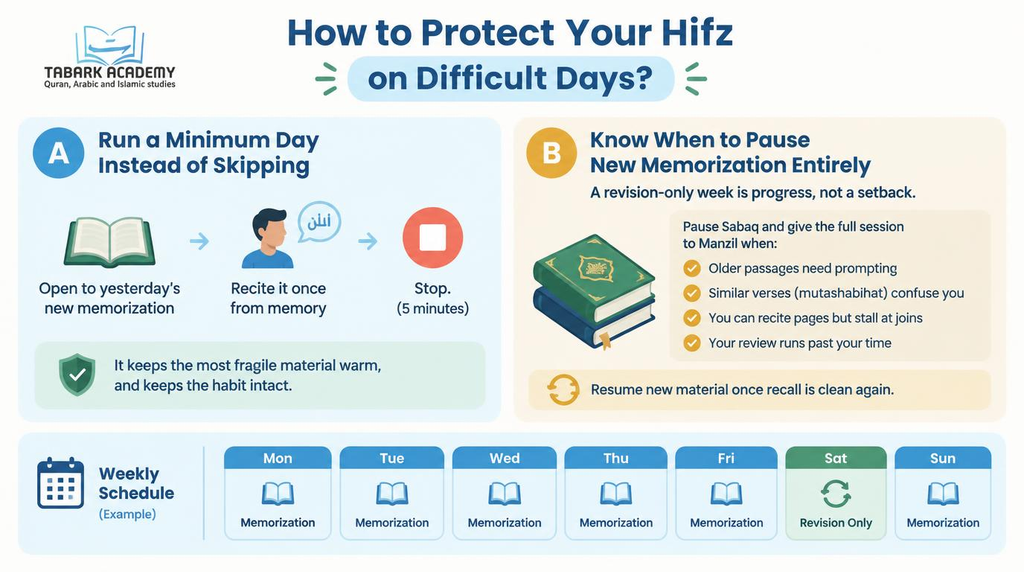
A. Run a Minimum Day Instead of Skipping
On a genuinely full day, do not skip. Run a 5-minute minimum day instead:
- Open to yesterday’s new memorization.
- Recite it once from memory.
- Stop.
That’s the entire session. It sounds too small to matter, but it does two things a skipped day doesn’t: it keeps the most fragile material warm, and it keeps the habit intact. A missed day rarely stays one day — it becomes two, then guilt, then a restart.
B. Know When to Pause New Memorization Entirely
A revision-only week is progress, not a setback. Pause Sabaq and give the full session to Manzil when:
- Older passages repeatedly need prompting before you can start them
- Similar verses (mutashabihat) keep pulling you into the wrong surah
- You can recite individual pages but stall at the joins between them
- Your review consistently runs past the time you have
Resume new material once recall is clean again. Adults who build this pause into their plan finish; adults who treat it as failure tend to quit.
Read also: 7 Daily Hifz Schedule Templates That Work For Every Learner
How to Calculate Your Own Daily Hifz Time?
Instead of adopting someone else’s schedule, size yours from your own numbers.
Step 1 — Find your honest daily minutes. Not your best day. The minutes you can protect on an average weekday.
Step 2 — Set a target you can repeat 15–20 times. This is the single most reliable test of whether a daily target is right. If you can’t repeat the day’s portion 15–20 times inside your Sabaq block, the portion is too large.
Step 3 — Estimate the timeline. Using a 604-page Mushaf:
Weeks to complete = 604 ÷ (pages per session × sessions per week)
At half a page, five days a week: 604 ÷ 2.5 = about 242 weeks, or roughly 4 years and 8 months before adding revision-only periods and consolidation.
Step 4 — Test for two to four weeks before committing. Can you prepare the portion without rushing, recite it accurately the next day, and still fit your Manzil? If not, cut the target — don’t cut the revision.
Verses vary enormously in length. Five short ayat from Juz Amma and five from Surah Al-Baqarah are not comparable workloads, so a target set in verses will quietly mislead your timeline.
Pages or lines from a consistent Mushaf give you a stable unit — which is also why sticking to one copy of the Quran throughout your Hifz matters. The visual position of a verse on the page becomes part of how you recall it.
Step Inside Our Virtual Classrooms
See our engaging teaching methods in action! watch real snippets of our live classes and discover how our expert instructors make learning interactive, memorable, and inspiring for every student.
Start Your Quran Learning Journey
Join Tabark Academy today for structured online lessons with qualified tutors, customized to fit your goals.
Book Your Free Trial LessonStart Your Hifz With A Plan Built Around Your Schedule
You don’t need more hours in the day. You need a daily Hifz plan sized to the hours you actually have — with the revision load mapped out before it becomes the thing that stops you.
Tabarak Academy’s one-to-one online Hifz program is built for working adults: a qualified teacher sets your daily target, corrects your Tajweed before errors get memorized, and manages your Sabaq, Sabqi, and Manzil balance as your memorized portion grows. Sessions are scheduled around your availability, in your time zone.
Our Quran Courses:
- Online Quran Classes for Beginners
- Online Quran Classes for Kids
- Online Quran Classes for Adults
- Online Quran Classes for Men
- Online Quran Classes for Sisters
- Quran Reading Course
- Quran Recitation Course
- Online Ijazah Course
- Online Qirat Course
- Weekend Quran Classes
- Intensive Quran Course
Book your free trial session with Tabarak Academy and get a realistic daily time target and timeline for your own Hifz.

Conclusion
How much time do adults need for Hifz per day comes down to three numbers, not one: 30 minutes is the floor that still protects revision, 45–60 minutes is the range most working adults sustain for a 3–5 year Hifz, and 90 minutes or more compresses the timeline only when the Manzil load is managed alongside it.
Whichever range you choose, the structure matters more than the total. Revision first, then new material, then older portions on rotation — at a fixed hour you can reach on an ordinary day, not a perfect one.
The takeaway is simple: pick the daily time you can repeat tomorrow, next month, and in year three. A modest target you never abandon will carry you further than an ambitious one you restart every few weeks.

Frequently Asked Questions About Daily Hifz Time for Adults
Below are the questions adults ask most often when planning how much time to spend on Hifz per day — covering minimum daily commitments, realistic timelines, and what to do when memorization isn’t sticking.
1. What is the minimum time an adult should spend on Hifz per day?
The practical minimum is 30 focused minutes per day. Less than that forces you to cut revision, and without daily revision new memorization fades within days — leaving you adding pages at the front while losing them at the back.
2. Can an adult memorize the Quran in one year?
A one-year Hifz is possible but requires roughly 4+ hours daily in a structured full-time program with a teacher. For adults studying around work or family, 2 to 5 years is the realistic range with dependable retention.
3. Why do I keep forgetting what I memorized yesterday?
Forgetting next-day material almost always means the daily target is too large or the repetition count is too low. Cut the portion in half and increase repetitions before moving to the next ayah — shaky memorization costs far more time to repair later than it saves now.
4. Do I need a teacher, or can I do Hifz alone?
You can memorize alone, but a teacher catches Tajweed errors before they get memorized and holds the revision schedule accountable — the two factors that most often decide whether an adult finishes. Tabarak Academy provides one-to-one sessions built around adult schedules.
5. How many ayat should an adult memorize per day?
Memorize whatever you can repeat 15–20 times inside your session. For most adults that’s 3–5 ayat in a 30-minute routine, or half a page to one page in a 60-minute routine.
6. Is it better to do Hifz in one long session or split it up?
Splitting works better for most adults. Take new memorization after Fajr while your mind is clearest, and move revision to after Asr or before Isha — new memorization and revision compete for the same mental resources when forced into one block.