
Teaching children the Quran can be challenging when parents do not know where to begin. Understanding the correct sequence of Noorani Qaida, Tajweed, and Hifz helps children build strong foundations and progress confidently.
Following the correct Quran steps for kids in the right order guides children from recognising Arabic letters to fluent, accurate recitation, helping parents support every stage of their learning journey.
1. Introduce Arabic Letters Before Opening the Quran
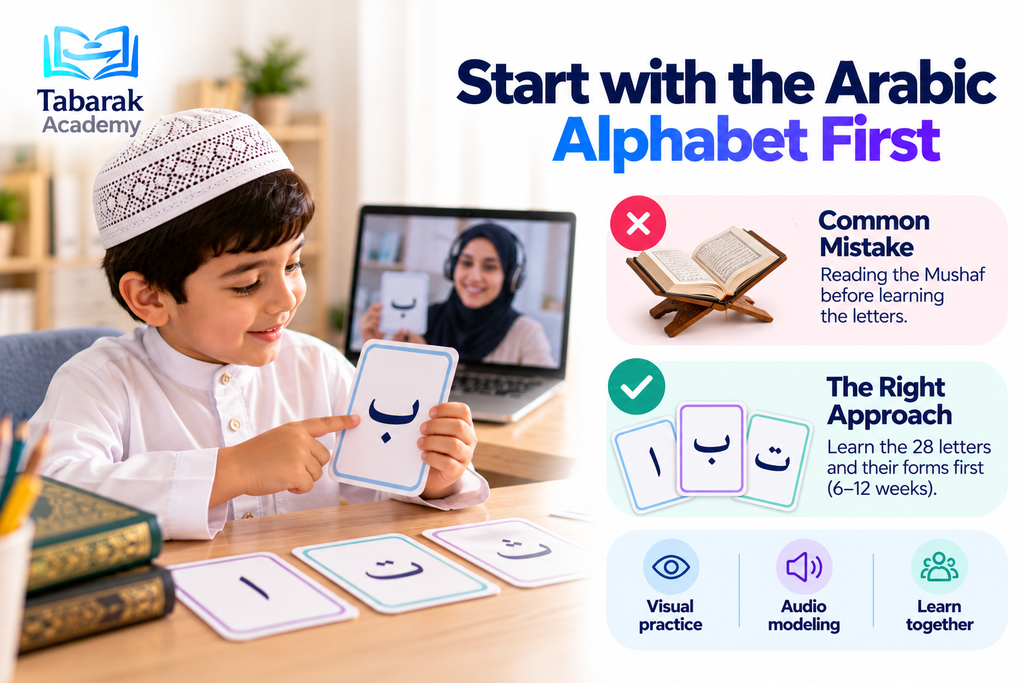
The single most common mistake parents and teachers make is opening the Mushaf before a child knows the Arabic alphabet.
A child who does not recognize all twenty-eight letters in isolation, and in their beginning, middle, and ending forms, will guess at words constantly. That guessing habit, once formed, takes years to break.
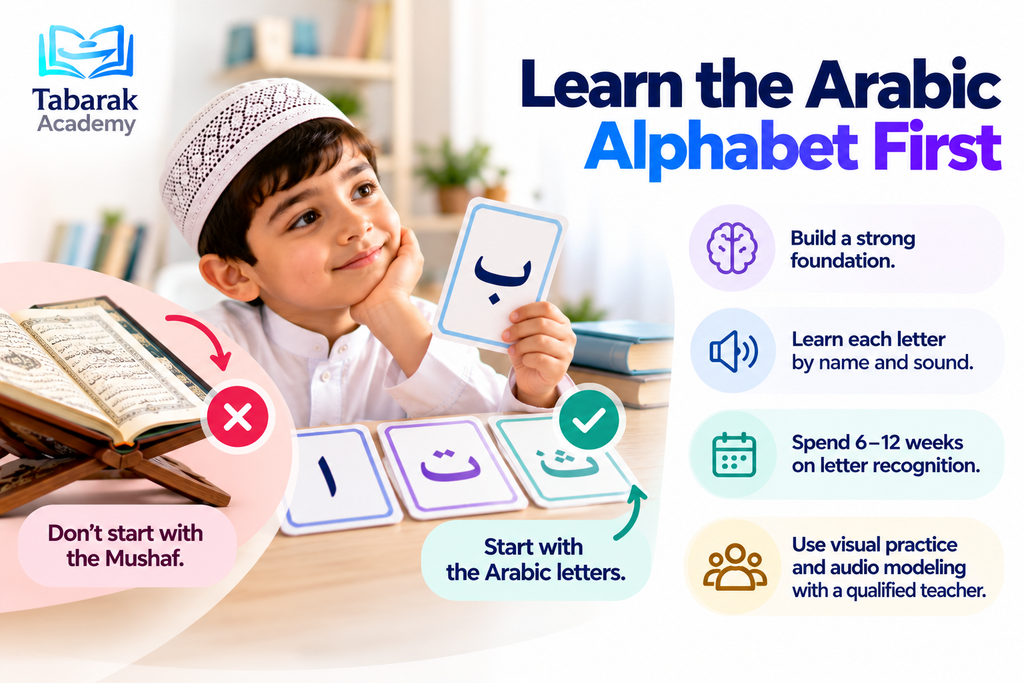
Every child must first learn each letter by name and by its correct sound. The letter looks different depending on where it sits inside a word, and children do not connect those shapes automatically.
Spending six to twelve weeks on letter recognition before any Quran reading begins is not slow, it is the correct investment. Rushing this stage is the single most consequential mistake in the entire sequence.
A qualified teacher, online or in person, uses visual repetition, audio modeling, and immediate correction to build this recognition correctly from the first lesson. Parents who are unsure of their own pronunciation should learn the letters alongside their child rather than waiting.
Families with children in this foundational stage benefit greatly from Tabarak Academy’s Noorani Qaida Course For Kids, which builds correct letter recognition and Makharij from the very first session with certified native Arab teachers.

Start your child on solid ground today.
2. Master Vowel Marks and Letter Joining Through Noorani Qaida
Once a child recognizes all the letters, the next stage is understanding how those letters change when vowel marks are added and how they connect into syllables and words.
This is the domain of the Noorani Qaida, and it is the stage where Quran reading actually begins. The Noorani Qaida introduces the following sequence:
- Short vowels: fatha, kasra, and damma applied to every letter.
- Tanween: the double vowel endings that appear in Quranic text.
- Long vowels and Madd: the elongation rules that shape Quranic rhythm.
- Sukoon: the marker showing a letter carries no vowel.
- Shaddah: the doubling mark that doubles the weight of a letter.
Letters then begin joining into syllables, and syllables into words drawn directly from Quranic vocabulary. This transition from isolated recognition to connected reading is where most informal teaching attempts stall.
A child praised for going fast at this stage learns to guess. Accuracy over speed is the only viable standard here, without exception.
Most children complete Noorani Qaida in three to eight months with daily fifteen-minute sessions. The pace depends almost entirely on consistency, not on a child’s natural ability.
Experience Our Interactive Learning
Curious about how we teach? Watch these brief video clips from our recent live sessions to see our structured curriculum, advanced learning platform, and dynamic student-teacher interactions firsthand.
Start Your Quran Learning Journey
Join Tabark Academy today for structured online lessons with qualified tutors, customized to fit your goals.
Book Your Free Trial Lesson3. Read Short Verses Slowly Before Tackling Full Surahs
After completing Noorani Qaida, the child is ready to read actual Quranic text. The correct entry point is not Surah Al-Baqarah or any long chapter. It is slow, accurate reading of short verses from Juz Amma.
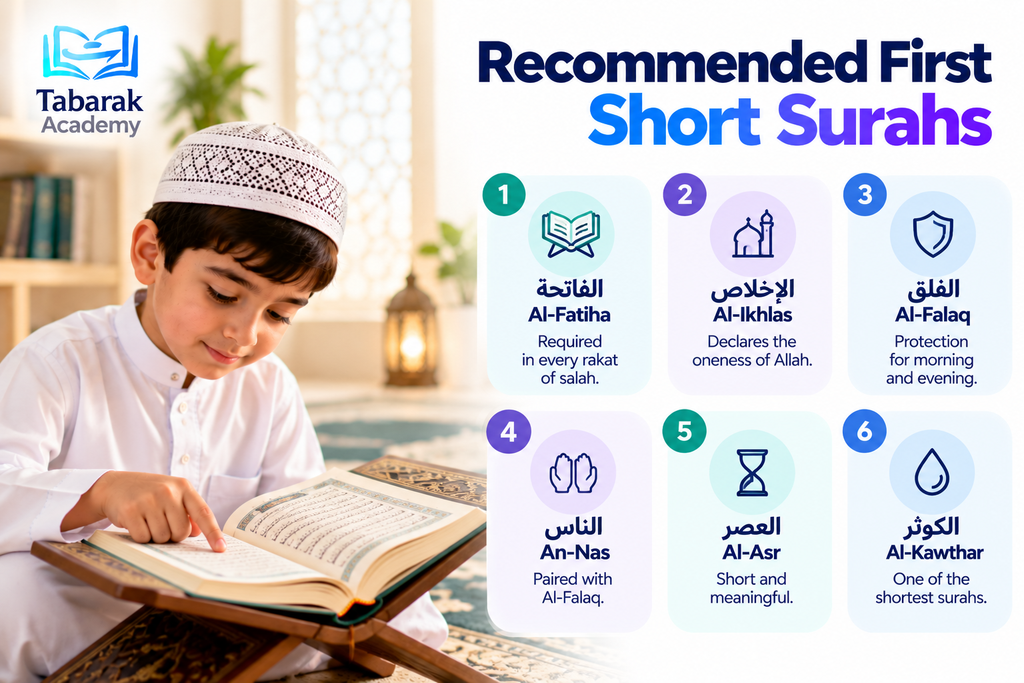
The recommended starting sequence for short Surahs is:
- Surah Al-Fatiha (1): required in every rakat of salah; gives the child an immediate, functional purpose for memorizing it.
- Surah Al-Ikhlas (112): four short verses declaring the oneness of Allah.
- Surah Al-Falaq (113): a short chapter of protection, recited every morning and evening.
- Surah An-Nas (114): paired with Al-Falaq in daily adhkar.
- Surah Al-Asr (103): three verses, deeply meaningful, easy to memorize.
- Surah Al-Kawthar (108): three verses, one of the shortest chapters in the Quran.
After these, most educators recommend Al-Masad, Al-Nasr, and Al-Zilzalah before progressing through Juz Amma sequentially. Each short Surah completed gives the child a concrete win, and concrete wins sustain motivation far better than general praise.
Accuracy must come before speed at this stage. A child who reads one verse correctly, slowly, and with the right letter sounds is learning properly.
A child who speeds through three verses guessing at sounds is building a problem.
Read more: How to Teach Quran to a Child with ADHD.
4. Apply Tajweed Rules to Verses the Child Can Already Read
Tajweed is the system of rules governing correct Quranic pronunciation and rhythm. It is introduced at this point in the sequence, not earlier, for a precise reason: a child cannot apply a rule to text they cannot yet read.
Teaching rule names to a child who is still decoding letters produces a child who can recite the rules and cannot use any of them.
Once a child reads short verses with reasonable fluency, the teacher introduces one rule at a time and drills it inside a verse the child already knows.
The following table shows the order in which the core beginner Tajweed rules are typically introduced:
The correct order for introducing beginner Tajweed rules to children:
| Rule | What It Controls | When It Appears |
| Madd (elongation) | How long a vowel is held | Short vowel letters followed by alef, waw, or ya |
| Qalqalah (echo) | A slight bounce on certain letters | Qaf, ta, ba, jeem, dal at rest or end of word |
| Ikhfa (concealment) | Nasalization before specific letters | Noon saakin or tanween before 15 letters |
| Idgham (merging) | Merging of similar or close sounds | Noon saakin or tanween before specific letters |
| Ghunnah (nasalization) | Nasal quality held for two counts | Shaddah on noon or meem |
Playing audio recitation of a clear, measured Quran reciter during daily routines, in the car, at breakfast, or before sleep, builds the ear for these patterns passively.
By the time a child formally studies a rule, they often already recognize the sound.
The Quran steps for kids in the right order treat Tajweed as an applied skill built on an existing reading foundation, never as an abstract subject taught before a child can read.
Families ready for this stage will find Tabarak Academy’s Learn Quran With Tajweed For Kids course provides live, one-on-one Tajweed correction in every session, with real-time feedback from certified teachers.

Give your child accurate recitation for life.
5. Develop Fluent Reading Across Juz Amma Before Beginning Hifz
After learning foundational Tajweed rules, a child must practice reading fluently across a wider range of text before any serious memorization is attempted.
This is the stage where the child moves from reading known Surahs accurately to reading unfamiliar Quranic text with reasonable confidence.
The following age-based guide shows realistic daily practice targets for this stage:
Recommended daily Quran reading practice by age group:
| Age Group | Daily Practice Target | Expected Milestone |
| 4 to 6 years | 5 to 10 minutes | Recognize letters, read isolated words |
| 6 to 9 years | 10 to 15 minutes | Read Juz Amma Surahs with basic Tajweed |
| 9 to 12 years | 15 to 25 minutes | Read fluently across multiple Surahs |
| 12 and above | 20 to 30 minutes | Read any Quranic page independently |
A child who reads three sessions per week from zero typically reaches independent short-verse reading within eight to twelve months. Two sessions per week roughly doubles that timeline.
Any teacher or program promising fluent reading in three months is either counting from a different starting point or compressing stages that cannot be compressed.
Consistent daily exposure to audio recitation runs alongside every reading stage. A child who hears the Quran at home regularly absorbs rhythm and pronunciation passively, and that passive exposure accelerates formal learning every time.
6. Begin Memorization With the Shortest Surahs in the Correct Order
Memorization, called Hifz, comes at this point in the sequence and not before. A child who memorizes by sound alone before reading is secure embeds errors that surface years later and are much harder to correct at that point than they were to teach correctly from the beginning.
The correct approach to memorization follows these specific steps:
- Break every Surah into individual verses and work one verse at a time.
- Repeat each verse five to ten times aloud before moving to the next.
- Connect the new verse to the previous one and recite both together.
- Complete the Surah as a full unit before starting the next one.
- Revise every memorized Surah at least once per week.
The weekly revision process is called Muraja’ah, and it is non-negotiable. Memorized verses fade within weeks without consistent review.
A child with a strong Muraja’ah habit retains Surahs for life. A child without one loses them and must relearn repeatedly, which is discouraging and inefficient.
A practical memorization session for a child aged six to nine years covers one to two verses of new material and three to five minutes of revision, all within a fifteen-minute session.
Older children from nine to twelve years can manage half a page of new material with a ten-minute revision block.
Following the Quran steps for kids in right order at this memorization stage means never allowing a child to move forward into new Surahs until previous ones are solid, checked, and regularly reviewed.
Tabarak Academy’s Hifz For Kids Course provides a fully structured memorization program with built-in Muraja’ah scheduling and certified teacher oversight from the first verse to the last.

Begin your child’s memorization journey now.
7. Connect Learning to Salah to Make Progress Meaningful
One of the strongest motivators for children at every stage of this sequence is linking what they are learning directly to their daily prayers.
A child who memorizes Surah Al-Fatiha knows they will use it in every single rakat of every salah for the rest of their life. That functional purpose is more motivating than any external reward.
Parents can build this connection practically by:
- Teaching Surah Al-Fatiha as the first priority in the reading stage, not just as a memorization target.
- Inviting children to stand alongside parents during salah so they hear familiar Surahs in context.
- Explaining briefly, in age-appropriate language, why a specific verse is being recited and what it means.
- Celebrating the first time a child completes a full salah reciting from memory what they have studied.
The Quran steps for kids in the right order are not purely academic. Each stage feeds directly into a child’s ability to worship, understand, and connect with the Quran as a living part of their life, not a school subject they will set aside later.
Allah Most High says:
إِنَّ هَٰذَا الْقُرْآنَ يَهْدِي لِلَّتِي هِيَ أَقْوَمُ (9)
Inna hatha alqur’ana yahdee lillatee hiya aqwam
Indeed, this Qur’an guides to that which is most suitable.
This verse reminds parents and educators that the Quran itself is the guide. Building a child’s relationship with it through the correct sequence, in the right order, is the most direct way to honor that guidance.
Step Inside Our Virtual Classrooms
See our engaging teaching methods in action! watch real snippets of our live classes and discover how our expert instructors make learning interactive, memorable, and inspiring for every student.
Start Your Quran Learning Journey
Join Tabark Academy today for structured online lessons with qualified tutors, customized to fit your goals.
Book Your Free Trial Lesson8. Build a Consistent Daily Structure That Fits the Child’s Age
Following the Quran steps for kids in the right order requires a schedule that a child can maintain without burning out. The most common reason children lose progress is inconsistent practice, not lack of ability.
Long sessions held once or twice a week are less effective than ten focused minutes every single day.
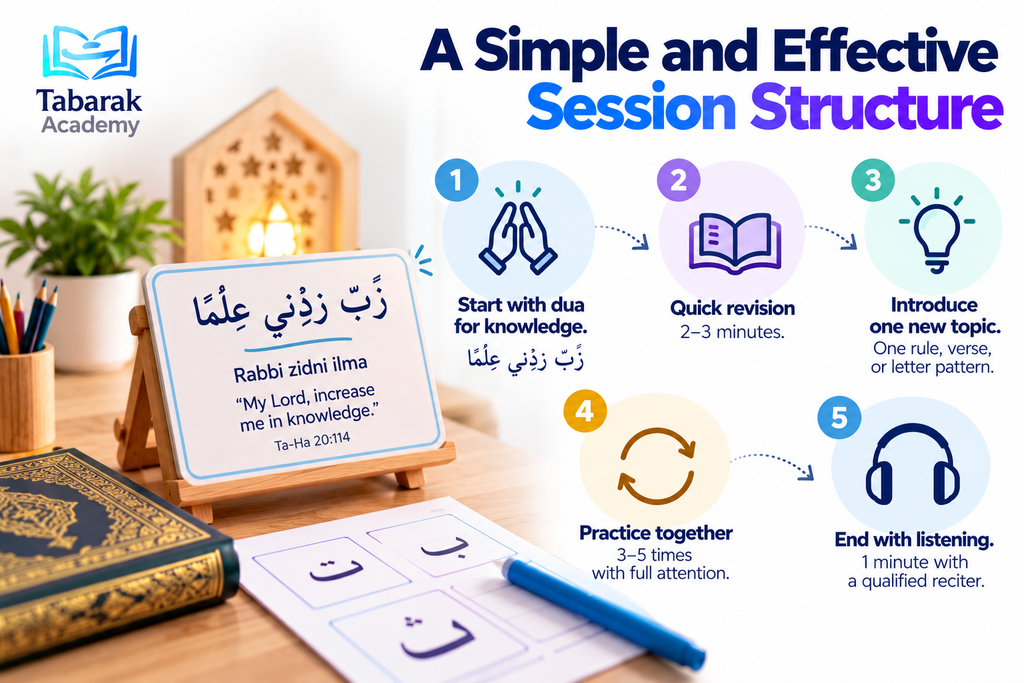
The following session structure works across all stages of the sequence:
- Open with the dua for knowledge: رَّبِّ زِدْنِي عِلْمًا (Rabbi zidni ilma – “My Lord, increase me in knowledge,” Surah Ta-Ha, 20:114).
- Spend the first two to three minutes revising what was learned in the previous session.
- Introduce no more than one new piece of content, one rule, one verse, or one new letter joining pattern.
- Practice the new content three to five times with full attention.
- Close with one minute of listening to a reciter modeling the same passage correctly.
Common session mistakes that slow progress include:
- Moving on because the child mostly has it, which is not the same as having it correctly.
- Comparing the child’s pace to a sibling or peer, which builds frustration rather than confidence.
- Correcting harshly after several errors instead of modeling the correct sound immediately.
- Skipping revision to cover more new material, which results in steady loss of what was previously learned.
Read more: How to Keep Quran Memorization Strong for Life.
Start with Tabarak Academy and Learn the Quran With Confidence
Tabarak Academy offers one-on-one live sessions with certified native Arab tutors who specialize in each stage of this exact learning sequence, from Noorani Qaida through advanced Hifz and Ijazah.
Every learner follows a structured progression designed for their specific level, whether they are a beginner child just learning letters or an older student ready for full Tajweed correction.
Sessions are available across all global time zones, with dedicated programs for kids, sisters, adults, and new Muslims. A free trial class is available for every new student before any commitment is made.
Our Quran Courses
- Noorani Qaida Course For Kids
- Learn Quran With Tajweed For Kids
- Hifz For Kids Course
- Quran Reading Course
- Quran Recitation Course
- Intensive Quran Course
Take the first step with your child today.
Conclusion
The Quran steps for kids in the right order follow one clear principle: every stage builds on the previous one, and skipping any stage creates problems that compound over time.
Arabic letters first, then vowel marks and Noorani Qaida, then short verse reading, then applied Tajweed, then fluency development, and finally memorization.
Follow this sequence with daily consistency, and every child can build a genuine, lasting connection with the Quran.
Frequently Asked Questions
What age should children start learning the Quran?
Most children are ready at four to six years old. Readiness matters more than exact age. A child who can sit briefly and repeat sounds is ready to begin.
What comes before Quran reading in the correct learning sequence?
Arabic letter recognition comes first, then vowel marks through Noorani Qaida, then short verse reading before Tajweed and memorization.
How long should a Quran session be for a young child?
Five to fifteen minutes for children under seven. Fifteen to twenty-five minutes for children aged seven to twelve. Daily consistency matters far more than session length.
When should Tajweed rules be introduced to children?
Tajweed rules are introduced after a child reads short verses with reasonable fluency. Teaching rules before a child can read produces students who know the rules but cannot apply them.
Should memorization start before or after reading fluently?
Always after. Memorizing before reading is secure embeds errors that are very difficult to correct later.
Why is Noorani Qaida essential in the Quran steps for kids in the right order?
Noorani Qaida teaches Arabic letters, vowel marks, and joining rules in a structured sequence. It builds the foundation that every later Quran skill depends on.
How often should memorized Surahs be revised?
Every memorized Surah should be reviewed at least once per week. Without regular Muraja’ah, children lose memorized content within weeks.

0 Comments