


How Long Does Hifz Take For A 7 Year Old? A Clear Guide For Parents
If you’re wondering how long hifz takes for a 7 year old, the honest answer is 3 to 7 years for most children. That’s a wide range, and where your child lands in it depends far more on the plan you follow than on how clever they are.
Maybe your child just turned seven. They already know Al-Fatiha and a few short surahs, and you smile every time you hear them recite in salah. Now you want to take the next step, but a few worries keep coming back.
Is seven too young? How much should they learn each day? And will this take two years or ten? These are fair questions, and many parents never get straight answers to them. Some websites promise a fast finish, while others just say “every child is different” and leave it there.
This guide gives you real numbers, not guesses. You will see the simple math behind every hifz timeline and what speeds memorization up or slows it down. You’ll also learn how to tell if your child is ready and get a weekly plan you can start this month.
What You Will Learn in This Article
- How long hifz takes for a 7-year-old at three different paces.
- The simple math behind every hifz timeline.
- The five things that make one child finish years before another.
- How to tell if your child is ready to start.
- A weekly hifz plan made for a young child.
Average Hifz Timeline for a 7 Year Old
Hifz for a 7 year old takes 3 to 7 years, and most children land in the middle, at about 4 to 5 years. Children who study 5 to 6 days a week often finish in 3 to 5 years. A gentle pace of 5 lines a day takes 5 to 7, and full-time madrasa students may finish in 2 to 3.
Why do so many children finish in 4 to 5 years? Most 7-year-olds start small and settle at about half a page a day, 5 days a week. Many then move up toward a full page by age 10, which brings the finish date closer.
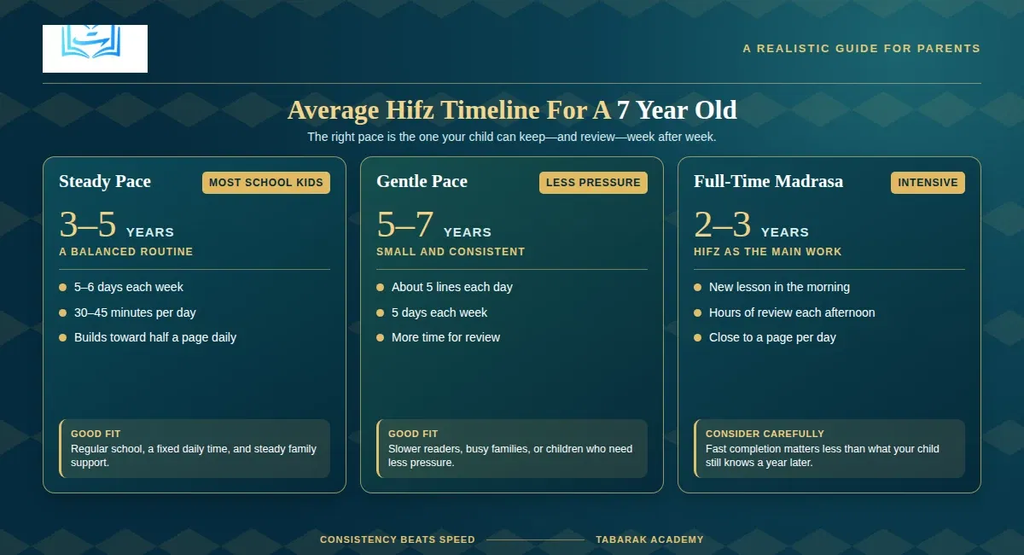
Each pace fits a different kind of family. The table below puts all three side by side.
| Pace | Weekly routine | Realistic timeline |
| Steady | 5 to 6 days a week, 30 to 45 minutes a day | 3 to 5 years |
| Gentle | About 5 lines a day, 5 days a week | 5 to 7 years |
| Full-time madrasa | Hifz is the main work of the day | 2 to 3 years |
Read on to see what each pace looks like in a normal week.
Steady Pace: 3 to 5 Years for Most School Kids
The steady pace is the most common choice for children in regular school. Your child learns a new lesson 5 to 6 days a week. Each day takes about 30 to 45 minutes.
At first, the daily lesson is small. Bit by bit, it grows to about half a page. This slow growth is what makes a finish in 3 to 5 years possible.
A child who starts at 7 on this pace often finishes between ages 10 and 12. The teen years are then free for school, strong review, and maybe an Ijazah.
This pace needs a set time every day. Many families pick right after school or right after Maghrib.
When the time stays the same, your child stops asking “Do I have to?” and just sits down.
It also fits well with online classes. You skip the drive to a mosque or center, so every minute you have goes to the Quran.
Gentle Pace: 5 to 7 Years With Less Pressure
On the gentle pace, your child learns about 5 lines a day. A page in the Madinah Mushaf has 15 lines, so 5 lines is one third of a page.
This pace suits kids who still read a little slowly. It also suits busy families, kids with lots of homework, and children who get worried easily.
The slower speed has a plus side. Your child has more time each week to go back over old lessons. So what they learn tends to stay with them longer.
A child who starts at 7 on this pace usually finishes between ages 12 and 14. Many kids move up to the steady pace later, once reading feels easy.
Some parents fear this pace is too slow. But a child who keeps going at 5 lines a day ends up far ahead of a child who starts with a full page and quits after six months.
Full-Time Madrasa Pace: 2 to 3 Years
In a full-time hifz school, learning the Quran is the main job of the day. Children get a new lesson in the morning. Then they spend hours on review in the afternoon.
Since they study most of the day, many students learn close to a page a day. That is how some finish in just 2 to 3 years.
This choice has a cost. It often means pausing or cutting back regular school. It also asks a lot of a young child, and some kids burn out.
For most 7-year-olds, a full-time school is not the right first step. It may suit an older child who reads well and truly loves to memorize.
If you visit one of these schools, ask how they plan review and rest days. How fast students finish matters less than how much they still know a year later.
The 604-Page Math Behind Every Hifz Timeline
Every hifz timeline comes from one simple sum. Once you know it, you can check any number you read online.
How to Work Out Your Child’s Hifz Timeline
You can work out your child’s hifz timeline in four simple steps. All you need is a phone calculator and one number: 604, the number of pages in the Madinah Mushaf that most hifz programs use.
- Choose the daily lesson. Decide how much your child will learn each day, such as 5 lines, half a page, or one page.
- Find the study days. Divide 604 by the daily lesson in pages. For half a page, that is 604 ÷ 0.5 = 1,208 study days.
- Spread the days over your week. Divide the study days by how many days your child studies each week. At 5 days a week, 1,208 ÷ 5 = about 242 weeks.
- Turn weeks into years. Divide the weeks by 52. Here, 242 ÷ 52 = about 4 years and 8 months.
If your child studies every day, the same half page takes about 3 years and 4 months. That small change in the routine moves the finish date by more than a year.
The whole sum takes less than a minute. Try it with two or three daily lessons to see which plan fits your family best.
The table below shows the most common daily lessons. The first two columns use a lesson that never changes. The last column shows what usually happens, because most children’s daily lesson grows as they get older.
| Daily lesson | Every day, no breaks | 5 days a week, no breaks | Typical finish (lesson grows with age) |
| 1 page | About 20 months | About 2 years 4 months | 2 to 3 years |
| Half a page | About 3 years 4 months | About 4 years 8 months | 4 to 5 years |
| 5 lines (one third of a page) | About 5 years | About 7 years | 5 to 7 years |
| Quarter of a page | About 6 years 7 months | About 9 years 3 months | 5 to 7 years |
Why the Real Timeline Is Longer Than the Math
The no-break columns assume your child never misses a day, never forgets a page, and keeps the same lesson size. Real life is not like that.
As your child learns more juz, review takes more of each week. Some weeks go fully to review. School tests, trips, late Ramadan nights, and sick days also eat up time.
A safe rule is to add 10% to 20% to the pure math. If the sum says 4 years and 8 months and the lesson never grows, plan for about 5 to 5 and a half years.
When the lesson does grow, the finish date moves closer. That is why the last column in the table is shorter than the pure math for the smaller lessons.
This gives you an honest goal from day one. Plans that leave out this extra time often make parents feel behind by the end of the first year.
Write your expected finish date on a calendar and check it every few months. If your child moves faster than you planned, you get a happy surprise instead of a worry.
Step Inside Our Virtual Classrooms
See our engaging teaching methods in action! watch real snippets of our live classes and discover how our expert instructors make learning interactive, memorable, and inspiring for every student.
Start Your Quran Learning Journey
Join Tabark Academy today for structured online lessons with qualified tutors, customized to fit your goals.
Book Your Free Trial LessonFive Things That Change How Long Hifz Takes
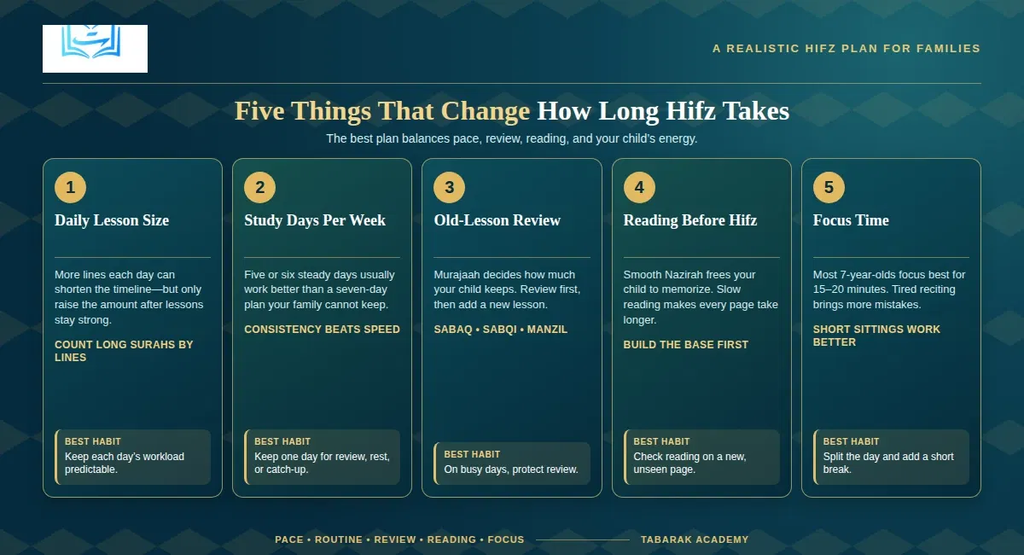
Two children can start at seven and finish years apart. The reason is rarely memory alone. These five things make the biggest difference.
1. How Much Your Child Learns Each Day
The size of the daily lesson changes the timeline more than anything else. Look back at the table. Going from a quarter page to half a page cuts years off the plan.
Most 7-year-olds start with 3 to 5 verses or a few lines a day. Raise the amount only after your child has kept every lesson strong for about a month.
How you count the lesson also matters. Juz Amma has 564 verses packed into about 23 pages, so its verses are very short. Three verses there is a light load.
In Surah Al-Baqarah, three verses can be several times longer. If you keep counting by verses, your child’s work suddenly gets much heavier.
So once lessons reach the long surahs, count them in lines, not verses. Each day then stays the same size, and your timeline stays easy to predict.
2. How Many Days a Week Your Child Studies
The number of study days is the second big lever. At half a page a day, 5 days a week takes about 4 years and 8 months.
At only 3 days a week, the same plan stretches to nearly 8 years. This is why a few lost days each week add up so fast.
Going the other way has a limit. Studying all 7 days saves only a little time. It also takes away the free day your child needs for review and rest.
For most 7-year-olds, 5 or 6 days of new lessons works best. The other days go to review or to a lighter routine.
Choose days you can really keep. A 5-day plan you follow will always beat a 7-day plan you break every week.
Some families also keep one spare day each month. They use it to catch up after a hard week.
3. How Your Child Reviews Old Lessons
Murajaah is the daily review of what your child has already learned. It decides how much of the Quran your child keeps over the years.
The Prophet ﷺ told us to keep going back to the Quran, because it slips away faster than a camel from its rope (Sahih al-Bukhari 5033). Without review, even strong lessons fade.
Many teachers split review into three layers. Sabaq is today’s new lesson. Sabqi covers the lessons from the last few days. Manzil is a share of older juz that changes each day.
Always do review first, then the new lesson. On a busy day, skip the new lesson and keep the review.
Review time also grows with your child. A child with a few juz needs only a short review. A child with ten or more juz may spend as long on review as on new lessons.
For a simple system you can run at home, read our guide on how to revise Quran without a teacher.
4. How Well Your Child Reads Before Starting
Nazirah means reading the Quran correctly from the Mushaf. It is the base that hifz is built on.
A child who sounds out each letter spends half the lesson reading, not memorizing. That makes every page take much longer.
A child who reads smoothly can put all their energy into remembering. Lessons go faster, and fewer mistakes sneak in.
Most children build this skill through Noorani Qaida and guided Quran reading. Learning basic tajweed at this stage helps too, so your child memorizes the right sounds from the start.
One problem is easy to miss. Some kids learn a surah by ear and seem to read it well, yet they cannot read a page they have never heard.
So check reading on a new page, not a known one. A few months spent on reading is never wasted, because it saves many more months later.
5. How Long Your Child Can Focus
Most 7-year-olds focus best for 15 to 20 minutes at a time. After that, their reciting gets tired and mistakes go up.
You will often see the signs. Your child yawns, mixes up verses, or starts looking around the room. These are signals to stop, not to push harder.
At this age, a longer sitting does not mean more learning. It often means more errors that the teacher has to fix later.
So split the daily time into two short sittings. One can be with the teacher. The other can be review or listening at home.
A short break between the two, even five minutes, helps your child come back fresh. Morning or just after school usually works better than late at night, when kids are tired.
Focus also changes from day to day. On a tired day, a good teacher shortens the new lesson and spends more time on review.
Is Your 7-Year-Old Ready to Start Hifz?
Before you start a full plan, it helps to know where your child stands today. The two parts below help you check.
Four Signs Your Child Is Ready for Hifz
Check these four signs at home:
- Your child reads the Quran smoothly with basic tajweed.
- Your child can sit through a short lesson without getting restless.
- Your child still remembers a short surah a few days after learning it.
- An adult at home can keep the routine going every day.
If your child shows all four, a daily hifz plan will likely go well. If one or two are missing, work on those first.
Home support is the sign parents forget most. A 7-year-old cannot run a plan alone. They need an adult who keeps the time and listens to them recite.
You do not have to judge this alone. At Tabarak Academy, our Al-Azhar certified tutors check your child’s reading and memory in a free trial class. Then they tell you which pace fits best.

This way, your child starts at the right level, not too hard and not too easy.
Why Ages 7 to 13 Are Called the Golden Age of Hifz
Many hifz teachers call ages 7 to 13 a golden window. Children at this age pick up words fast and keep them for a long time.
They also have fewer duties than teenagers. And habits built at this age often last into adult life.
Starting at 7 puts most of your child’s hifz inside this window. That is one reason so many families begin at this age.
Still, reading matters more than age. A smooth reader of 8 often moves faster than a 7-year-old who still stumbles in the Mushaf.
Older children and adults finish hifz every year too. So this window is a help, not a limit.
Allah tells us He made the Quran easy to remember (Surah Al-Qamar 54:17). The Prophet ﷺ said that the one who reads the Quran and has memorized it will be with the noble, righteous angels (Sahih al-Bukhari 4937).
Read also: Best Mushaf for Hifz
A Weekly Hifz Plan for a 7-Year-Old
A good plan mixes new lessons with review every week. Below is a simple plan you can follow, plus what you can do at home.
The Day-by-Day Hifz Schedule
This plan gives your child five days of new lessons and two days for review and rest. You can move the days around to fit your school week.
| Day | Focus | What happens |
| Monday to Friday | New lesson | 3 to 5 new verses (later, a few lines) plus recent lessons |
| Saturday | Join the week and older review | Recite the whole week’s lesson as one piece, then a share of older surahs (manzil) |
| Sunday | Light day | Rest, listen to a good reciter, or catch up on a missed lesson |
Each day in the plan has its own job. Monday to Friday build new memory in small, steady steps.
Saturday does two jobs. When your child joins the week’s verses into one piece, they learn how each verse leads into the next.
The older review that follows keeps past surahs fresh. That way, nothing fades while new lessons pile up.
Sunday gives your child room to breathe, so they come back on Monday ready to learn.
If your weekend falls on Friday and Saturday, just shift the plan by a day. The pattern matters more than the names of the days.
Write the plan on paper and stick it on the fridge. Your child can then see the week ahead and tick off each day.
What Parents Can Do Between Classes
You do not need to be a hafiz to help your child. Your job is to follow along, not to teach.
Once a day, listen while your child recites the day’s lesson. Follow in the Mushaf and point out any word they miss.
Play the lesson on repeat in the car or at bedtime. Keep one Mushaf at home too, because your child remembers where each verse sits on the page.
Celebrate each surah and each juz with something small. A hug, a sticker, or their favorite meal tells your child the effort was seen.
For easy ways to check what your child remembers, try these self-testing methods for Quran memorization.
If your days are too full to follow closely, Tabarak Academy’s Hifz for Kids course gives your child private lessons. You also get a monthly report on how they are doing.

Common Mistakes That Make Hifz Take Longer
Some mistakes add months or even years to a child’s hifz. Each one is easy to avoid once you spot it.
- Doubling the lesson after a missed day. Just carry on with the normal plan.
- Memorizing without a teacher. Your child cannot hear their own small mistakes, so they turn into habits.
- Comparing your child to a brother, sister, or classmate. It hurts their love for the Quran.
- Using shouting or punishment. Fear turns the lesson into something to run from.
- Rushing to finish. A child who knows 10 juz well and loves them is better off than one who rushed and now dreads class.
Experience Our Interactive Learning
Curious about how we teach? Watch these brief video clips from our recent live sessions to see our structured curriculum, advanced learning platform, and dynamic student-teacher interactions firsthand.
Start Your Quran Learning Journey
Join Tabark Academy today for structured online lessons with qualified tutors, customized to fit your goals.
Book Your Free Trial LessonStart Your Child’s Hifz With Tabarak Academy Today
Your child’s hifz needs a clear plan and a teacher who hears every word. Tabarak Academy has taught the Quran to Muslim families for 25 years. More than 6,800 students in over 15 countries learn with us.
Here is what your child gets:
- Private 1-on-1 live classes. Your child never shares the teacher, so every verse gets checked.
- Tutors with a verified Al-Azhar Ijazah, so your child learns from a trusted chain of teachers.
- Female tutors for girls, at no extra cost and with no waiting list.
- Morning, afternoon, evening, and weekend times that fit around school.
- A monthly progress report, so you always know where your child stands.
- A certificate for eligible courses, and a path to Ijazah for students who qualify.
Your first class is free. We confirm your time within 24 hours.
The tutor checks your child’s reading and memory, then gives you a pace and a timeline you can trust. No card is needed, and there is no obligation to continue.

Our Quran Courses
Learn the Quran with Tabarak Academy in private online classes for kids and adults.
- Quran Reading Course
- Quran Recitation Course
- Online Ijazah Course
- Online Qirat Course
- Quran for Toddlers / Young Children
- Weekend Quran Classes
- Intensive Quran Course
- Al-Azhar Quran Course
Final Thoughts on How Long Hifz Takes for a 7 Year Old
So, how long does hifz take for a 7 year old? For most children, it takes somewhere between 3 and 7 years, and many finish in about 4 to 5. Whether your child follows a steady, gentle, or full-time pace decides where they land in that range.
You don’t have to take any number on trust, including ours. Use the 604-page sum, plug in your child’s daily lesson and study days, and you will have your own answer in a minute.
Then add a little extra time for real life. Exams, trips, sick days, and review weeks will come, and planning for them now saves you stress later.
Keep in mind that the timeline is not set in stone. It changes with the size of the daily lesson, the number of study days, the review system, your child’s reading, and how long they can focus.
Small changes in any of these can save or cost you years. A child who reads smoothly and reviews every day often finishes well ahead of a child who memorizes fast but skips review.
It also helps to remember that every child moves at their own speed. Some months your child will fly through pages. Other months, school or family life will slow things down, and that is completely normal.
Frequently Asked Questions About Hifz for a 7 Year Old
Parents often have more questions once they start planning. Here are clear answers to the ones we hear most.
Is It Better to Start Hifz at 5 or at 7?
Both ages work, in different ways. A 5-year-old learns short surahs by listening and repeating. A 7-year-old who reads well can begin a full daily plan.
Should My Child Learn Tajweed Before Starting Hifz?
Your child should know basic tajweed before or during early hifz. The full rules can come later, one step at a time.
Can a 7-Year-Old Do Hifz Online?
Yes, many 7-year-olds do hifz online and do well. Private video lessons keep your child’s full attention on one teacher. It helps if a parent stays close by during class.
What Should My 7-Year-Old Memorize First?
Most 7-year-olds start with Juz Amma, beginning with its shortest surahs. Next, many move on to Juz Tabarak. Short surahs give quick wins that keep children excited.
Should My Child Learn the Meaning While Memorizing?
Yes, a simple meaning helps a lot. When a child knows what a surah is about, the verses link together in their mind. A short story or summary before each surah is enough at this age.
What If My Child Forgets a Juz They Already Learned?
Forgetting is a normal part of hifz. Pause new lessons and go over that juz until it feels strong again. Our guide on how long it takes to re memorize a juz shows what to expect.
What If My Child Stops Wanting to Memorize?
First, check if the lesson is too long or the sitting too tiring. Make the load lighter and add more praise. A short break is often better than quitting, and most children come back with fresh energy.
What Happens After My Child Finishes Hifz?
After finishing, your child keeps reviewing for life, so the Quran stays strong. Many students also go on to earn an Ijazah. To check their memory over time, they can use these ways to test your own hifz.